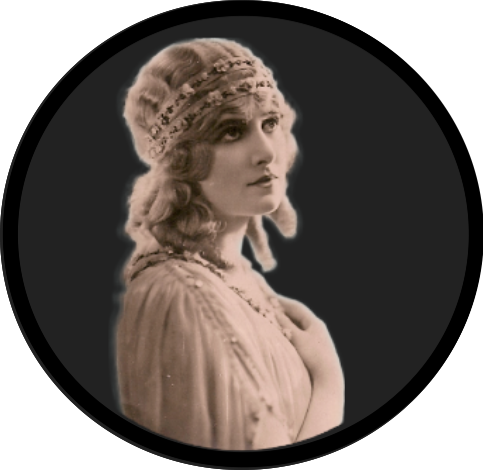
1910- Bélisaire (Éclipse)
By IVO BLOM
While most French silent films on Greco-Roman Antiquity in the collection of the British Film Institute are Pathé and Gaumont productions, a rare example is a film by the company Éclipse: Bélisaire (1910). It not only refers to a historical figure. It also relies on a long tradition of French literature, theatre and painting concerning the Byzantine general, while deviating from it in intriguing ways. Little is known about the film and who made it, and the actors remain unidentified. Yet, some information is known about the company that produced it: Éclipse. So detective work has been required to analyse this unusual antiquity film.
The film
The scenario of Bélisaire, which is entitled La mort de Bélisaire, strangely enough, is dated September 1909, well over a year earlier than the film’s actual release.[1] Were there obstacles created by the censors? Perhaps, but currently we do not know. What is striking is that the written plot is very different from that of the actual film. The script describes how general Belisarius rejects the advances of Empress Theodora. But when she witnesses he is in love with a female commoner instead, she takes revenge with her crony Besas [2] and brings an accusation of conspiracy by Belisarius to Emperor Justinian. Belisarius is blinded by Besas with acid as punishment, while Theodora witnesses the act. A young slave leads the blinded general away, but they fall into an abyss. A soldier saves them. When he hears about Theodora’s treachery, he takes his sword and forces himself into the tent of Justinian, accusing him of the crime. Justinian does not answer, but when Besas tries to speak, the soldier kills him. Justinian, Theodora and the soldier visit the dying Belisarius, and Justinian asks him for forgiveness. Belisarius pardons him and dies. As we will see later on, this script is closer to previous artistic representations in literature and the arts than the final film.
In the film print instead,[3] only the fundamentals of the script remain: the Byzantine general Belisarius gloriously returns from the battlefield and is rewarded by Justinian in his throne room. It is clear that the empress, who hands the general a precious sword, loves the general, but he shows no interest at all. Belisarius rejects Empress Theodora because he loves his Antonina, after which Theodora, who has seen the enamoured couple, swears revenge with the help of her crony (he is unnamed, but let’s call him Besas). Theodora and Besas order two bravos to drop acid into Belisarius’ eyes, but Antonina secretly has witnessed their plotting. During the bravos’ journey to Belisarius, who lives in the countryside, Antonina cunningly switches the acid for harmless drops. She afterwards tells Belisarius about the intended crime, so he abandons the army and pretends to have been blinded. The people plead with Justinian for Belisarius’ return to court. Pretending to be blind, Belisarius returns, but once before the royals, he unmasks the crime and the culprits. Besas is dragged away by soldiers (probably to be executed), but Belisarius prevents Justinian from letting Theodora undergo the same fate. She is only sent out of the throne room; her fate is unknown. According to some trade papers, the film ends not with her execution but with her exile. In short, Belisarius is not really blinded but, once returned to court, he reveals his supposed blinding and accuses Theodora and Besas of the treacherous act. Besas is not killed on the spot as in the script, but dragged away to what we suspect may be his execution or at least a lifetime in prison. Finally, Antonina, absent in the script, has an important function in the final film version as Belisarius’ saviour.
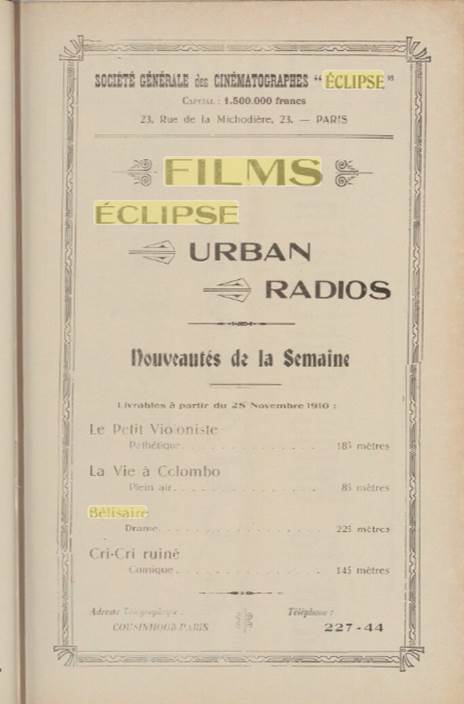
The French trade paper Ciné-Journal 19 November 1910, mentioned the film in an advertisement among Éclipse’s new releases in France (figure 1).[4] One month later, the British film journal The Bioscope for 29 December 1910 mentioned the film’s British release on 28 December, praising the film as ‘A well-staged and costumed drama, set in the time of ancient Rome, with many magnificent scenes’.[5] The German trade paper Der Kinematograph announced that the film, entitled ‘Belisar’, would be released as of 5 January 1911, one week after the British release.[6] One month later, Éclipse would make a bigger mark in Germany with the first of its Nat Pinkerton detective films, but more about that later.
The Bioscope, in providing the film’s plot, explains some matters that are not that obvious in the BFI film print – which moreover contains quite elementary, single frame German intertitles. The journal for instance makes clear that the faked blinding may well help the general retire from the court he dislikes: ‘Belisaire, wishing to leave the pomp and splendour of the Court, and to retire to a happy wedded life, follows a pre-arranged plan.’ The Bioscope, also heightens the dramatic effect in its wording, using in addition to the citations above such terms as ‘scoundrels’ and ‘dark days’.[7] However, it too is not specific about what exact punishment Theodora will undergo in the end: ‘Theodora, wretched and forlorn, is meted out the punishment she so richly deserved.’[8] The German trade paper Der Kinematograph published a plot similar to the one in The Bioscope, but added a happy ending: the Empress was exiled and Belisarius was permitted to marry the good Antonina.
Bélisaire was released in the United States on 8 March 1911 (so quite a few months after the European releases), with the more timeless title The Fury of a Woman Scorned. Its American distributor was George Kleine of the Kleine Optical Company. According to IMDb, the journal Moving Picture World (MPW) described the plot in a way quite similar to that in The Bioscope. While initially withdrawing from the court and enjoying his wedded life with Antonina as The Bioscope says (whereas other sources make clear he is not married yet), and also stressing like The Bioscope that ‘dark days fall upon the State, and Justinian misses the sage counsel of Belisarius’, MPW puts more emphasis towards the end on Belisarius’ sense of duty: ‘Belisaire once more takes the helm of the ship of State.’[9] Another plot description in MPW for March 1911[10] totally missed the Byzantine setting and presented the film as set in Roman Antiquity, which is not entirely surprising, as Belisarius is clearly dressed as a Roman general from the first or second century. This mistake confirms the generalist costume design used in early cinema, stretching the era of the Roman Empire way beyond the reign of Emperor Constantine, as we are dealing with a sixth-century Byzantine general here. Moreover, as we will see below, the throne room of Justinian, for example, looks Roman and not particularly Byzantine, which may well have inspired the critic to write about the timeframe accordingly. The description of the plot in this issue of MPW is only mentioned with broad strokes.[11] And what all plot descriptions do not tell us is that Theodora’s crony is dragged away, probably to be executed, but that Belisarius saves Theodora from undergoing the same fate.
How do these various versions of the story of Belisarius compare, then, with the historical record or the prior circulation of the general in French literature, painting and theatre?
Sources: History, literature, theatre, painting
Flavius Belisarius, also known as Belisarios (Greek: Βελισάριος) (505-565), was probably the greatest general of the Eastern Roman Empire (fig. 2). On the orders of Emperor Justinian I, he reconquered a large part of the former Western Roman Empire. Belisarius is not very well known outside historical circles today, but this is due more to a lack of (popular) interest in Byzantine history than to his qualities, his great tactics, his victories despite often being at a numeric disadvantage, and his impeccable track record (even if his conquests were at times fleeting and undone in later years). Some scholars consider him, significantly, to have been the last Roman general. And yet his extraordinary military activities are not the subject matter of the Éclipse film. There is only a vague reference to it in the opening shot of the film, as the general is rewarded by the emperor for his victories. They have already taken place before the film’s plot starts (the film thus starts in media res).
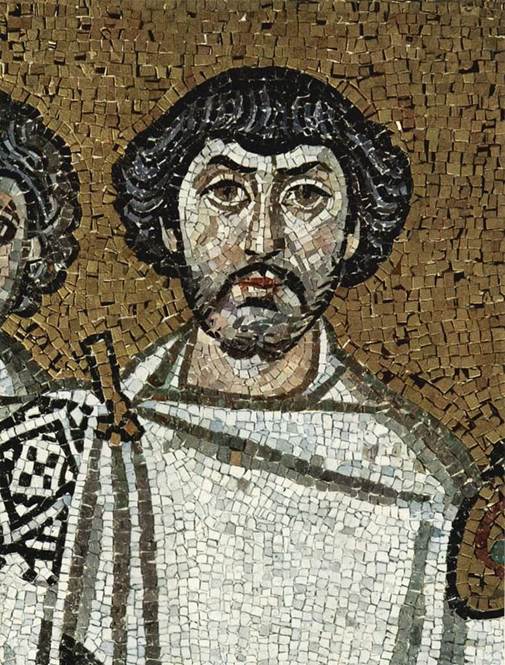
Figure 2. Belisarius on the mosaic at the San Vitale in Ravenna. Source: https://commons.wikimedia.org/wiki/File:Meister_von_San_Vitale_in_Ravenna_013.jpg.
The plot of the film Bélisaire is completely different from the history of Belisarius’s life as a general winning victories across the empire, but it is also different from how Belisarius has been depicted in prior French literature, theatre and painting where he has received repeated attention. Already in Byzantine times, some attention had been paid to Belisarius’ wife, Antonina. Procopius in his sixth-century Secret History wrote about the couple, but in hindsight and from a perspective close to the Imperial Court, denigrating both Belisarius and his wife Antonina, the former as weak-willed and too clement to his opponents, and the latter as adulterous and debauched.
Yet, in comparison to Procopius, 20th and early 21st century Anglophone literature and scholarship provides a much more positive image of Belisarius and Antonina, and partly also of Theodora. In the 1938 fictional biography Count Belisarius by Robert Graves (author also of I Claudius), Belisarius and Antonina are victims of Justinian’s fears, jealousy and abuse of power, with Belisarius always remaining loyal to the whims of his emperor and enduring his humiliations and castigations with the patience of a saint. Indeed, at the end of his book, Graves draws a parallel between Belisarius’ humiliations and those of Christ before Pilate (Graves, 1938/1947: 526-527). Ian Hughes (2009), in his study Belisarius: The Last Roman General, focuses on the military feats of Belisarius, including the Nika riots, the African Wars, the Vandal and Goth Wars, and the last threat from the Balkans, but also explains Procopius’ dislike of Antonina as she was of humble origins. Yet, Antonina was close to Empress Theodora and would often use this bond to temper Justinian’s drastic actions against and humiliation of Belisarius. The couple must have married sometime after the suppression of the Nika riots and before Belisarius’ expedition to Africa, Hughes concludes (Hughes, 2009: 68-69). Hughes also comments on a theory that Theodora kept Belisarius close to her confidante Antonina, so he would not rebel against the imperial couple (Hughes, 2009: 210-211). Therefore, during some expeditions, Antonina was allowed to accompany her husband (so he would not commit adultery), while at other times Theodora kept her close to herself.
In 2023, in reaction to the military histories of Belisarius, David Allan Parnell exclusively focused on the relationship between Belisarius and Antonina in Belisarius & Antonina: Love and War in the Age of Justinian, presenting them as one of the most important power couples of their times, but not without flaws. Parnell observes: ‘These failures knock them from their lofty perch, humanize them, and make them even more relatable and intriguing as subjects of study’ (Parnell, 2023: 1). He presents them also as ‘part of the Christianization of Roman society, a process that did not come without growing pains and disagreements among believers’ (Parnell, 2023: 3). A vague remnant of this Christianization might be traceable in the Éclipse film, in which it is a Christian monk who reunites Belisarius and Justinian. Parnell states that the two couples, Belisarius and Antonina and Justinian and Theodora, were closely linked together and ‘over the long haul of their lives’ considered their relationship to be ‘mostly stable’ (Parnell, 2023: 3). That scholarly account is quite different from previous works that stress continuous conflicts between the two couples, as well as within the couples. It is also quite different from the Éclipse film Bélisaire. The Éclipse film presents Belisarius as a strong man, physically and morally, and his Antonina (who supposedly is not his wife yet) as loyal, heroic and cunning – totally the opposite of the account by Procopius. Moreover, as Hughes writes, the real Antonina was much older than Belisarius and already had children from a previous marriage – yet the actress in the Éclipse film looks much younger than the man playing Belisarius.
A major legend, which has been unmasked as apocryphal but is nonetheless essential to Belisarius’ post-antique tradition, is that of his blinding. An influential literary source here is the stage play Bélisaire (1643) by Jean Rotrou. As Nina Ekstein has written in her article ‘Rotrou’s Bélisaire: Hierarchy and Meaning’ (2010), the plot of Rotrou’s novel is relatively simple: ‘Bélisaire, a historical figure from the sixth-century East Roman Empire, returns victorious to Constantinople, having expanded the lands controlled by the emperor Justinian. César’s wife, Théodore, however, nurses resentment against the conquering general for having not responded to her amorous advances before her marriage to the emperor. She dispatches three men to murder Bélisaire at different moments during the course of the play.’ All attempts fail, and while Justinian lavishes honours on Bélisaire, Théodore persists in her hatred of this man, despite his importance for the empire. ‘César eventually learns that it is his wife who seeks to have his general killed, and orders Théodore’s exile. Bélisaire, however, intercedes on Théodore’s behalf.’ She hates him even more for that and falsely accuses him of trying to seduce her. ‘César believes her without question and, refusing to listen to his defence, sends Bélisaire off to have his eyes plucked out. Bélisaire dies from the ordeal, Théodore then admits her own responsibility, and César is overcome by regret and remorse.’ (Ekstein, 2010: 2). In conclusion, Ekstein writes: ‘I read Bélisaire as a tragedy of unintended hubris, wherein Bélisaire’s glorious victory upsets the tripartite hierarchy of subject, emperor, and divine forces, revealing serious instabilities within the hierarchical structure and destroying the hero in the process’ (Ekstein, 2010: 16). The plot of the play above makes clear that, just as in the film, in Rotrou’s play we already encounter Belisarius’ victorious return to Constantinople, Empress Theodora’s revenge after being rejected by Belisarius, the emperor on the verge of exiling her for her plotting, and Belisarius’ prevention of that punishment. Yet in Rotou’s play the blinding of Belisarius succeeds, in contrast to the film, and the emperor’s remorse comes too late. Thus, the apocryphal blinding of Bélisaire starts in the mid-seventeenth century and not in the late-eighteenth century, as is generally assumed. Also, already here in this historical drama we encounter a phenomenon often used afterward in historical films, namely that major events, in this case the blinding and downfall of Belisarius, are caused by the personal revenge of an – often upper-class – man or woman often for reasons of sexual rejection.
Nevertheless, it is very clear that the philosophical novel Bélisaire by the academician Jean-François Marmontel, published in 1767, caused a bigger impact on French representations of Belisaire. The plot starts in medias res: General Belisarius, hero of the empire, is blinded on the orders of Emperor Justinian; he returns home, guided by a child. During his journey, he meets a succession of young aristocrats, one of his veterans, and several of his former enemies. All are outraged by the cruel fate that has befallen him. He explains to them why, instead of being filled with resentment, he accepts his fate, and how his faith in Justinian and the state remains intact. One of the young aristocrats he meets, Tiberius, convinces Justinian to pretend to be his father; he then takes him to the blind Belisarius, allowing the emperor to listen incognito to the old hero's pronouncements on politics. The book was clearly intended as a guide to good government. Through the character of Justinian, an ageing emperor, it clearly targeted Louis XV, who was in the final years of his reign. The book caused much commotion and polemic, typical of the political debates in the era of the Enlightenment: while his friend Voltaire praised and supported it, writing his own Anecdotes sur Bélisaire (1767), and rulers like Maria Theresia of Austria and Catherine the Great of Russia liked it, Marmontel’s adversaries managed to have the book banned by the French Catholic Church. The book was not against imperial rule per se, however, but promoted tolerance and justice and criticised the ingratitude of monarchs (see Renwick, 2016 and Rehman, 2017)
Marmontel wrote that he had based his idea on what was commonly known then about the Byzantine general – as paintings like Belisarius Receiving Alms by Mattia Preti (1660-65, Museum Boijmans van Beuningen, Rotterdam) and Belisarius Begging for Alms by Giovanni Paolo Panini (1717, Calvet Museum, Avignon) indicate. However, after the publication of Marmontel’s book, the legend of the blind, begging, wise ex-general gained a particular hold over French artists – a French tradition of representing Belisarius grew. Even if historians have unmasked in hindsight the blinding and downfall of Belisarius as an apocryphal story. In the second half of the eighteenth century many French paintings depicted the blind general reduced to misery, such as Belisarius by François-André Vincent (1776, Musée Fabre, Montpellier), Belisarius Receiving Hospitality from a Peasant (1779, Musée de Augustins, Toulouse) by Jean-François Pierre Peyron and, most well-known, Jacques-Louis David’s Belisarius Begging for Alms (1781, Palais des Beaux-Arts, Lille, figure 3). After David’s painting, more examples followed, like François Girard’s - often reproduced - Belisarius (1797, J. Getty Museum, Los Angeles), with the blinded wandering former general carrying a boy bitten by a snake. In. addition to painting, several French sculptures of the blind and begging ex-general were made in the late eighteenth century, such as Jean Antoine’s Houdon’s Belisarius (1773, Musée des Augustins/ Musée des Beaux-Arts de Toulouse), Jean-Baptiste Stouf’s bust of the old and blind Belisarius (c. 1785-91, J. Getty Museum, Los Angeles) and Antoine Denis Chaudet’s The Rest of the Blind Belisarius (1791, Musée de Lille). Marmontel’s novel even inspired an opera, Bélisaire (1796), by Berton Philidor. They all thus commented on the cruelty of absolute rulers, calling for change. It is indeed striking that ordinary people show mercy to the downfallen general, while soldiers are appalled by his humiliation.
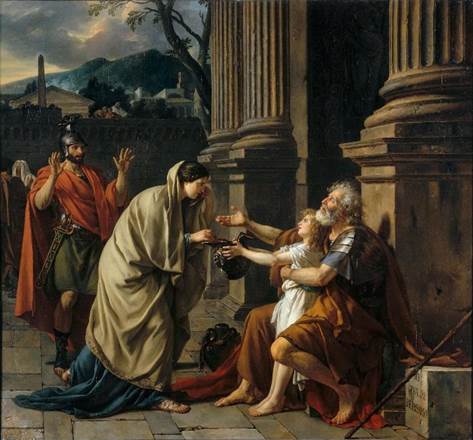
Figure 3. Belisarius Begging for Alms (Jacques-Louis David, 1781, Palais des Beaux-Arts, Lille). Source: https://commons.wikimedia.org/wiki/File:David_-_Belisarius.jpg
During the nineteenth century, interest in Belisarius continued beyond France, such as in the opera Belisario (1836) by Gaetano Donizetti, with libretto by Salvatore Cammarano, indirectly inspired once more by Marmontel’s book, the ultimate French source. Yet this opera, first performed at the Teatro La Fenice in Venice on 4 February 1836, and a success all over Europe all through the nineteenth century, deviates substantially from the Marmontel plot. The libretto still retains the element of Belisarius’ blinding, but changes almost all the rest. Theodora has completely disappeared from the tale, and her vengeful role is instead taken up by the general’s wife Antonina who, horrified that her son may have been killed on Belisarius’ orders because of a prediction, accuses him of conspiracy and murder, after which the general is tried and blinded. The lost son is found, the family reunites, but Belisarius is mortally wounded in a fight against the Barbarians. Led before the emperor he dies, while Antonina asks for his pardon in vain. While the plot of this opera may be reminiscent of a Greek tragedy, in particular Clytaemnestra’s revenge against Agamemnon for sacrificing their daughter Iphigenia, it is far removed from Marmontel’s novel, Rotou’s play or the film produced by Éclipse. It is also far from the recent analyses of Hughes and Parnell of the real Antonina.
While the Byzantine era had been condemned in the late nineteenth century as a period of ill rule, in the later nineteenth century it was rediscovered within the wave of Orientalism that swept the arts. In a minor role, Belisarius returned as a supporting character in the late nineteenth-century Orientalist play Théodora by Victorien Sardou, staged in 1884 at the Théâtre de la Porte Saint-Martin in Paris, and starring Sarah Bernhardt as Theodora, Léon Marais as Andreas, Philippe Garnier as Justinian, and Henri Luguet as Belisarius. When the play was reprised in 1902, Pierre Magnier played Andreas and Maxime Desjardins Justinian, while Édouard Céalis played Belisarius. Photos of the Sardou play were widely reproduced, for example on postcards. In the same vein as the Sardou play, in 1887 French painter Benjamin-Constant painted two large portraits of Empress Theodora, one seated on her throne and in a setting reminiscent of the Basilica San Vitale in Ravenna, the other seated in the imperial box at the Colosseum (where the real Theodora never had been). In 1909 (so one year before the Éclipse film Bélisaire), Ernesto Maria Pasquali had already filmed a Sardou adaptation to screen entitled Teodora imperatrice di Bisanzio for the young company Pasquali. The Pasquali film basically followed the first part of Sardou’s tale, until the moment Theodora’s lover, called Eraclio instead of Andreas, is about to kill the empress. Sardou’s play and its two film adaptations centre around the doomed love affair between the passionate empress, whose modest background initially drives her to find love in plebeian circles, and the Greek patrician Andreas, who initially does not know she is the person he politically despises the most. In the end (although this is not shown in the Pasquali film), Theodora accidentally poisons her lover, and Emperor Justinian avenges himself on his adulterous wife by having Theodora strangled to death.[12]
So in 1909-1910, Éclipse had at its disposal a rich French tradition for representing the general Belisaire and the empress Theodora that dates back to the seventeenth century. And it may be the prestige of that tradition which drew the company momentarily to this subject matter. Yet while the film Bélisaire certainly borrows some elements from previous literature, theatre and visual arts, it also deviates interestingly from that tradition in the development of its plot and its visuals.
Narration and the look of the film
With regard to plot, while Theodora as the scorned and avenging empress was already part of Rotrou’s play, in the film she does not succeed in her evil plan, and it is only because of the victim’s plea for mercy that she is not imprisoned or executed. Marmontel’s novel, and all subsequent works inspired by it, make it clear that it was emperor Justinian himself who was the cause of Belisarius’ blinding and misery. Instead in the film he is the just ruler who misses his loyal general and is not afraid to punish the culprit, even if it is his own wife. In contrast to Marmontel’s novel and its popularity among artists in the Age of the Enlightenment, the Éclipse film lacks its critique of the monarchy, as it does not criticize Justinian’s rule, only Theodora’s adulterous escapades and her vile conspiracy to blind the general. The film reduces the critique of political institutions to melodrama. Finally, it is the wit and cunning of Belisaire’s loyal Antonina that saves the general's eyes and reputation in the end, which is quite the opposite of Procopius’ original damning image of her as an adulterous, plotting and lustful wife, who only maintains her position because of her close ties with Theodora and the impeccable reputation of her husband. It is curious to read that even in the original script for the film, Theodora succeeded in having Belisarius blinded, while in the film, Antonina only fakes it to fool the plotters, and Belisarius manages to unmask their conspiracy.
Considering the look of the film, first of all, we do not encounter any trace of the Orientalism so dear to the Sardou play and its derivations. The sets are actually quite simple. Justinian’s Roman-like throne room (fig. 4) has painted backdrops suggesting architraves and walls decorated with Pompeian-like murals and a diagonally based layout to create some depth. It fits the tradition in early cinema of sets no bigger than one room, even if there are a few steps down to enter it. Absent is the vastness that is closely connected with the representation of later films on Theodora and Justinian, like Leopoldo Carlucci’s 1921 Teodora, filmed over a decade after Bélisaire. Here, its gigantic sets designed by Armando Brasini seem to be as important as the characters and plot. Indeed, larger sets would only appear one year after Bélisaire and rather more in Italian than French films, such as La caduta di Troia (Giovani Pastrone, 1911 – see my essay on the website about the Itala films). So, depth in staging within the sets is still quite limited. However, while previously even exteriors were studio sets, following an innovation in early French films introduced by directors like Albert Capellani around 1909 (see Abel, 1994: 268-269),[13] now interiors staged in studios were being alternated with exteriors shot on real locations – thus heightening the verisimilitude of the film. And so, during the travel of the two bravos to attack Belisarius (fig. 5) we get a lovely view of woods near a rocky coastline, which may well have been along some French coast, say the Côte d’Azur near Hyères. Also, the shots with Belisarius and Antonina in the countryside are taken at real locations, with massive rocks combined with trees as the setting, somewhat reminiscent of the Fontainebleau woods. Yet, the cinematography is traditional, that is: all shots are long shots in which the actors are visible full-figure, and the camera is fixed. Lighting and editing are also modest, favouring the actors’ performances.
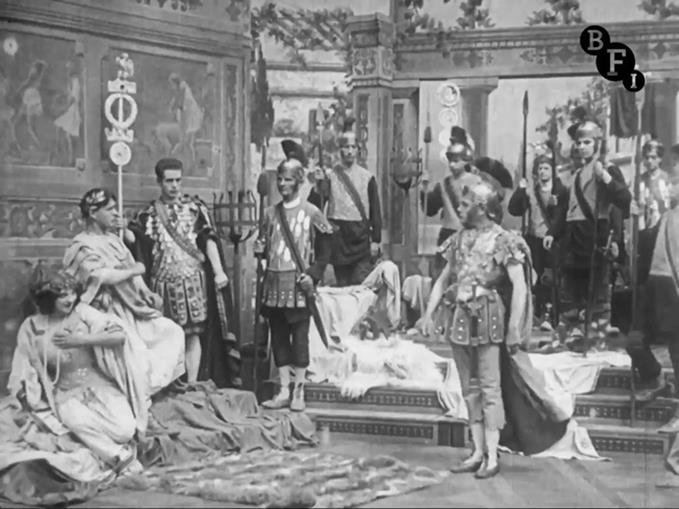
Figure 4. Bélisaire (dir. unknown, Éclipse 1910). Opening scene.Print BFI National Archive.
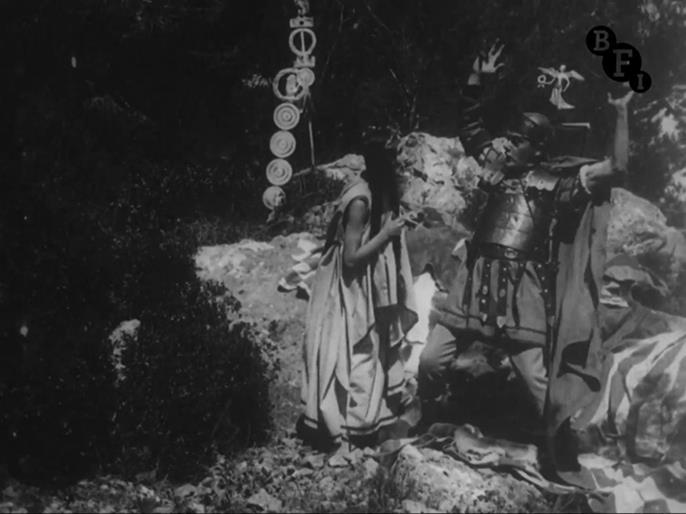
Figure 5. Bélisaire (dir. unknown, Éclipse 1910). Antonina tells her beloved about her clever replacement of the acid. Print BFI National Archive.
But what was the context of the film’s production? How emblematic was it for the company that produced it: Éclipse? And if we do not know the identity of the actors, can we at least make some informed guesses?
The company Éclipse
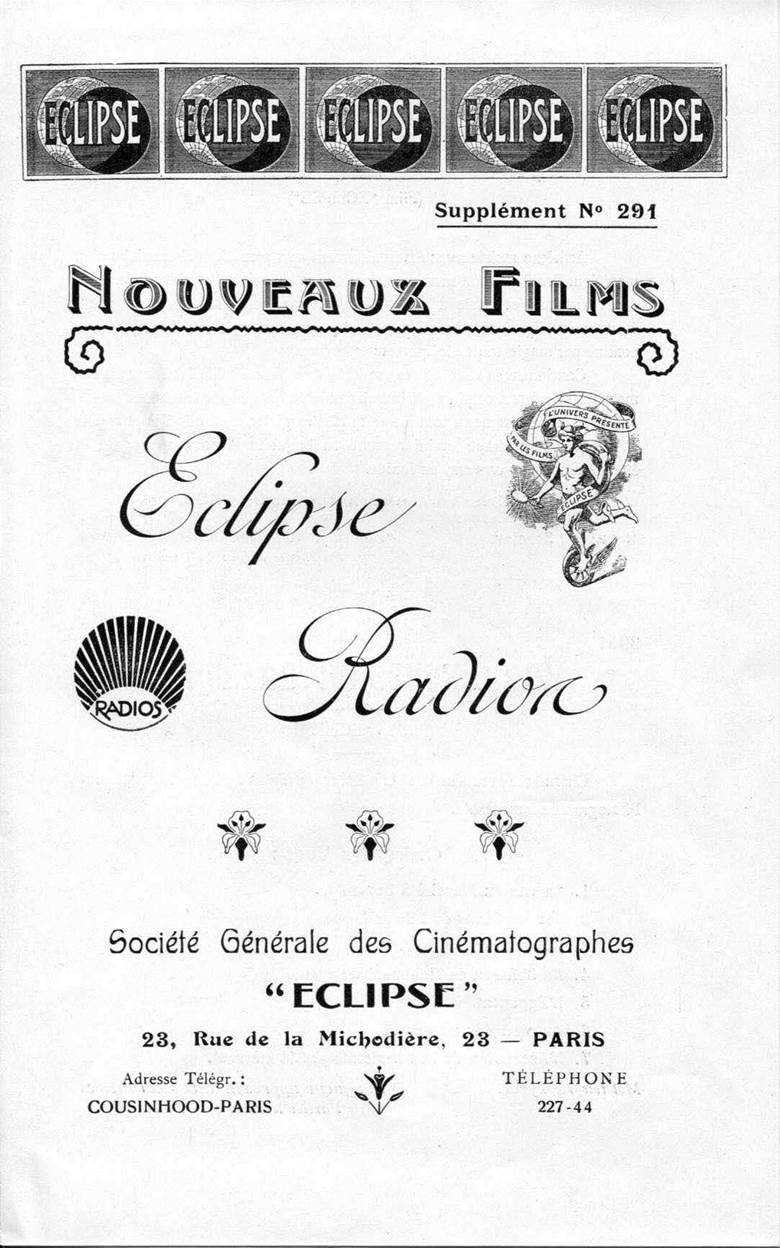
Figure 6. Brochure Éclipse, 1910s. Courtesy Eye Filmmuseum, Desmet Collection.
By 1910, the film production company Éclipse was the fourth largest in France, after Pathé, Gaumont and Éclair. As Laurent Mannoni writes in his entry in Richard Abel’s Encyclopedia of Early Cinema (Mannoni, 2005: 199): ‘The Société Générale des Cinématographes Éclipse, a public limited company with a capital of 600.000 francs, was founded by George Henri Rogers and Paul Joseph Roux in August 1906. Eclipse, which took over the Charles Uban Trading Company’s Paris franchise in November that same year, owned a shop in the Passage de l’Opéra and a small studio in Courbevoie. In July 1908, a new increase in capital (1.500.000 francs) made it possible for the company to launch Charles Urban Albert Smith’s Kinemacolor films and to purchase a majority of shares in the Radios company, which had been created in 1907. By 1913, Éclipse was the fourth largest French film manufacturer, releasing 150 films per year, among them the Arizona Bill series, directed by Gaston Roudès and starring Joë Hamman. Ten years later, after suffering financially during World War I, the company was purchased by Omnium EEG.’ (Mannoni, 2005: 199; see also Bernard, 1993)Through its partnership with the British company Urban, Éclipse also had access to the network of the American cartel Motion Picture Patents Company aka the Edison Trust, which greatly eased its international distribution.
In contrast to Gaumont, Film d’Art and Pathé, let alone Italian companies like Cines, Ambrosio or Itala, Éclipse was not known for its production of films on Greco-Roman Antiquity. Just like the other French companies, however, it produced short comedies, initially with anonymous characters and later with types like Arthème, Polycarpe, Fred and Maud, as well as modern dramas, and from 1910-11 also detective films. Éclipse also made travel films, concerning nature and local customs in places such as Europe (including France) and the United States. A smaller section of its production was dedicated to historical films about French national heroes like Napoleon and well-known theatrical figures like Cyrano de Bergerac and Hamlet, or tales set in the French past like Un complôt sous Louis XIII (1909), Le troubadour (1909), La filleule de Louis XI (1909), L'assassinat de l'amiral de Coligny (1910), and L'assassinat d'Henri III (1911), and occasionally elsewhere, as in Le tyran de Florence (1910). Yet, Éclipse also distributed films for the companies Raleigh & Robert, Radios, Urban and Ambrosio. Therefore, it is sometimes difficult to tell whether certain film titles really belong to Éclipse or to sister companies. For example, IMDb notes a film entitled Saint Paul and the Centurion, released in the USA on 29 June 1910, which is actually the Radios production La fille du centurion (1910 – see our discussion of this film elsewhere on this MoD website). The oldest Greco-Roman themed film Éclipse produced was probably Philémon et Baucis (1909), followed by Bélisaire (1910). On the whole, Antiquity was not high on the agenda of Éclipse.
According to the wonderful site Cinetourist by the late Roland-François Lack,[14] Éclipse had at least two studios in the Paris suburbs, one in Courbevoie, just north of the Bois de Boulogne, and the other in Boulogne-sur-Seine, south of the same park. The studio in Boulogne, at Rue de la Tourelle, was taken over from the company Radios in 1908, when Éclipse took over the whole company– henceforth, all Radios productions were distributed by Éclipse. The shots of the throne room and Theodora’s room in Bélisaire must have been taken in one of Éclipse’s studios in Courbevoie or Boulogne. For the shots on location, see the previous section.
We have not been able to identify the actors in Bélisaire, not even after a call to the members of the organisation Domitor which specialises in early cinema. This is perhaps not entirely surprising as, so far, we know little about the regular actors at Éclipse. Apart from the studio’s regular comedians such as Aimée Campton (Maud), Charles Servais (Polycarpe), Ernest Servais (Arthème) and René Hervil (Fred), the most famous dramatic actor was Pierre Bressol. After his 1908-09 detective series playing the character Nick Carter, based on a popular French feuilleton and filmed at Éclair, Bressol switched to Éclipse in 1910 or 1911, where he developed a new detective hero, called Nat Pinkerton, possibly inspired by the earlier Nat Pinkerton detective films made in 1909 by Viggo Larsen in Denmark. Between 1911 and 1914, Bressol acted in and directed many of the Nat Pinkerton detective films, of which the first probably was Les cavaliers noirs aka Nat Pinkerton, which still exists in the Dutch Desmet collection at the Eye Filmmuseum. Around 1910-11, many actors of the Paris Odéon theatre acted at Éclipse too, such as Pierre Daltour, Andrée Méry, Romuald Joubé, Colonna Romano, Jeanne Grumbach, M. Gay and Mme C. Didier (of whom several also worked at Pathé), while actors from other Parisian theatres also performed for Éclipse, of whom Henri Étiévant (Théâtre de l‘Ambigu) and Jacques Grétillat may be the best known. In particular Joubé and Étiévant would pursue productive film careers afterwards, Étiévant also as film director.
Conclusion
With regard to genre, the Antiquity film Bélisaire was an exception for the company Éclipse, even though historical films in general were getting very popular by 1909-1910, both within France and elsewhere, both with studios like Pathé and Gaumont and with audiences. Éclipse may well have sought to profit from this interest, even if afterwards they chose different paths like detective films. Stylistically, the film conforms to French film style around 1910, with tableau-styled shots, but also exploits the novelty of using real exteriors, as well as using limited depth and studio sets of modest scale. Future identification of the cast may help to determine whether the film’s actors were coming from the stage, as they did in the genre of film d’art. Yet, it is also clear that this film only harks back vaguely to the rich tradition in the literature and art of the Enlightenment dealing with Belisarius that criticized the cruelty of the monarchy, just as it ignores the Orientalism of Sardou’s play and its derivations. In its representation of Belisarius, the film comes closest to the Rotrou play of the seventeenth century, and this is a mark of early French films on Antiquity that often rely, directly or indirectly, on canonical works of national literature, theatre and art. Yet, in general, the film’s plot relies on nineteenth-century melodrama, in which a powerful woman seeks revenge when rejected, a plot often used in early French films like Pathé’s Messalina (1910).
For information on the studio Éclipse, I’d like to thank the members of Domitor, in particular Clara Auclair, Frank Kessler, Jean-Claude Seguin, Emmanuelle Champomier, Stephen Bottomore, and Ines Toharia Teran, as well as Bryony Dixon (BFI), Elif Rongen (Eye Filmmuseum), Morgan Corriou, and the staff of the BnF.
Footnotes
- ^ La mort de Bélisaire. Bibliothèque national de France (BnF), Département des arts du spectacle, 4-MY-1069.
- ^ The real Belisarius had ??????
- ^ The BFI print stems from the so-called Abbé Joye Collection, hence the German intertitles. See our general introductory text to this site for this collection.
- ^ Ciné-Journal, 117, 19 November 1910, also listed the film itself on p. 27 in the overview of Nouveautés Cinématographiques. The film was categorised as ‘drama’ and had a length of 225 m. Main office of the Société Générale des Cinématographes Éclipse was then 23, Rue de la Michodière, in Paris.
- ^ The Bioscope, 29 December 1910. In Britain, the film was released by Urban. With thanks to Jean-Claude Seguin for the text in The Bioscope, as wellas for general information on Eclipse.
- ^ Der Kinematograph, 209, 28 December 1910, s.p. . This issue also gives a content description of the film.
- ^ Ibid.
- ^ The Bioscope, 29 December 1910
- ^ IMDb: https://m.imdb.com/title/tt1085410/plotsummary/?ref_=tt_ov_pl. IMDb refers to Moving Picture World but doesn’t indicate which year or page. I could not trace the quotation within the pages of MPW. Instead, MPW of March 1911, p. 550, lists the film as being released on 8 March. See also The Billboard, 27 May 1911, p. 44.
- ^ Motion Picture World, March 1911, p. 656.
- ^ Moving Picture World, March 1911, p. 656. The issues of 1911 of MPW on the site https://mediahistoryproject.org/reader.php?id=moviwor08chal don’t state dates or numbers.
- ^ A French adaptation of Sardou’s play to screen was also made in 1912 by Henri Pouctal for Le Film d’Art, in which Pierre Magnier, who previously had acted in the stage version with Bernhardt, was one of the actors once more. In 1921, so over a decade after the film Bélisaire, Leopoldo Carlucci would film an adaptation of the Sardou play entitled Teodora, with Rita Jolivet as Theodora, and with Adolfo/ Adolphe Trouché as Belisarius.
- ^ Abel discusses this novelty in relation to Capellani’s historical films Jeanne d’Arc (1909) and La Mort du Duc d’Enghien (1909).
- ^ https://www.thecinetourist.net/eclipse.html
Abel, R. (1994) The Ciné Goes to Town: French Cinema, 1896-1914. Berkeley/ Los Angeles: University of California Press.
Bernard, Y. (1993) L’Éclipse : l’histoire d’une maison de production et de distribution cinématographique en France de 1906 à 1923. Thèse de doctorat, Université Paris VIII.
Champomier, E. (2018) ‘Éclipse, la face cachée de l’histoire du cinéma’, Hypothèses, upload 26-04-2018, https://cine0819.hypotheses.org/167
Ekstein, N. (2010) ‘Rotrou’s Bélisaire: Hierarchy and Meaning’, Papers on French Seventeenth Century Literature, 37(73), pp. 439–453.
Graves, R. (1938/1947). Count Belisarius. London: Cassell.
Hughes, I. (2009) Belisarius: The Last Roman General. Yardley, PA: Westholme.
Mannoni, L. (2005) ‘Éclipse’, in Abel, R. (ed.) Encyclopedia of Early Cinema. New York: Routledge, p. 199.
Parnell, D.A. (2023) Belisarius and Antonina: Love and War in the Age of Justinian. Oxford: Oxford University Press.
Rehman, I. (2017) ‘History’s model general? Reflections on the life and times of Belisarius’, War on the Rocks, 21 September. https://warontherocks.com/2017/09/historys-model-general-reflections-on-the-life-and-times-of-belisarius/.
Renwick, J. (2016) Marmontel, Voltaire, and the Bélisaire Affair. Oxford: Voltaire Foundation.