Cabiria (original)
1914
Alternative Titles
N/ABFI identifier
25365For further information on how to access the film and associated materials, check the Notes on the Print under the Technical tab.
Synopsis
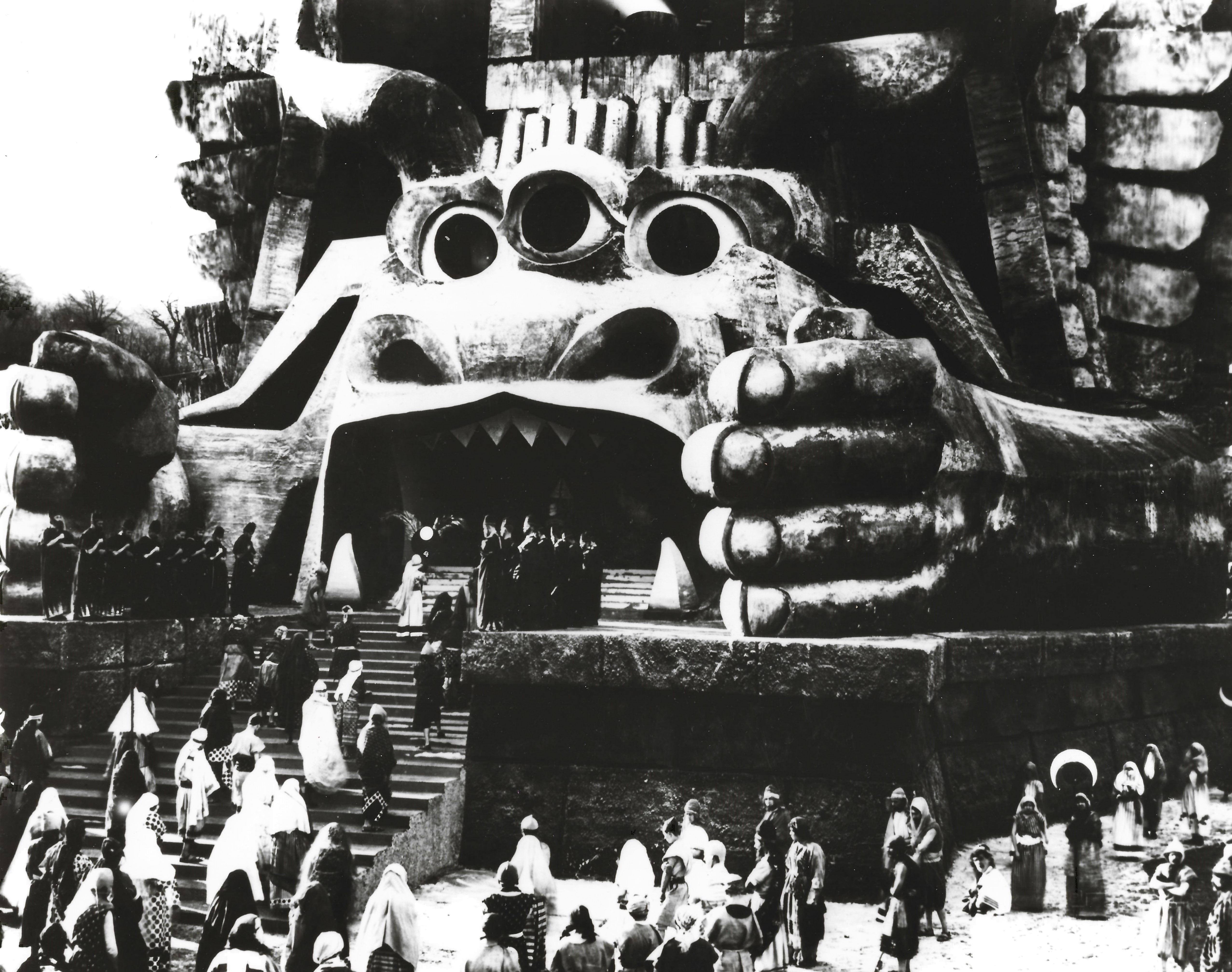
The story of the abduction of a young girl, Cabiria, by pirates during the Punic Wars between Rome and Carthage and her rescue by a slave friend, Maciste. Rl.1. In the eruption of Mt. Etna, Batto is hurt and his house ransacked. His daughter Cabiria and her nurse Croessa are captured by Phoenician pirates and sold in the slave market at Carthage to Karthalo, high priest of the temple of Moloch, for sacrifice. She escapes and meets Fulvio and Maciste and asks him to help her and gives himm her ring (1427). R l.2. At the temple of Moloch, 100 children are being sacrificed to the god. Maciste, Croessa and Fulvio creep in. Maciste seizes Cabiria and he and Fulvio retreat to the top of the temple. They take Cabiria to Bodastoret, the inn-keeper, and he sends the pursuers away. Croessa is punished for her part in the rescue. Hannibal and his men cross the Alps and threaten Rome. Sophonisba, daughter of Hasdrubal is promised to Massinissa, King of Numidia. Massinissa sends Sophonisba a present and asks her to meet him in the garden in the moonlight. Bodastoret tells Karthalo of Fulvio and Maciste's hiding. Sophonisba prepares to meet Massinissa (1394). Rl.3. Maciste, Fulvio and Cabiria escape to the temple but are pursued. Fulvio dives into the sea to escape pursuers. Maciste and Cabiria seek refuge in a garden and come upon Sophonisba and Massinissa. Maciste pleads with Sophonisba to help Cabiria. Sophonisba takes the child. Maciste is chained to a grindstone. Fulvio returns to Rome to fight. Archimedes develops his sun machine which destroys the Roman fleet. Fulvio swims away from the burning ships. He is rescued by three men who, seeing Croessa's ring upon his finger, take him to Batto's (Cabiria's father) house. Fulvio promises to search for Cabiria and leaves. The unhappy Sophonisba is given to Sifax, the conqueror of Massinissa by Hasdrubal in return for an alliance against Rome. Scipio, the conqueror of Spain, and Lelio, the Numidian, send Fulvio to Carthage to spy out the defences (1705). Rl.4. Inside Carthage, Fulvio goes to Bodastoret's inn to find the whereabouts of Maciste and Cabiria. He rescues Maciste from the grindstone. Maciste does not know where Cabiria is. They leave Carthage. Karthalo is sent by Hasdrubal to Cirta to see Sirax to persuade him to attack the Romans. Lelio sets fire to Sifax's camp. Maciste and Fulvio are lost but seeing the flames make for them. They are captured by fugitives from Cirta and taken back to Cirta. Massinissa captures Sirfax. Elissa, Sophonisba's maid, gives Fulvio and Maciste water (1447). Rl.5. Massinissa besieiges Cirta. Sophonisba has a dream. Karthalo interprets it and insists that the unkown rescued victim (Cabiria) must be returned. Maciste escpes on seeing Karthalo wth Elissa whom is is taking to his house, and follows them. From Karthalo, Maciste learns that the slave Elissa is the little Cabiria. Maciste and Cabiria escape from the house and are joined by Fulvio. Fulvio and Maciste hide in the food stores but Cabiria is captured. Cirta surrenders at the sight of Sifax in chains. Massinissa and Sophonisba meet again and he dedicates his sword to her. He obtains mercy for Fulvio and Maciste from Sophonisba. Fulvio implores for mercy for Cabiria but Sophonisba tells him she is dead (1317). Rl.6. Scipio learns from Lelio that Sophonisba is trying to make Massinissa break his allegiance with Rome. Scipio meets Massinissa and demands Sophonisba as part of his booty. Massinissa sends poison to Sophonisba by Maciste. She pours it into a cup and drinks. Fulvio arrives but she is dying. She gives him Cabiria who is not dead. Sophonisba then dies (1165). (8455ft) Note: Archive also holds a BFI 360 print of the restored version, with Italian intertitles. (Shotlist)
- Production Country: Italy
- Production Company: Itala Film
- BFI Category: Fiction
- Source: N/A
Cast
Lydia Quaranta (Cabiria, aged 20)
Umberto Mozzato (Fulvio Axilla)
Bartolomeo Pagano (Maciste)
Luigi Chellini (Scipio)
Gina Marangoni (Croessa)
Dante Testa (Karthalo, high priest of Moloch)
Camilla Catena (Cabiria as a child)
Raffaele Di Napoli (Bodastoret)
Vitale De Stefano (Massinissa)
Enrico Gemelli (Archimedes)
Alex Bernard (Sifax)
Ignazio Lupi (Arbace)
Emilio Vardannes (Hannibal)
Italia Almirante-Manzini (Sophonisba)
Edoardo Davesnes (Hasdrubal)
Credits
Director: Giovanni Pastrone
Production Company: Itala Film
Script: Giovanni Pastrone
Director of Photography: Giovanni Tomatis, Augusto Battagliotti, Natale Chiusano, Carlo Franziere, Vincenzo Dénizot
Special Effects: Segundo de Chomón
Art Director: Camillo Innocenti, Romano Luigi Borgnetto
Intertitles: Gabriele D'annunzio
Fire Symphony Music: Ildebrando Pizzetti
Original Music: Manlio Mazza
Restoration: Museo Nazionale del Cinema
Restoration Collaboration: Centro Sperimentale di Cinematografia, Cineteca Nazionale, La Cinémathèque française, National Film and Television Archive, Filmoteca Española
Restoration Assistance: Museum of Modern Art, Gosfilmofond
Restoration Funding: Lumiere Project
Film Technical Information
- Original Length: 4000 m
- Length of BFI Viewing Print: 8345 ft
- Support: Viewable
- Black and White
- Format: 35 mm , D3, VHS
Comments on the print:
The 35 mm viewing copy in the BFI collection (identifier 25365) predates the restoration of the silent version with a stock date of 1955 and elements of it, especially reel 3, are quite worn. It is 8345 ft. For the various elements the BFI holds, see https://collections-search.bfi.org.uk/web/Details/ChoiceFilmWorks/150022649 For the paratexts in the BFI (such as programmes), see the discussion of the film on this website.
The original length was 4000 metres, according to V. Martinelli, Il cinema muto italiano. I film degli anni d'oro. 1914. Prima parte. Bianco & Nero, Rome: Centro sperimentale di cinematografia, 1993: p. 73 . Currently, the best accessible print of Cabiria is the reconstruction of the original version in 2006 by the Museo Nazionale del Cinema in Turin, of which the BFI holds a copy. The Museo has also restored the sound version of 1931. For details on these restorations, see http://www2.museocinema.it/restauri/muti_restaurati.php?id=34
The Museo in Turin, as the city in which Cabiria was made, also possesses a wealth of relevant paratextual materials, such as production photographs, stills, posters, programmes, advertising sheets, contracts, correspondence, screenplays, daily agendas, editing sheets, intertitles and their translations into multiple other languages, musical scores, and censorship approvals. They can mostly be found by searching for the film on the Museo’s website: http://www2.museocinema.it/collezioni/Muto.aspx
Visual Resources


