1910- Héliogabale (Le Film d’Art)
By IVO BLOM
The print of the film Héliogabale (André Calmettes, Le Film d’Art 1910) that survives in the British Film Institute National Archive is, as far as we can tell, unique. While another early French film on the life of the Roman emperor Heliogabalus, L’Orgie romaine (Louis Feuillade, Gaumont 1911) has received considerable attention from scholars, much less consideration has been given to this Film d’Art version of his life. So what aspect of antiquity does this film reconstruct, what can we say about its cast, production team and set design, in its plot and mise-en-scene what ties does it have with contemporary theatre and painting, how different is it from L’Orgie romaine, and why does it seem that the only two films made about such an unusual Roman emperor were produced solely in France and solely at this time?
Plot and historical background
The 1910 Le Film d’Art production Héliogabale is remarkable in a number of respects. The plot centres around the abduction of a Vestal Virgin by the Emperor Heliogabalus which leads to his overthrow. At the beginning of the film, he arrives outside the temple escorted by Roman solders and arm-in-arm with two of his male court favourites to witness a sacrifice by the High Priest of Vesta, Julia Aquilina Severa. He is attracted to her, but his advances are checked by the High Priest who leads the vestal into the protection of the temple. The Emperor returns with military force to knock the High Priest out of the way and abducts Julia from within the temple as she prays before the sacred flame. His violent actions outrage the watching populace. At an orgy in the palace, Heliogabalus attempts to rape the vestal, but is thwarted by insurrectionists who burst into the room. He flees through a trapdoor leading to the sewers but is eventually captured. His appeal to Julia for mercy is met by her averted face, and the mob prepares to throw him into the Tiber (here the film breaks off shortly before its ending, but we can guess the final action). The BFI print stems from the famous Joye Collection, one of the biggest collections of early cinema worldwide, which once belonging to the Jesuit priest and teacher Abbé Joseph Joye, who used to lecture with these films at the gymnasium in Basel, the Borromäum (Cosandey, 1993).[1] According to the Borromäum Catalogue this was an Éclair production. However, it has now been identified as a – hitherto lost - 1910 production from Le Film d'Art, a company that from 1908 appealed to middlebrow audiences through the adaptation to screen of masterpieces of theatre, opera or literature, staged by directors, writers, and actors from the legitimate theatre, albeit within the time span of a one-reeler.
The plot of Héliogabale utilises but also breaks away from the ancient sources such as Herodianus and Cassius Dio. They describe how, in late 220 AD, the Emperor Heliogabalus married the Vestal Virgin Julia Aquilia Severa against her will (some even talk of rape). The marriage was considered by them as highly controversial because the chastity of Vestal Virgins was a requirement for the protection of Rome and they were punished with being buried alive if they broke their vow or neglected the ‘eternal’ flame at the Temple of Vesta. The marriage Heliogabalus made with Severa was revoked at the instigation of his powerful grandmother, Empress Julia Maesa, who forced him to marry a more acceptable choice, Annia Faustina. Yet quite soon he divorced Faustina and went back to Severa, who stayed with him until his death. As many stories about Heliogabalus were written from a hostile perspective some time after his reign (see Icks, 2024), and Cassio Dio’s account is only known through a medieval intermediary it is difficult to establish what really happened. In any case, the historian Cassius Dio claimed Heliogabalus had a more committed relationship with his chariot driver than with any of his wives.[2]
Production and cast
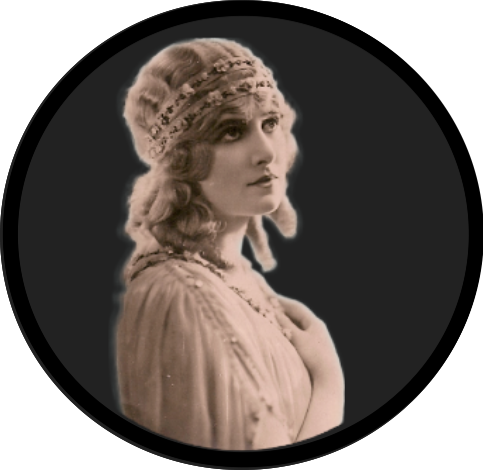
While sources such as Ciné-Ressources and Eric Le Roy’s 2008 filmography of the company Le Film d’Art in the journal 1895[3]identify the main actors as Émile Dehelly, Rolla Norman, and Henri Desfontaines, the scriptwriters as Henri Lavedan and G. Lenotre, and the director as André Calmettes, an ad in the journal Ciné-Journal states more accurately the names of the leading actors.[4] When viewing the BFI print, I identified the abducted Vestal Virgin to be Olga Demidoff as is documented by Ciné-Journal, while Comédie-Française actor Jacques Guilhène, misspelled as Guilhème in Ciné-Journal, plays Emperor Heliogabalus. Indeed, the actor in the film looks a great deal like a caricature of Guilhène that survives in the French archive Gallica.[5]With the proof given by Ciné-Journal, we can conclude that this is a Film d'Art representation of the Emperor from 1910 and not an Éclair or Gaumont film, and that Le Roy's filmography identifies the main actors incorrectly.[6] Moreover, Richard Abel in his monograph The Ciné Goes to Town (1994) also mentions the names of Demidoff and Guillhène (Abel, 1994: 255-256) as the leads, even if he copies the misspelling of ‘Guilhème’ from Ciné-Journal. The British trade journal Kinematograph Weekly announced the film in 1910 as ‘The Last Days of Heliogabalus, Emperor of Rome. A vivid and superbly staged story of Rome and its corrupt days with a striking climax.’ In Britain, the company Cosmopolitan Film & Co., Gerrard Street, London distributed all Le Film d’Art films. Héliogabale was announced as on release in Britain from 28 May 1910.[7]
Playing the Vestal Virgin was a French stage and screen actress, Olga Demidoff (originally Olga Doubetzky, 1888-1970), who flourished on stage in the 1900s and on screen in the early 1910s. It is interesting that in June 1910, the year when the film Héliogabale was made, Demidoff acted on stage opposite Jean Hervé in Marius vaincu, a play by Alfred Mortier set in Roman Antiquity that concerned the rivalry between Marius and Sulla. By then Demidoff and Hervé were part of the troupe Nouveau Théâtre d'Art. In 1909 Demidoff started her film acting career at Pathé Frères and Le Film d'Art. She probably first acted in the historical drama Les enfants d'Édouard (Le Film d'Art, 1909) directed by André Calmettes and inspired by Paul Delaroche's famous painting. Demidoff was billed on the film poster as coming from the Théâtre de la Porte St Martin. She played Queen Elizabeth, while Philippe Garnier played the Duke of Gloucester and Charles Krauss Edward IV. Thus, when in 1910[8] Demidoff acted as a Vestal Virgin opposite Jacques Guilhène as the debauched title character in Héliogabale, it was a renewed collaboration with Calmettes for Le Film d'Art. Yet Ciné-Ressources and Le Roy state that Les enfants d’Édouard was her only Film d’Art film. The evidence of this BFI print indicates that it clearly was not. At Pathé Frères, Demidoff also acted in comedy, as in the Max Linder farce Max et sa belle-mère (1911). At least from 1910, Demidoff also worked at Éclair, e.g. in Chiens et loups (1910), La fin de Don Juan (1911), Tom Butler (1912), Le sphinx (1912) and the sequel Zigomar contre Nick Carter (1912). In 1913, Demidoff was Ida, the mother of the protagonist in André Liabel's feature-length adaptation of Alphonse Daudet's novel Jack. Several years later, Demidoff performed in her last three films: Le devoir d'abord (Adolph Candé, Éclair 1917), La mission du Docteur Klivers (Pierre Bressol, company unknown 1919), and Sublime offrande (Maurice Landay, Vandal & Delac 1920).
Playing Heliogabalus was a renowned French stage actor, Jacques Guilhène (1886-1936), who after his studies with George Berr at the Conservatory immediately entered the Comédie Française in 1908. In 1909, he played Hyacinthos there in the three-act dramatic play La Furie, written by Jules Bois. Set in ancient times, Paul Mounet was in the lead as Herakles, and Albert Lambert, Louis Delaunay, Jacques Fenoux, René Alexandre and Louis Ravet acted alongside him, while the female leads were Eugénie Segond-Weber, Madeleine Roch, Louise Sylvain, Jeanne Provost and Gabrielle Robinne. In the 1910s, but particularly in the 1920s, Guilhène flourished at the Comédie Française in plays by Molière, Victor Hugo, Ibsen, Maurice Donnay and others. Guilhène would debut on screen in 1909 in the Le Film d’Art production Joseph vendu par ses frères, directed and scripted by Paul Gavault and George Berr, and shot in the woods of Fontainebleau. This was followed by several Le Film d’Art productions such as L'Aigle et l'Aiglon (1811-1832) (Calmettes, 1910), Une Tragédie à Byzance (dir. unknown, 1910), and L’Usurpateur (Calmettes, Henri Pouctal, 1911), while he had the title role in Jésus de Nazareth (1911) directed by Calmettes and Henri Desfontaines. Parallel to his work for Le Film d’Art, Guilhène also acted at Éclair and its film d’art-like section, A.C.A.D. (Association Cinématographique des Auteurs Dramatiques), such as in Eugénie Grandet (Émile Chautard, 1910). In the 1920s, he would also act in various films such as La Porteuse de pain (1923) by René Le Somptier and the serial Mylord l'Arsouille (René Leprince (1925). In short, the casting of Demidoff and Guilhène for Héliogabale confirms Film d’Art’s policy of involving renown stage actors in its productions to uplift and promote cinema as a new middle-class medium and pastime, but the casting also confirms the continued attachment of the two actors to the company Film d’Art.
Set design
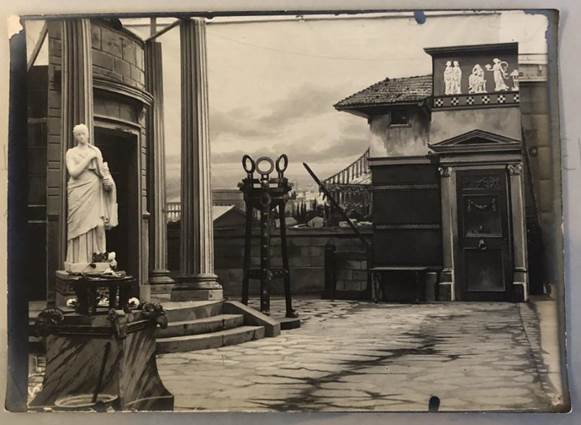
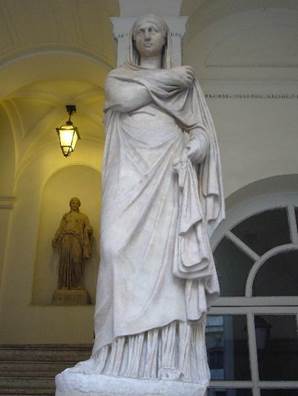
Figure 1. Photo of film set. Courtesy of Cinémathèque Française, Paris. Collection Dalmouth, Iconothèque.
Figure 2. Statue of Vestal. Palazzo Braschi, Rome. Source: https://commons.wikimedia.org/wiki/File:Palazzo_Braschi_-_Vestale_1020774.JPG.
The sets of the Calmettes film Héliogabale are modest in size. It is only as of 1911, beginning in Italy with such films as La caduta di Troia, that we notice a considerable growth in the size and depth of the sets of silent Antiquity films (see my text ‘The set designs for classical antiquity from the Turinese film studio Itala (1909 to 1911)’ on this website). Héliogabale basically consists of five sets: the exterior and the interior of the Temple of Vesta, the banquet room in the imperial palace, the lower part of the palace with the trapdoor giving access to the sewer, and the place where the sewer enters the river Tiber. An original photo of the first set exists. It shows the rather small Temple of Vesta on the left, which only vaguely resembles the remains of the actual Temple of Vesta in the Forum Romanum in Rome, with its Corinthian columns and its rotund form. In front of the temple, we see a white statue in the foreground (white perhaps to simulate marble) which could represent Vesta or a Vestal, and in the background a giant tripod brazier,[9] while close to the camera there is a low little altar, used for offerings. The Vestal statue looks a little like an original now at Palazzo Braschi in Rome, which has the same gesture with the right arm and the same heavy drapery. The painted floor is designed to suggest a cobblestone street. On the right, we notice a building which could be the facade of a house. On the whole, the space is quite small - more an alley than, say, the Forum Romanum, and confirming the modest sizes of sets in early cinema. Then again, the original Temple of Vesta was not enormous, but was prized as one of the oldest buildings in the Forum.
The Cinémathèque Française attributes this photo from its collection to the film Au temps des premiers chrétiens (1910), based on Henryk Sienkiewicz’ novel Quo vadis?, but the set is exactly the same as that of the first scene in Héliogabale, when the emperor first sees the Vestal Virgin Severa in front of the Temple of Vesta. So either the attribution by the Cinémathèque is wrong, or we have a case of recycling of a complete set. The photo stems from the so-called photo collection ‘Dalmouth’, which includes several rare set photos from early Le Film d’Art productions, both empty sets as well as sets populated by the actors, plus a few photos of the Film d’Art studio in Neuilly near Paris.[10] Yaroshevitch Dalmouth was a photographer from Marseille, who was set photographer for Le Film d’Art between 1909 and 1911, the last year Le Film d’Art produced films.
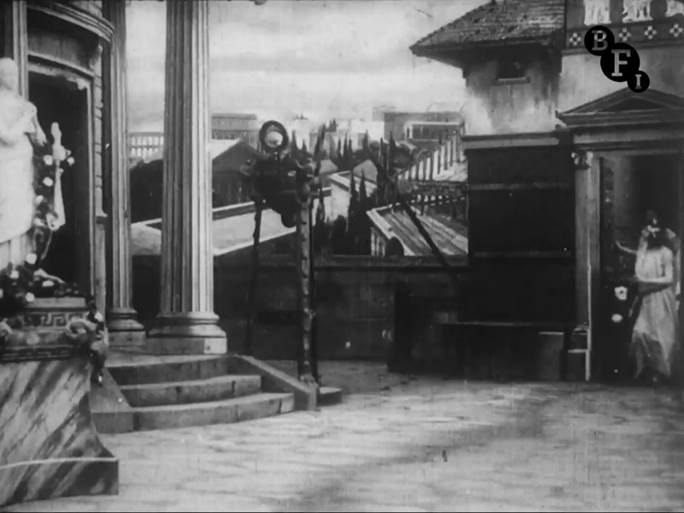
Figure 3. Capture from the BFI National archive print. Start of the action in the film.
Héliogabale and Vestal Virgins in European opera, painting and literature
In Calmettes' film, Heliogabalus abuses his power over Rome by abducting a vestal and attempting to rape her. She is saved just in time from such tyrannical behaviour by the outraged citizenry. The Vestal Virgin is a victim and survives, but the film is clearly responding to a rich tradition of operas, paintings, illustrated books and postcards, and even preceding films, in which Vestal Virgins are punished for breaking their vows of chastity, thus causing the Vestal flame to be extinguished and Rome to be unprotected. In many cases, the unfaithful women are punished by being buried alive, as in the early Pathé Frères film La Vestale (1908).[11]In that earlier film, the goddess herself takes pity on her priestess and miraculously makes the flame burn again, a divine signal to the High Priest that the punished woman must be forgiven.
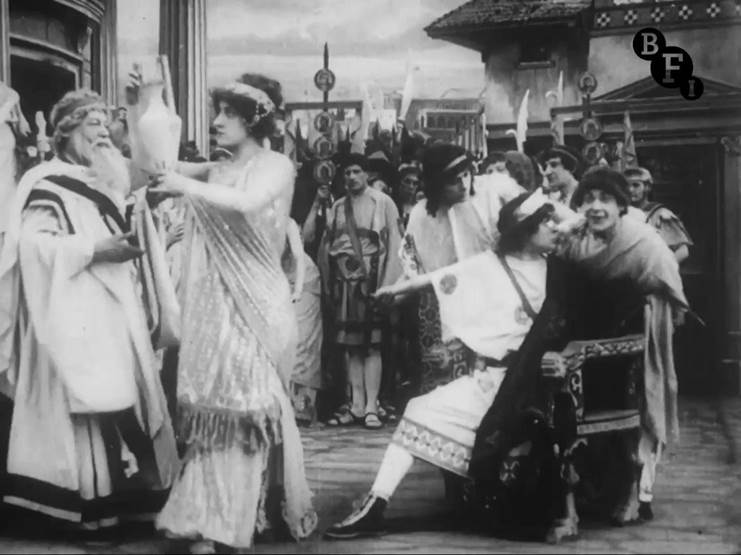
Figure 4. Héliogabale (1910). The Emperor meets the Vestal Virgin and wants to have her. Print BFI National Archive.
The plotline of that earlier film is very similar to the libretto of Gaspare Spontini's opera La Vestale, first performed in 1807. Both are about a general who returns successfully from war but then discovers that his grieving beloved has become a Vestal Virgin. During his wooing of her in the temple, the flame blows out, she is condemned to death, but lightning reignites the flame. This is seen as a divine sign, and the Vestal is freed and allowed to rejoin her general. In addition, a later opera, La Vestale by Saverio Mercadante, first performed in Naples in 1840, also contains elements that reappear in the Pathé film. In this other operatic version, Emilia thinks her lover, the soldier Decio, is dead and therefore becomes a Vestal Virgin, as in Pathé's film. But Decio returns a hero after defeating the Gauls (as does the general in the Pathé film). He is horrified to see that it is his beloved Emilia who puts the laurel wreath on his head. Again, this triumphal sequence is just like that in the film. However, the opera then takes an entirely different turn. After Emilia is sentenced to death by Decio's father for allowing the flame to expire during her secret meeting with Decio, Decio begs his father for mercy in vain. Emilia is eventually buried alive and Decio commits suicide - an ending more reminiscent of the ending of the Greek tragedy Antigone, where King Creon also refuses to grant mercy to Antigone, upon which his son commits suicide on Antigone's corpse. The ending of Mercadante's opera is also reminiscent of Verdi's opera Aida, in which her lover follows her into death when she is buried alive. In short, Pathé's film La Vestale borrows from both Spontini and Mercadante.
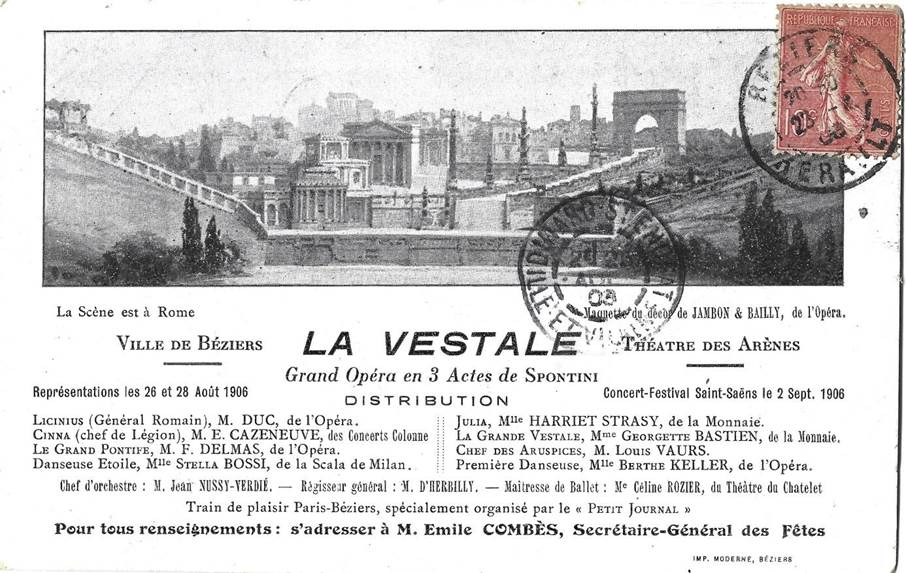
Figure 5. La Vestale (1906) at Béziers. Postcard collection Ivo Blom.
In France, Spontini’s La Vestale was performed, for example, on 26 and 28 August 1906 at the Théâtre des Arènes in Béziers (figure 6); so, two years before the Pathé film La Vestale was made and four years before Héliogabale. The lead singers were Valentin Duc as the general Licinius, Harriet Strasy (Jeanne Pacquot-Dassy, according to the papers then) as the Vestal Julia, Georgette Bastien as La Grande Vestale and Jean-François Delmas as the High Priest, while dances were performed by the leading ballerinas Stella Bossi from the Scala in Milan and Berthe Keller from the Paris Opera. Sets were by Jambon and Bailly. The size of the set of Rome was clearly much larger than that of the average early one-reeler set in Greco-Roman Antiquity (figure ?). Indeed, these large sets, even if partly painted backdrops, may well have inspired filmmakers to start experimenting with larger sets too, beyond the standard-size of the modest dimensions of a single, ordinary room. Instead, the Mercadante opera was largely out of reach in France, because a French version of the Italian opera had not yet been secured – so the French papers explained when the 1906 version by Spontini was performed.[12]
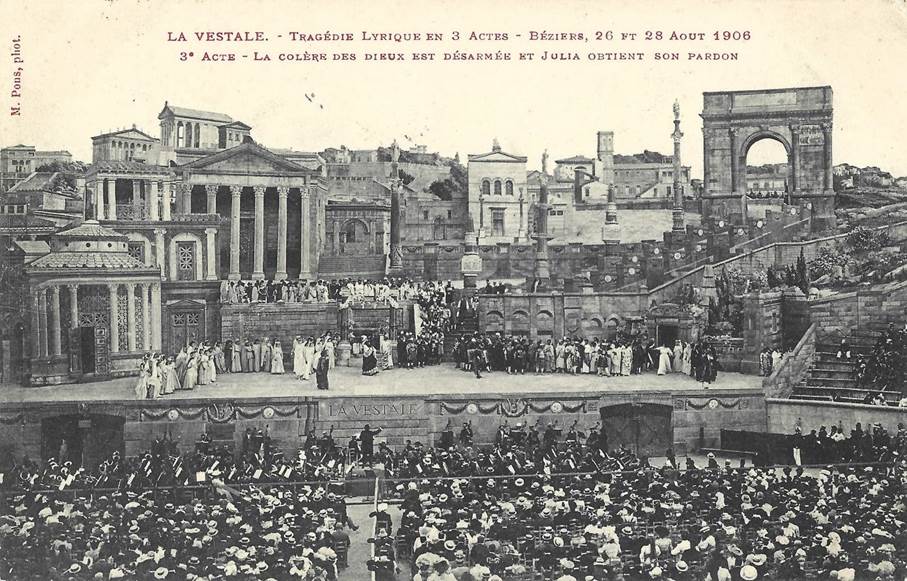
Figure 6. La Vestale (1906) at Béziers. Postcard collection Ivo Blom.
Richard Abel writes of Calmettes’ film: ‘For most of its length, this film mounts its story of the cruel third-century Roman emperor in just three [actually, five] LS tableaux of painted-flat decors, placing it even more firmly within the tradition of nineteenth-century historical paintings, opera stagings, and earlier Pathé films.’ (Abel, 1994: 255). For the scene of the orgy at Heliogabalus’ court (figure 7, and despite the relative lack of grandeur of its mise-en-scene, Abel compares Lawrence Alma-Tadema's The Roses of Heliogabalus (1888, coll. Pérez-Simon, Mexico, figure 8) ( (Abel, 1994:316, note 173). Although one could, just as well, compare Thomas Couture's Les Romains de la Décadence (1847, Musée d'Orsay, Paris, figure 9). I would argue rather that, while Calmettes' film draws on the operatic tradition concerning Vestal Virgins as love objects to present on screen the abusive desires of the Emperor Heliogabalus, it seems relatively detached from the painterly iconography for that emperor and for imperial decadence more broadly.
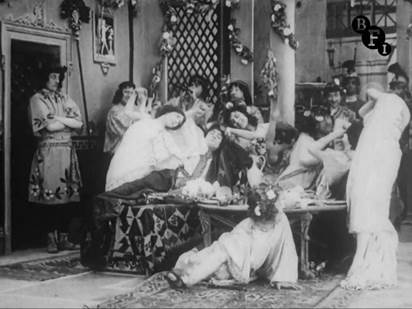
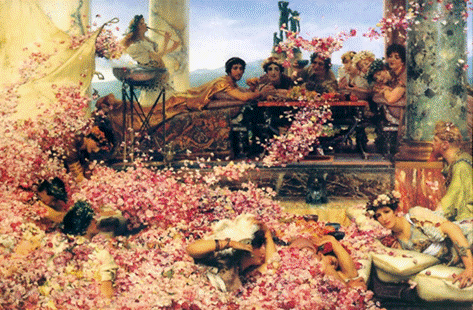
Figure 7. Héliogabale (1910). Banquet/orgy at the emperor's palace. Print BFI National Archive.
Figure 8. Lawrence Alma-Tadema, The Roses of Heliogabalus (1888. Coll, Pérez-Simon, Mexico). Source: https://commons.wikimedia.org/wiki/File:Alma-Tadema_-_The_Roses_of_Heliogabalus.jpg
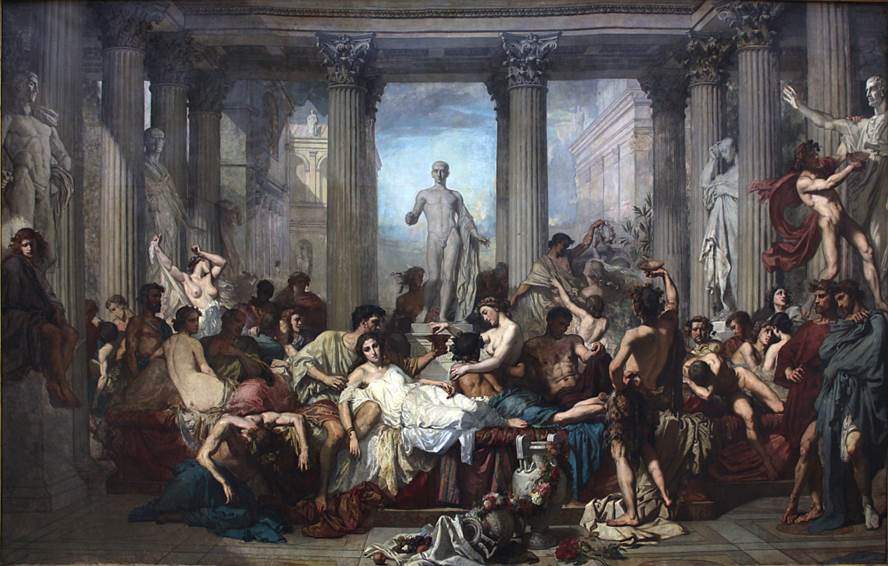
Figure 9. Thomas Couture, Les Romains de la Décadence (1847, Musée d'Orsay, Paris). Source: https://commons.wikimedia.org/wiki/File:Thomas_Couture_-_Romans_during_the_Decadence_-_Google_Art_Project.jpg.
The nineteenth-century painterly interest in Rome as home to extreme decadence (and in Heliogabalus as decadence’s embodiment) is far more pronounced in Feuillade's film Héliogabale/ L’Orgie romaine of the following year. Maria Wyke cites Alma-Tadema's The Roses of Heliogabalus more convincingly as inspiration for a sequence in the Gaumont film that begins with a shower of flowers descending on Heliogabalus' dinner guests (Wyke, 2017 see also D'Hautcourt, 2006). That painting is a little more sinister than the film scene because the anecdote, taken from the apocryphal source of the Historia Augusta, suggests that the guests were smothered by the great mass of rose petals, a kind of death in ecstasy.[13] However, the banquet sequence in L'Orgie romaine continues with an action, again inspired by the Historia Augusta, in which panic breaks out among the same guests when Heliogabalus unleashes lions on them, much to the sadistic emperor's delight (figure 10).[14] Whereas Auguste Leroux depicted the scene in one of the extraordinary colour illustrations he made for a 1902 edition of Jean Lombard's novel L'Agonie (1888) that utilised Heliogabalus to depict allegorically the seeming disorder of end-of-century France, Henri-Paul Motte's painting Héliogabale et ses convives (1909, lost painting, figure 11) is probably the most direct inspiration for the banquet scene in the film. In fact, Feuillade copied part of his film set from Motte's painting with the diagonally placed colonnade on the right side of the frame.[15] Still, the final dramatic flight of the guests away from the banquet hall and their pursuit by the lions in this richly imagined sequence of Feuillade’s film (figures 12 and 13) certainly recall Leroux’ illustration (figure 14).
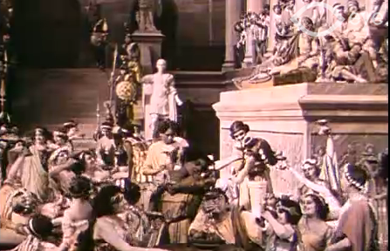
Figure 10. Héliogabale/ L'Orgie romaine (1911). Print Eye Filmmuseum.
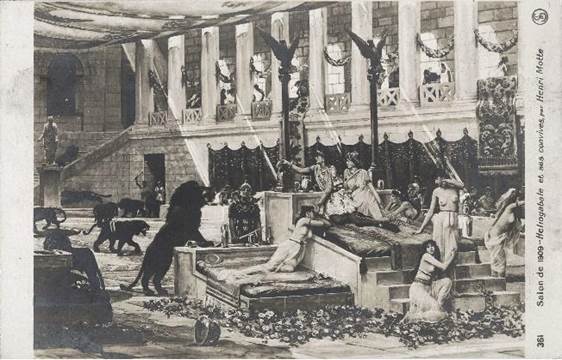
Figure 11. Henri-Paul Motte, Héliogabale et ses convives (1910). Postcard collection Ivo Blom.
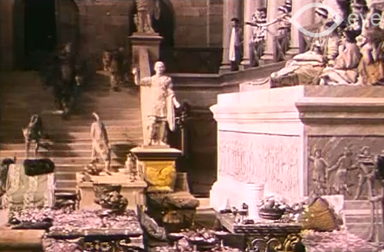
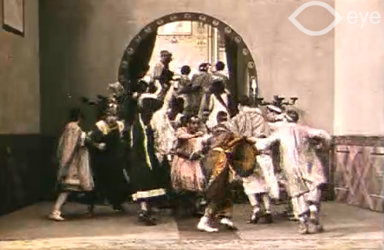
Figure 12-13. Héliogabale/ L'Orgie romaine (1911). Print Eye Filmmuseum.
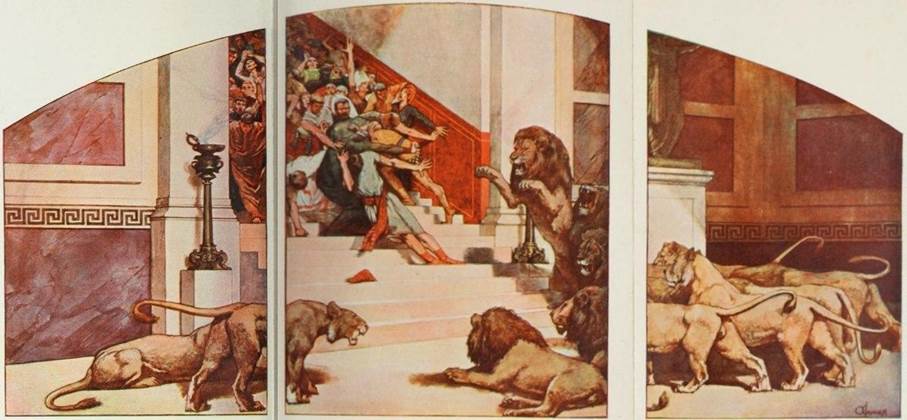
Figure 14. Auguste Leroux, illustration from Jean Lombard’s L'Agonie (1902). Source: https://commons.wikimedia.org/wiki/File:L%27agonie_(1902)_Et_les_premiers,_debouchant_dans_une_salle_deserte,_virent_distinctement_une_douzaine_de_lions_en_liberte.jpg.
A remarkable French theatrical version
The Roman emperor Heliogabalus was apparently of considerable interest in French culture around 1910, because in that summer, just a few months after the Film d’Art production was released, a remarkable theatrical version of his life followed.
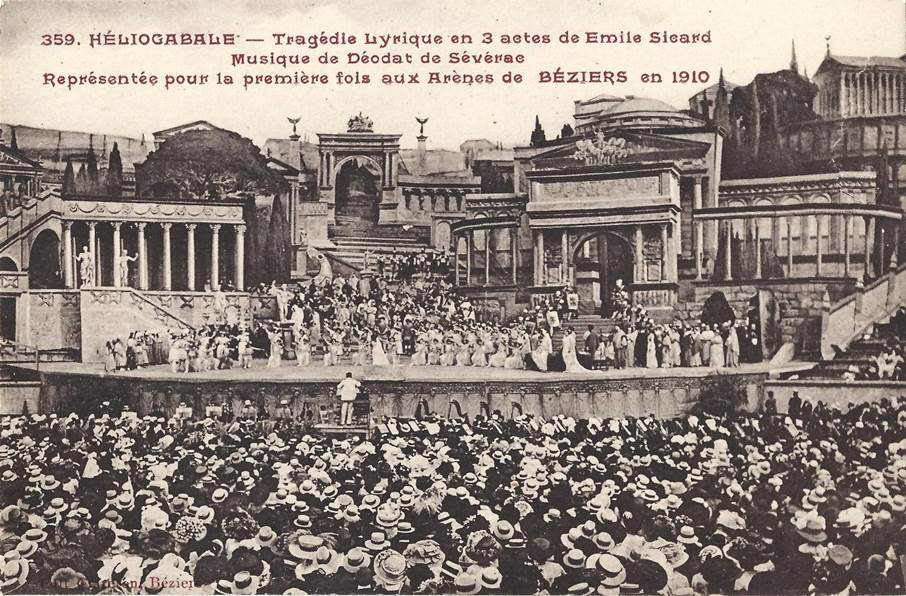
Figure 15. Héliogabale at the Arena of Béziers. Postcard coll. Ivo Blom
On 21 and 23 August 1910, at the Théâtre des Arènes in Béziers (figure 15), the lyrical tragedy Héliogabale, written by Émile Sicard (figure 16) and with music by Déodat de Séverac, was performed. The artistic director was Dr. Charry, who had taken over from the founder of the stage shows at Béziers, Fernand Castelbon de Beauxhostes, while the mise-en-scene was created by Mr. Derbilly. The show consisted of prose theatre, a 400 member, live orchestra conducted by Mr. Asselmans of the Opéra Comique, a choir of 160 singers, a ballet led by Mr. Belloni of the Scala of Milan, and a prologue by Charles Guéret.[16] This combination of prose theatre, orchestral music and ballet was not uncommon in France in the early 1900s, in particular with the open air performances staged during the summertime. Renowned actors from the Comédie Française and other reputed Parisian stage companies were called for in this case: Édouard de Max played Héliogabale, other actors included René Alexandre Rusca, Jean Hervé Claudien (figure 17), Madeleine Roch Soemias (figure 18), and Lucie Brille Julia, while star dancers like Stacia Napierkowska (figure 19), Ea-Karité (both Opéra Comique) and Nina Sereni (Scala, Milan) were involved too, as well two singers from the Paris Opera, Mr Franz and Germaine Le Senne.
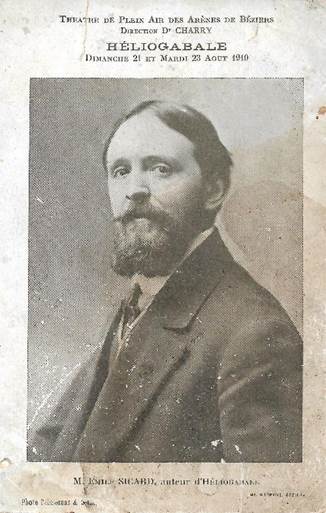
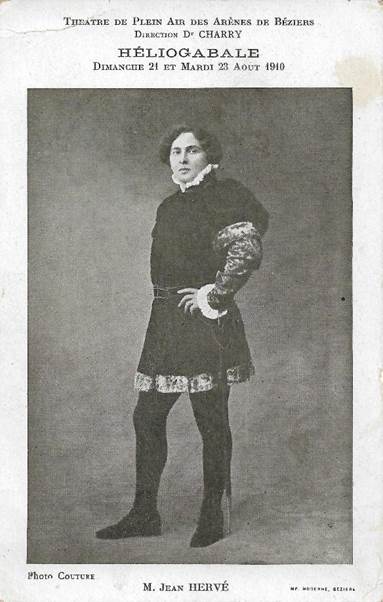
Figure 16. Emile Sicard, author of Héliogabale (1910). Postcard coll. Ivo Blom. Postcard collction Ivo Blom.
Figure 17. Jean Hervé in Héliogabale (1910). Postcard collection Ivo Blom.
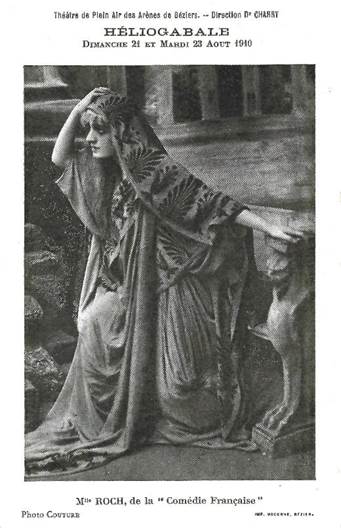
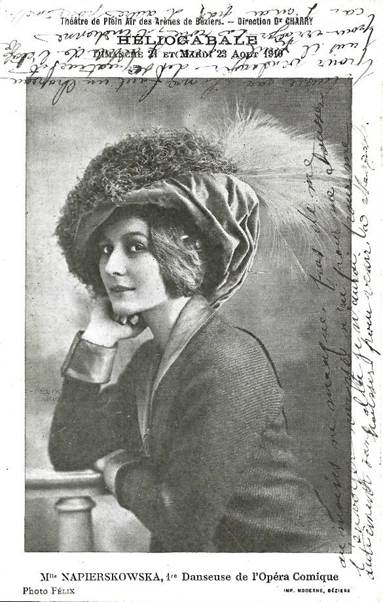
Figure 18. Madeleine Roch in Héliogabale (1910). Postcard collection Ivo Blom.
Figure 19. Stacia Napierkowska in Héliogabale (1910). Postcard collection Ivo Blom.
The plot of this Héliogabale[17]combines ancient sources with a straightforwardly Christian message. The play narrates the last days of the emperor, well-known for his debauchery and cruelty, his Oriental sun-cult which he placed above the traditional Roman gods, the machinations of his mother, and – unmentioned in ancient sources - his persecution of the Christians. His mother Soemias fears a coup by her sister Julia and her nephew Alexander. One of Heliogabalus’ favourites, Claudien (Claudius), is eager to marry a Christian girl, Cloelia, and convert. He wants to leave Rome but promises Julia to help overthrow Heliogabalus. The Christian Rusca pleads with Heliogabalus to return his daughters to him but is thrown out of the city. The first act finishes with Heliogabalus’ magicians, whom he considers traitors and parasites, ordered to be smothered under an avalanche of flowers (an allusion to the Historia Augusta but also to Tadema’s painting). In the catacombs Claudien converts and is engaged to Cloelia. Despite his wish to leave Rome, he promises Rusca to help him overthrow Heliogabalus. In the last act, Heliogabalus ignores all of his mother’s pleas and warnings, and continues his bacchanal and Sun cult dance as the new Adonis. In the end, Rusca’s soldiers invade the palace, and the emperor is thrown into the Tiber.[18] The Christians sing a final song, glorifying the new era that will overcome Oriental decadence. Here Christianity is promoted as being part of us, of the Western world, while the Oriental cult presents Otherness, which needs to be expunged. As Sicard himself remarked: ‘There are some beautiful things to do in Héliogabale! In sum it is the freefall of paganism into oriental decadence followed by the sunrise of Christianity!’ (Musk, 2024) Indirectly, it was also a conservative criticism by the Regionalist Sicard against what he considered to be the decadence of Paris, the present-day version of ‘pagan’ Rome. Therefore, locally, the play was a huge success in Béziers itself (though also because of its multi-medial spectacle). Not all critics in Paris were convinced however.[19]
Two Heliogabaluses on the French screen
Héliogabale by Calmettes clearly lacks the explicit Christian message of the three-act tragedy by Sicard. The emperor’s disrespect for Roman religion is quite clear - Vesta, her priests and priestesses - but there is no sign of his ‘Oriental’ beliefs. The emperor abuses his power more conventionally instead through sexual assault. He exceeds the norms for heterosexual male behaviour through his lust for, abduction and attempted rape of an innocent, pious woman. When caught and about to be thrown into the Tiber (in reality he was first decapitated before being thrown in), he pleads with Severa for mercy, but she is so appalled that she refuses to help him, creating the classic ‘an-eye-for an-eye’ revenge we so often encounter in film plots on Roman antiquity. Even if the last few metres of the film are lacking, and even if you did not know the history of this emperor, it is very clear how Heliogabalus’s life must end. In L’Orgie romaine (1911), the subsequent film by Louis Feuillade, as Maria Wyke argues, the emperor is also punished (he is beheaded offscreen by his praetorians and then onscreen his head is paraded on a spear). But in this later Gaumont film he is punished only after his decadent femininity is put on intriguing display. Played by Jean Aymé, this more unconventional Heliogabalus is feminine and Other in costume and gesture (he is seen admiring the dresses of his female courtiers as well as his own, and having his toenails painted). He is also characterised as capricious, cruel and, ultimately, cowardly, following Cassius Dio’s damning depiction. It would appear that each film is drawing on different aspects of the dense clustering of representations of the Roman emperor that had taken shape in nineteenth-century Europe, and in particular in France between the 1880s and the 1910s. The allegorical use of Heliogabalus in French discourses of national decline and the need for renewal clearly provided French cinema with the opportunity to tempt spectators into cinemas with scenes of excess and decadence contained by seemingly moral and patriotic plotlines.
Footnotes
- ^ The BFI acquired this collection in 1976, which consists of some 1250 film prints from the years 1907-1912. In his study, Cosandey discusses 69 titles within the framework of a 1993 retrospective. The original tinted nitrate print of Héliogabale was acquired by the BFI in the 1970s, and was preserved as a black-and-white safety negative in 1983 and a black-and-white safety positive in 1990. It has German flashtitles and lacks a main title.
- ^ See Herodian’s History of the Roman Empire since the Death of Marcus Aurelius , 5.5-5.8. For Cassius Dio, Roman History, Book 80, ch. 9.1-4 (on the Vestal Severa) and ch. 15.1-4 (on his favourite charioteer).
- ^ Ciné-Ressources: http://cinema.encyclopedie.films.bifi.fr/index.php?pk=133803&_ga=2.123250627.938240037.1746557953-860276688.1746557953. See also Le Roy, et al. 2008.
- ^ Ciné-Journal, 9 April 1910, https://gallica.bnf.fr/ark:/12148/bd6t5372950b/f19.item.
- ^ https://gallica.bnf.fr/ark:/12148/btv1b53104282t.r=Jacques%20Guilhene?rk=21459;2.
- ^ NB the Bibliothèque national de France (BnF) lacks a scenario for the film. For Jacques Guilhène, see our postcard on Flickr: https://www.flickr.com/photos/truusbobjantoo/54256995983/in/photolist-2i3mxvR-2i3mxwH-9fnmAM-2qEvhBZ.
- ^ Ad for ‘The Last Days of Heliogabalus’, The Kinematograph & Lantern Weekly, May 12, 1910. The ad does mention the two main actors as ‘Jaques Guitheni’ and ‘Mlle Demidoff’, despite the wrong spelling of Guilhène’s first and last name.
- ^ Ciné-Ressources incorrectly lists 1909. http://cinema.encyclopedie.films.bifi.fr/index.php?pk=133803&_ga=2.123250627.938240037.1746557953-860276688.1746557953
- ^ Roman braziers were much smaller, but a painter such as Alma-Tadema depicted giant ones in several of his late 19th century antiquarian works.
- ^ See Gignac, 2023. As Gignac notes, Dalmouth’s set photos followed closely the traditions of the stage and academic painting, showing the best possible viewing position of actors and their poses. In addition, I’d like to add that early set photos, reproduced also on postcards and as magazine illustrations, often condense the film’s action instead of just ‘freezing’ the action. They shrink the time-based development within a film to a placing together of various actions and poses that happen over time in the film – just like academic painting did in the 19th century.
- ^ The BFI has a print of this film, which is coloured-in but slightly incomplete, while a complete version at the CNC can be seen at the site GP Archives (a password is required).
- ^ Le Radical, 25 August 1906, https://gallica.bnf.fr/ark:/12148/bpt6k7609316j/f4.item.r=la%20vestale%20mercadante%20opera.zoom
- ^ Historia Augusta, ch. 21.5: ‘In a banqueting-room with a reversible ceiling he once overwhelmed his parasites with violets and other flowers, so that some were actually smothered to death, being unable to crawl out to the top.’
- ^ Historia Augusta, 21.1: ‘Among his pets he had lions and leopards, which had been rendered harmless and trained by tamers, and these he would suddenly order during the dessert and the after-dessert to get up on the couches, thereby causing an amusing panic, for none knew that the beasts were harmless.’. Historia Augusta, 25.1: ‘When his friends became drunk he would often shut them up, and suddenly during the night let in his lions and leopards and bears — all of them harmless — so that his friends on awakening at dawn, or worse, during the night, would find lions and leopards and bears in the room with themselves; and some even died from this cause.’
- ^ Henri-Paul Motte’s Héliogabale et ses convives was shown in 1910 at the Salon des Artistes Français in Paris. It is unclear where it survives, if at all.
- ^ The numbers and other details are mentioned in the review by Robert Oudot in the journal Comoedia, 22 August 1910, as well as on special postcards printed with the credits for the play.
- ^ For the published version of this lyrical tragedy in three acts, see Emile Sicard, Héliogabale (Paris: Le Feu, 1910).
- ^ Apparently, he was either killed before that or could not swim.
- ^ Yet, in addition to the very favourable review in Comoedia, in the journal Le Théâtre of 1 October 1910 Gabriel Boissy also wrote a eulogy on the play and its performance.
Abel, R. (1994) The Ciné Goes to Town: French Cinema, 1896-1914. Berkeley/ Los Angeles: University of California Press.
Cosandey, R. (1993). Welcome Home, Joye! Film um 1910. Aus der Sammlung Joseph Joye (London). KINtop Schriften 1. Basel: Stadtkino; Basel/ Frankfurt: Stroemfeld/Roter Stern.
D'Hautcourt, A. (2006). ‘Peinture ou théâtre? Louis Feuillade, Héliogabale et le cinéma français en 1911’, The Review of Inquiry and Research, 84, pp. 107-123.
Gignac, M. (2023). ‘Le fonds Dalmouth ou le Film d'Art au second degré’, 1895. Revue d'histoire du cinéma, 99, pp. 32-57.
Icks, M. (2024) ‘The crimes and vices of Elagabalus: Building blocks for a character assassination’, Classica et Christiana, 19 (2), pp. 659-675.
Le Roy E., et.al. (2008). ‘Le film d'Art & les films d'art en Europe (1908-1911). Filmographie’, 1895. Revue d'histoire du cinéma, 56, 2008, pp. 341-360.
Lombard, J. (1888/ 2002) L’Agonie. Paris: Séquier. Series ‘La Bibliothèque Décadente’. With facsimile of the Auguste Leroux illustrations.
Musk, A. (2024). A Meridional Manifestation: Déodat de Séverac’s and Emile Sicard’s Héliogabale as Produced at Béziers. Cambridge; University of Cambridge. Varian Symposium, Trinity College.
Wyke, M. (2017). ‘The Pleasures and Punishments of Roman Error: Emperor Elagabalus at the Court of Early Cinema’, in: B. Dufallo (ed.), Roman Error: Classical Reception and the Problem of Rome's Flaws. Oxford: Oxford University Press, pp. 209-232.