
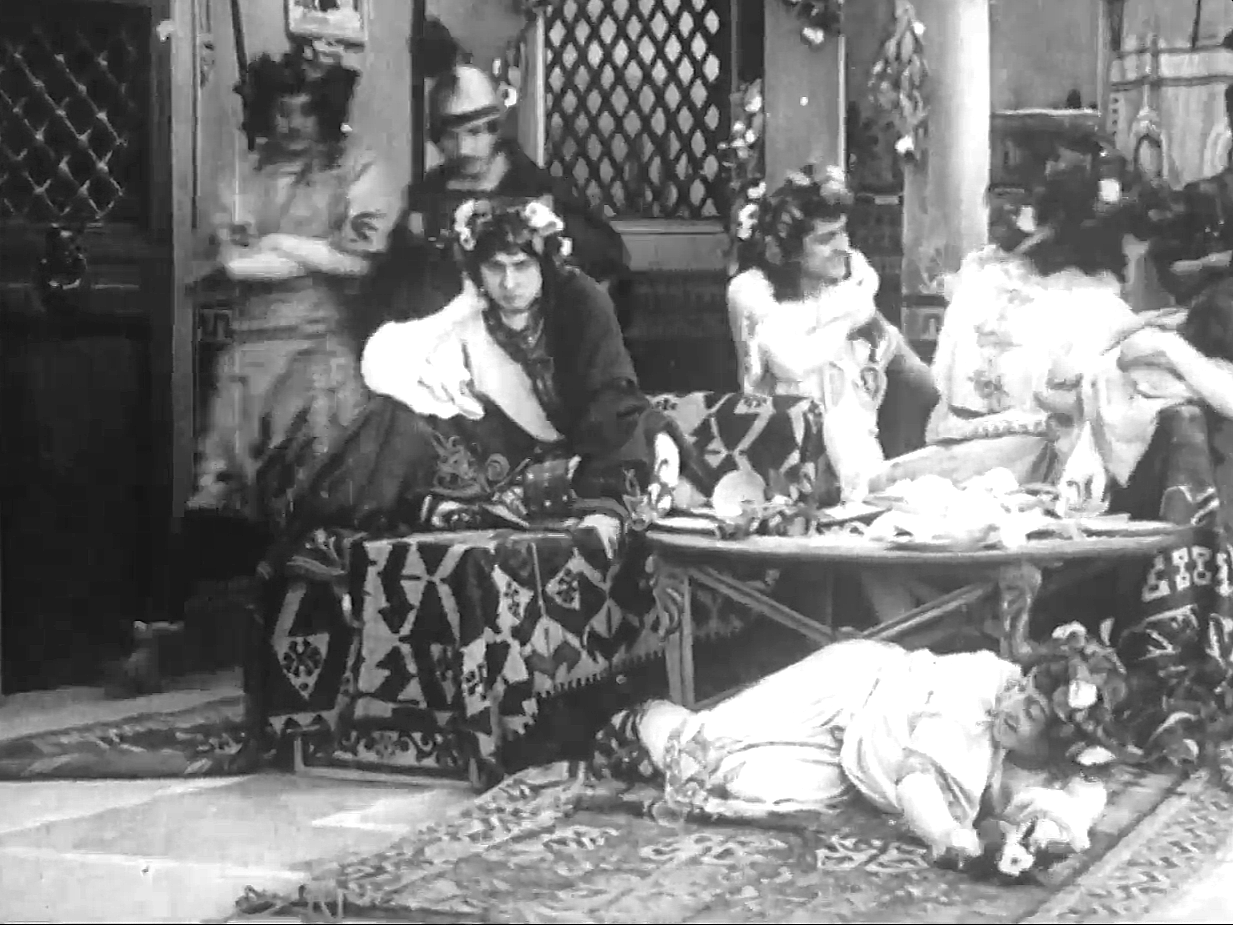
Héliogabale (original)
1910
Alternative Titles
Heliogabalus (Archive)
BFI identifier
362027Synopsis
The abduction of a Vestal Virgin by the Emperor Heliogabalus leads to his overthrow. Heliogabalus arrives arm-in-arm with two of his court favourites to witness a sacrifice by the Chief Priest. He is attracted to the Vestal Virgin, Julia Aquilina Severa, but his advances to her are checked by the Chief Priest. The Emperor returns with force to knock the Chief Priest out of the way and enter the temple. He abducts Julia as she prays before the sacred flame, thereby outraging the watching populace. At an orgy at his palace he attempts to rape her, but is thwarted by insurrectionists who burst into the room. Heliogabalus flees through a trapdoor leading to the sewer, but is captured. His appeal to Julia for mercy is met by an averted face, and the mob prepares to throw him into the Tiber (484ft). Incomplete. Note: According to the Borromäum Catalogue this is the Eclair production. However it has been identified as the 1910 Film D'Art production. See also LAST DAYS OF HELIOGABALUS reviewed in The Bioscope 2/6/1910 p. 35. (Shotlist)
- Production Country: France
- Production Company: Le Film d'Art
- BFI Category: Fiction
- Source: N/A
Cast
Jacques Guilhène
Olga Demidoff
Credits
Production Company: Le Film d'Art
Distr.: Pathé Frères
Dir.: André Calmettes
Film Technical Information
- Original Length: 198 m
- Length of BFI Viewing Print: 483 ft
- Support: Viewable
- Black and White
- Format: 35 mm , MP4
Comments on the print:
Source for original length: Kinematograph and Lantern Weekly 12 May 1910.
As far as we can tell, the BFI print of this film is unique. The original tinted nitrate print of Héliogabale stems from the Abbé Joye collection. It was acquired by the BFI in the 1970s. It was preserved as a black-and-white safety negative in 1983 and as a black-and-white safety positive in 1990. It has German flashtitles and lacks a main title. The film should not be confused with a Gaumont production of 1911 directed by Louis Feuillade with the same title.