
1917- L’Esclave de Phidias. Sculptors in silent cinema and the representation of an artist
By IVO BLOM
For centuries, Phidias has been considered the best sculptor of Greek antiquity and the lead artistic director of the Parthenon. Famous for his statues of Athena at the Parthenon and his Zeus at Olympia, his later downfall in Athens has been the subject of much dispute. The French film L’Esclave de Phidias or, in its Anglophone distribution, The Slave of Phidias, was directed by Léonce Perret for the Gaumont studio in 1917. It draws on some elements of the ancient accounts of Phidias, like the sculptor’s downfall and exile, but mainly moulds them into a melodrama about an artist who, thanks to the joys of music, finally capitulates to his model who is herself hopelessly in love with him. Yet he then has to face the revenge of the woman he scorned, resulting in his exile from Athens together with his beloved slave. Nothing is shown of his bond with the celebrated statesman Pericles, Athen’s leader, nor of the art works for which he achieved fame. Curiously, the sculptures of Phidias are almost invisible in the film. Instead, when it was released during the First World War, critics praised not the works of the artist but the artistry of the film itself (its exteriors were shot at a neoclassical villa and in its lush gardens in the South of France, Fig. 1) and recognised the importance of its music, underlined by the special score composed for this ‘silent’ film.[1]
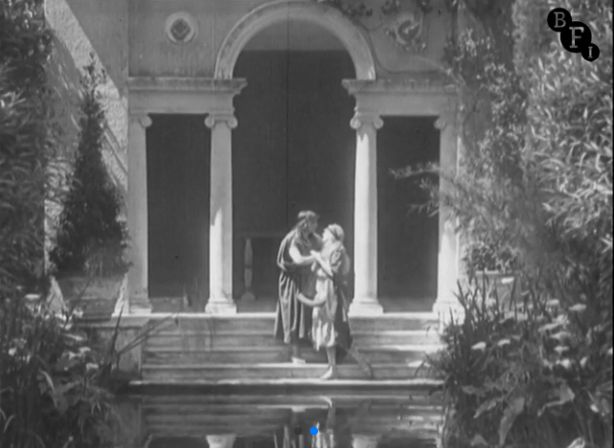
Figure 1. L’Esclave de Phidias (Gaumont, 1917). Print BFI National Archive.The love between Phidias and Callyce. The setting is the neoclassical Villa Maryland at Cap Ferrat which was built in 1907.
Sculptors and models in silent film
When Léonce Perret made his film The Slave of Phidias in 1917 for the French company Gaumont, it certainly was not the first time sculptors from Greco-Roman antiquity were represented in silent film. In addition to multiple films on Pygmalion (see e.g. our text on Pygmalion, the Ivy Close Films version of 1912), other films mixed up elements of the Pygmalion story and its adaptations (in particular the nineteenth-century operetta by Von Suppé) with historical details about Greek sculptors like Phidias. Thus we can observe in the American film The Marble Heart (Imp/Universal, 1915), based on a stage play of 1864 and already filmed by Vitagraph in 1909, a parallel story about the ancient sculptor Phidias and a modern counterpart, in which three female statues Phidias brings to life (as in the tale of Pygmalion) then dump him for a rich man. [2] In an earlier American short, The Rival Sculptors (Edison, 1911), a jealous Athenian sculptor seeks to destroy the statue of a rival artist, who is also the better of the two in obtaining the love of a young rich woman. The woman takes the place of the statue, ‘comes alive’ to everybody’s astonishment, and offers a mallet to the avenging sculptor to finish the job. Ashamed, he retreats. In the Italian film La modella (Film d’Arte Italiana, 1915), we are in modern times, when an innocent woman models for a statue of a nude and is ashamed when the statue and its model are mocked on exhibition. The statue used in the film, however, is not a modern invention but a copy of an ancient Roman original of a Danaide, now at the Vatican Museum, that was so popular in the eighteenth century that it was endlessly photographed and many variations of it were made.
Lynda Nead, in her monograph, The Haunted Gallery (2007), considers cinema the ultimate Pygmalionist medium and its evident interest in animating artworks as a means of self-promotion: ‘Is it surprising that early film-makers turned frequently to the subject of the animated painting, to the image or statue that is magically endowed with a mischievous life? The theme was a metaphor for the new medium and its powers. It surpassed the illusionistic capacities of the traditional arts.’ (Nead, 2007: 52). Yet Nead also warns about the limitations of the new medium in relation to its motif of bringing art to life: ‘Inanimate forms could be endowed with life but they were only shadows and illusions of absent originals. The monochrome of early films and the absence of synchronised sound were constant reminders of the deceptive nature of film and the inevitable, dreadful failure of its claims to capture life.’ (Nead, 2007: 52-53)
It is also relevant to this film to note that, in the plotlines of silent cinema, both painters and sculptors often select their models from the street or the countryside. Such humble origins are meant to indicate that these models possess an innocent type of ideal beauty (Blom, 2013). Yet, as soon as the models become ‘women of the world’, fashionable, bourgeois, corrupted, capricious and like a femme fatale, the artists lose interest in them. Often these films create a parabola at the end of which the artists feel entitled to destroy their artworks as, based on corrupted flesh, they no longer represent ideal beauty. The models themselves, unaware of or unconcerned by the damage they have caused financially, morally and even physically, may at the end of these films be killed as punishment, sometimes even by the very artworks they had inspired. Thus, at the end of La chiamavano Cosetta (Eugenio Perego, 1917), the sculptor kills the model who has driven his own son to suicide. He crushes her under the enormous unfinished marble of a female nude that resembles the work of the Italian sculptor Giovanni Prini.
Phidias in art
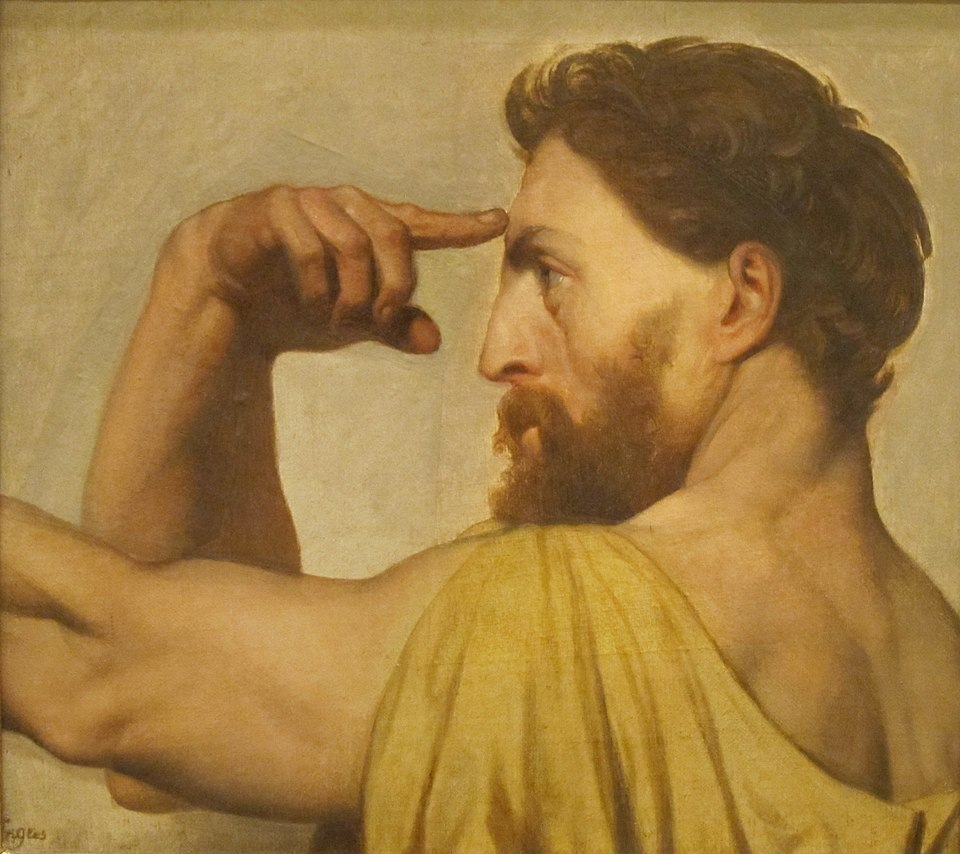
Figure 2. Study for Phidias in 'The Apotheosis of Homer' (Jean-Auguste-Dominique Ingres, 1827). San Diego Museum of Art. Source: Wikimedia Commons, https://commons.wikimedia.org/wiki/File:Study_for_Phidias_in_%27The_Apotheosis_of_Homer%27_by_Ingres,_San_Diego_Museum_of_Art.JPG

Before his representation in cinema, Phidias as the supreme civic artist was certainly represented in visual arts although not to any great extent. In addition to some examples from classical antiquity itself, it is in particular during the nineteenth century that he was depicted both in painting and sculpture, in connection with his famous art works like the Athena Parthenos or in terms of his bond with Pericles. His long-lasting reputation as one of the finest sculptors of Greek antiquity procured him a prominent part within Jean-Auguste-Dominique Ingres’ Apotheosis of Homer (1827, figure 2), now at the Louvre. Likewise, his reputation inspired the French painter Paul Delaroche to put him on one of three thrones in the central portion of his Hémicycle des Beaux-arts (1841-42) at the École nationale supérieure des beaux-arts in Paris. There Phidias, representing the art of Sculpture, is flanked by the architect Ictinus and the painter Apelles, all sitting on thrones. Thus, architecture, painting and sculpture are presented as the three main axes of the art academy. Similarly, in 1864, Edward Poynter depicted Phidias holding a miniature of his Athena statue, designed for the South Court Mosaics of the Victoria and Albert Museum, where it was on view between the 1870s and 1949. Two decades later, in 1887, the French sculptor Aimé Millet turned Phidias appropriately enough into a sculpture, with, once more, a small version of the Athena Parthenos appearing behind him. It was shown at the 1887 Paris Salon and the 1889 World Fair in Paris and is now exhibited at the Jardin du Luxembourg in Paris. All of these examples show reverence to and recognition of the artist himself, his status and his use as the symbol of Sculpture at large. None of this has much prominent in Perret’s melodrama, although the magnificence of the villa in which the sculptor works confirms his status as an acclaimed artist. Yet, other paintings are also worth considering where they show Phidias at work, given that in Perret’s film we see him attempting to sculpt a goddess at his villa, even if we never see the result of his labour.
Several nineteenth-century painters depicted Phidias working in his studio, most often on the Athena Parthenos, whereas in the film he is attempting to make a commissioned statue of the goddess of love. Thus, he was represented by the Italian painter Raffaello Sorbi in 1869 (Phidias in his Workshop, carving the Minerva for the Parthenon, private collection) and by the Belgian artist Pierre-Olivier-Joseph Coomans in 1876 (Phidias in his Atelier, Smithsonian American Art Museum). In Sorbi’s painting, we see the sculptor looking at and admiring his own work, with his semi-nude female model standing nearby holding a version of Athena’s shield. A small, possibly bronze, copy of the same statue is standing left of the artist, while we see many stools, a klismos-like chair, a leopard skin, a large white sculpted frieze of horsemen (perhaps in a battle with the Amazons), and an enormous wall in the background, topped by a painted frieze. The Athena statue is larger than life and attracts most attention. Phidias is evidently in awe of his own statue which works almost like the art historical practice of exhortatio: the figure in the painting demonstrates where we as viewers should appreciatively focus our gaze. In this metavisual respect, Sorbi’s painting is quite similar to the many Pygmalion paintings of the nineteenth century, like those by Normand and Bargellini (for which see my website essay on Pygmalion and (Nead, 2007: 67-68). In Coomans’ version, the studio is an open rather than enclosed space partly giving way to a Roman-type peristyle, and is visited by several onlookers, while a model poses for Phidias who is sculpting an unspecified statue. Here the artist is just one of several ‘actors’ within the setting, and the scantily dressed model even seems more important in compositional terms than the artist or his statue. She is also positioned in a quite illogical, mirrored version of where she should be in order for Phidias supposedly to look at her when sculpting his artwork. Perhaps that position was more convenient to the structure of the composition to ensure the display of a sensuous woman.
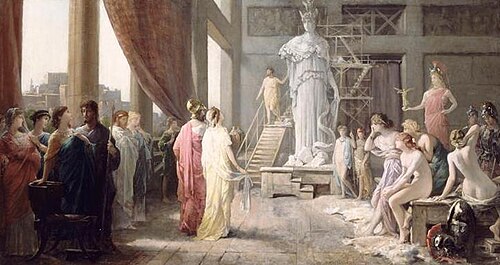
Figure 3. Périclès visitant l'atelier de Phidias (Louis-Hector Leroux, 1898). Musée Bonnat-Helleu, Bayonne. Source: Wikimedia Commons, https://commons.wikimedia.org/wiki/File:Illus0362.jpg

Louis-Hector Leroux), in his Périclès visitant l'atelier de Phidias (1898, Musée Bonnat-Helleu, Bayonne, figure 3), depicts a large crowd visiting the spacious studio of Phidias, where a giant version of the Athena Parthenos is displayed, almost triple human size. Stairs around the statue indicate how the artist was able to carve such a massive artwork. The artist himself is represented so small in scale he is hardly recognizable, while Pericles and his mistress Aspasia are visible at the back. On the right, we see nude female models, whose nudity apparently is of no concern to the rich male and female visitors lined up on the left. As in Sorbi’s version, there are high walls to accommodate the monumental statues but, as in the painting by Coomans, we also are given a vista onto the city of Athens and its Parthenon through a half-open curtain. Finally, in 1868, the Anglo-Dutch painter Lawrence Alma-Tadema painted a very unusual artwork, Phidias Showing the Frieze of the Parthenon to his Friends (1868, Birmingham Museum). While Leroux’s work breathes light and whiteness, Tadema’s version is clouded in darkness, as we are in the upper scaffolding of the temple, with light just slipping through from below. In this rare example, we do not see the studio but the artist working on location and not even really working, as he is showing his rich friends around, in the way a celebrated modern artist might guide his friends around the work he is currently creating. Indeed, by 1868 Tadema himself had become an acclaimed artist, still living in Brussels at the time, but very soon, in 1870, he would move to London and remain there for some decades.
In considering paintings of Phidias, we may say that depictions of the sculptor and his studio differ interestingly between artists, even within the time span of one century. They are also very different in design from the presentation of Phidias’ studio in Perret’s film (Fig. 4). It seems to be just a small corner of his luxurious villa and does not look like a real sculptor’s studio. It is filled with the clichéd props of luxury in antiquity films – such as tiger skins, a Roman style portrait bust of a man, a fake painted vista of a peristyle, a few amphoras, an anachronistic folding chair, some columns and trellis, vases, a neoclassical tabouret, and a hint of wall decoration that is part Greek meander and part Art Nouveau. When posing, the model Callyce is not nude or scantily dressed but initially clothed in enormous drapery that is quite common to depictions of stage actresses posing in classical style in early twentieth-century postcards. She thus also looks like Phidias’ original vision of the goddess Venus whom he has seen at the start of the film and whose image he has been commissioned to make (not that of Athena as in primary sources). The model leans against a column, her long curls draped over her shoulders, as if a character from a Pre-Raphaelite painting. In later shots, she wears a decorated tunica, showing her bare legs. Phidias wears a highly decorated tunica and a hairband but, in contrast to many classical or nineteenth-century depictions of him, he does not sport a beard. Perhaps the director (or the actor Luitz-Morat) wanted to ensure the visibility of the desperate sculptor’s facial expressions. All in all, in contrast to previous artistic representations, Perret’s film The Slave of Phidias is not about Phidias as the epitome of (classical) Sculpture at large, nor Phidias’ reputation within art history or traditional art academies, nor his bond with the powerful Athenian statesman Pericles, nor even his important political and cultural position within fifth-century BC Greece. It is rather about the downfall of an important young artist because of the personal vendetta of his mistress and, therefore, his forced exile from his fatherland together with his new beloved, who has also been his model for a statue of Venus, the Goddess of Love. Moreover, as we will see below, music plays a rather more important role within the plot than sculpture.
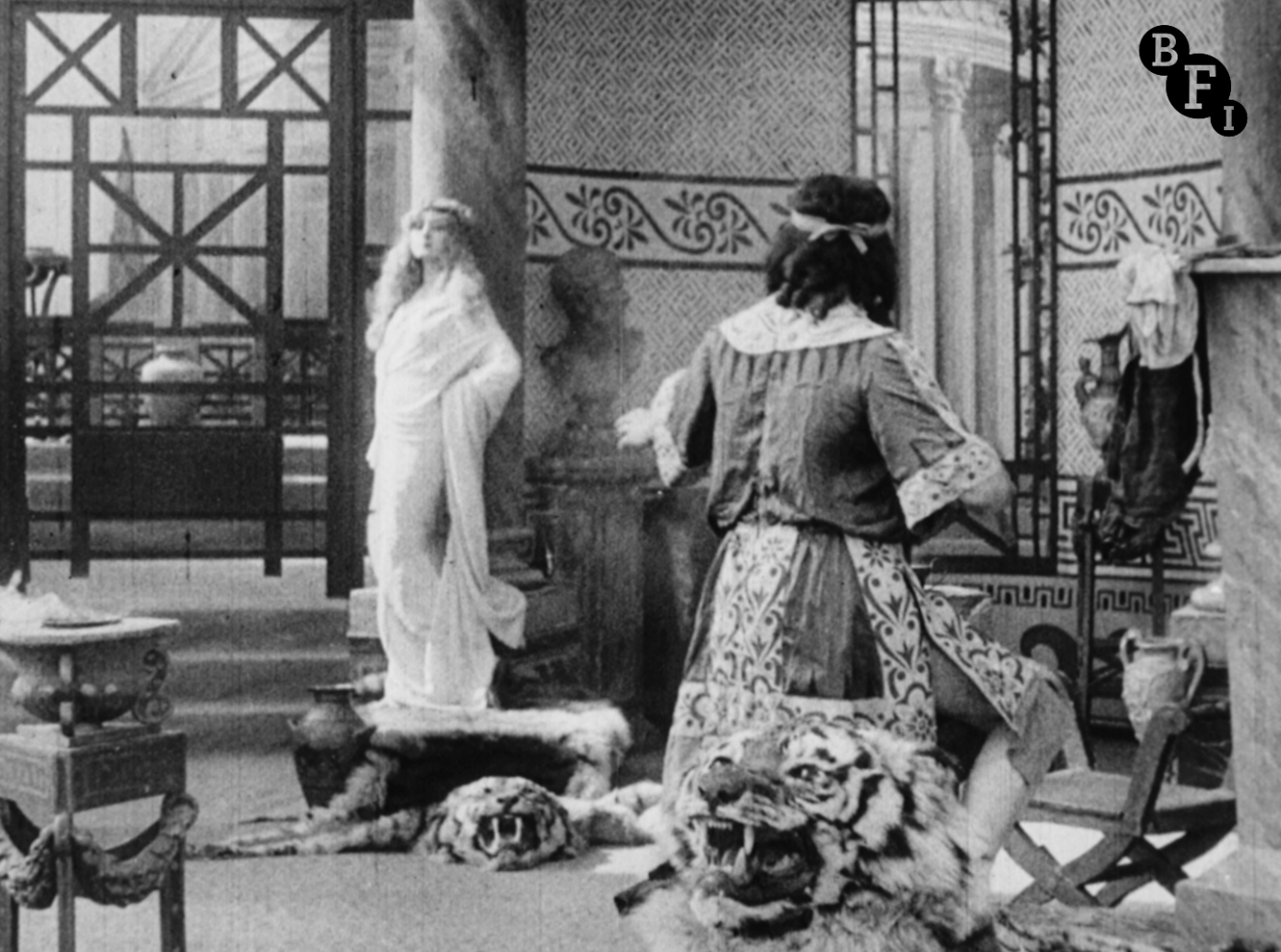
Figure 4. Phidias at work in his studio. L’Esclave de Phidias (Gaumont, 1917). Print BFI National Archive.
L’Esclave de Phidias. Script and film.
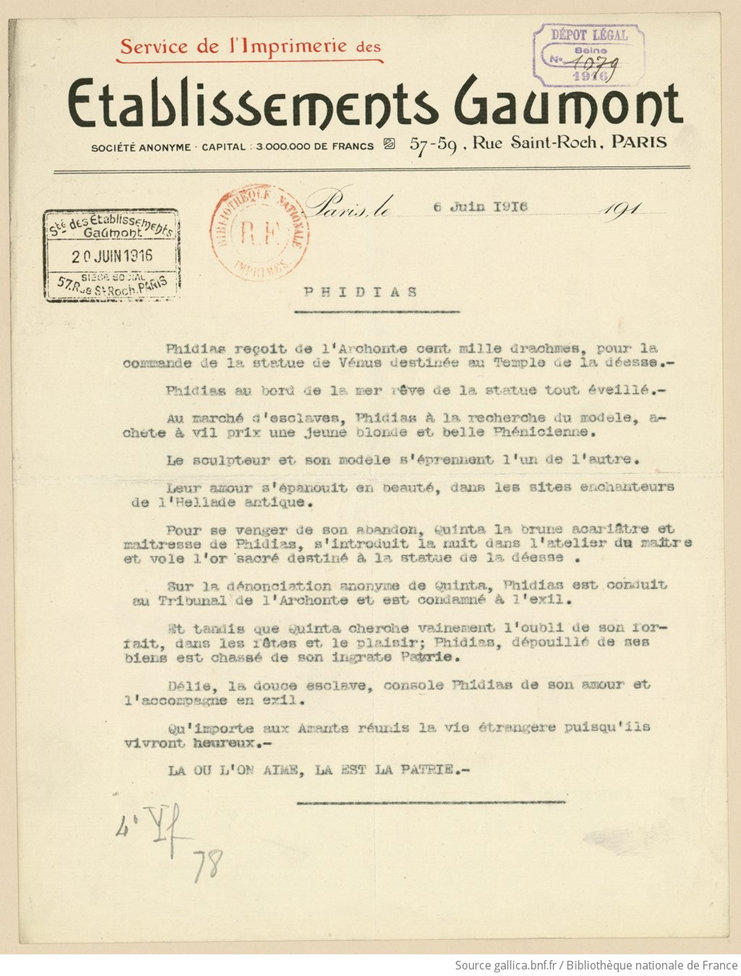
Figure 5. Scenario L’Esclave de Phidias, Gaumont, 1916. Source: Bibliothèque national de France (BnF), https://catalogue.bnf.fr/ark:/12148/cb39571474t.
Based on the film’s scenario (figure 5) [3] and a Spanish series of postcards issued by Chocolate Salas-Sabadell, we can deduce that the BFI safety print available for viewing is incomplete (lacking, for example, the scene in which Phidias buys his model at a slave market) as well as not being tinted (as the original nitrate print must have been). Instead it is black and white.
The scenario for The Slave of Phidias, possibly written by director Léonce Perret himself, is partly based on the biography of Phidias’ patron composed by Plutarch at the beginning of the second century AD (Life of Pericles). The historian comments that, after finishing the famous Athena Parthenos statue, and partly because of the power of his protector Pericles, some jealous Athenians accused Phidias of embezzling gold intended for the statue (which he countered in court) and of adding the likeness of Pericles and himself to the shield of the Athena statue (which might have been true, cf. (Bogdanovna Larionova, 2021). So, Plutarch writes, the sculptor was imprisoned and died in jail. Plutarch’s version of events, which appears to draw on accusations made by the opponents of Pericles and Phidias, is highly contested today (see Price, 2013 and Filonik, 2013). Nowadays, scholars argue that Phidias was in fact exiled to Olympia, made his Zeus statue there and died there as well. In the Gaumont film, the reason for Phidias’ downfall is changed from a civic to a domestic cause. Phidias’ mistress Quinta (as in the scenario, although she is his wife according to the BFI print) steals the money the artist has been given by the city to make a new statue of Venus (her Greek name Aphrodite is Romanized in the film’s French scenario and in the English intertitles of the BFI print). Quinta does so as vengeance for his rejection of her and his affair with his model (called Delia in the script and Callyce in the final film). The film indeed ends with Phidias being ejected from Athens and sailing away from his beloved city together with his true love, who accepts exile with him. ‘Where You Can Love Each Other, There Is Your Fatherland’, the scenario concludes in quite a modern way. As we see repeatedly in early cinema, the motivation for religious or political persecution is most frequently the revenge of a scorned rival in love. History is turned into personal melodrama, so that audiences can easier engage with tales from the past.[4] Silent film screenwriters were not very original in that respect, even where antiquity films were based on theatrical and literary sources. In Perret’s film, at least, the protagonists do not die because of the act of revenge but are exiled, in this approximating closer to what is now considered to have happened to the real Phidias.
At the start of the film, the city of Athens has commissioned Phidias to make a statue of Venus. After seeing a vision of the goddess by the seashore, Phidias buys a new female slave in the slave market (the scenario speaks of a blonde Phoenician woman) and gets to work. The model, however, falls in love with him with increasing intensity, while he does not notice or does not want to, as he seems to be stuck without inspiration. We do not get to see the beginning of work on the sculpture, only the model and the artist. In later shots, we only see a pedestal on which the sculpture is covered by a cloth. Instead, another sculpture outdoors is brought to our attention. Callyce, having seen that Phidias is meeting with Quinta, withdraws to the large gardens of his lush villa and pays homage to a large herm-like sculpture bearing a portrait bust of the artist. She first offers it a large bunch of flowers she has gathered herself, then despairingly kneels before it (figure 6), and finally rises and passionately embraces it. This homage and kiss are reminiscent of Eunice’s celebrated embrace of the statue of Petronius early on in Henryk Sienkiewicz’ novel Quo vadis? (1896) and afterwards reproduced in its various stage and film adaptations, such as the 1913 film directed by Enrico Guazzoni for the Italian company Cines. The latter must have been an ‘evergreen’ to Perret when he conceived his own film, as it had an extremely long run and was shown all over Europe repeatedly during the First World War. Similarly to Eunice, Callyce is a slave who is submissive to her master but is mentally tortured because she cannot obtain his love, at least for the moment. In Quo vadis?, the mental torture is later increased by the physical torture of flogging – it is only then, because of Eunice’s fortitude in the face of this punishment, that Petronius understands she really loves him, which is quite bizarre reasoning at least to our modern minds. However, it permits the momentary description of titillating sadism towards women for readers and its visual display for theatre and cinema audiences justified by the ancient institution of slavery. Likewise, in The Slave of Phidias, Callyce is also flogged later on, at the instigation of the jealous Quinta. Phidias discovers what is happening and puts a stop to it.
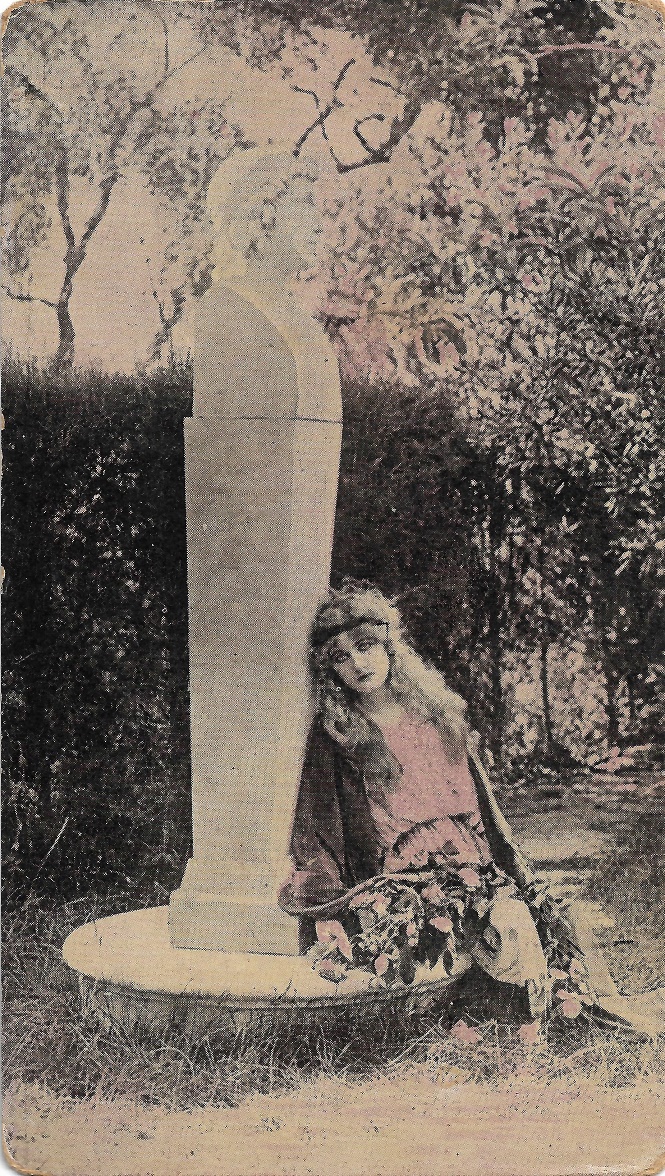
Figure 6. L’Esclave de Phidias (Gaumont, 1916). Spanish collector’s card by Chocolate Salas-Sabadell. Postcard collection Ivo Blom.
At last Callyce melts Phidias’ heart, not with her physical beauty, as in other films about ancient sculptors, but with the music of her lyre. This also explains why we never see the sculpture of Venus Phidias is trying to make based on Callyce as his model: it is never the focus of the story. Hence also the need for extra effort with the film’s accompanying musical score (see below). Later, when Phidias is falsely accused of theft and imprisoned, Callyce follows him to the gate of the prison where she once more plays the lyre, this time to comfort him. Both here and in earlier shots, Perret uses backlighting to aestheticize his images of Greek antiquity. In general, he invested a great deal in the aesthetics of the film, through the architecture of the villa and its gardens (the Villa Maryland at Cap Ferrat, for which see Aylin Atacan’s essay on this website) and through recent rain showers which had left pools of water on the terrace that reflected the setting. It is a pity that the accessible BFI print lacks colour, as according to an intertitle, the nighttime scene in which Callyce goes to see Phidias in prison was opaline blue. Using a blue tint with which to wash the film stock was a common method used in silent cinema to shoot in daytime and pretend it was night. That effect is lost in the BFI viewing print. Another important musical moment occurs at the party Quinta has arranged to celebrate her victory and forget her shameful betrayal of her lover: the film frame fills with female musicians and dancing girls. Afterwards, Callyce follows the soldiers who are escorting Phidias out on the road to exile. The lovers are reunited and at sunset they climb over the rocks near the sea, to the boat that will take them away. Again, Perret uses backlit shots here to stress the beauty of the landscape and the tragic romance of the couple.
Release and reviews of the film
On 27th January 1917, the French trade journals Ciné-Journal and L’Écran announced L’Esclave de Phidias as a new Gaumont film of 910 metres, available for exhibition from 16th February. [5] The advertisement in L’Écran included one large photograph of the desperate sculptor confronting his model in his studio (Fig. 7).
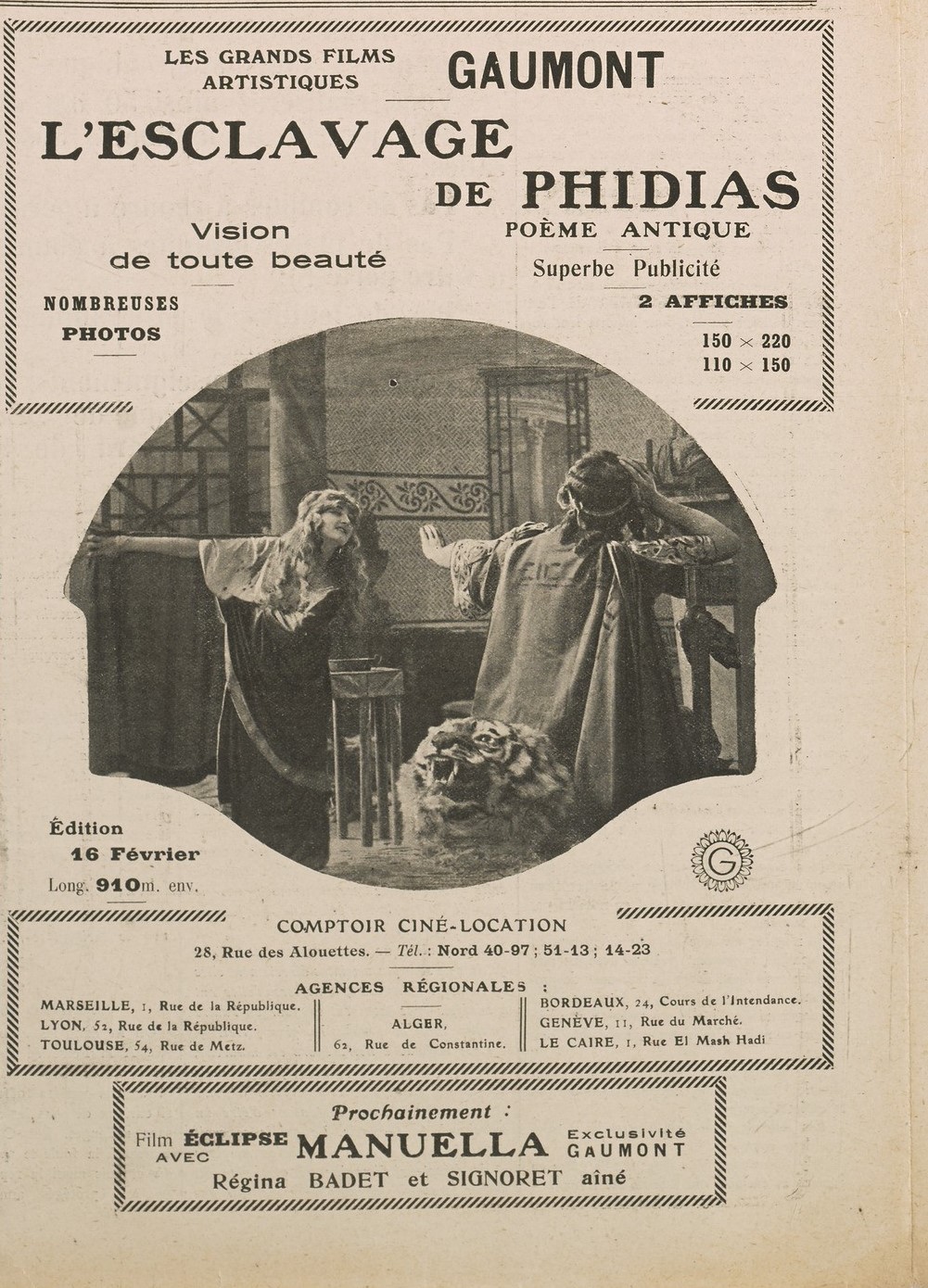
Figure 7. Advertisement announcing the release of L’Esclave de Phidias, here announced as L’Esclavage de Phidias, L’Écran, 27 January 1917, https://gallica.bnf.fr/ark:/12148/bpt6k3278123t/f1.image.
In its issue of 3rd February 1917, Ciné-Journal included a full page advertisement for the film with two large photos, again announcing it as available from 16 February (Fig. 8). [6] The photos here focus on Phidias’ discovery of Callyce in the slave market and Callyce playing the lyre on the shore, accentuating the amorous affair between the couple and the important roles of music, farewell and outdoor shooting in the film. The length here is listed as 850 m.
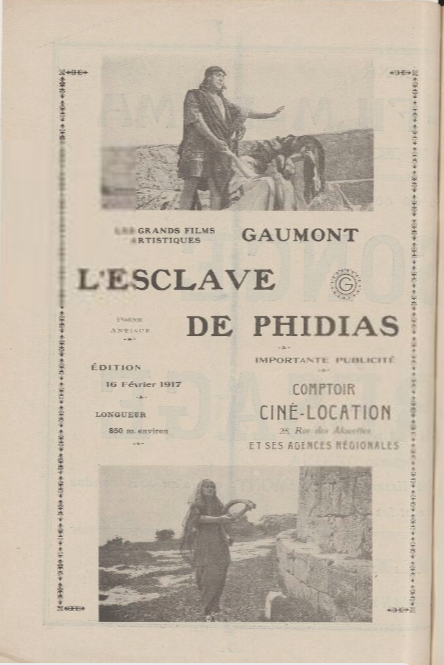
Figure 8. Advertisement in Ciné-Journal, 3 February 1917, https://gallica.bnf.fr/ark:/12148/bpt6k32781247/f1.image.
The film journal Le Courrier Cinématographique placed in its issue of 3rd February a similar advertisement with the same photo as in L’Écran. [7] On Saturday, 3rd February 1917, a special projection by invitation only of The Slave of Phidias was held at the Gaumont Palace, the studio’s 3000-seat mega-cinema and its regular theatre for holding premieres. [8] The film was presented as a ‘poème antique’. Yet, for unknown reasons, it would take until mid-April before the film had its normal release at the Gaumont Palace and was announced in the film trade press as being shown there. During that release, on 22nd April 1917, the weekly La Vie de Paris recommended The Slave of Phidias at the Gaumont Palace as a feast for music and art lovers. Composer Eugène Poncin had written a special score that involved alternating choirs with solos plus a full orchestra ‘which substantially increases the worth of this filmic masterpiece’.[9] The theatre magazine La Rampe recommended the film in its issue of 26th April and utilised a photograph of the leading actress Suzanne Delvé, who played Callyce. [10] From May 1917, the film at last started to circulate around France, while as late as 26 October 1917 it returned to the Paris Gaumont Palace once more.
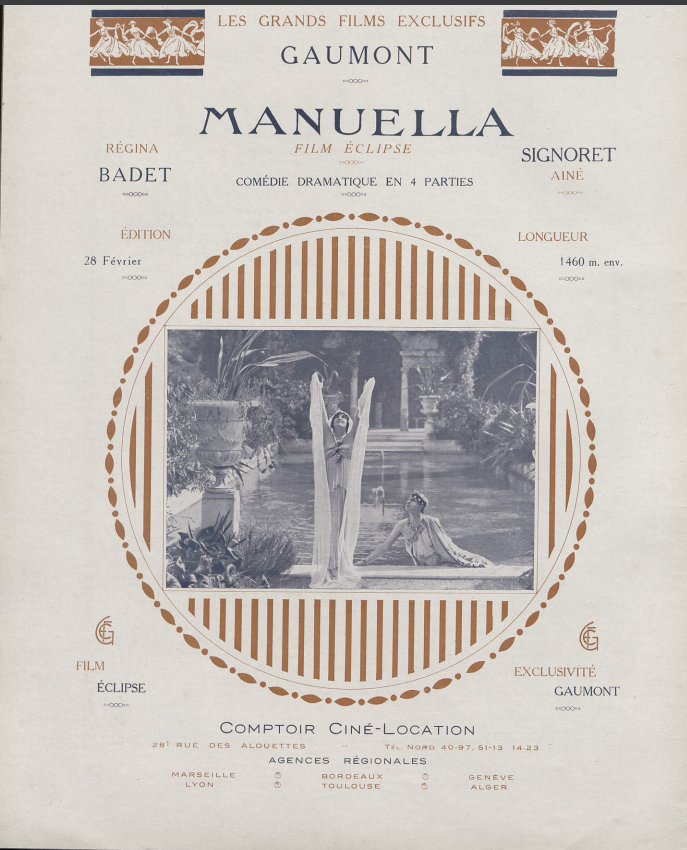
Figure 9. Advertisement by Gaumont for the film Manuella (1916), which despite its modern story seems to contain a scene set in Antiquity using the same Villa Maryland and its pond. Le Film, No. 48, 12 February 1917. Both films were shown within one programme at the Gaumont-Palace cinema. Source: http://www.cineressources.net/consultationPdf/web/o002/2258.pdf.
In Le Courrier Cinématographique of 10th February 1917, Edmond Floury wrote a rave review of both films L’Esclave de Phidias and Manuella both of which had been shown at the Gaumont Palace the previous Saturday: ‘The Slave of Phidias, an ancient poem, is a series of reconstructions of scenes, each more graceful than the last, introducing us to Athenian customs as described by the poets of the time. […] The plot unfolds amid superb symbolic landscapes, and the staging is sumptuous and very beautiful. We witness dances and delightful farandoles, whose charm is enhanced by a very appropriate musical adaptation. The chorus reinforces the action and supports the very pleasant voices of the soloists. The cast was perfectly chosen. Miss Suzanne Delvé is grace personified, and it is easy to understand why Phidias falls madly in love with her. Mr. Louis Morat is an Athenian of the most handsome bearing, and his farewell to his homeland, which has rejected him, is almost tragic. Ms. Ramey is a very pretty person, but her task is thankless, her role being confined to hatred and perfidy. A very beautiful work that borders on pure art, L'Esclave de Phidias will be a treat for delicate minds enamoured of beauty.’[11] Indeed, music plays an important part in The Slave of Phidias as it is perhaps not so much Callyce’s physical beauty as her playing of the lyre that warms the heart of Phidias and makes him fall in love with her. For this reason, it is quite understandable that extra investment was made in the music to accompany the film.
On the same date of 10th February 1917, Ciné-Journal joined the praise of the film, its aesthetic beauty and historical exactness, its cinematography, mise-en-scene and the performance of its actors. It added: ‘We in particular like to remark the marvellous effects of the nocturnal and daytime lights on the Aegean sea and its shores.’[12] In addition to the previous reviews, in the journal Le Film of 12th February 1917 (figure 9), Constant Larchet also wrote a very positive review, even if it contained some critical sidenotes: ‘We witnessed a cinematic spectacle in which the artistry of movement, the choice of locations, the choreography of the processions, the evocation of a distant past that seems to be the prototype of classical lyricism, and the poetic softness of photography with its seductive horizons all came together. The performances of Miss Madeleine Ramey (the courtesan Quinta) and Mr. Luitz Morat (Phidias) provide a backdrop for the charming talent and elegiac blonde beauty of Mlle Suzanne Delvé (the slave Callyce). This delicate ancient poem, some of whose reminiscences could easily have been avoided, is a cinematographic work that does great honour to French cinema, which we must defend more than ever, especially in these times of daily difficulties, unforeseen the day before and imposed the next. We cannot praise highly enough the persistent artistic effort which, to the credit of Gaumont, seems to be the industrial hallmark of this renowned brand.’ After describing the content of the film, Larchet also singled out the specially composed score by Poncin and the performance of the music: ‘Let us not forget to mention that this ancient poem was accompanied by a musical score specially written by Mr. Poncin. The rhythms are graceful, the writing seemed to me to be scholarly—perhaps a little too much so for the cinema, which does not always have at its disposal orchestras of the importance of that of the Gaumont-Palace—and the choral part is very skilfully handled.’[13] Overall, the French reviews were very glowing about the film, pointing out its aesthetic qualities as well as the beauty of the accompanying music. The praise of authenticity, though, should be taken with a pinch of salt. Despite its favourable reception among the critics, The Slave of Phidias was not a film that remained for weeks in a row on the screens of the French cinemas, like Gaumont’s melodrama L’Enfant de Paris of 1913. It is also not clear if it was possible to guarantee the combination of large orchestra and choir everywhere.
By 1917, audiences, fed up with images of trenches and ruinous landscapes, may well have cherished the beauty of the setting and the romance of the tale told in The Slave of Phidias. Yet the portrayal of injustice and forced exile in time of war may have struck a special chord with European film audiences, especially those many who had fled their native lands, like the Belgians, or the French inhabitants of Northwest France beyond the Western Front. Produced and released in wartime, Perret’s film defended French cinema and the Gaumont company in particular as institutions that held aesthetic qualities in high esteem. Clearly, the French reviews were keen to defend French cultural values, and prepared to overlook historical flaws in mise-en-scene and historical background.
Footnotes
- ^ See Aylin Atacan’s sister essay on this website about the film’s use of the modern villa and the interesting temporal dialogue it creates between the artistic ideals of ancient Greece and modern cinematic storytelling.
- ^ Moving Picture World, 26 June 1915, p. 2167.
- ^ Scenario L’Esclave de Phidias, Gaumont, 1916, BnF, cote FRBNF39571474.
- ^ Compare our website essay on the early French film Bélisaire, but it also happens in films like The Sign of the Cross (Famous Players, 1914) and Fabiola (Palatino Film, 1918).
- ^ Ciné-Journal, 27 January 1917. L’Écran, 27 January 1917.
- ^ Ciné-Journal, 3 February 1917.
- ^ Le Courrier Cinématographque, 3 February 1917.
- ^ Hebdo-Film, 20 January 1917.
- ^ La Vie de Paris, 22 April 1917. The same photo was used in an ad in the journal L’Écran of 27 January 1917, where the title was slightly altered in L’Esclavage de Phidias.
- ^ La Rampe, 26 April 1917.
- ^ Edmond Floury, ‘Au Gaumont-Palace. L’Esclave de Phidias’, Le Courrier Cinématographique, 10 February 1917, p. 6. The author’s translation.
- ^ N.n., ‘Presentations. Au Gaumont-Palace. L’Esclave de Phidias’, Ciné-Journal, 10 February 1917. Translation by the author.
- ^ Constant Larchet, ‘L’Esclave de Phidias’, Le Film, 12 February 1917. Translation by the author.
Blom, I. (2013) ‘Of artists and models. Italian silent cinema between narrative convention and artistic practice’, Acta Universitatis Sapientiae: Film and Media Studies 7, pp. 97-110. DOI: 10.2478/ausfm-2014-0017
Bogdanovna Larionova, N. (2021). 'Transformation of the legend about the image of Phidias and Pericles on the shield of Athena Parthenos by Plutarch and other ancient authors', Manuscript, October, 14 (11), pp. 2308-2312. In Russian, with English abstract.
Filonik, J. (2013) ‘Athenian impiety trials: A reappraisal’, Dike 16. 16, pp. 26–33. doi:10.13130/1128-8221/4290.
Nead, L. (2007) The Haunted Gallery: Painting, Photography, Film c.1900, New Haven, CT/ London: Yale University Press.
Price, M. J. (2013) ‘The statue of Zeus at Olympia’, in: Clayton, P.A., Price, M.J. (eds.), The Seven Wonders of the Ancient World. London/ New York, Routledge, pp. 59-68.