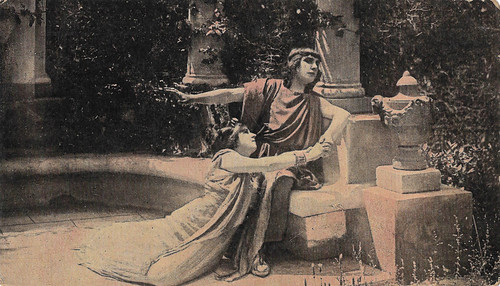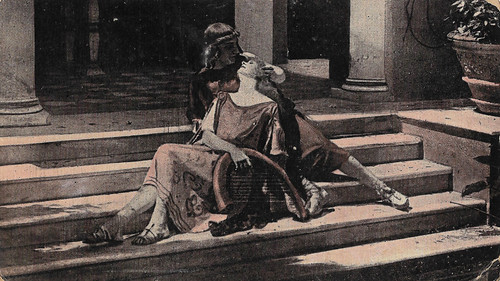

Esclave de Phidias, L' (original)
1917
Alternative Titles
The Slave of Phydias (Alternative), Slaves of Phydias (Alternative)
BFI identifier
348024Synopsis
Ancient Athens. The devotion of a slave girl, Callyce, to her master, the sculptor Phydias, takes her into exile with him. Rl.1. [Lacks initial section]. Sculptor Phydias searches for a divine model for a statue of Venus. Callyce, his slave girl, is in love with him, but her advances are rejected until she makes an offering of love flowers to one of the deities. Phydias embraces her, but their passionate encounter is seen by the sculptor's wife, Quinta. She has Callyce beaten, but Phydias saves her from further punishment. Quinta then steals the sacred gold set aside for the proposed statue of Venus and publicly accuses her husband of the theft. He is arrested. Callyce goes in search of him, playing her lyre (1617ft). Rl.2. From his prison cell Phydias hears her music. He is sentenced to exile. Quinta meanwhile watches a display of dancing by slave girls. Phydias is led into exile by a mounted guard of soldiers, followed by the faithful Callyce, who succours him when he collapses. At nightfall, by the sea, he bids farewell to Greece and is embraced by Callyce. On a boat, they approach Elide, the road of oblivion. Finis (789ft). (2406ft) (Shortlist) [Synopsis, viewing copy] Melkios sends Phydias a letter commissioning the carving of a statue of Venus for the Temple of the Goddesses. Phydias searches for a Divine Model for the statue. Callyce, the slave girl he selects, is in love with him but her advances are rejected. Callyce attempts to please him by picking his favourite flowers. Returning to the studio she spies Phydias with Quinta. Disheartened, Callyce takes the flowers as a love offering to a statue of a deity (End Reel One). Phydias hears Callyce playing her lyre in the gardens. He is enamoured. Phydias embraces Callyce but their encounter is seen by Quinta. Later, Quinta's affections are rejected by Phydias. She plans her vengeance. Quinta has Callyce beaten, but Phydias intervenes. Quinta then steals the gold payment for the statue of Venus and publicly accuses Phydias of the theft. Phydias is arrested. Callyce searches for him. playing her lyre. From his prison cell, Phydias hears her music and climbs to the window to see her. Meanwhile, Quinta hosts a party and watches a display of dancing slave girls. Phydias is sentenced to exile and is led away by a mounted guard of soldiers. Followed by the faithful Callyce, Phydias is comforted when he collapses. At nightfall, by the sea, Phydias bids farewell to Greece and is embraced by Callyce. They board a boat to Elide, the road of oblivion. End title (End Reel Two). (Synopsis)
- Production Country: France
- Production Company: Société Nouvelle des Etablissements Gaumont
- BFI Category: Fiction
- Source: N/A
Cast
Luitz Morat (Phydias)
Suzanne Delve (Callyce)
Credits
Director: Léonce Perret
Cinematographer: Georges Specht
Film Technical Information
- Original Length: 850/ 910 m.
- Length of BFI Viewing Print: 2405 ft
- Support: Viewable
- Black and White
- Format: 35 mm , MP4
Comments on the print:
L' Esclave de Phidias, aka The Slave of Phydias (Léonce Perret, Gaumont 1917) was preserved in 1982 by the BFI as a 35mm black and white positive safety (2405 ft.), based on a 35 mm tinted and toned nitrate print (2675 ft.). Provenance of the nitrate: Bert Langdon. The BFI archive has a MP4 viewing copy. The print has English intertitles. Original length in France was either 850 m. (Ciné-Journal, 3 February 1914 ) or 910 m. (L’Écran, 27 January 1917). NB The BFI catalogue also uses the title The Slaves of Phidias, but there is only one slave in the film's plot. The BFI print is unique but incomplete, lacking for example a scene in which Phidias buys his model at a slave market.
Pantelis Michelakis adds: The film is catalogued by FIAF under the BFI’s alternate title as Slaves of Phydias, attributed to Italy, dated 1916, with no director and no production company (FIAF 35954), so that a French Gaumont film of 1917 by Perret is recorded as an anonymous Italian film of the year before.
Visual Resources