
1909- Saffo (Pineschi)
By IVO BLOM and MARIA WYKE
Based on ancient sources like Menander and Ovid, in the nineteenth century a heterosexual biography and iconography for the celebrated ancient Greek poetess Sappho emerged in which she fell desperately in love with a handsome fisherman and committed suicide by jumping off a cliff when rejected by him. The Sappho of antiquity who sings of erotic desire within an intimate world of women is replaced by a Sappho more suited to constrained nineteenth-century sensibilities in which she loses her poetic authority and her homoerotic desire. The early Italian film Saffo (Pineschi, 1909) treads in the footsteps of this nineteenth-century convention, but adds an extra dimension by alternating its painted backdrops for interiors with shots for its exteriors of real, albeit often neoclassical, locations, such as the park of Villa Borghese in Rome. This strategy of authenticating the classical by means of the neo-classical has consequences for how, in the film, ancient time and space merge with the modern.
Sappho in literature, visual arts and on stage
The real Sappho was a poetess who lived on the island Lesbos. She was probably born somewhere in the third quarter of the seventh century BC (sources differ) and was possibly active until around 570 BC. She came from an elite family. Her poetry was largely, if not exclusively, lyrical and meant to be sung (either solo or with choral voices) and performed to the accompaniment of musical instruments – she is therefore often represented holding musical instruments herself, such as the lyre. Sappho may have been exiled around 600 BC, as a result of a conflict between political elites, causing her to emigrate to Sicily. Yet little is known about her, and what little the sources say is often contradictory. Sappho was, nonetheless, an obvious choice for cinematic representation in the late 1900s when the prestige and familiarity of antiquity was frequently used as a means for the relatively new technology to enter into the networks of European culture.
A tradition going back at least to Menander’s stage comedy The Girls of Leukas (fourth century BC), suggests that Sappho killed herself by jumping off the Leucadian cliffs (Leucas/ Lefkás, in Greece) in despair over her forlorn love for Phaon, a ferryman. This story seems to appropriate for Sappho and to distort two myths regarding the goddess Aphrodite, who had figured extensively in her poetry. In one, Aphrodite rewards the old ferryman Phaon by restoring his youth and beauty for having carried her on his ferry without asking for payment. In the other, Aphrodite is healed of her grief over the death of her lover Adonis by throwing herself from the Leucadian cliffs (Kivilo, 2021: 179-182). Joel Lidov suggests that the story of Sappho’s leap may have been invented by the comic poets or stemmed from a misinterpretation of a first-person reference in a non-biographical poem (Lidov, 2011:205). In general, scholars have concluded that this version of Sappho’s death served to reassure the ancient world of Sappho’s heterosexuality. A main source for posterity was Ovid’s Heroides (see Showerman, 1986), which appropriates Menander’s distorted perspective, and thus the heteronormative legend continued to circulate for centuries.[1] It took on particular significance in the nineteenth century for writers and artists who considered homosexuality immoral and wished to portray this celebrated classical poet as heterosexual (Hallett, 1982: 448-449; Walen, 1999: 238). The tragic love of Sappho for Phaon is present in many nineteenth-century literary, theatrical and artistic works, such as Pacini’s opera Saffo of 1840. It also stands in a centuries-long tradition in which female heroines of the classical world commit suicide, preferably over the loss of love combined with the loss of political authority (Dido, Cleopatra).
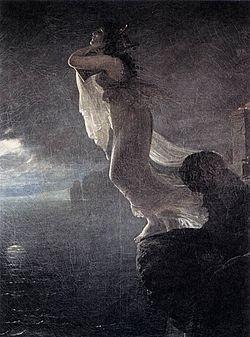
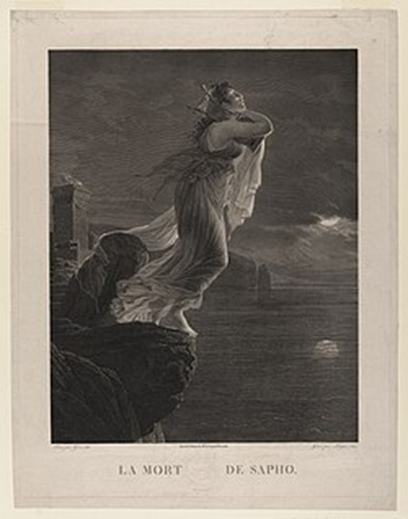
Fig 1. Antoine-Jean-Gros, La Mort de Sapho (1801, Musée Baron Gérard, Bayeux). Wikimedia Commons. https://commons.wikimedia.org/wiki/File:Antoine-Jean_Gros_-_Sappho_at_Leucate_-_WGA10704.jpg

Fig 2. Reproduction of a print by Jean-Nicholas Laugier (1819). Wikimedia Commons https://commons.wikimedia.org/wiki/File:La_Mort_de_Sapho_(Laugier).jpg
.jpg)
There are many famous artistic depictions of Sappho in the nineteenth century. Parallel to the representations of Cleopatra in nineteenth century art (see on this site, my text on the early French film Cléopâtre), it is mainly the poet’s death rather than her life that inspired artists. A good example of her suicidal jump from the Leucadian cliffs is that by Antoine-Jean Gros (1801, Musée d’art et d’histoire Baron Gérard, Bayeux, figure 1), a painting that seems to anticipate Giacomo Leopardi’s famous poem Ultimo canto di Saffo (1822). Contemporaries noticed Gros’ shift towards a strongly emotional style, fundamentally deviating from the cool, emotionless principles of Greek art. Already at an early stage, its popularity led to the painting being widely reproduced, specifically in prints, which kept the image in public memory for a long time (Figure 2). Gros’s dramatic climax would be repeated in Théodore Chassériau’s Sapho se précipitant dans la mer du rocher de Leucade/ Sappho leaping into the Sea from the Leucadian Promontory (1846, Musée du Louvre, Paris), with a stern looking Sappho jumping to her death. Chassériau also painted another version, prior in narrative time, with Sappho still in contemplation on the rock (1848, Musée d’Orsay, Paris). A few decades later, Charles Mengin showed a seminude, pensive Sappho on the rock before her jump, her lyre lowered almost to the ground and her gaze turned towards the viewer (1877, Manchester Art Gallery). Gustave Boulanger also painted Sappho on the rock before her jump but still holding her lyre, her garments fluttering in the wind (before 1888, private collection). In 1898, however, the Peruvian painter Daniel Hernández Morillo composed a naked Sappho during her fall from the rock, having none of the determination of Chassériau’s version (private collection). In 1896, Charles Amable Lenoir depicted the last part of the poet’s fall, with a now naked Sappho drowning in the sea still holding onto her lyre (Museum Wiesbaden). Between the 1870s and the 1890s, the Symbolist painter Gustave Moreau, a pupil of Chassériau, made countless paintings of Sappho’s suicide: ranging from her contemplation on the rocks beforehand, to her fall and her body laid out afterward on the shore. According to the elaborate description of the final moments of the film Saffo, published by the studio Pineschi, Sappho clambers over some rocks by the seashore and advances to their edge, hoping for the return of Phaon. She sighs, she smiles sadly and, suddenly, she throws herself headlong into the sea. ‘Her loyal handmaidens arrive but it is too late … the waves of the sea, passionless and magnificent, have closed over the body of the unhappy poetess’. The BFI print is incomplete. It ends abruptly when Sappho is throwing off her outer garments on a high rock. The poetic language of the studio’s description, however, suggests that, although her body was not shown floating in the waters, the filmmakers were well aware of the rich seam of artistic depictions of these moments on which they could draw.
Sappho performing her poetry and in pursuit of Phaon were themes that also inspired a number of nineteenth-century artists. Jacques-Louis David’s Sappho and her lover Phaon (1809) deviates from the grand dramatic gesture of her suicide. The work was painted for a Russian prince and therefore the only one of David’s paintings at the Hermitage nowadays. Here we are presented with Sappho and Phaon as two lovers, intimately engaged with each other. Poetry and music are both represented by, respectively, a scroll of verses and a lyre. The statue Sappho (1801) by Claude Ramey, now at the Musée du Louvre, is also remarkable. Here she holds the famous letter she supposedly wrote to Phaon herself according to the poetic imagination of Ovid. In later decades, Lawrence Alma-Tadema, Thomas Ralph Spence, Hector Leroux and Pierre Olivier Joseph Coomans all depicted Sappho in public performances, while Jean-Léon Gérome and Gustav Klimt painted her as a poet in more intimate settings. Simeon Solomon even dared depict her in a lesbian embrace in his Sappho and Erinna in a Garden at Mytilene (1864, Tate Britain/ Palazzo Chiablese), a rare counterexample to the heterosexual versions of Sappho in nineteenth-century art. The Pineschi film opens with Sappho performing her poetry and accompanying herself on the lyre before her admiring handmaidens. However, this poetic performance in the feminine space of her home is very soon overheard and interrupted by a male admirer. An intertitle in English translation announces: ‘Sappho loves art. She is not fond of love.’ This opening sequence may suggest to the film’s spectators that her desire for and vain pursuit of Phaon is just punishment for her earlier rejection of a man’s love.
On the stage, one of the most popular operas about the Greek poetess was Saffo, a lyrical tragedy in three acts by composer Giovanni Pacini with text by Salvadore Cammarano, It was first performed at the Teatro San Carlo in Naples on 29 November 1840. Amidst the festivities of the wedding of Climene, daughter of the high priest of Apollo in Leukas, to the handsome Phaon, Sappho arrives and reveals a shocking truth, claiming that Phaon is still in love with her. This revelation sends shockwaves through the gathering. Angry and in despair, the High Priest curses Sappho and banishes her. Yet, fate has other plans, and unforeseen Sappho and Phaon meet again, setting the stage for a tragic love triangle, ultimately culminating in Sappho’s suicide. Pacini’s opera was one of the most popular operas about the poetess. It was performed all over Italy in over forty theatres and also elsewhere in Europe, such as London, Barcelona and New York. Already, by 1873, some seventy different productions of the opera had been staged.
Pacini’s opera was still so popular in the 1910s, that the meat extract company Liebig made a series of 6 cards on the opera (series S1125, ca. 1914-1917, figure 3), condensing the opera’s plot to six moments and discarding Sappho’s status as poetess: Phaon’s rejection of Sappho, the wedding preparations for Climene, Sappho attending the wedding of Phaon and Climene, Sappho chased from the temple, Sappho appearing before the haruspices;[2] and Sappho preparing to jump from the Leucadian rock (Phaon wants to follow her but is held back by the others). Some elements of the libretto return in the Pineschi film, such as Sappho’s realisation that Phaon is betrothed and her confrontation with the couple at their wedding. But the film nowhere suggests that Phaon may have such warm feelings for Sappho that he wishes to join her in death. Instead, he rejects Sappho from their first meeting and continues to do so across the film, but she is blinded by the strength of her love.
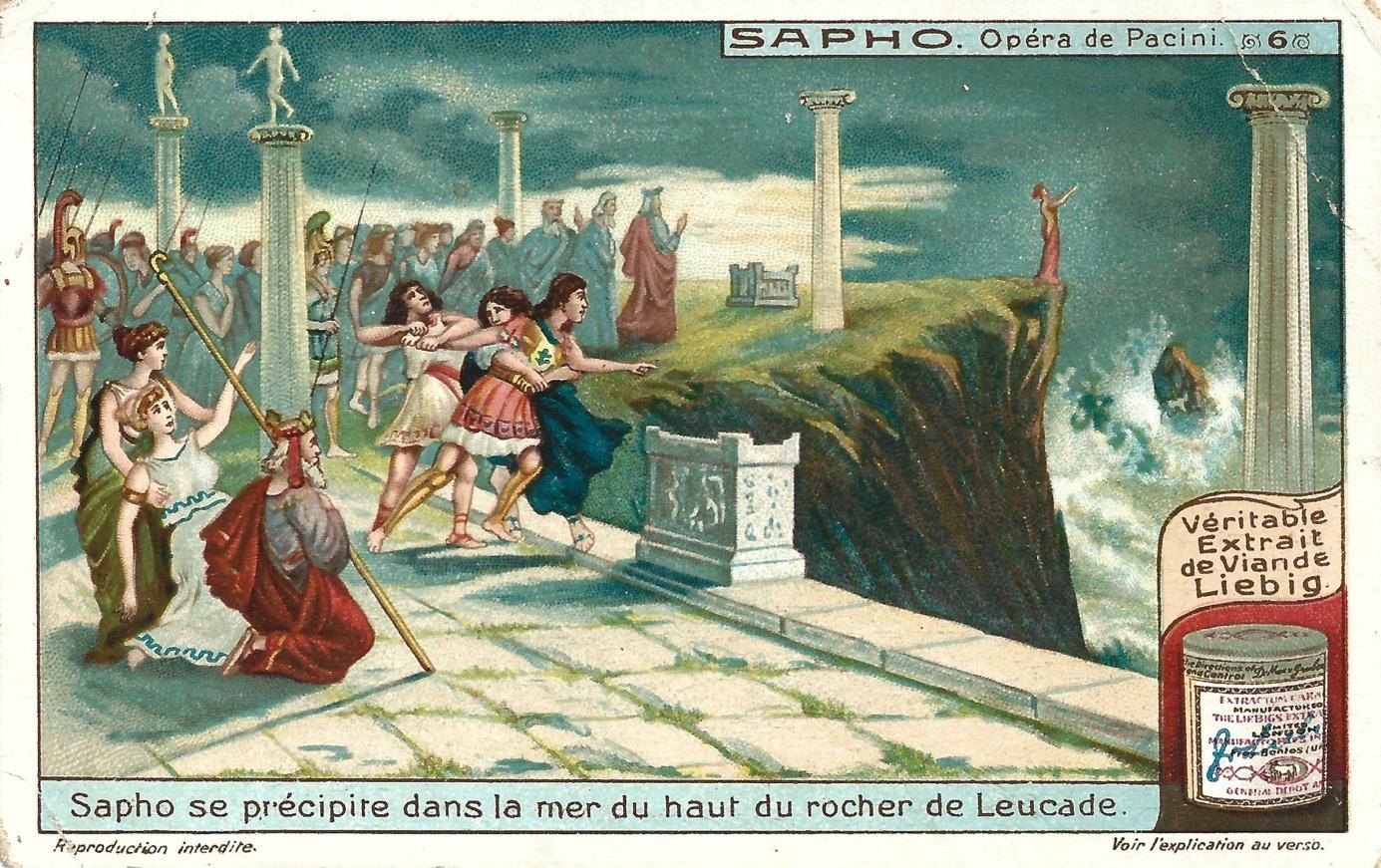
Fig 3. Scene from the Pacini opera, No. 6 (final card). Sappho throws herself from the Leucadian rock. Liebig meat extract minicard. Collection of the author.
During the nineteenth century various other operas on Sappho were staged, such as those by Friedrich August Kanne (1810), Luigi Mosca (1812), Anton Reicha (1822), Johannes Bernardus van Bree (1834), Giovani Battista Ferrari (1941), Charles Gounod (1851), Eugène Delavault (1876) and last, but not least, Jules Massenet (1897). Yet, Massenet’s version was based on the novel Sapho: moeurs parisiennes by Alphonse Daudet (1884), in which Sappho is the name used by a scandalous artist’s model who lives in modern Paris. There was also a the theatrical tragedy Sappho (1818) by the Austrian playwright Franz Grillparzer., whose most important play this was. Here, Sappho throws herself from the high cliffs into the sea when she finds that her love for the youth Phaon is unrequited and that he prefers her young slave, named Melitta. The couple elopes but is forced to return, with Melitta now understanding Sappho’s pain, while Phaon shouts that he admires Sappho as an artist but despises her as a human being. He repents too late, when others remind him of his wrongdoing in destroying Sappho with his words and deeds. After dropping all of her earthly awards into the sea, and blessing the couple, Sappho jumps in, right before the eyes of Phaon and Melitta. The Pineschi film has some ties with the play where it demonstrates interest in Sappho’s tormented discovery that she has a rival for Phaon’s love. However, that rival is never shown as sympathetic to Sappho’s suffering, nor is Phaon ever shown to regret his rejection of her. On screen, Sappho dies tormented and alone.
The Pineschi production and its reception
Saffo, subtitled Scena dell’antica Grecia/ A Scene from Ancient Greece, was produced by the small Roman company Pineschi and directed by Oreste Gherardini. His wife Renata Morandi Gherardini took the lead role. She was known as a stage actress, performing at the Roman Teatro Manzoni. Between 1906 and 1909, it was quite common for the newly founded Italian film companies to attract stage actors to play in or direct early films. Oreste Gherardini himself had also been a stage actor (see Camerini, 1983).
A description of the content of Saffo and a screenshot of its opening sequence was published by the studio in its first Bollettina quindicinale della Società Italiana Pineschi, dated January 1909 (figure 4).[3] The bulletin catalogues the film as production no. 38. Its original length was 174 m. (Bolletino) or 178 m. (Bernardini, 1996: 389), while the existing print at the BFI (a black and white preserved safety negative based on a tinted original nitrate that no longer exists) measures 517 ft. (157 m.). So not too much is missing from the BFI print and what is missing can be determined by the published description.The British print is unique.[4] It has original English intertitles but a main title card is missing. As the original nitrate no longer exists, a full restoration of the film would be difficult and at present only imprecise captures can be taken or scans made.
From watching the film and reading the description, we observe Sappho take up her lyre to sing a new poem while her handmaidens are moved by the lyrical passion (‘l’impeto lirico’) of their mistress. Sappho laughs at a male admirer’s confession of love as she thinks it too mundane compared to art (‘essa ama l’arte, non l’amore mondano’). Instead, she seeks further poetic inspiration on a rock by the sea where she spies the handsome fisherman Phaon. He is not interested in her attentions, and when his betrothed meets him at his boat and embraces him, Sappho finds herself smitten and desolate. She tries in vain to win him over again in her garden, but he rejects her contemptuously at which point, in profound frustration, she breaks her lyre over her knee. While dreaming, she has a vision of Phaon embracing his beloved, (achieved through the effect of superimposition). She awakens in shock and goes in search of him. She discovers he is being married at a temple and tries to intervene, begs him on her knees, and even attempts to pull him out of the arms of her rival, but Phaon pushes her away once more. Completely desperate, Sappho returns to the rock that hangs over the sea and commits suicide by jumping in headlong. Her female helpers arrive too late to prevent the death of the unhappy poetess (‘infelice poetessa’).[5]
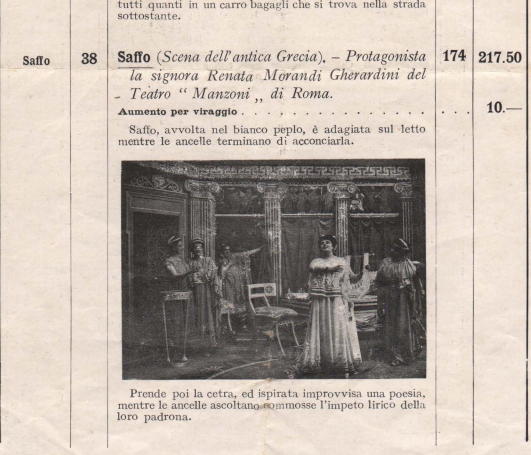
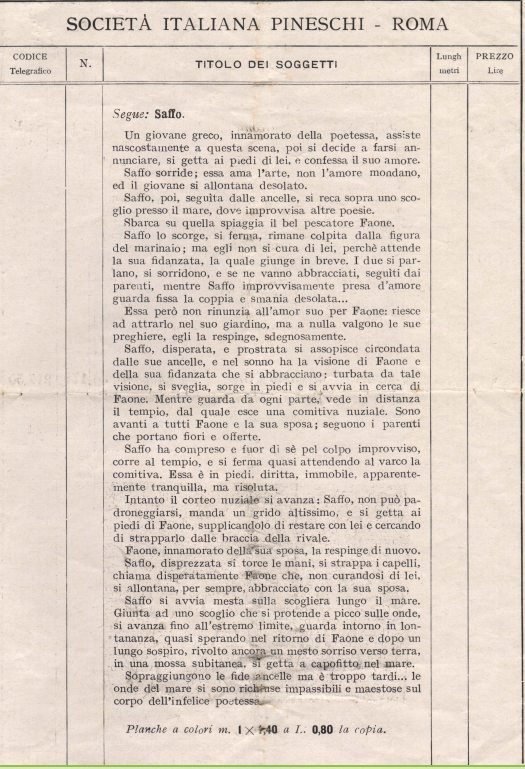
Fig 4. Bollettina quindicinale della Società Italiana Pineschi, No. 1, January 1909. Source: Centro Sperimentale di Cinematografia. https://fondazionecsc.b-cdn.net/wp-content/uploads/2019/11/6158_Bollettino_quindicinale_n_1_1909.pdf
On the initiative of the brothers Azeglio and Lamberto Pineschi, the company Pineschi was founded in Rome on 21 June 1907 as Società Italiana Pineschi, a joint-stock company with a share capital of 65,000 lire. The company specialized in the production of short films inspired by literary and historical dramas, as well as documentaries. In 1908, the Pineschi brothers were the first in Italy to create an early sound film system through the synchronization of the cinematograph and the gramophone, starting with the film Il Trovatore, based on Verdi’s opera. Subsequently, they filmed the Shakespeare adaptation La bisbetica domata / The Taming of the Shrew (possibly its first film adaptation), while in 1909 they also adapted Otello / Othello, as well as three films related to aspects of Greek and Roman antiquity with long traditions in literature, the arts and the stage. They started with Saffo (its first known Italian screening was on 15 February 1909) and followed it with Fedra (May 1909) and Spartaco (August 1909). In the same year 1909, Piedmontese industrialists Giuseppe Scotti, Ettore Calzone, and Giuseppe Villa acquired a stake in Pineschi, and following the departure of its founders, in summer 1909, they changed the company’s name to Latium Film, with its headquarters and factory at Via Appia Nuova 77 (see Bernardini 1981 and Brunetta 2003).
When Saffo came out in Italy, A. Centofanti recognised the aestheticism it gleaned from its ancient theme, wrote in the Neapolitan paper Il Café-Chantant e la Rivista Cinematografica in April 1909: ‘Finally also the Italian cinematograph and, this time, on behalf of the valorous company Pineschi of Rome, has dared to treat the classical sources of Greek art, presenting us with a film of extraordinary historical-artistic importance, entitled Saffo.’ Yet, Centofanti also had some points of criticism: ‘As a work of art, Saffo has been presented to us in a reworked version and quite distant from how she was described by Herodotus or Porphyrius, Strabo, Pluto, Ovid, etc.’ Centofanti also remarked that the cinematographer should have moved closer to show the physiognomies of the actors. Yet, all in all the critic was satisfied, saw the audience around him was too, and anticipated a long run.[6]
The British trade paper The Bioscope, commenting on the film on 2 December 1909, was even without any criticism: ‘Rarely, we should imagine, in the history of the cinematograph, has a film of such remarkable beauty as the present been produced. In so far as the necessary limitations of the moving picture machine allow, we should describe Sapho as “a perfect film”. Its story is intensely dramatic, its acting is magnificent, and it is set on a natural stage which has given the full scope to the many beautiful effects possible to the bioscope artist.’ Adding pedagogy to aestheticism as the added values of antiquity films, the author claimed the incidents in the plot helped understanding better Grecian life and manners and called the film a ‘remarkable and unique addition to the picture library of the cinematograph’.[7] In the UK, the film was distributed by the Walturdaw Film Agency, one of the oldest British film renting companies. In the United States, the film came out earlier, as the American trade paper Moving Picture World noted that Saffo was released there in May 1909 and concluded after describing the plot: ‘The manufacturers believe this to be one of their strongest films and one that should prove popular among those exhibitors desiring the best in film production’.[8] Curiously, in a programme of March 1910, the Cinema Volta in Dublin, initially set up by James Joyce and opened on 20 December 1909, showed a programme of shorts that included Saffo. On this occasion, various papers mentioned the film’s presence within the programme.[9] There were plenty of 1909 films screened at the Volta well into 1910 as most titles shown there - in particular French and Italian films - were sent in bulk from the company's home base in Trieste (as Luke McKernan indicated in his article on Joyce and Cinema Volta, and in his filmography of the Volta [McKernan, 2010]).[10] One century later, in 2010, McKernan organised a programme to commemorate the relationship between Joyce and cinema at the Glasgow Film Theatre, with a screening that included the BFI version of Saffo.[11]
Locations and scenography
Closer inspection reveals the real locations where the exteriors of the Pineschi film Saffo were shot. The importance of these settings is perhaps revealed by the film’s use of the subtitle ‘scene from ancient Greece’ as well as the favourable comments in the press on their naturalism. The use of outdoor locations, which was surely a novelty for 1909 (see also my text on this website concerning early Itala films of 1909-1911), although the makers selected Roman-styled neoclassical sites in or near Rome as stand-ins for archaic Greece. Thus several sequences were shot at the Villa Borghese park in Rome, near constructions of the late eighteenth and early nineteenth century. Sappho and her handmaidens rest and sleep at the Fontana d’Esculapio or Fountain of Asclepius, at the crossing of Viale Giorgio Washington and Viale Fiorello La Guardia in the Villa Borghese park (figure 5). The fountain was built between 1830 and 1834 and based on a design by the architect and archaeologist Luigi Canina, when the park was still the property of the Borghese family. The statue of Asclepius, visible under the arch in the film, has now disappeared. The structure, looking like a triumphal arch, is flanked on both sides by female figures of which the originals are now in the nearby Museo Pietro Canonica. The fountain consists of a picturesque rock-like arrangement holding up the arch from which water gushes down. At the feet of the rising structure stands a large circular marble basin, adding a second water display (figure 6-7). Overall, it references both ancient architecture and romanticised late eighteenth-century visions of antiquity, as in the paintings of Hubert Robert. Sappho’s nightmare vision of the wedding of Phaon is thus rendered more disturbing by its occurrence at so romanticised a spot.
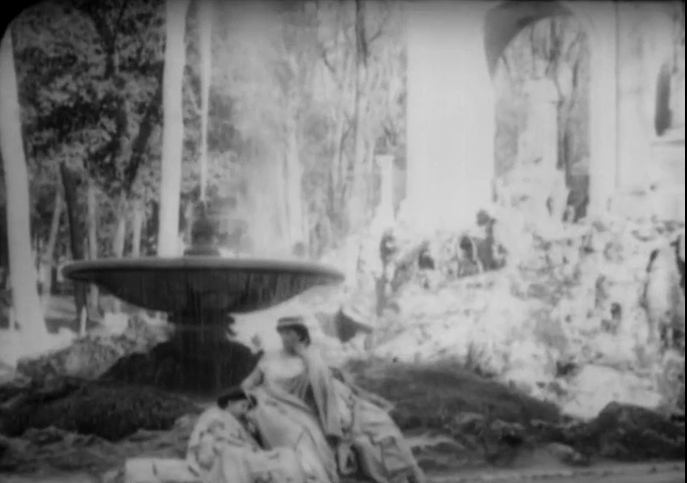
Fig 5. Saffo (1909). Collection BFI National Archive. Sappho has visions of Phaon and runs to him, later followed by her awakened friends.
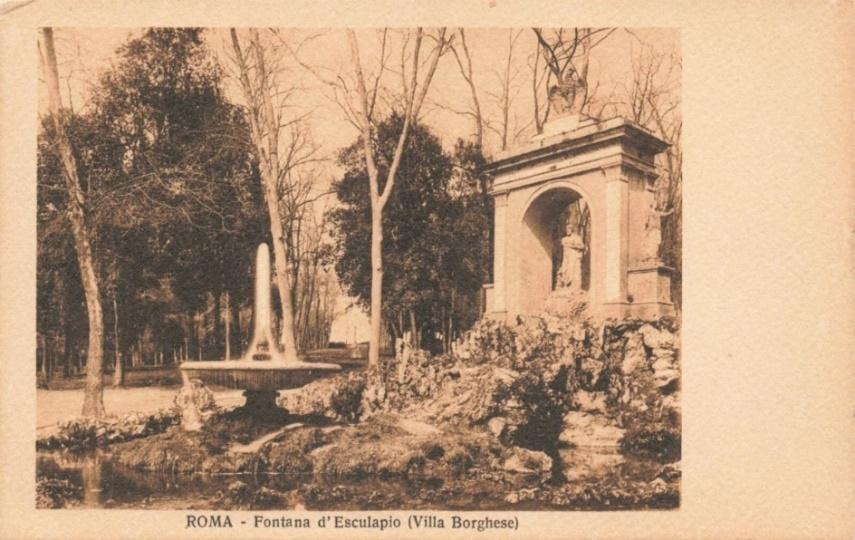
Fig 6. Old postcard of the Fontana d’Esculapio, possibly 1910s. Collection of the author. The statue is now missing but is still visible on this card.
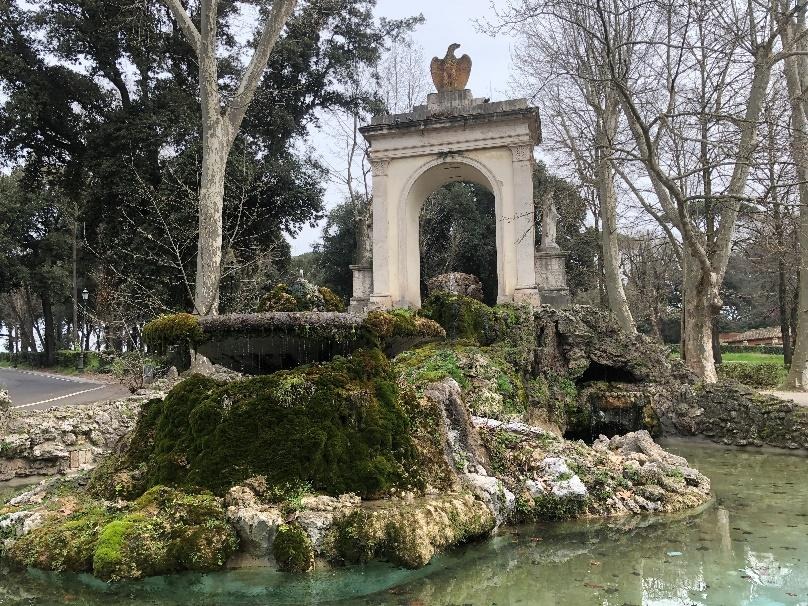
Fig 7. The Fontana d’Esculapio as it is today. Photo by the author, taken 7 March 2026.
Earlier on in the film, Saffo despairs after her attempt to convince Phaon of her profound love for him and dramatically snaps her lyre in half (figure 8). Overlooking a terrace situated high on a hill and bordered by wooden fencings, she looks vexedly into the distance. This sequence may well have been filmed at the Villa Borghese park, although we have not been able to trace the exact location. If you look closely, you can see a modern horse rider below in the distance. There are many places in the park where the shot could have been taken, though by 1908 the new entrances from Valle Giulia – which look somewhat similar - still had to be constructed. They were completed in 1911, the year the nearby Galleria d’Arte Moderna was also opened, all of which were constructed to commemorate the first fifty years of the founding of the new Italy (1861).
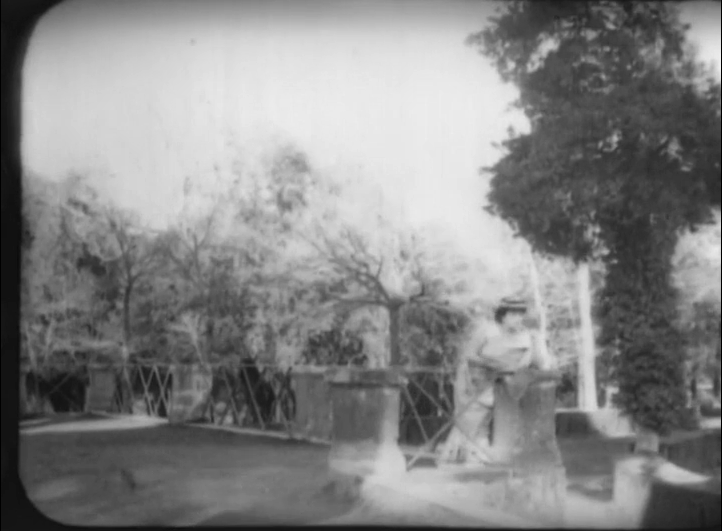
Fig 8. Saffo (1909). Collection BFI National Archive. Sappho despairs.
However, one outdoor location in Saffo can be identified without a shadow of doubt. When the poet tries to prevent the marriage of Phaon but arrives too late, according to tradition the scene was set at the Temple of Apollo. Yet Gherardini filmed it at the well-known Temple of Diana at the Villa Borghese park (figure 9-10). This neoclassical building was designed by Antonio Asprucci and built in 1789 for Marcantonio IV Borghese. Originally, there was an antique statue of Diana located within the temple, the so-called Diana of Gabi, a Roman copy of a Greek original, but this was sold in 1807 to Napoleon and ended up in the Musée du Louvre in Paris. Although the temple was empty by the time the film was made, a copy of the statue is nowadays visible within it. When Gherardini filmed at the park, it had recently been bought by the Italian State (in 1902) and given to the City of Rome in 1903 to become a public space. So the park had become public territory just a few years before Saffo was filmed there. The neoclassical structures within the Villa Borghese park provided the Roman filmmakers with a convenient backdrop that might seem authentically classical against which the tormenting love of Sappho could unfold, while the performance of a classical drama among these neoclassical structures might authenticate the park as an impressive and cultured site now made available for all Italians to enjoy as part of a shared national heritage.
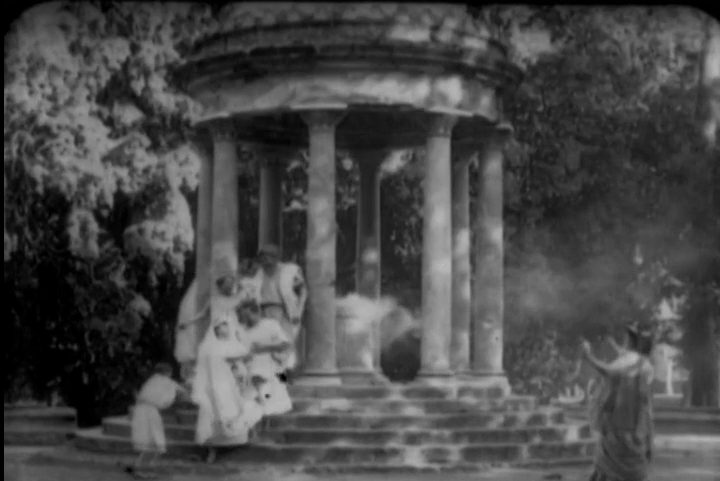
Fig 9. Saffo (1909). Collection BFI National Archive. Temple of Diana, Villa Borghese. Sappho witnesses Phaon’s marriage and makes a scene.
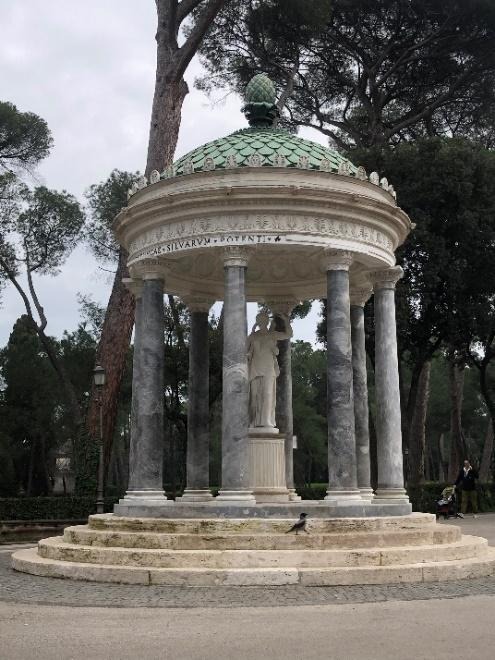
Fig 10. The Temple of Diana, as it is today. Photo by the author, taken 7 March 2026.
In May 1909, another Pineschi production came out - Fedra, just a few months after Saffo. It was subtitled Dramma mitologica dell’antica Grecia and was clearly intended as a follow up to Saffo. The director once more was Oreste Gherardini, who also played Theseus. Did he also play the fisherman Phaon in Saffo? He certainly looks like the actor in Saffo, though it is difficult to be certain because of the imprecision of the images in the available prints of both films. Yet, for Fedra archival history has been kinder. The BFI still has a tinted nitrate of the film and has preserved the film also as a black and white positive safety print. Here too we seem to be dealing with a print unique to the BFI National Archive.[12] A photograph in the reference work by Aldo Bernardini, Il cinema muto Italiano, 1905-1909 (Bernardini, 1996: 296), suggests Gherardini’s wife once more played the lead as Phaedra, although the author doesn’t say. Beyond their common interest in ancient Greek history and mythology, the two films are interlinked in other ways. The set of the interior of the poet’s house in Saffo was clearly reused in Fedra for the interior of the house of Phaedra and Theseus. We can observe the same door opening on the left, the flat columns in the background with the curtains hat hang between them and the frieze with dancing figures on top that loosely imitates ancient Greek styles (figures 11-12).
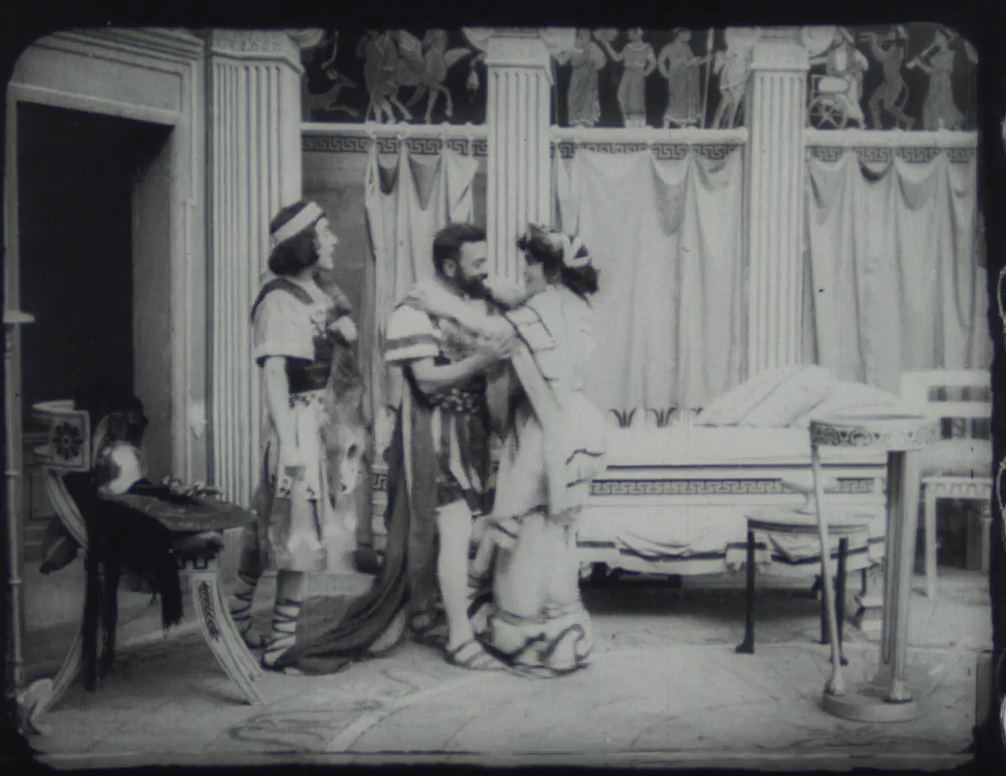
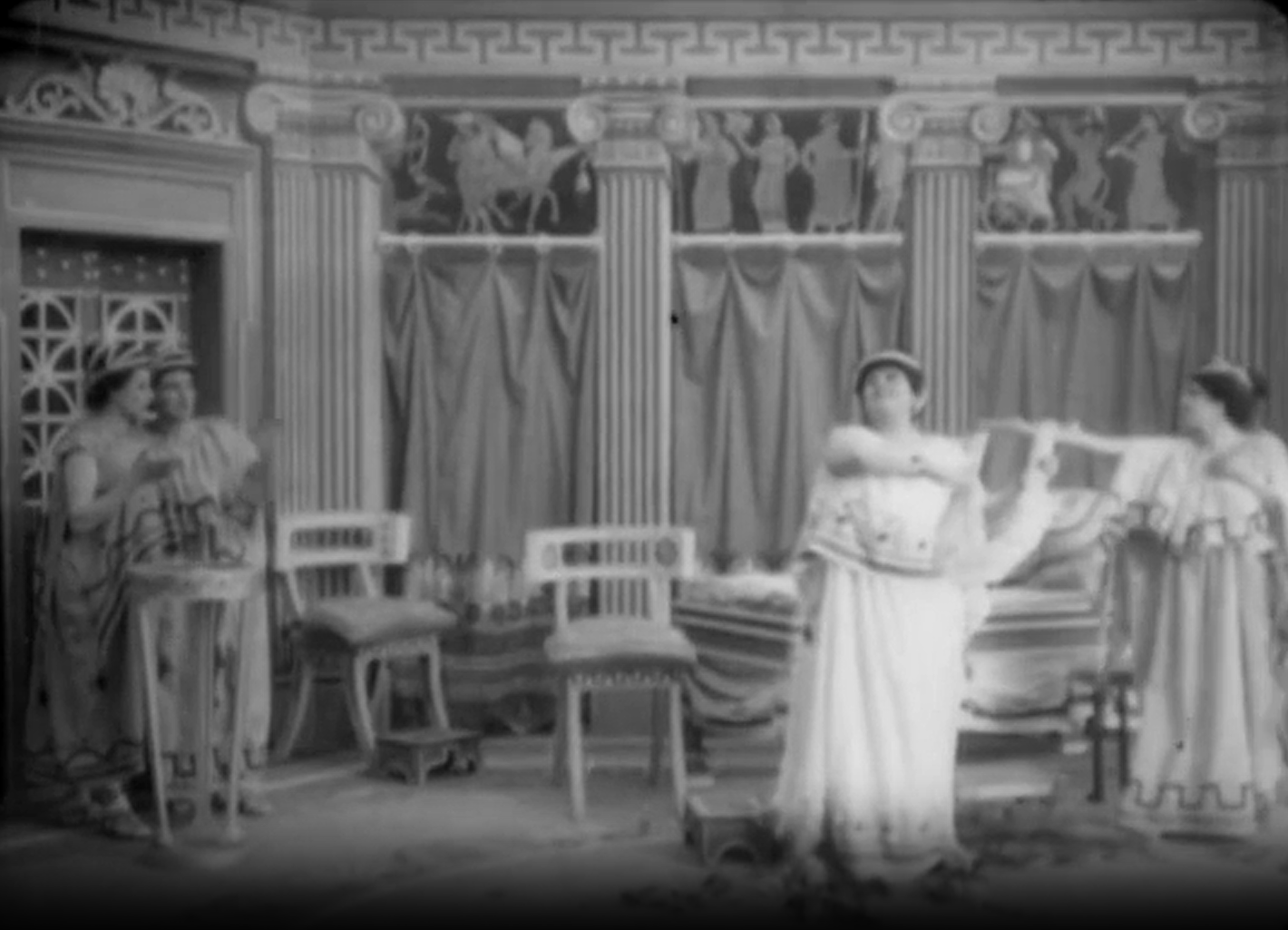
Fig 11. Fedra (1909). Collection BFI National Archive. Theseus’ homecoming.
Fig 12. Saffo (1909). Collection BFI National Archive. Sappho playing the lyre at her home.
Just as in Saffo, exteriors in the plot of Fedra were shot at outdoor locations (figures 13-14). One shot was clearly taken at the so-called Fontana dell’Ovato at the Villa d’Este in Tivoli, a location that the Roman film company Cines would repeatedly reuse in later antiquity films like Agrippina (1911) and Quo vadis? (1913).
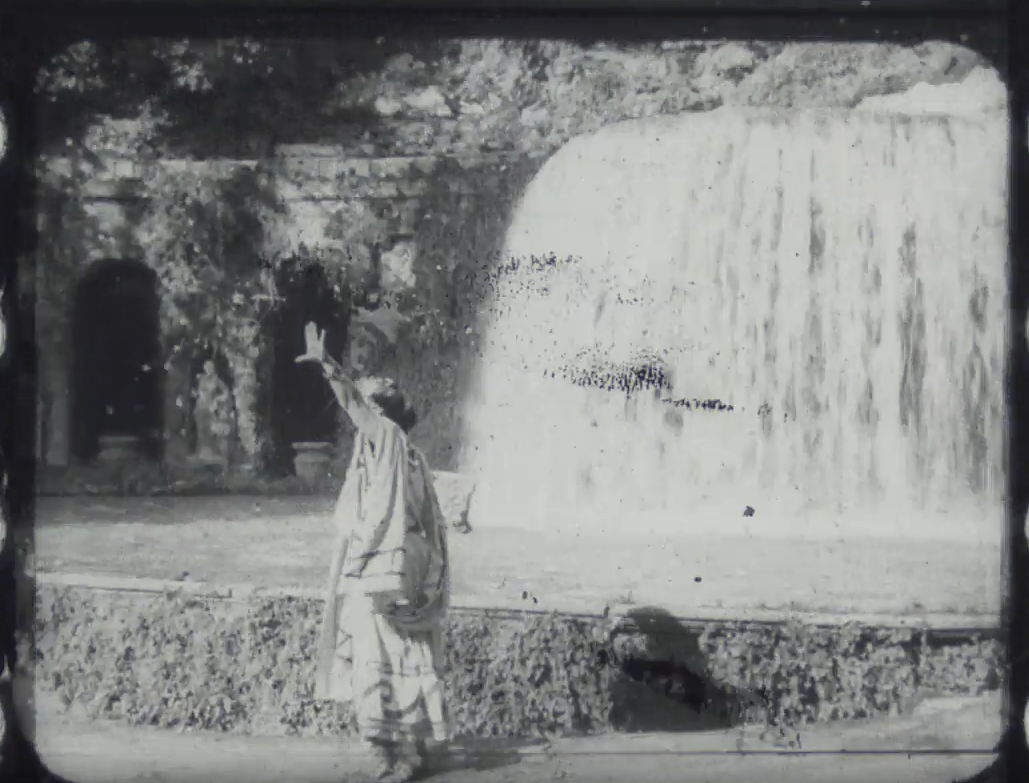
Fig 13. Fedra (1909). Collection BFI National Archive.
Fig 14. Fedra (1909). Collection BFI National Archive. The fountain is without doubt the Fontana dell’Ovato at Villa d’Este.
The final outdoor setting is also the most important – the seashore with its rocks and beach - even if its precise location cannot be identified. Given that Sappho disdains love for poetry, it is fitting that it is to the sea she comes seeking inspiration for her poetry only, instead, to find a love that is unrequited and fatal. We see Sappho at first playing her lyre on the rocks, then encountering Phaon and his betrothed by his boat which is drawn up on the shore. Later, by the light of the moon glistening on the waves, Sappho approaches Phaon as he holds his fishing net and prepares to push his boat out to sea. But he repulses her violently. It is then from the rock where she had first turned for poetic inspiration that she commits suicide out of unrequited love. The setting by the sea thus gives a realistic feel and a fatal propulsion to the ancient Greek drama.
Conclusion
It is clear that on a basic level the Pineschi production of Saffo bears traces of inspiration from nineteenth-century traditions in the visual arts and theatre in which the life of Sappho had been heterosexualized. Yet, it also deviates from nineteenth-century representations in creating a more condemnatory version of Sappho, if you compare its plotline to the details in, say, Pacini’s opera or Grillparzer’s tragedy or its visualisations to the depiction of her suicide in painting. The utilisation of real outdoor locations for exterior scenes is remarkable, and contrasts with earlier French or Italian films set in antiquity, such as Amour d’esclave (1907) or La rivale (1908). This production strategy coincides with the introduction of location shooting in historical dramas around 1909-1910 by other Italian companies such as Itala and Cines. The case of Saffo confirms that in early cinema it was common to recycle sets, props and costumes when dealing with antiquity, because at this time ancient Greece and Rome were only loosely evoked and not reconstructed with an antiquarian eye. Saffo also confirms that in early cinema ancient Greece was often represented in the style of ancient Rome, with modern neoclassical structures standing in for classical ones. In an Italian context, the move to outdoor shooting using modern buildings also demonstrates that in the cinema, as in the park, Italians were being encouraged to embrace the classical world as a common unbroken heritage of which the nation could be proud.
Ivo Blom and Maria Wyke
Footnotes
- ^ See DeJean, 1989 for the troubled sexual politics of Sappho's reception in, particularly, French literature and translation from the mid-sixteenth century to the Second World War.
- ^ In ancient times, haruspices were a type of soothsayer who foretold the future or advised in decisions by consulting the entails of slaughtered holy animals.
- ^ Bollettina quindicinale della Società Italiana Pineschi, No. 1, January 1909. Source: CSC. https://fondazionecsc.b-cdn.net/wp-content/uploads/2019/11/6158_Bollettino_quindicinale_n_1_1909.pdf
- ^ None of the current Italian archives possesses a print of the film.
- ^ A later Italian film adaptation, Saffo (Aldo Molinari, 1918), starring Ileana Leoniov, contains the same plot, and a print still exists in the CNC archives in France. One year before the Pineschi production, however, the American company Essanay made a Sappho that was inspired by Daudet’s modern-day novel Sapho, which had already inspired playwrights and Jules Massenet’s opera.
- ^ A. Centofanti, Il Café-Chantant e la Rivista Cinematografica, Naples, 10 April 1909.
- ^ The Bioscope, London, 2 December 1909, p. 47. See also Bernardini, 1996: 389-391.
- ^ Moving Picture World, IV, 21, May 1909, p. 688. MPW mentions the length was 574 ft.
- ^ Dublin Evening Mail, 3 March 1910, p. 2; The Evening Telegraph, 3 March 1910, p. 1; Sinn Féin, 5 March 1910, p. 4. With thanks to Luke McKernan for all information on Saffo and the Cinema Volta.
- ^ The Volta was sold in June 1910.
- ^ https://thebioscope.net/2010/12/11/when-films-go-astray/
- ^ None of the Italian archives have a print of this film. The BFI safety print is much shorter than the nitrate (130/200 ft.), while the film’s original length was 296 m. (Bernardini, 1996: 289).
Bernardini, A. (1981) Cinema muto italiano: Industria e organizzazione dello spettacolo 1905-1909. Bari, Laterza.
Bernardini, A. (1996). Il cinema muto italiano, 1905-1909. Rome: Centro Sperimentale di Cinematografia/La Nuova ERI.
Brunetta, G. P. (2003) Guida alla storia del cinema italiano: 1905-2003. Torino, Einaudi.
Camerini, Claudio (1983). ‘La formazione artistica degli attori del cinema muto italiano’, Bianco e nero, 44, 1, Jan./March 1983:43.
DeJean, J. (1989) Fictions of Sappho: 1546–1937. Chicago: University of Chicago Press.
Hallett, J. P. (1982) 'Beloved Cleïs', Quaderni Urbinati di Cultura Classica, 10, pp. 21–31.
Kivilo, M. (2021) ‘Sappho's Lives’, in Finglass, P. J.; Kelly, Adrian (eds.). The Cambridge Companion to Sappho. Cambridge: Cambridge University Press, pp. 11-21.
Lidov, J. (2011) ‘The meter and metrical style of the new poem’. Classics@. 4, online edition of March 11, 2011.
McKernan, L. (2010) ‘James Joyce and the Volta programme’ & ‘Volta filmography’, in John McCourt (ed.), Roll Away the Reel World: James Joyce and Cinema. Cork: Cork University Press: 15-27, 187-204.
Ovid, Heroides and Amores. Showerman, G. (En. translation), Goold, G. P. (revision of the 2nd edition) (1986) Cambridge, MA/London: Harvard University Press. Original second edition 1977, based on the original 1914 edition.
Walen, D. A. (1999) ‘Sappho in the closet’, in T.C. Davis, E. Donkin, (eds.). Women and Playwriting in Nineteenth-Century Britain. Cambridge: Cambridge University Press, pp. 233–256.