
1909- Nerone (Ambrosio)
By STELLA DAGNA (Adjunct Professor, Università degli Studi di Milano Statale)
and ANDREA MENEGHELLI (Archivio Pellicole, Cineteca di Bologna)
Nerone, also known as Nerone o l’incendio di Roma (Nero or the Burning of Rome in Anglophone distribution), directed by Luigi Maggi and Arturo Ambrosio in 1909, should be regarded as one of the true ‘gems’ of early Italian cinema. In a period that predates the triumphs of Cabiria (1914), Quo vadis? (1913), and other grand colossal or epics, Nerone stands out as a particularly striking example of a cinema whose strength lay in its power of synthesis. How do you capture, in just a quarter of an hour, the defining moments in the life of history’s most bloodthirsty emperor? How do you evoke the grandeur of ancient Rome using nothing more than painted backdrops?
Fortunately, we have at our disposal a beautifully restored print of the film, allowing us to reflect on these questions. Yet the restoration process, too, holds its own mysteries…
A strikingly photogenic emperor
Nero is a strikingly photogenic emperor. Beyond periodic efforts to reassess his ‘black legend’, his myth endures in the popular imagination: his baroque excesses, the Great Fire of Rome, and his bloody familial relationships lend themselves especially well to cinematic representation (for a survey of silent cinema’s representations of Nero, see the essay by Wyke on this website).
It is therefore unsurprising that among the earliest and finest Italian ‘costume dramas’ of the early twentieth century one finds one of his first film biographies: Nerone (also known as Nerone o l’incendio di Roma), produced in 1909 by the Turin-based company Ambrosio and directed by Luigi Maggi and Arturo Ambrosio. The era of feature-length epics had not yet arrived. Cabiria (1914) and Quo vadis? (1913) would follow only a few years later. The very young Italian film industry condensed great novels, myths, and celebrated lives into the duration of a single reel—approximately fifteen minutes at most. This does not mean, however, that these short visual narratives lacked ambition from the outset. On the contrary, Italian cinema emerged already determined to move beyond fairground attractions and to conquer the theatre, and with it a bourgeois audience. Nerone, together with Gli ultimi giorni di Pompei (1908), also produced by Ambrosio, is ‘the forerunner of the historical or pseudo-historical genre’, as film historian Gian Piero Brunetta writes (Brunetta, 2001: 156). It marked an important step in the ‘theatricalization’ of moving pictures. For its time, the film represented a considerable production effort and achieved notable success. It was the second entry in the prestigious ‘serie d’oro’ (‘alla francese’), a label the company used to designate its most ambitious productions. At the film competition Concorso Mondiale di Cinematografia, held in Milan in October 1909, Nerone received significant recognition (Bernardini, 2015: 361-363; Lasi, 2012; Montericcio, 1994). It was also described in the influential American trade paper The Moving Picture World as ‘one of the most remarkable films ever made’[1] (figure 1) and in the United States it even became the centre of a legal dispute over distribution rights.[2]
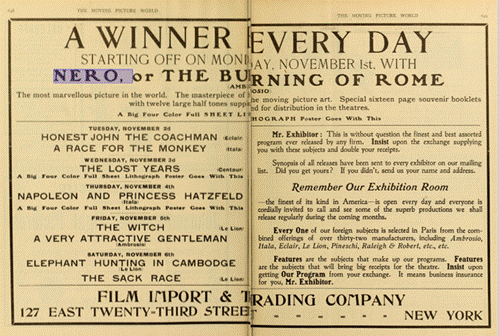
Fig. 1. Advertisement by the American distribution company published in The Moving Picture World in 1909. Nero or the Burning of Rome is the flagship film of the catalogue and is described as ‘The most marvelous picture in the world’.
Arturo Ambrosio himself (figure 2), interviewed during a business trip to the United States, chose Nerone as a prime example of his company’s production policy, governed (at least in public statements) first and foremost «by quality».[3] In the Italian tycoon’s account, it was not money but art that guided Ambrosio’s production strategy. In the case of Nero, this aspiration appears almost obsessive, at least judging from the striking remarks he made in the same interview: ‘I seldom ate or slept while this same Nero was being produced, and if I did sleep I dreamt Nero’, Ambrosio declared.[4] Fortunately, we can now assess the results of those supposed sleepless nights, as a fine, restored print of the film has been available since 2018. We will return to the details of the restoration. For now, let us consider the structure of this fifteen-minute gem.
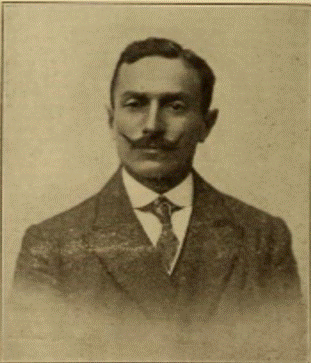
Fig. 2. Arturo Ambrosio. Portrait accompanying the interview published in The Moving Picture World (1909a).
The Film
Rome, first century CE. Outside one of the city’s many temples, people stroll, greet one another, and converse at the foot of a statue that bears a suspicious resemblance to the Apollo Belvedere (a masterpiece of ancient sculpture inspired by a Greek original produced only in the following century). The emperor Nero emerges with his retinue, hand in hand with his wife Octavia. She is played by Mirra Principi, he by Alberto Capozzi, a leading man later destined for considerable success in refined romantic roles. The imperial couple is greeted with the ‘Roman salute’ by a small crowd.[5] Among them is the beautiful Poppaea Sabina, wife of Salvius Ottone (figure 3). Nero scrutinizes her through his famous emerald and is instantly captivated. He dispatches his ‘secretary’ Epaphroditus - played by Luigi Maggi who was also one of the film’s directors - to gather information. From that moment on, as a contemporary promotional synopsis declares: ‘the master of the world has but one thought, but one desire: Poppaea’.[6]
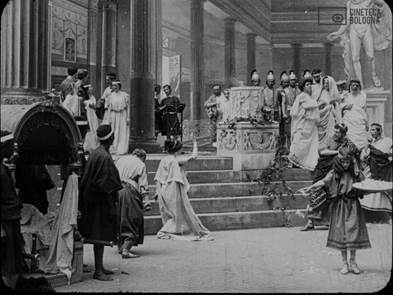
Fig. 3. The first meeting between Nero and Poppaea. In the background, a reproduction of the Apollo Belvedere. A striking scenographic idea, but probably anachronistic: the statue is considered a copy of a Greek original and is dated to the 2nd century CE, thus after Nero’s death in 68 CE. Courtesy of Fondazione Cineteca di Bologna.
Guided by Epaphroditus (figure 4), the emperor encounters the beautiful patrician again at night in a tavern, after making his way through the alleys of the Suburra,[7] cloaked in a voluminous mantle and enveloped in a strikingly blue tint.
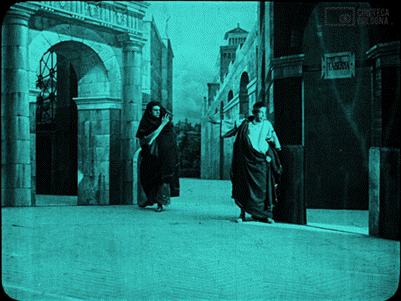
Fig. 4. Epaphroditus (Luigi Maggi, actor and director) leads Nero through the streets of the Suburra to meet Poppaea. Courtesy of Fondazione Cineteca di Bologna.
The two meet under the astonished gaze of the tavern’s usual patrons: slaves, gladiators, and a graceful dancer, played in a luxury cameo by one of the most famous actresses of the Ambrosio production company, Mary Cleò Tarlarini (figure 5). The seduction scene performed by Poppaea (figure 6) —potentially quite risqué by the standards of the time—was nevertheless judged ‘elegante e corretta’ (elegant and proper). It was performed by Lydia De Roberti, described as ‘una artista studiosa’ (a diligent artist).[8] Was this meant as praise? Most likely yes, especially considering that De Roberti herself, five years later, was once again called upon to portray Poppaea in Nerone e Agrippina (1914) by director Mario Caserini.
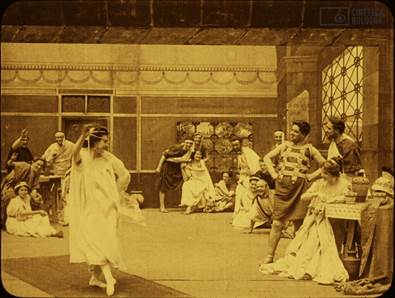
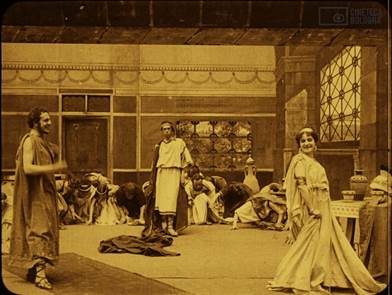
Figs. 5-6. At the tavern. Before Nero reveals his presence (figure 6), the dancer entertaining the patrons is Mary Cleo Tarlarini (figure 5). Courtesy of Fondazione Cineteca di Bologna.
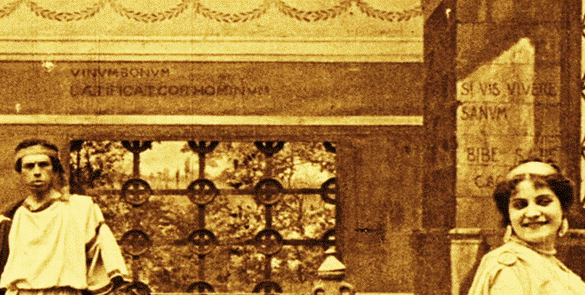
Detail of fig. 6: as evidence of the care taken in the film’s scenic reconstruction, the tavern walls bear cheeky mottoes praising wine: Vinum bonum aedificat cor hominum (Good wine gladdens the hearts of men, above) and Si vis vivere sanum, bibe saepe […] (If you want to live healthily, drink often, on the column).
In short, Poppaea Sabina becomes Nero’s favoured companion. A long sequence shows her parading in triumph alongside the emperor during the celebrations of the Kalends of June. The ‘procession’ was a near-constant feature of early Italian historical films: an ‘attractional’ interlude that allowed audiences to take in, at leisure, martial soldiers, lictors bearing fasces topped with wolf masks, and graceful handmaidens (in ever-changing costumes, as we shall see), while also admiring the historical precision — real or presumed — with which Roman insignia had been recreated (Blom, 2023: 159-160). The empress Octavia, understandably, attempts to resist the influence of the new favourite, but with little success. After trying to assert her rights before her husband and his mistress during an orgy, she is humiliated and mocked by him in front of courtiers, slaves, and freedmen (figures 7 and 8).
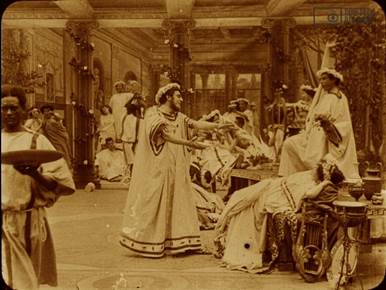
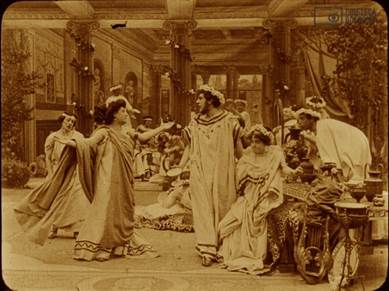
Figs. 7–8. The orgy scene and Octavia’s protests. A contemporary reviewer considered the depiction of imperial debauchery too ‘cold’. Courtesy of Fondazione Cineteca di Bologna.
This scene, crowded with extras miming drunken revelry and amorous abandon to the sound of the cithara, did not convince the stern reviewer of Lux, who dismissed it as ‘povera, poverissima cosa’ (a poor, very poor thing), since it failed to arouse ‘disgusto’ and instead left spectators cold (Lux, 1909). In reality, it appears strikingly meticulous today, rich in detail and convincing. This also due to the playful esprit de corps on set, traces of which survive in a couple of stereoscopic photographs, most probably taken by an unknown amateur filmmaker for private use, now preserved in the collection of the Museo Nazionale del Cinema in Turin (figure 9).
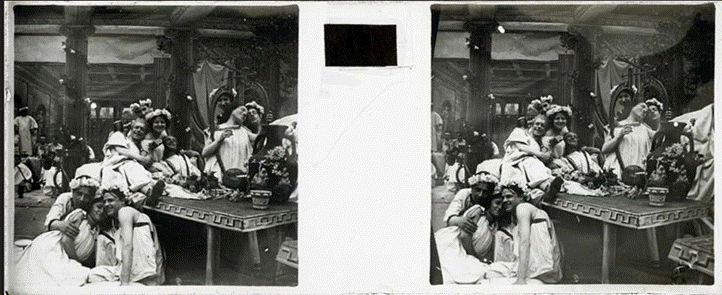
Fig. 9. Stereoscopic photograph taken on set. The cast appears to have bonded together well. Courtesy of Museo Nazionale del Cinema, Turin.
Octavia’s humiliation, however, is still not enough for the ambitious Poppaea. During a passionate rendez-vous in the imperial gardens, Poppaea sees Octavia pass by accompanied by a loyal handmaid. She exploits her influence over Nero to urge him to order his wife’s death. He complies, because he is ‘debole e vile’ (weak and cowardly), as stated in the promotional synopsis. Octavia’s fate is sealed. The sentence is delivered at a house on Pandataria, the island now known as Ventotene, where those who had fallen into imperial disfavour were sent into exile. There the legitimate empress lives in secluded exile, in an atmosphere of serenity that contrasts with that of the imperial court. Upon receiving the order of execution from the praetorians, Octavia tenderly embraces her favourite handmaid and then clasps a flowering branch as she awaits the blow of the dagger that will kill her (figures 10 and 11).
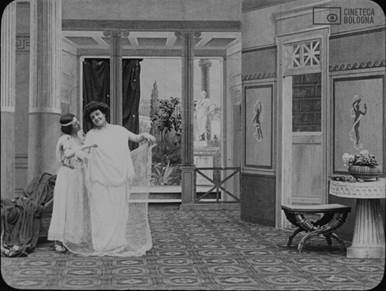
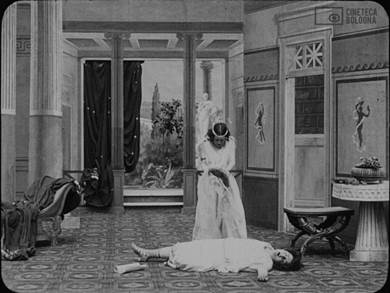
Figs. 10–11. The peace of Octavia’s home is disrupted by the praetorians, who kill her on Nero’s orders. Courtesy of Fondazione Cineteca di Bologna.
The latter, left alone, gathers the bloodstained veil that still wraps her mistress’s lifeless body (revealing a small foot clad in a ‘sandal’ of a form that is scarcely Roman and very much Belle époque, detail of figure 11). It will become the evidence by means of which she will call upon the people of Rome to rise in revolt against the tyrant.
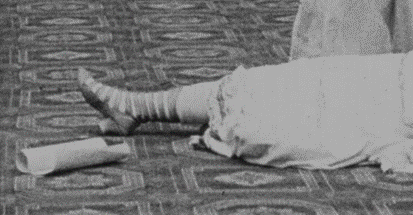
Detail of fig. 11. The sandal worn by Mirra Principi (alias Octavia) has a distinctly Belle Époque design rather than an ancient Roman one.
The same people who only a few shots earlier had hailed Poppaea are immediately ready to change their minds and rise up against the uxoricidal tyrant, reflecting the abrupt shifts of sentiment characteristic of early twentieth century ‘synthetic’ cinema. The emperor, however, has spies everywhere. Warned by an informer of the danger, Nero orders the burning of the city ‘per domare l’insurrezione popolare’ (to quell the popular uprising). Epaphroditus at once unleashes his arsonists. The screen turns red: Rome is engulfed in flames, and the crowd pours into the streets in a state of terror. From the palace terrace, Nero delights in the majestic spectacle and plays the lyre. Poppaea joins him. The diabolical couple embraces, seized by a shared erotic and blood-soaked exaltation (figure 12).
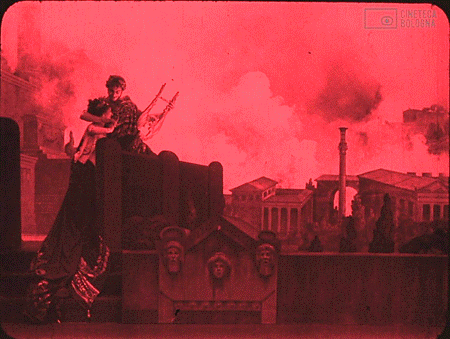
Fig. 12. Embracing, the ‘satanic’ couple contemplates the burning of Rome. Courtesy of Fondazione Cineteca di Bologna.
This will be Nero’s final act of cruelty, at least in the film. From this point onward, events unfold perhaps a little too rapidly: Poppaea disappears, and the emperor is left alone in the Domus Aurea. In reality, four years elapsed between the Great Fire of Rome and Nero’s death, but nothing in the surviving print suggests such a passage of time. Nero is now prey to sudden — and somewhat implausible — remorse (figures 13 and 14). Not for the murder of Octavia, nor for the burning of Rome, but for the persecution of the Christians, which, up to this point, the film has not even mentioned. In the typical device of superimposition used at the time to render a character’s inner world, two scenes of martyrdom are shown, inspired in turn by Jean-Léon Gérôme’s painting The Christian Martyrs’ Last Prayer (1863-83) and Henryk Siemiradzki’s painting Nero’s Torches (1876) and then picked up by Henryk Sienkiewicz in Quo vadis? (1895), a best seller destined to leave a lasting mark on the Neronian imaginary well beyond the early twentieth century: victims in the circus awaiting the lions and their burning as human torches (Blom, 2023: 44-54).[9]
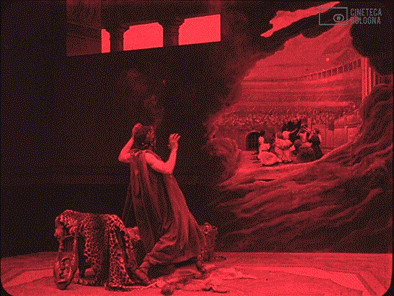
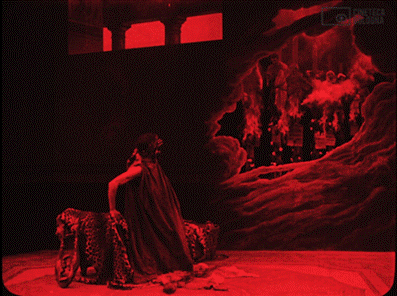
Figs. 13–14. Nero, overcome with remorse for the martyrdom of the Christians. An event questioned by contemporary commentators more attentive to historical accuracy. The superimpositions depict the two punishments described in the novel Quo Vadis?, which was extremely popular at the time: the Christians praying in the arena awaiting the lions, and the Christians burned as human torches. Courtesy of Fondazione Cineteca di Bologna.
The cruel yet loyal Epaphroditus, however, manages to draw the emperor away from his terror at the atrocities he has committed. The Senate has pronounced a death sentence: if captured, Nero will be flogged to death. He must flee. Yet on the road to the villa of the freedman Faonte, the fugitives are discovered and overtaken. Even in this final, fatal moment, Nero shows no last trace of imperial dignity. Overcome with fear, he hesitates to take his own life, until Epaphroditus thrusts the dagger into his throat. The emperor dies gasping (perhaps somewhat excessively, Capozzi lingers somewhat too long over his death scene), while Galba’s soldiers and enraged citizens mock and jeer at him (figure 15). Sic transit gloria mundi.
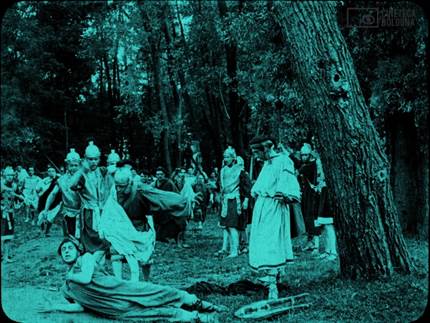
Fig. 15. The death of Nero in his death throes. Courtesy of Fondazione Cineteca di Bologna.
A cinema of synthesis
Nerone is probably one of the most accomplished examples of the Italian ‘costume drama’ genre that preceded the explosion of feature-length peplum epics in the early 1910s. These were short historical films in which the narrative is constructed in relatively autonomous blocks, each designed to exhaustively represent a key event within a self-contained tableau (Brunetta, 2001: 156).
To contemporary viewers, such films may appear very simple, even primitive. Certainly not complex enough to justify the sleepless nights Ambrosio claimed to have endured during production. However, although the cinema of that period was less elaborate and more straightforward than what would follow, Nerone and the finest films of its time possess a quality that perhaps no other period in film history expressed with such effectiveness: synthesis.
Early Italian cinema (and much of European cinema more broadly) is, above all, a cinema of synthesis. There were two essential elements that a talented metteur en scène of the time had to master in condensed form: the time of the narrative and the space of the frame.
To recount a great novel, a Shakespearean drama, or the life of an emperor in a quarter of an hour clearly required selecting only a few significant events from a much larger narration. Yet, this was not the principal difficulty: even more challenging was making the causal relationships between the different tableaux - organized as relatively ‘autonomous’ blocks - intelligible. Love, jealousy, and revenge were (and remain) universal drivers of human behaviour. They were particularly easy to stage and for audiences to decode, even without the presence of words. This need for clarity often stretched the bounds of historical plausibility. In Nero, the emperor has Octavia killed at Poppaea’s instigation; the people rebel because of this crime, and Nero burns Rome to quell the uprising. This is a chain of causations that bears no resemblance to the accounts of the historians, yet is perfectly linear. In the film’s final part, when the narrative attempts to move beyond the private sphere (the relationship with Poppaea) toward the political (the persecution of the Christians, Nero’s flight, and his death), the story in fact becomes less intelligible to those without prior knowledge of ancient history. Why are Nero’s nightmares suddenly populated by arena sacrifices and human torches? What has become of Poppaea? Why has the Senate condemned him, and who are the soldiers pursuing him?
From this perspective, one scene is particularly controversial: the one depicting Nero prey to remorse. No source attests that this ever occurred — quite the contrary. The Neronian legend portrays him as cruel and cowardly to the very end. The reviewer of Lux also noted this, commenting: ‘A Nero—skeptical, criminal, cynical—suddenly assailed by remorse strikes us as an enormous anachronism: it completely overturns his character’.[10] And yet the scene of remorse is a pivotal moment in the film, marking a shift in tone and opening the drama onto a more collective and tragic dimension. It also brings the film back within the reassuring bounds of conventional morality. A morality far stricter than that of the theatre, since cinema was a popular art, and the public was not to be in any way ‘incited’ to transgress the norms of social life. The underlying idea is that those who commit infamous acts of cruelty will not only meet an ignominious death, but will inevitably be tormented additionally by remorse for those acts.
Early Italian silent historical dramas emerged and developed in a constant and demanding state of balance. On the one hand, they aspired to a degree of historical verisimilitude that would grant them the cultural legitimacy their makers coveted for them: they quote famous paintings, pay close attention to set design, and wink at historically informed viewers in their promotional brochures (for instance by mentioning Galba or the flight to the villa of Faonte). On the other hand, for the convenience and constraints of staging, they take extraordinary liberties with historical fact. The underlying assumption is that ‘fidelity’ should be understood more in relation to the visual tradition of history than to history itself. The audience is expected to recognize - and take pleasure in recognizing - the iconic figures and key set-pieces of a well-known story, rendered in the most striking and spectacular manner possible. ‘Stitching’ these moments together clearly, engagingly, and with a sufficiently fast pace thus becomes a matter of cinematic skill rather than historical expertise.
Most Italian costume dramas made before 1913 were not set in ancient Rome, but rather in the Middle Ages or the Renaissance. In this way, the most spectacular scenes could be shot outdoors, taking advantage of the actual monuments of Italian historic cities (for example, the colonnaded courtyard of the papal palace in Viterbo was widely used). Nero, by contrast, was for the most part shot in the studio. The Rome that appears on screen is largely painted on scenic backdrops—though very skillfully so. The film’s sets were in fact designed by Decoroso Bonifanti, a painter and the principal set designer in the early years of the Ambrosio company.[11]Bonifanti carefully conceived the backgrounds, paying close attention to the precise characterisation of each setting (see, for instance, the witty inscriptions on the walls of the tavern in the detail of figure 6 or the elegant Pompeian frescoes in Octavia’s villa in figures 10 and 11). The Museo Nazionale del Cinema in Turin preserves a series of his beautiful preparatory sketches for the film.[12]
Study of these sketches reveals that, despite the use of painted backdrops, the staging of Nerone aimed to emphasize the depth of field of the sets. This effect of depth was achieved through the conception of separate elements, later positioned with skill on set in order to optimize the effect of depth and make the screen space appear as vast and varied as possible. This was a typical feature of the ‘cinema of synthesis’ which sought to gather as many elements as possible within a single frame, organizing them across different planes of depth. At times, such devices could also produce unusual perspectival effects, in which, especially in the background, the proportions between actors and scenic elements were not always respected. This is not the case in Nero, as already noted by contemporary commentators. Not only were the settings of the film described in the press of the time as ‘indescribably magnificent’,[13] but it was also explicitly stated that ‘we only exceptionally observe the exaggerated disproportions between foreground and background so common in improvised cinematographic works’.[14]
A photograph taken on set during the filming of the ‘Triumph of Poppaea’ helps us better understand this staging technique (figures 16 and 17). The set organizes the mass of extras vertically as well as horizontally, thanks to the use of the staircase. The scenography is constructed through the arrangement of at least five distinct layers of painted scenic elements. On top of all that, a carefully offset camera position, placed at a forty-five-degree angle to the compositional focal point, makes the frame feel far more spacious, creating an impression of breadth and three-dimensionality for the spectator. This stands as further proof that the cinema of the period drew on theatre and painting, yet already fully understood itself as something entirely different.
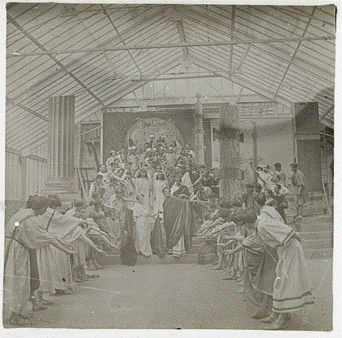
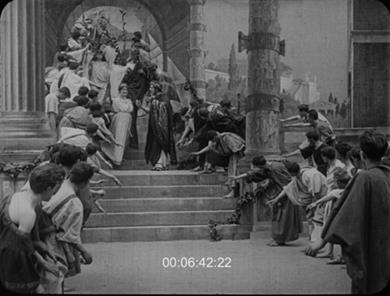
Figs 16-17. Comparison between the detail of a stereoscopic photograph taken on the set of Nerone (courtesy of the Museo Nazionale del Cinema, Turin) and an image from the film showing ‘The Triumph of Poppaea’ (courtesy of the Fondazione Cineteca di Bologna).
The restoration
The restoration of Nerone was the result of a happy collaboration between several film archives: Fondazione Cineteca di Bologna, Museo Nazionale del Cinema, Centro Sperimentale di Cinematografia – Cineteca Nazionale, Eye Filmmuseum, and Deutsche Kinemathek. The restoration was carried out at the laboratory L'Immagine Ritrovata in Bologna. The project came together thanks to a couple of fortunate circumstances. First, together with Claudia Gianetto (Museo Nazionale del Cinema), we were working on a retrospective dedicated to Arrigo Frusta for the 2018 edition of Il Cinema Ritrovato film festival in Bologna. Frusta headed Ambrosio’s Screenwriting Office and is credited with writing around 250 films, including Nerone (another notable work of his is the 1913 version of The Last Days of Pompeii, directed by Eleuterio Rodolfi) (Alovisio, 2005). A new restoration of Nerone seemed like the perfect opportunity to make the Frusta retrospective even more engaging.
The second circumstance was the discovery, a few years before, of a nitrate print of the film. When it was released, Nerone was a major hit. According to Arturo Ambrosio, 342 copies were distributed worldwide, as stated in his interview with The Moving Picture World.[15] One of these copies was acquired by Cineteca di Bologna. It is part of a collection of about twenty silent films that were found in a basement in Reggio Emilia. The owner had inherited them from his father, Rodrigo Levoni. It remains unclear why and when the collection was assembled. One thing is certain: it is extremely valuable. The Levoni collection includes some of Pathé’s scènes en plein air (such as Les Bords de la Tamise d'Oxford à Windsor [The Banks of the Thames from Oxford to Windsor], Coiffures et types de Hollande [Hairstyles and typical costumes of Holland) and scènes instructives (such as Oiseaux sauvages des monts d'Ecosse [Birds of Prey from the Mountains of Ecosse], La mangouste ou Rat des Pharaons [The Mongoose or The Pharaohs’ Rat]) with astonishing stencil coloring, as well as a few Italian dramas and historical films from the 1910s. The copy of Nerone was one of the most unfortunate in the Levoni collection: nearly complete, tinted and black-and-white, with Italian intertitles, but heavily affected by chemical decay. For a significant portion of the film - roughly a quarter of its total length - the emulsion was partially or completely gone. That was far too much to achieve a satisfying result on its own. We needed additional sources to fill in the decayed parts.
Our search through the FIAF[16] network led us to the Eye Filmmuseum in Amsterdam and to the Centro Sperimentale di Cinematografia – Cineteca Nazionale in Rome. Eye provided a tinted and black-and-white nitrate print (Desmet Collection) with Dutch intertitles, but - same old story - it was affected by chemical decay in several portions. The Cineteca Nazionale contributed a safety dupe negative made from a nitrate print that had since been discarded. After scanning, comparing the three elements showed that it was possible to reconstruct the film almost in its entirety, avoiding the chemically decayed sections. Whenever possible, the main sources were the Bologna and Amsterdam prints, which shared exactly the same editing and coloring and displayed photographic quality far superior to the dupe negative from Rome.
One final problem was concentrated in the last thirty seconds of the film: the scene depicting the emperor’s death. A few frames were still missing. To fill these gaps, we resorted to a 16mm print from the Deutsche Kinemathek, even though it was badly scratched and of very poor photographic quality.[17] In brief, the restoration involved a ‘cut-and-paste’ reconstruction using four different sources, as follows:
- Scene 1: Cineteca di Bologna (hereafter BO) for the first part + Eye (hereafter EYE) for the second part
- Scene 2: EYE for the first part + dupe negative from Centro Sperimentale di Cinematografia (hereafter CSC) for the second part
- Scene 3: BO
- Scene 4: EYE
- Scene 5: BO
- Scene 6: CSC
- Scene 7: CSC + (for a few frames) EYE
- Scenes 8, 9, 10: EYE
- Scene 11: EYE + (for a few seconds) CSC
- Scene 12: EYE
- Scene 14: 16mm print from Deutsche Kinemathek for the first part + BO for the second part
Regarding the intertitles, the only source used was the Bologna print. The sequence order and the placement of the intertitles were verified through documentation from Museo Nazionale del Cinema. The final restored print now measures 291 m., while according to Aldo Bernardini (Bernardini, 1996: 342) the original length was 338 m.
As is often the case in film restoration, the final result was based on a set of informed hypotheses that led to the completion of one possible version of the film. Rarely - perhaps never - is a restoration the definitive last word. Restoring a film is like chasing a ghost – that is, the original version which is by nature elusive and prone to slipping out of reach. Nerone fits perfectly into this pattern.
As mentioned, the nitrate prints used for the restoration of Nerone contained both black-and-white and tinted sections, as was typical of Italian cinema of the period. However, the question of Nerone’s colours reveals more unusual, surprising, and in some respects mysterious aspects. In addition to scrutinizing all the prints mentioned above, we discovered that the Paris-based company Lobster Films preserved a fragment of the film related to the ‘Triumph of Poppaea’. In all the elements that had been used for the restoration, the scene in question appears in black and white. The Lobster fragment, by contrast, features stencil coloring applied to costumes in a wide range of hues, brown Roman fasces, Nero’s bright red tunic, golden standards… The result is particularly striking, as befits the spectacle of the procession, which in historical films of that period was a key aspect, designed to dazzle audiences with the richness and accuracy of its costumes and sets. That scene raises unresolved questions. As far as I know, there were no stencil-coloring labs in Italy. So who carried out the work? When and where was it done? Did Ambrosio send the film to a French laboratory? And, if so, why? Was the stencil coloring applied to the film - or rather to some copies of the film - limited to the Triumph scene, or did it extend to other scenes as well? Perhaps Ambrosio sold the film not only as a whole, but also in individual, particularly spectacular sections?
There is a second, even more puzzling surprise. The nitrate print from Bologna actually contains eight individual hand-colored frames. Six of these are from the scene depicting the ‘Triumph of Poppaea’, but for the most part they show colours that do not match those found in the Lobster fragment.
Let’s consider this example (figure 18):
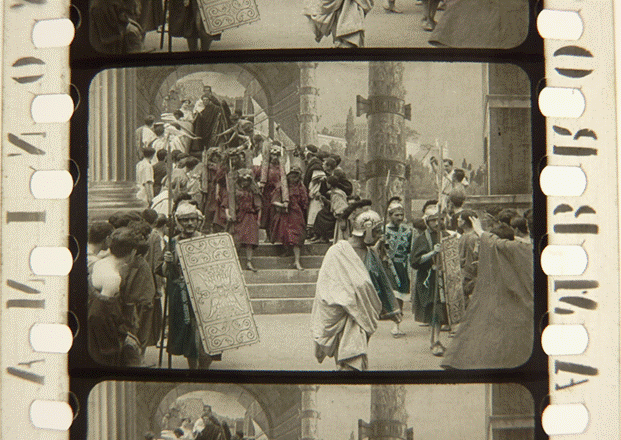
Fig. 18. Courtesy of the Fondazione Cineteca di Bologna.
In the frame from the Bologna print, the soldiers’ costumes display a blue tint. In the Lobster fragment, this colouring is absent. Similarly, in the frame in figure 19 the drape covering Nero appears brown, while the same garment in the Lobster fragment shines in bright vermilion red.
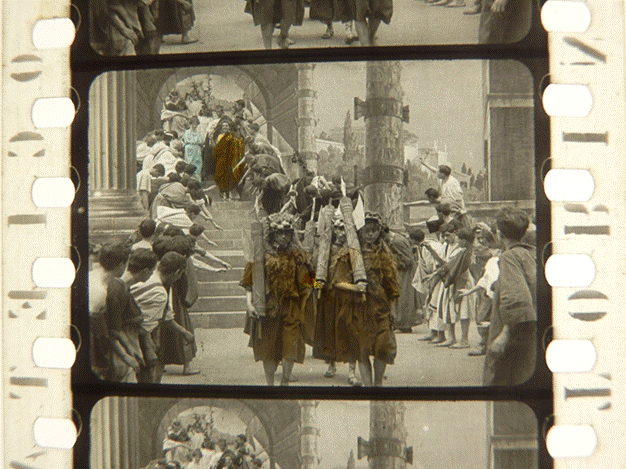
Fig. 19. Courtesy of the Fondazione Cineteca di Bologna.
Our favorite example involves two maidens carrying olive branches, who wear pink dresses in the Lobster fragment. In this frame from the Bologna print (figure 20), their tunics are blue.
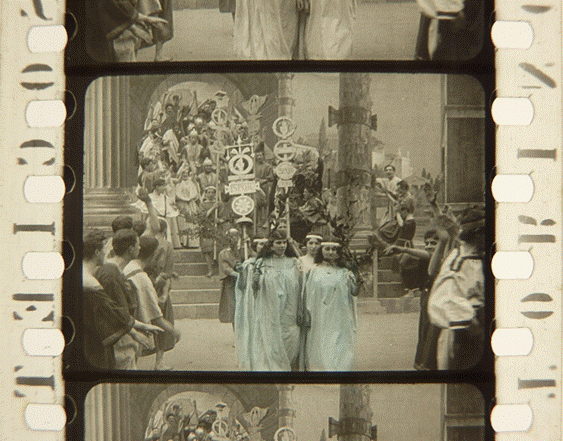
Fig. 20. Courtesy of the Fondazione Cineteca di Bologna
But just a few frames later (figure 21), it’s as if they have magically changed outfits, and we see them dressed in pink, just as in the Lobster fragment.
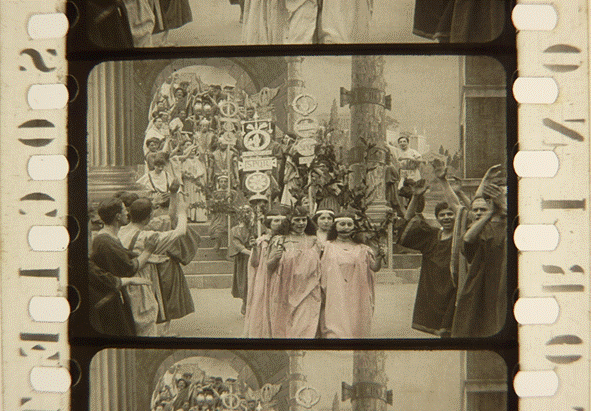
Fig. 21. Courtesy of the Fondazione Cineteca di Bologna.
How should we interpret the coloured frames that appear as barely perceptible flashes in the Bologna print? Perhaps we should consider this element a working copy on which experimental colour tests were carried out for potential commercial use? We have no convincing answers. We admit we love mysteries—but we would love to see this one resolved someday.
Conclusions
The existence of copies featuring (mysterious) stencil-printed colouring attests to the fact that Nero was a production on which Ambrosio had placed great hopes. In particular, it was a pivotal film in the development of the historical film genre during the early years of Italian cinema. It can be considered a fundamental ‘link’ in the transition from costume dramas to the grand, spectacular kolossal or epic that would soon take Italian screens by storm. While still, to all intents and purposes, a film that adheres to the rules of ‘synthetic’ cinema (condensing all its narrative information within the screen’s time and space), Nero simultaneously focuses on the spectacle of crowd scenes and, above all, experiments with a more structured narrative in which the causal link between the acts of private individuals and those of history becomes more complex than was customary at the time. The incendiary emperor would, in subsequent cinema, take on many other faces and portrayals, but, in its apparent simplicity, Maggi and Ambrosio’s Nero already contains, in embryo, the essence of an iconic cinematic character.
Stella Dagna (Università degli Studi di Milano) and Andrea Meneghelli (Cineteca di Bologna)[18]
Footnotes
- ^ The Moving Picture World (1909), ‘Nero or The Burning of Rome (import)’, vol. 5, n. 19, p. 645.
- ^ The Moving Picture World (1909), ‘“Nero” injunction denied and case dismissed’, vol. 5, n. 21, p. 718.
- ^ The Moving Picture World (1909), ‘Important Interview with Mr Arturo Ambrosio’, vol. 5, n. 19, p. 640.
- ^ Ibid.
- ^ In fact, there is no evidence in ancient sources that what we now call the ‘Roman salute’ was used in ancient Rome. It is, in all likelihood, a neoclassical invention, one that Italian silent historical films themselves helped to popularize (Arcangeli, 2024).
- ^ ‘Il padrone del mondo non ha che un pensiero, desiderio solo: Poppea’. Brochure Serie d’Oro, Officine Grafiche della S.T.E.N. - Torino, 8 pp., 29, 4x15, Collection Museo Nazionale del Cinema, P41263-P41267.
- ^ The ill-reputed pleasure and underclass-district of Ancient Rome.
- ^ Pig, La cine-fono e la rivista fono-cinematografica, n. 83, December 6, 1909, cited in Bernardini, 1996: 344.
- ^ On the influence of the Polish novel Quo vadis? on Italian silent cinema, see Woźniak and Wyke (2020: 107-208).
- ^ ‘Un Nerone scettico, delinquente, cinico, che a un tratto sia assalito da rimorsi, ci sembra un enorme anacronismo: è capovolgere interamente la figura di lui’. ‘Nerone’, Lux, n. 1, October 31, cit. in Bernardini, 1996: 344.
- ^ Decoroso Bonifanti (1861-1941), painter and set designer, studied at the Accademia Albertina in Turin before moving to Argentina for several years, where he established a school that trained many prominent local artists. Upon returning to Italy, he worked as a set designer at Ambrosio from 1908 to 1914.
- ^ It is possible to consult Decoroso Bonifanti’s sketches for Nerone on the website of the Museo Nazionale del Cinema: http://www2.museocinema.it/collezioni/Muto.aspx
- ^ ‘Nero or the Burning of Rome’, The Moving Picture World, November 1909, vol 5, n. 19, p. 645.
- ^ ‘Non osserviamo che eccezionalmente le esagerate sproporzioni tra i piani e gli ultimi, tanto comuni nei lavori cinematografici improvvisati’. Rodolfo Namias, ‘Il Concorso mondiale di cinematografia a Milano. Osservazioni sulla tecnica cinematografica’, Il progresso fotografico, n. 10, October 1909, cited in: Bernardini, 1996:343.
- ^ The Moving Picture World (1909), ‘Important Interview with Mr Arturo Ambrosio’, vol. 5, n. 19, p. 640.
- ^ Fédération International des Archives du Film (International Federation of Film Archives) is the international organisation for film archives around the world, founded in 1938.
- ^ The BFI nitrate print fragment (only 84 m.) was considered, but didn’t add anything and, moreover, was in poor shape.
- ^ This text was conceived and agreed upon by both authors. Specifically, the section on the restoration was written by Andrea Meneghelli, while the others were written by Stella Dagna.
Alovisio, S. (2005) Voci nel silenzio. La sceneggiatura nel cinema muto italiano.Turin/ Milan: Museo Nazionale del Cinema/ Il Castoro.
Arcangeli, M. (2024) Quel braccio alzato. Storia del saluto “romano”. Rome: Castelvecchi
Bernardini, A. (1996). Il cinema muto italiano, 1905-1909. Rome: Centro Sperimentale di Cinematografia/La Nuova ERI.
Bernardini, A. (2015) Le imprese di produzione del cinema muto italiano. Bologna: Persiani.
Blom, I. (2023) Quo vadis?, Cabiria and the ‘Archaeologists’: Early Italian Cinema’s Appropriation of Art and Archaeology. Turin: Kaplan.
Brunetta, G. P. (2001) Storia del cinema italiano. Il cinema muto, Roma: Editori riuniti. Third ed.
Lasi, G. (2012) La produzione cinematografica nel sistema economico-industriale italiano tra il 1908 e il 1914. Il caso della Milano Films. Doctoral thesis, Università di Bologna,
Montericcio, M. (1994). ‘Il concorso cinematografico di Milano del 1909’, in Raffaele De Berti, Elena Mosconi (eds.), Il cinema delle origini a Milano, 1895-1920. Comunicazioni sociali, July-December 1994, 3-4(16), pp. 423-429.
Woźniak, M. and Wyke, M. (eds.) (2020) The Novel of Neronian Rome and its Multimedial Transformations: Sienkiewicz’s Quo vadis. Oxford: Oxford University Press.