
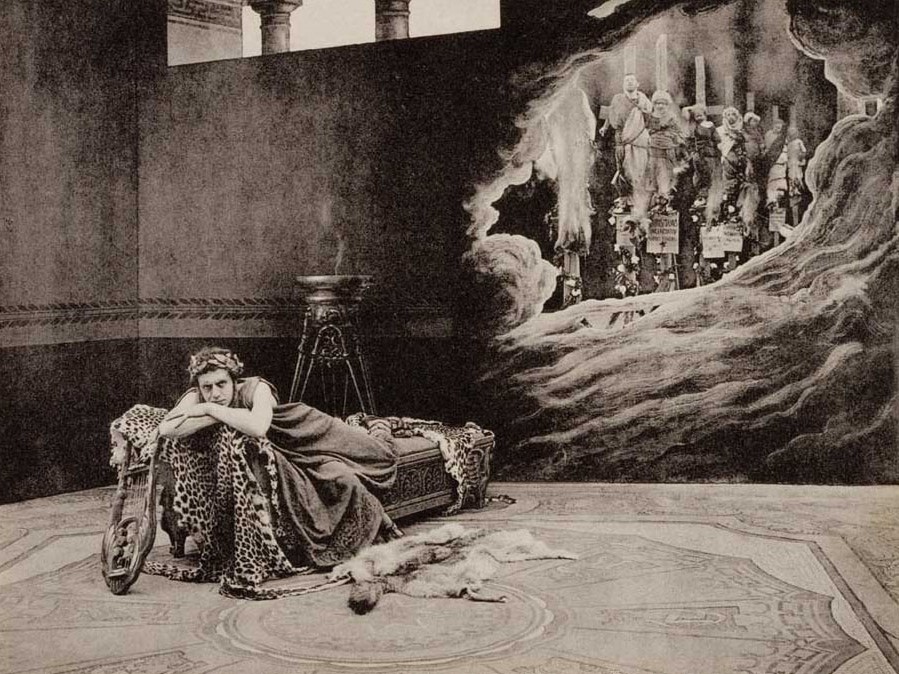
Nerone (original)
1909
Alternative Titles
NERO (Alternative)
NERO; OR, THE BURNING OF ROME (Alternative)
NERO, OR THE FALL OF ROME (Alternative)
NERO UND DIE KAISERIN OCTAVIA (Alternative)
UNTER DER SCHRECKENSHERRSCHAFT EINES RÖMISCHEN CÄSAREN (Alternative)
NERON (Alternative)
BFI identifier
241328For further information on how to access the film and associated materials, check the Notes on the Print under the Technical tab.
Synopsis
The life of Emperor Nero. Based on the dramatic poem by Arrigo Boito. No main title. Nero and his servant talking in the palace. They leave (6). Two men walking along a quiet street at night. As they disappear the servant and Nero appear; the servant holds a cloak around his face. Nero points to something, or someone, unseen and they leave. Nero is going to meet Poppaea (22). Nero leads the Empress Octavia from the temple to the acclaim and adulation of the crowd (87). Nero and Octavia in a garden; she appears to be pleading with him (91). A street in Rome. A maid who has witnessed Octavia's assassination spreads the news of her mistress's murder and shows the veil which is snatched by a man and waved aloft. The crowds follow him (121). Rome is set alight by torch-bearers.; the crowds flee in panic (156). Nero and Poppaea on the tower of the palace, Nero plays a lyre and laughs with Poppaea as they watch Rome burn (167). Gladiators and women feasting and drinking. Nero embracing and kissing Poppaea. Octavia remonstrates with Nero and is pushed roughly away. Nero leaves with Poppaea. Octavia's maid comforts her and leads her away (222ft). Note: Incomplete. The scenes are in the wrong order. The number on the first intertitle frame is 44501. There is nitrate damage on several frames. German intertitles. (Shotlist)
- Production Country: Italy
- Production Company: Torino Società Anonima Ambrosio
- BFI Category: Fiction
- Source: N/A
Cast
Lydia De Roberti (Poppea)
Alberto A. Capozzi (Nerone)
Luigi Maggi (Epafrodite)
Mirra Principi
Mario Voller Buzzi
Serafino Vité
Ercole Vaser
Credits
Director: Luigi Maggi, Arturo Ambrosio
Production Company: Torino Società Anonima Ambrosio
Adaptation: Arrigo Frusta
From the poem by: Arrigo Boito
Director of Photography: Giovanni Vitrotti
Designer: Decoroso Bonifanti
Film Technical Information
- Original Length: 338 m
- Length of BFI Viewing Print: 232 ft
- Support: Viewable
- Black and White
- Format: 35 mm
Comments on the print:
The BFI National Archive holds a 35 mm black-and-white safety negative of 224 ft (68 m.) and a safety positive of 232 ft (71 m.)., based on a tinted nitrate print of 275 ft. (84 m.). This is an incomplete version. In 2018 a collaborative restoration of Nerone was undertaken by Museo Nazionale del Cinema (Turin), Cineteca di Bologna and Cineteca Nazionale (Rome), with the assistance of Eye Filmmuseum (Amsterdam) and Stiftung Deutsche Kinemathek (Berlin). Forming the basis of the restoration were: a nitrate print of the film that had recently resurfaced at the Cineteca di Bologna (unfortunately partly touched by decay); a tinted and also partly decayed Dutch nitrate print from Eye’s Desmet Collection; a dupe print from Rome (of which the nitrate no longer existed); and a 16mm dupe positive from Berlin. The result of the restoration was a near complete version of the film, available in both 35 mm celluloid and digital format. After the 2018 restoration, coloured-in fragments of the film were also found within the Lobster Film collection in France. The film’s original length was 338 m. (Aldo Bernardini, Il cinema muto italiano, Vol. 1905-1909), the restored version measures 291 m. For details of the 2018 restoration, see For details on the restoration, visit http://www2.museocinema.it/restauri/muti_restaurati.php?id=193&l=en
The Museo Nazionale also possesses stills, production photographs, programmes and advertising material.