
1910- Cléopâtre (Pathé frères)
By IVO BLOM
In addition to other early Pathé film titles on antiquity,[1] the BFI National Archive also holds a copy of the 1910 Pathé frères film Cléopâtre (Cleopatra), directed by Ferdinand Zecca and Henri Andréani. The film is mostly based on the French stage play Cléopâtre by Victorien Sardou and Émile Moreau, which was first performed in 1890 and in turn inspired by William Shakespeare’s play. The film was released in France in January 1910.[2] The acclaimed stage actress Madeleine Roch plays the title role, while the dancer Rianza plays a supporting role as the queen’s friend, who will also dance to try and distract her from her grief. In contrast, Stacia Napierkowska plays a messenger who is poisoned after delivering the bad news of the failure of Mark Antony's army against Octavian’s, and dies while dancing in contortion. The sets may have been designed by the Atelier Marcel Jambon, although Jambon himself died in 1908 and the record of his collaboration is not confirmed in the most recent sources, only in an older print held by the Cinémathèque française. As Jean-Pierre Berthomé pointed out in his article, ‘Les décorateurs du cinéma muet en France’ (Berthomé, 2011) , companies like Pathé and Film d'Art in the early years of cinema often rented sets already made for the theatre by workshops like Jambon’s. Also, the name of Jambon was used by his atelier long after his death. As we shall see later on, this may also explain at least some of the design features of the sets for the film Cléopâtre.
There are several copies of the film that survive in a number of archives. In addition to the black-and-white preserved print at the BFI,[3] a new, razor sharp 4K restoration was made by the Fondation Jérôme Seydoux-Pathé based on the original black-and-white negative, deposited at the Cinémathèque française. However, the CNC (Centre National de la Cinématographie) holds an unusual print, that is tinted or coloured with stencils in which Cléopâtre has been extended by inserts from other Pathé films, making it more spectacular but certainly also more incoherent. This print was originally found in the Mexican film archive Filmoteca UNAM and entered the CNC collection through an exchange in 2002, after which it was preserved there. The extended film appears to have been released in 1914. When the competing Italian feature film Marcantonio e Cleopatra (Enrico Guazzoni, Cines 1913) came out in late 1913, it may have caused Pathé to plunder its own catalogue to extend its older film by inserting shots of all kinds of films dealing with antiquity and even beyond, given that it uses battle scene footage from the Hundred Years War from its film La Siège de Calais (1911). Other added fragments came from Messaline (1910), also with Madeleine Roch, and the Biblical films Absalon (1912) and La Fille de Jephté (1913). All four films had been directed by Henri Andréani, the co-director of Cléopâtre, while there was also an inserted sequence from Sémiramis (1911) by Camille de Morlhon, with Yvonne Mirval instead of Roch. Pathé’s attempt to compete with Cines’s film blatantly failed, however, as by 1914 film style had radically changed from 1910. The film’s release was hardly acknowledged.[4] I am basing my analysis mainly on the British copy and the one from the Fondation, but I have also used the CNC version too for comparison. After preserving the print of the Cinémathèque française in the 1990s in an analogue version Claudine Kaufmann, archivist and restorer there at the time, wrote on the pictorial qualities of the film: ‘Cléopâtre transposes the aesthetic universe - if not the virtuosity of execution - of ‘art pompier’ painting. In a succession of tableaux-vivants, the actors, hieratic and majestic, and at the height of tragedy, suspend their movements and assume the pose of an invisible Cabanel.’ (Kaufmann, 1997, p. 111).[5] Yet, the theatrical metareferences may be just as important.[6]
Traditions for Cleopatra
It is difficult to say anything about the real Cleopatra VII Philopator, who was born around 69 BCE and died in 30 BCE. She was queen of ancient Egypt and the last of the Ptolemaic rulers in Egypt. The problem with researching Cleopatra is that ancient literary sources, such as Plutarch, Suetonius and Appian, only mention Cleopatra for her place in Roman history as the seducer of both Julius Caesar and Mark Antony, so theirs is as colourful a version of the queen’s life as Pathé's stencil-coloured films, one could say. Indeed, the image of Cleopatra is a kind of black legend promulgated by Augustan propaganda (Wyke, 2002, pp. 195-243), relayed by poets like Horace, Propertius and Lucan, and Roman historians like Livy, Dio Cassius and Eutropius. Cleopatra challenged the values of the Roman Republic: a woman of political power who posed a threat to Roman virility and virtue. An important woman in a world ruled by men. This is exactly why Cleopatra became so popular with playwrights, novelists, painters and filmmakers: in this Roman-oriented tradition, she is a woman of character, seductive, dangerous, greedy for power, stronger than those around her (including men), cruel, lustful and passionate (Roller, 2010).
One of the most famous plays about her life is William Shakespeare's Antony and Cleopatra, first staged in 1607 and published in 1623. Yet, the play was not performed in Britain between 1660 and 1759, and performances were not well received thereafter. Yet, fuelled by late nineteenth-century Egyptomania (see Lant, 1997), the Victorian desire to criticize individual desire before public duty, and recent successes of the previously unpopular Shakespeare plays Julius Caesar and Coriolanus, Herbert Beerbohm Tree wanted to stage Shakespeare’s Antony and Cleopatra with Constance Collier as the Egyptian Queen (figure 1) and himself as Antony.[7] The play opened in late 1906 and received much praise for its grandiose spectacle, its sets, costumes, and accessories, whilst some voices in the press and even some of the actors involved expressed mixed views about the production. Nonetheless, the play had ninety performances, running until March 1907, and its spectacle would not be surpassed for decades (Richards, 2009: 197, 205-212).
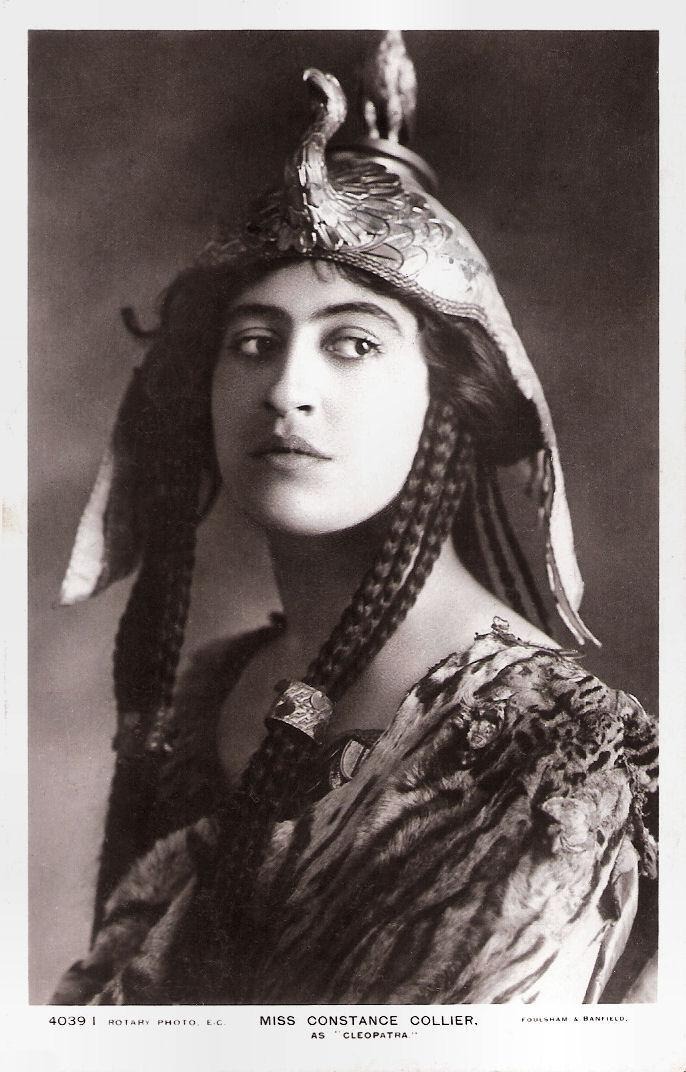
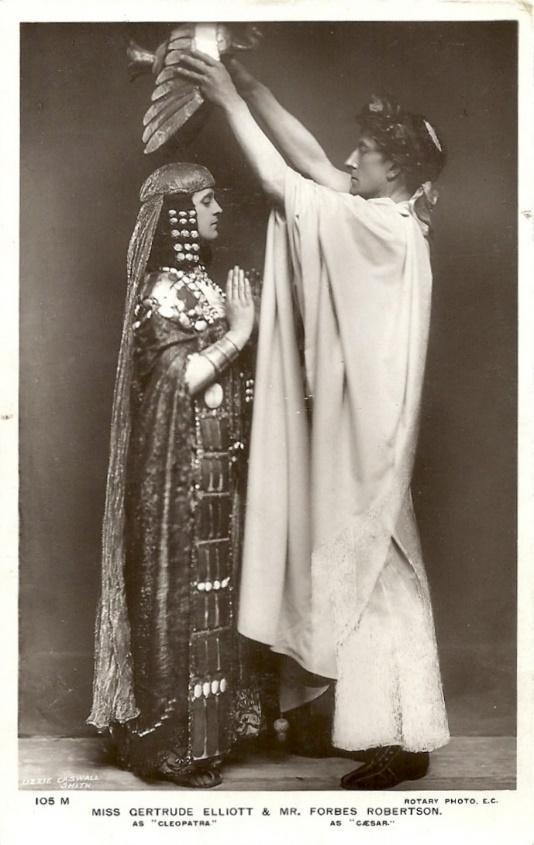
Figure 1. Constance Collier in Antony and Cleopatra (1906-7). Photo by Foulsham & Banfield. Rotary Photo 4019 I.
Figure 2. Gertrude Elliott and Forbes-Robertson in Caesar and Cleopatra (1906-7). Photo by Foulsham & Banfield. Rotary Photo 105 T. Both images are postcards, collection Ivo Blom
In addition to Shakespeare, another important stage play concerning the Egyptian queen was George Bernhard Shaw’s Caesar and Cleopatra. Although written in 1898-99, it was not properly performed before 1906, the same year as Tree’s Antony and Cleopatra. It was first performed - unsuccessfully - by Max Reinhardt in Berlin, but later stagings in New York and London, both with Johnston Forbes-Robertson and Gertrude Elliott in the leads, were more successful (figure 2), even if audiences did not really know how to react to such an idiosyncratic take on the genre of the nineteenth-century toga play. As Jeffrey Richards writes:
Caesar and Cleopatra was Shaw’s response to Shakespeare’s Roman plays which were enjoying a new popularity at the high noon of British imperialism. Shaw was disdainful of both Antony and Cleopatra (‘I have a technical objection to making infatuation a tragic theme. Experience proves that it is only effective in a comic spirit’) and Julius Caesar (‘Shakespear [sic] who knew human weakness so well, never knew human strength of the Caesarian type. His Caesar is an admitted failure’). Utilizing the recognized ingredients of the toga genre (spectacle, lavish sets and costumes, large casts), he created his own version of the story, deliberately intruding anachronisms, inserting a critique of British imperialism and constructing a Caesar who rather than a ruthless dictator enslaved by a grand passion for Cleopatra emerged as a wise and witty analogue of Shaw himself, an intellectually superior being who undertakes to educate the schoolgirl queen for rulership. (Richards, 2009: 229-233; cf. Wyke, 2021).
Yet, despite these two recent British precedents, French theatre is far more obviously the precedent as a more explicit basis for Pathé’s Cléopâtre, whose recourse to the French stage is a phenomenon recurrent in the creation of the classical worlds of several early French films.
Traces of painting in Pathé’s film
As Kaufmann observes above, the Pathé film’s tableaux evoke the pictorial iconography for Cleopatra that developed in the nineteenth century. The closest evocation appears to occur when the body of the poisoned messenger is taken to be thrown over the balcony in the film Cléopâtre (figure 3). Here we see a composition that recalls the cruel queen who tries her poisons on her slaves or prisoners as painted by Alexandre Cabanel (Cléopâtre essayant des poisons sur des condamnés à mort/ Cleopatra Testing Poisons on Condemned Prisoners, 1887, Royal Museum of Fine Arts, Antwerp, figure 4). This was a common visual trope for the queen, less well known but closer to the date of the film is the painting by Suzanne Daynes-Grassot (Cléopâtre essayant des poisons sur des esclaves, exhibited in Paris in March 1910, actual location unknown).[8] Both works were familiar from postcards, prints and other forms of reproduction. As in Cabanel’s painting, so in the Pathé film we see the male slaves carrying the corpse of the poisoned victim away, although the setting has much less depth than in the painting and Cleopatra is not placed in the foreground.
Cleopatra was also portrayed as an ideal of beauty and seduction in her first meeting with Julius Caesar by Jean-Léon Gérôme (Cléopâtre et César/ Cleopatra and Caesar, 1866, private collection), and in her first meeting with Mark Antony by Lawrence Alma-Tadema (The Meeting of Antony and Cleopatra, 1885, private collection).[9] It is intriguing to see that, in the Pathé film, Cleopatra’s barge is presented in two consecutive shots, using deep staging. Once Cleopatra is in it, the barge becomes the focal point at the back, as all the actors in the foreground confirm by turning to pay reverence to the queen. As was quite common on the stage, as well as in early cinema before the emergence of feature films, Cleopatra’s barge sails off sideways to the left and, in the next shot, the barge re-enters sideways from the left at the Roman camp, with real water underneath the clearly rather bidimensional boat. Cleopatra exits the first scene and enters the second in a regal way. In the second shot, Cleopatra holds up and pulls back a large veil to reveal herself, as if she were Aphrodite rising from the sea. The barge is crammed with people (mainly white women and children and black male slaves), recalling the overcrowded barge in William Etty’s The Arrival of Cleopatra in Cilicia (1892, Lady Lever Art Gallery, Port Sunlight, UK). Even if these two sequences do not refer to any painting in particular, the film’s scenario, deposited at the Bibliothèque national de France (BnF), describes the barge in quite pictorial words: ‘In order to seduce him she appears in a galley with purple embroidery, and she lay there in a tent of gold-embroidered cloth.[10]
Most of the nineteenth-century paintings that depict Cleopatra do not show her life but her death. As far back as the Baroque period, Guido Reni (1635-1640, Palazzo Pitti, Florence), Guercino (c. 1648, Palazzo Rosso, Genoa) and others painted the queen who, after the failure of her army and the suicide of Mark Antony, also commits suicide by arranging for a deadly viper to bite her on the breasts, for many painters a convenient classical alibi also for the display of female nudity. It was especially in nineteenth-century art that we see a proliferation of semi-nude or totally nude Cleopatras at the time of her suicide: from German and Austrian painters like German von Bohn (1841, private collection) and Hans Makart (1875, Neue Galerie, Kassel) to English painters like John Collier (1890, Gallery Oldham) and Reginald Arthur (1892, Roy Miles Gallery, London), and from French painters like Jean-André Rixens (1874, Musée des Augustins, Toulouse) and Louis-Marie Baader (1899, Musée des Beaux-Arts, Rennes) to Spanish painters like Juan Luna (1861, Museo del Prado, Madrid) and Italians such as Achille Gisenti (c. 1878-79, Museo Civico, Brescia) and Gaetano Previati (1888, location unknown). Because of reproductions on postcards and lantern plates and as illustrations in magazines and newspapers, images of these paintings became part of the cultural memory of the late nineteenth and early twentieth century, even beyond the heyday of the popularity of the artworks themselves. The compositions often feature a combination of seated and standing women mourning or despairing, which is reproduced in the death scene in the Pathé film (Roberts, 1998). Also, both in the paintings and the film, Cleopatra lies on a sumptuous Egyptianate bed, surrounded by her handmaidens. Refusing to lose her authority as a queen and become instead a slave of Rome, she presses a viper to her breast. Yet, while female nudity was permitted and was common in nineteenth-century painting, it was not in mainstream early cinema.
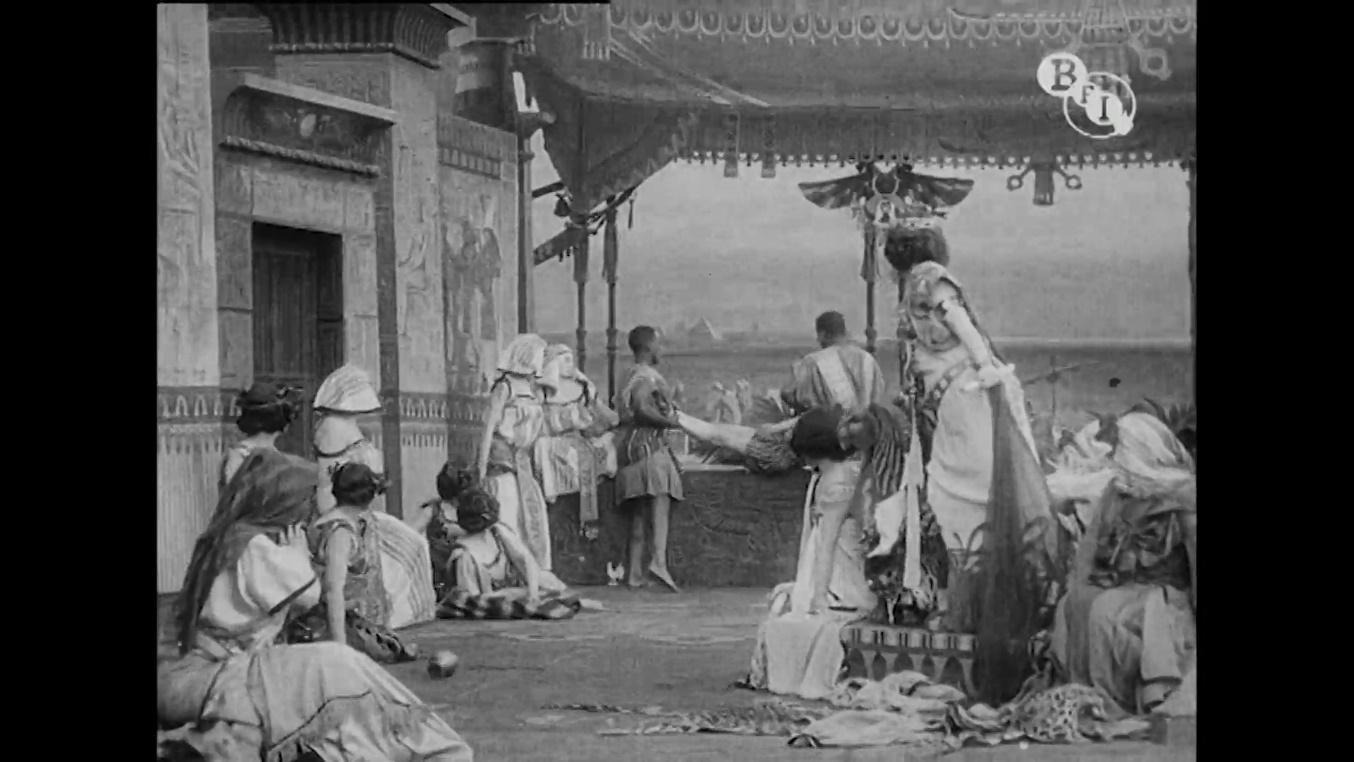
Figure 3. Cléopâtre (1910). Screenshot courtesy of BFI National Archive.
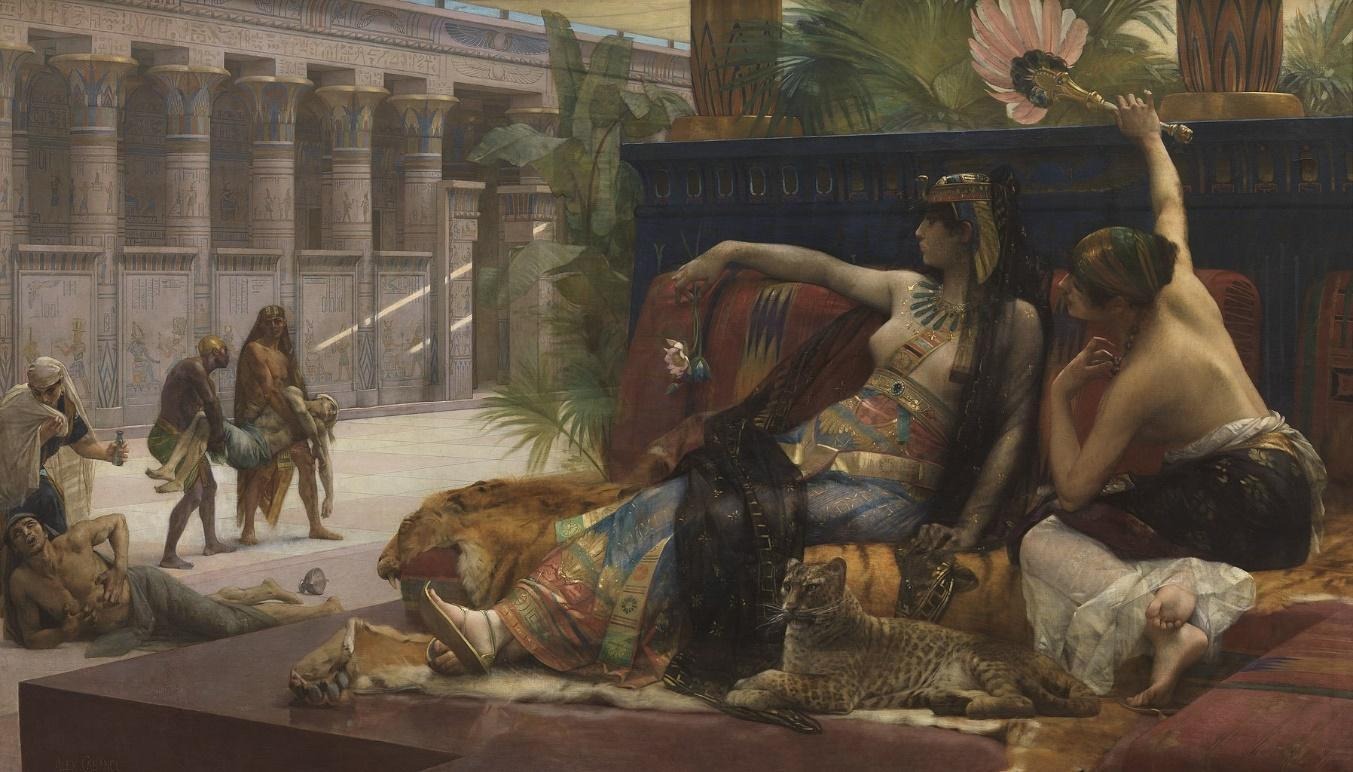
Figure 4 Alexandre Cabanel, Cléopätre testing poisons on condemned prisoners (1887, Antwerp, Royal Museum of Fine Arts). Source Wikimedia Commons: https://commons.wikimedia.org/wiki/File:Cleopatra,_Alexandre_Cabanel,_1887,_Koninklijk_Museum_voor_Schone_Kunsten_Antwerpen,_1505FXD.jpg

The French stage version in comparison to the film
Yet, we need to return to the theatre, because in the context of our film the French stage is much more important even than French painting,[11] in particular the stage play Cléopâtre by Victorien Sardou and Émile Moreau, which was first staged on 23 October 1890 at the Théâtre de la Porte St. Martin in Paris. The main actors were Sarah Bernhardt and Philippe Garnier, who played Cleopatra and Mark Antony. The sets were designed by several people such as Lavastre, Carpezat, Jambon, Rubé, Chaperon, and Lemeunier, while the costumes were designed by Théophile Thomas. Xavier Leroux composed the music for the show.[12] For Bernhardt, it was one of the most important of her stage spectacles. In addition to several photo-portraits by Napoléon Sarony and others, Georges Clairin also painted her in one of her exotic costumes for the play. The original costumes worn by Bernhardt were also put on show at the recent exhibition on Sarah Bernhardt at the Petit Palais in 2023, which also included a drawing by her friend Louise Abbema of Bernhardt as Cleopatra in front of the Sphinx ' (Cantarutti et al., 2023).
I mention the Sardou/Moreau/ Bernhardt play in particular because in an illustration on the cover of the magazine L'Illustration of 25 October 1890 (figure 5) we see several elements that return in the Pathé film. It looks as if the illustration is based on a watercolour of the set design by Adrien Emmanuel Marie which was then transformed into an etching or engraving by Michelet.[13] The set of the stage play was clearly a greater inspiration for the scene of the poisoned messenger in the film than the Cabanel painting. Observe the marquis above Cleopatra, the emblem of the winged bird in the background, and on the left, the two spears, while the messenger wears the same striped shorts (figure 6). If Zecca and Andréani did not see the play, at least they must have seen this illustration of one of the sets and appropriated it for their film. Perhaps there were sets from the play still remaining in the theatre workshops. Further research into the sets and costumes of the play might reveal other similarities with the mise-en-scene of the film. Gouaches by Jean-Baptiste Lavastre survive showing the sets for the Sardou and Moreau play that are still accessible today on the site Gallica, while also available on Gallica are examples of the elaborate stage costumes by Thomas.[14] A year before the Pathé film, Alexandre Benois or Léon Bakst (sources differ) designed sets and costumes for Michel Fokine's ballet Cléopâtre (1909), with Ida Rubinstein in the title role and with Anna Pavlova and Fokine himself as the main characters and dancers. Yet, here I do not see much correspondence between the sets or costumes of the ballet and those of the film.[15] Perhaps the Russian ballet was too modern or ‘modernist’ for the people at Pathé to use as a source, despite the filmmakers evident interest in dance (a troupe of women dancing a sword fight to entertain Antony, Rianza performing an elegant dance for Cleopatra, Stacia Napierkowska enacting the death of the messenger in a contorted dance). Moreover, the plot has little to do with the Shakespearian drama nor the ancient Roman sources, on which Sardou and Moreau had based their own play.
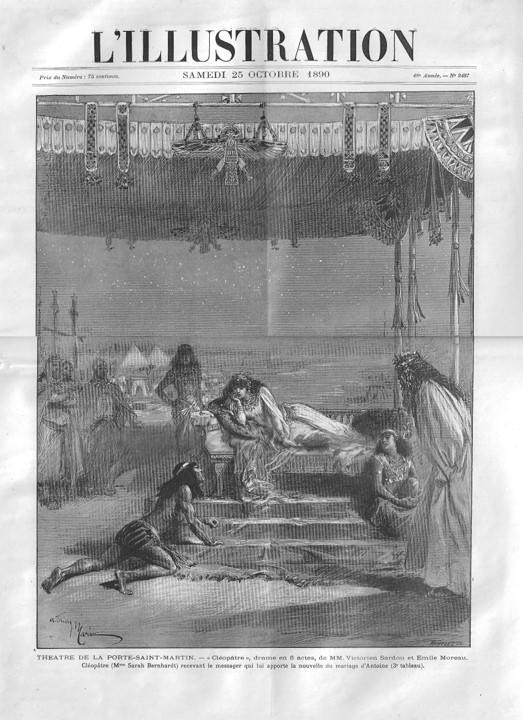
Figure 5. L'Illustration, 25 October 1890. Stage play Cléopâtre by Sardou and Moreau. Collection Ivo Blom.
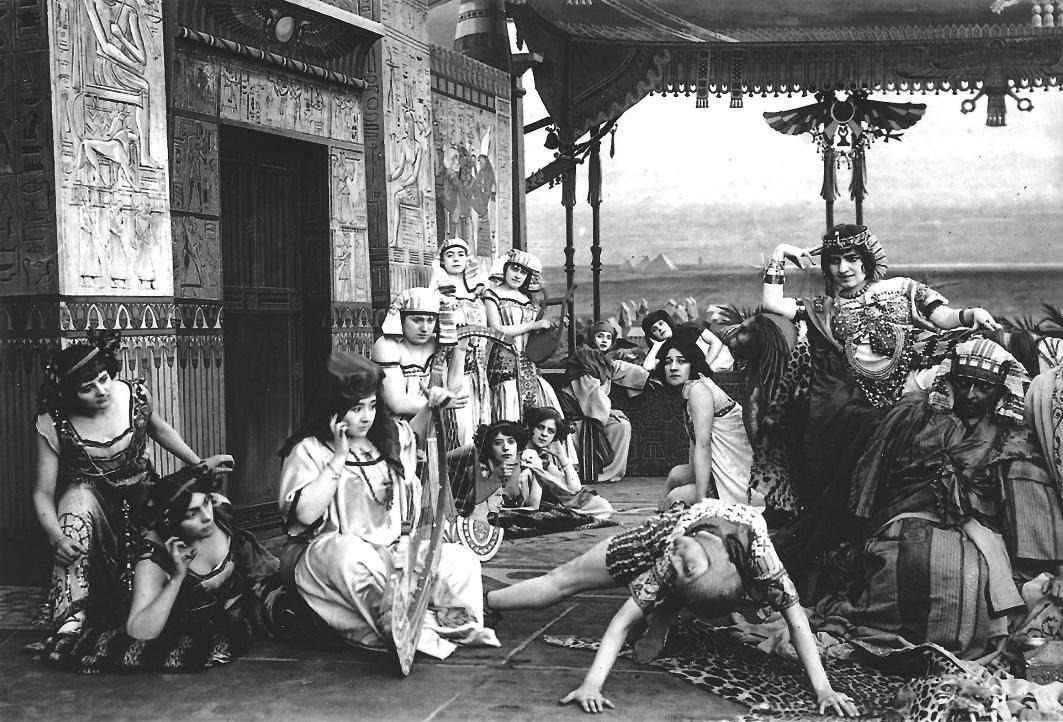
Figure 6. Cléopâtre (1910). Still. Collection Ivo Blom
Film style, acting and cast
Discussing the French pre-feature, single-reel fiction films of the years 1909-1911, Richard Abel remarks in his The Ciné Goes to Town (1994), that unlike their biblical films, ‘Pathé and Gaumont’s “oriental” films not only remain firmly locked into the old tableau style system of narration, refusing their central characters any kind of subjectivity, but also consistently devalue and even demonize the “East” as “feminine”’ (Abel, 1994: 258), as seductive but also cruel. Abel considers the poisoning of the messenger in Cléopâtre as epitomizing ‘the exotic cruelty and “otherness” of Egypt which the film seeks to put on display’(ibid.). Indeed, the Egyptian queen sadistically rejoices in watching the effect the poison has on the messenger who brings the news of Antony’s defeat. She cannot care less when her slaves throw the corpse over the balcony, reminding us once again of the Orientalist visualisation of a cruel and ice-cold Cleopatra in Cabanel’s painting.
Abel notes that the film Cléopâtre was part of a larger Cleopatra craze during 1910, ‘from cigarettes to beauty soap and light bulbs’. He also points out that Pathé launched the film in the USA with a massive campaign in the main cities and in response received rave reviews in, for example, Moving Picture World, Views and Film Index and Pathé Bulletin (ibid. and 516, note 179). He comments adversely on the film’s histrionic acting relative to other films being made at the time and relates it to the traditions of the stage: ‘The acting within these spaces, however, is nowhere as economical as that so characteristic of Film d’Art productions and instead resorts to the tradition of broadly stylized gestures, divorced from the verbal acclamations supporting them on the stage.’ (ibid.).
Madeleine Roch (1883-1930) who played the lead in Cléopâtre was a respected prose theatre actress from the Comédie Française.[16] She worked there from 1903 onward. In her first years at the Comédie, Roch mainly acted in plays by Racine set in Greek and Roman antiquity, such as Andromache, Bérénice, Britannicus, Iphigénie and Phèdre. In these films, she initially had supporting parts, but from at least 1906 onward she was given lead roles, such as Andromache. In the summertime, at the open air Théâtre des Arènes in Béziers, she starred in Le premier glaive (1908), La fille du soleil (1909), Héliogabale (1910), and Les esclaves (1910). She also performed in open air theatre at Orange, Cauterets and Pau. Between 1909 and 1911, Roch acted in various historical shorts, mainly at Pathé, where Andréani directed her in the antiquity-related films Messaline/ Messalina (Ferdinand Zecca, Henri Andréani, 1910) as another cruel and lustful woman from antiquity, Cléopâtre/ Cleopatra (Ferdinand Zecca, Henri Andréani, 1910), and Moïse sauvé des eaux/Moses Saved from the Waters (Henri Andréani, 1911) as the mother of Moses. In 1912, Roch quit film acting, possibly because that year she became ‘sociétaire’ at the Comédie Française.
Intramediality: film vs. film
In addition to these pictorial and theatrical, and therefore trans-medial, links between the Pathé film and earlier representations of Cleopatra, there is also an interesting intra-medial link between it and another ‘Oriental’ Pathé film. Both the BFI and the Fondation Jérôme Seydoux-Pathé have a black and white version of the film Le caprice du vainqueur (The Winner’s Whim), also directed by Zecca and Andréani and made only months after their Cléopâtre. Thanks to Dominique Moustacchi of the CNC, I discovered that a stencil-coloured version of the film also survives there. Apart from this second Pathé film’s beautiful tints and colourings, it also stands out for representing a remarkably anti-Roman and fictional episode during Julius Caesar’s stay in Egypt, in which his highhanded desire for an Egyptian girl is followed by an ‘inflammable’ revenge in which his palace is put to the torch. Equally remarkable is how elements of Cléopâtre's set design have been recycled, such as the large headless, Egyptian-styled statue of a seated man (figure 7), which returns at least twice in various scenes of Le caprice du vainqueur (figure 8). The Egyptianate columns and architraves of Cleopatra’s palace also return in the palace where Caesar holds a decadent feast. In fact, this type of recycling between films also occurred in other studios, as I have indicated for the Cines company (Blom, 2023, pp.143-158) and for the Itala Film company (see my essay on this website for four Itala Films concerning Greco-Roman antiquity). But if it is true that Cléopâtre itself takes up existing theatrical scenic elements, one wonders whether the sets of Le caprice du vainqueur constitute the recycling of already recycled material.
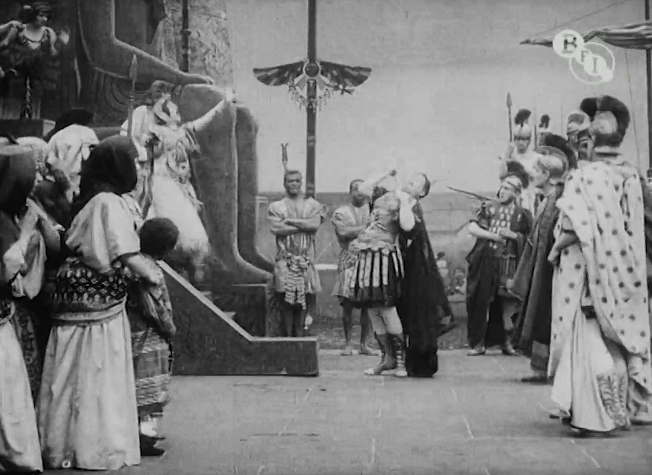
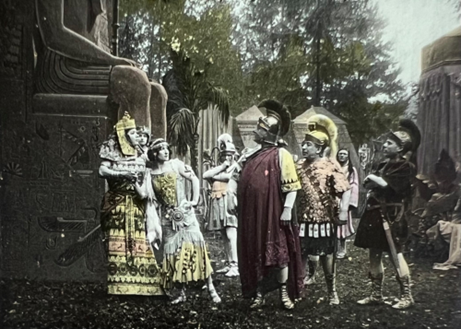
Figure 7. Cléopâtre (1910). Screenshot, courtesy of the BFI National Archive.
Figure 8. Le caprice du vainqueur (1910). Screenshot courtesy of Collection CNC.
The case of the 1910 film Cléopâtre shows how early cinema engaged regularly in both trans-and intra-medial relationships, to utilise the terms deployed by Irina Rajewsky and Werner Wolf (Rajewsky, 2005; Wolf, 2009 and 1999) The traces in Cléopâtre of earlier media are indicative of what is known, in the coinage of André Bazin, as ‘impure cinema’ (see Nagib, Jerslev, 2014). While the recycling of elements of Cléopâtre in Le caprice du vainqueur suggests that the latter film seems to be operating as a kind of Baudrillardian ‘simulacrum’ of ancient Rome, a world that only exists within a chain of visual images of antiquity (Baudrillard, 1994). In an essay pending on this website concerning Le caprice du vainqueur, Maria Wyke will additionally consider how the connections and differences between these two films can be understood in terms of different types of Egyptomania at play in the French Third Republic and how the intramedial relationship between these two films opens up some ambiguities in the seemingly conventional Orientalism of Cléopâtre.
Ivo Blom
Footnotes
- ^ The other films are : Les Martyrs (1905), Amour d’esclave (1907), La Vestale (1908), Le Caprice du vainqueur (1910), and Idylle romaine (1910).
- ^ The site Cine-Ressources claims the film dates from 1909. http://cinema.encyclopedie.films.bifi.fr/index.php?pk=60703&_ga=2.254564175.613582674.1745321674-711878304.1745321674
- ^ The site Cine-Ressources claims the film dates from 1909. http://cinema.encyclopedie.films.bifi.fr/index.php?pk=60703&_ga=2.254564175.613582674.1745321674-711878304.1745321674
- ^ Béatrice de Pastre, Director of Collections and vice-director of Film Patrimony at the CNC, has written a detailed unpublished report on this extended version, which was kindly shown to me. Stéphanie Salmon was co-author of the text.
- ^ Translation by the author.
- ^ Metareference as a trans-medial concept is discussed in Wolf, 2011.
- ^ Tree had just recently played Nero to Collier’s Poppaea in Stephen Phillips’ play Nero, also in 1906.
- ^ Rachel S. Du Forez, ‘Salon des Femmes Peintres et Sculpteurs’, Parigina, 16, 25th March 1910, p. 57.
- ^ There are also portraits of Cleopatra in her majesty and pride by John William Waterhouse (1888, private collection)) and Alma-Tadema (1875, Art Gallery of New South Wales), without a specific narrative.
- ^ BnF, scenario Cléopâtre, https://gallica.bnf.fr/ark:/12148/btv1b6407715p. The script was deposited in 1909.
- ^ In 1885 the French opera Une nuit de Cléopâtre by Victor Massé was performed, but this adaptation of an 1838 novella by Théophile Gautier, does not deal with Mark Antony’s sojourn in Egypt, his defeat by Octavian or Cleopatra’s death.
- ^ For the cover of the music sheet, see https://gallica.bnf.fr/ark:/12148/btv1b84370373.r=cleopatre%201890%20theatre?rk=128756;0.
- ^ Théâtre de la Porte Saint-Martin. Cléopâtre, drame en 5 actes, de MM. Victorien Sardou et Emile Moreau. https://gallica.bnf.fr/ark:/12148/btv1b8437039x.r=cleopatre%201890%20theatre?rk=236052;4
- ^ For the costume designs of the play see e.g. https://gallica.bnf.fr/ark:/12148/btv1b8406002r/f1.item.r=cleopatre%201890%20theatre, for the set designs, see e.g. https://gallica.bnf.fr/ark:/12148/btv1b7000106q.r=cleopatre%201890%20theatre?rk=85837;2.
- ^ For photos and set design of this ballet, see Gallica, e.g. https://gallica.bnf.fr/ark:/12148/btv1b7002862c.r=cleopatre%201909%20fokine?rk=21459;2 and https://gallica.bnf.fr/ark:/12148/btv1b7002861z.r=cleopatre%201909%20fokine?rk=42918;4. NB earlier, the set design was attributed to Alexandre Benois.
- ^ In contrast Stacia Napierkowska (1886-1945) almost always would have a dance scene in her films, such as her almost hysterical dance in La tragica fine di Caligula Imperator (Ugo Falena, 1917).
Abel, R. (1994) The Ciné Goes to Town: French Cinema, 1896-1914. Berkeley/ Los Angeles: University of California Press.
Baudrillard, J. (1994) Simulacra and Simulation. Ann Arbor: University of Michigan Press.
Berthomé, J. (2011), 'Les décorateurs de cinéma en France', 1895, 65(65), pp. 90-111. DOI: 10.4000/1895.4437.
Blom, I. (2023) Quo vadis?, Cabiria and the ‘Archaeologists’: Early Italian Cinema’s Appropriation of Art and Archaeology. Turin: Kaplan.
Cantarutti, S., Champy-Vinas, C. et al. (2023) Catalogue Sarah Bernhardt: Et la femme créa la star. Paris: Petit Palais, Musée des Beaux-Arts de la Ville de Paris.
Kaufmann, C. (1997) ‘Au commencement, il y a l’image. Journal de la restauration (1)’, Cinémathèque, 11 (Spring), p. 106-115.
Lant, Antonia (1997). ‘The curse of the Pharaoh, or How cinema contracted Egyptomania’, in: Matthew Bernstein & Gaylyn Studlar eds., Visions of the East: Orientalism in Film, London: I.B. Taurin, pp. 69-98. This text originally appeared in the journal October, 59, Winter 1992, pp. 87-112.
Nagib, L. and Jerslev, A. (eds.) (2014) Impure Cinema: Intermedial and Intercultural Approaches to Film. London: I.B. Tauris.
Rajewsky, I. O. (2005) 'Intermediality, intertextuality, and remediation: A literary perspective'. Intermédialités, 6, pp. 43-64.
Richards, J. (2009) The Ancient World on the Victorian and Edwardian Stage. London/New York: Palgrave MacMillan.
Roberts, H.E. (ed.) (1998) Encyclopedia of Comparative Iconography: Themes Depicted in Works of Art. Chicago; London: Fitzroy Dearborn.
Roller, D.W. (2010) Cleopatra: A Biography. Oxford/ New York/ Auckland: Oxford University Press.
Wolf, W. (1999)The Musicalisation of Fiction: A Study in the Theory and History of Intermediality. Amsterdam/ New York: Rodopi.
Wolf W. et al. (2009). Metareference Across Media: Theory and Case Studies. Amsterdam/ New York: Rodopi.
Wolf, W., with Bantleon, K., and Thoss, J. (ed.) (2011) The Metareferential Turn in Contemporary Arts and Media: Forms, Functions, Attempts at Explanation. Amsterdam: Rodopi.
Wyke, M. (2002). The Roman Mistress: Ancient and Modern Representations. Oxford: Oxford University Press.
Wyke, M. (2021) ‘Lessons in History: Bernard Shaw’s Discomforting Caesar’, in R. Rajaand and T. A. Hass (eds.), Caesar’s Past and Posterity’s Caesar. Series Rome Studies. Archaeology, History and Literature vol. 1. Turnhout: Brepols, pp. 199-212.