
login

MUSEUM of DREAMWORLDS

MUSEUM of DREAMWORLDS

Silent Antiquity Films in the BFI National Archive

← Back to all films Film CardImage

Cléopâtre (original)

1910

Alternative Titles

Cleopatra (Alternative), Kleopatra (Alternative)

BFI identifier

22344

Synopsis

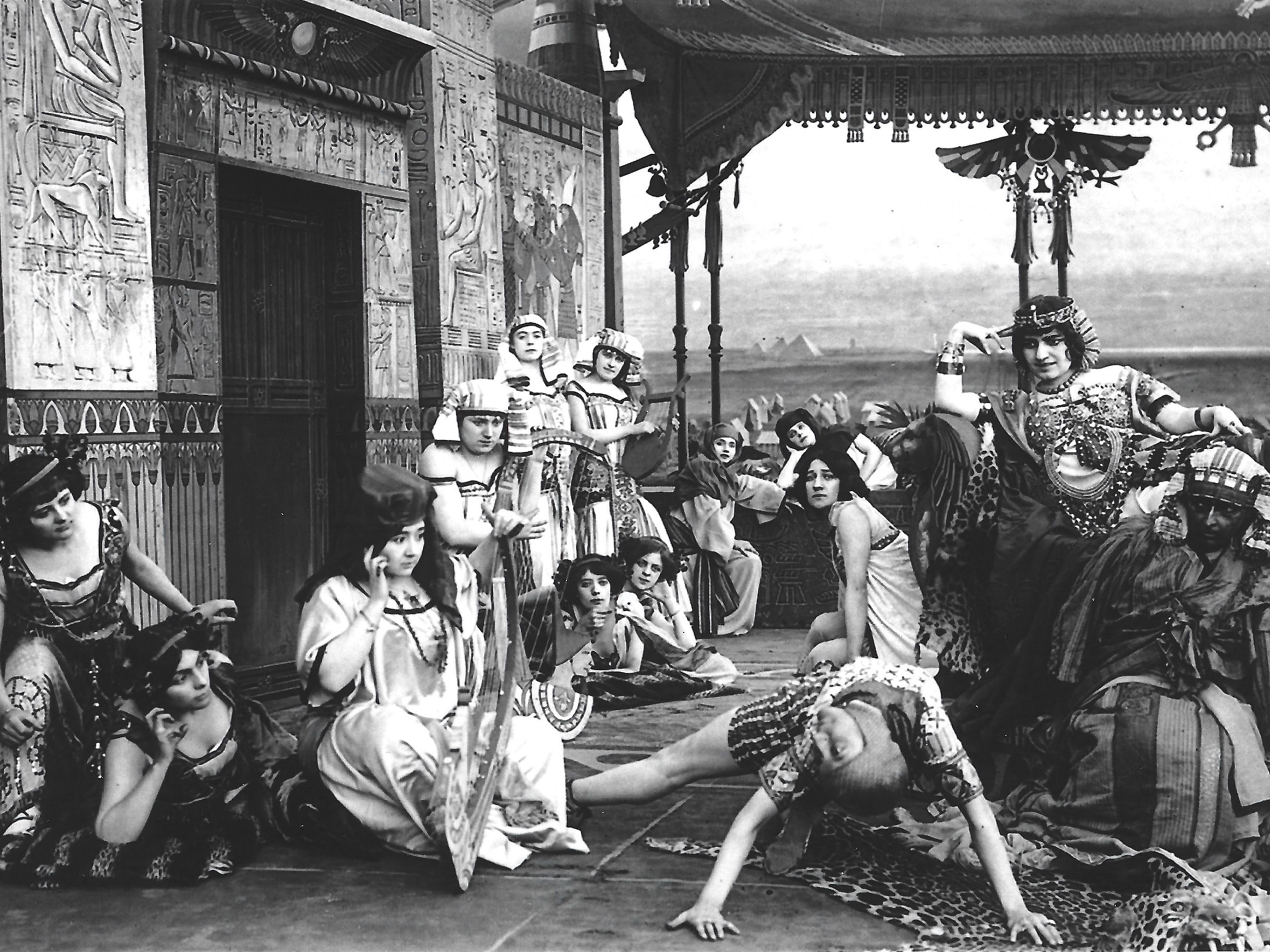
The story of Cleopatra, Queen of Egypt, and her love for the Roman Mark Antony. Cleopatra is seen at her court prior to departing for Mark Antony's camp. Mark Antony receives Cleopatra at his camp. After she has alighted from her boat he dismisses all his company and then, watched by Octavius, he declares his love for Cleopatra before leaving with her on the boat. Later at the Roman camp, Mark Antony dismisses Octavius who has been critical of him for his infidelity. In Egypt, Mark Antony and Cleopatra are seen enjoying entertainments - dancing, gladiators, etc. Octavius arrives and declares war on Mark Antony. Cleopatra, relaxing in an apartment overlooking the pyramids, is bought news of Mark Antony's defeat by a messenger. She is angry and has the messenger poisoned. Mark Antony stabs himself and the Romans rush Cleopatra's palace. She retires to an inner room where she poisons herself with an asp bite. Octavius rushes in to find her dead (868ft). Incomplete. (Shotlist)


Production Country: France
Production Company: Pathé Frères
BFI Category: Fiction
Source: N/A

Cast

Madeleine Roch (Cleopatra)
Stacia Napierkowska (Le Message)
Rianza (La Danseuse)
Jeanne Bérangère

Credits

Director: Ferdinand Zecca, Henri Andréani
Décors: Jambon
Production Company: Pathé Frères
Script: Ferdinand Zecca, Henri Andréani

Film Technical Information

Original Length: 355 m
Length of BFI Viewing Print: 250 m
Support: Viewable
Black and White
Format: 35 mm , Digital Betacam

Comments on the print:

The BFI holds an original, tinted and stencil-coloured nitrate print of this film of 900 ft. (274 m.). It stems from the renowned Abbé Joye Collection and has German intertitles, but lacks the main title card. It was preserved in 1980 on black-and-white safety stock (the positive measures 819 ft./ 250 m.). Later on, a digital version of the film was also made. In 2024, the Fondation Jérôme Seydoux-Pathé had a new, razor sharp 4K restoration made at the Immagine Ritrovata film lab, based on the original black-and-white negative, deposited at the Cinémathèque française. The CNC (Centre national de la cinématographie) in Paris preserved a 560 m. long tinted and stencil-coloured print, originally at the Filmoteca UNAM in Mexico. This is a reworked version that came out in 1914 and to which fragments from several other historical films by Pathé were added to let the film compete with the Cines epic then in circulation -Marcantonio e Cleopatra (1913) directed by Enrico Guazzoni.      

Source for original length: from the FJSP website pathe.com/document/cleopatre/5fdd2ae2af99ca9e7f2816c6?pageId=60cb022c6fb6ab1f3a2a538a&q=cleopatre&pos=1

Printed Materials

Cléopâtre
Slide Image failed to load...
Cléopâtre : film de Henri Andreani : scénario
Cléopâtre
Slide Image failed to load...
Cléopâtre : film de Henri Andreani : scénario
BnF
Slide Image failed to load...
BnF Pathé-Cléopâtre : film de Henri Andreani : scénario (résumé conforme à la vue) avec photogrammes
BnF
Slide Image failed to load...
BnF Pathé-Cléopâtre : film de Henri Andreani : scénario (résumé conforme à la vue) avec photogrammes
BnF
Slide Image failed to load...
BnF Pathé-Cléopâtre : film de Henri Andreani : scénario (résumé conforme à la vue) avec photogrammes

Visual Resources

Photographie
Slide Image failed to load...
Photographie d'exploitation-Cléopâtre, par Ferdinand Zecca, par Henri Andréani - Scènes dramatiques et réalistes (8ème Série)-
Photographie
Slide Image failed to load...
Photographie d'exploitation-Cléopâtre, par Ferdinand Zecca, par Henri Andréani - Scènes dramatiques et réalistes (8ème Série)-
Photographie
Slide Image failed to load...
Photographie d'exploitation-Cléopâtre, par Ferdinand Zecca, par Henri Andréani - Scènes dramatiques et réalistes (8ème Série)-
Photographie
Slide Image failed to load...
Photographie d'exploitation-Cléopâtre, par Ferdinand Zecca, par Henri Andréani - Scènes dramatiques et réalistes (8ème Série)-
Photographie
Slide Image failed to load...
Photographie d'exploitation-Cléopâtre, par Ferdinand Zecca, par Henri Andréani - Scènes dramatiques et réalistes (8ème Série)-
Photographie
Slide Image failed to load...
Photographie d'exploitation-Cléopâtre, par Ferdinand Zecca, par Henri Andréani - Scènes dramatiques et réalistes (8ème Série)-
Cléopâtre,
Slide Image failed to load...
Cléopâtre, par Ferdinand Zecca, par Henri Andréani - Scènes dramatiques et réalistes (8ème Série)
Cléopâtre
Slide Image failed to load...
Cléopâtre (Pathé, 1910) Still from the early French film Cléopâtre (Ferdinand Zecca, Henri Andréani, Pathé Frères, 1910).
Cléopâtre
Slide Image failed to load...
Cléopâtre Bergeret (4) Vintage French postcard, 1900s-1910s. Cliché Morinel, Nantes

1910 - Cléopâtre and Le Caprice du vainqueur: Roman Egypt in Paris

Cléopâtre, as the first in the Pathé studio’s Série d’Art, places the queen theatrically at the centre of a resplendent Orientalist tableau filled with pharaonic monuments, lotus leaf pillars, exotic canopies and couches, black slaves, leopard skins and feathered fans, all showcased in stencil colour. Digging into the archaeology of this Egyptian environment played out before a French camera in a cold January exposes its colonialist tropes: the dangerous queen seduces Mark Antony but is overcome by Octavian, the true embodiment of the masculine West. However, the colonial rhetoric of the film turns out to be more complicated when compared with the Pathé film Le caprice du vainqueur with which it had been paired. Here Julius Caesar, as the embodiment of the Western imperialist in Egypt, is cruel and licentious. His demand that an innocent girl dance before him results in an uprising by the Egyptian people who burn down the palace and oust him from it. Overturning the discourses of colonialism, the West is here temporarily defeated by the East. This analysis explores how these two films shape Roman Egypt according to a complex, distinctively French, brand of Orientalism played out within a late nineteenth-century French culture of Egyptomania.

1910- Cléopâtre (Pathé frères)

In addition to other early Pathé film titles on antiquity,  the BFI National Archive holds a copy of the 1910 Pathé frères film Cléopâtre (Cleopatra), directed by Ferdinand Zecca and Henri Andréani. The film is mostly based on the French stage play Cléopâtre by Victorien Sardou and Émile Moreau (1890), which was in turn inspired by William Shakespeare’s play, but it also bears similarities with nineteenth-century painting. The film contains a typical tableau-like style and histrionic acting, reminiscent of the stage. The lead role was performed by the acclaimed stage actress Madeleine Roch, who previously had acted in several stage plays set in antiquity and acted in various historical films at Pathé around 1910. Cléopâtre also typically follows the Western Orientalist tradition in representing the East as feminine and cruel.