
login

MUSEUM of DREAMWORLDS

MUSEUM of DREAMWORLDS

Silent Antiquity Films in the BFI National Archive

← Back to all films Film CardImage

Pygmalion and Galatea

1912

Alternative Titles


BFI identifier

333681

Synopsis

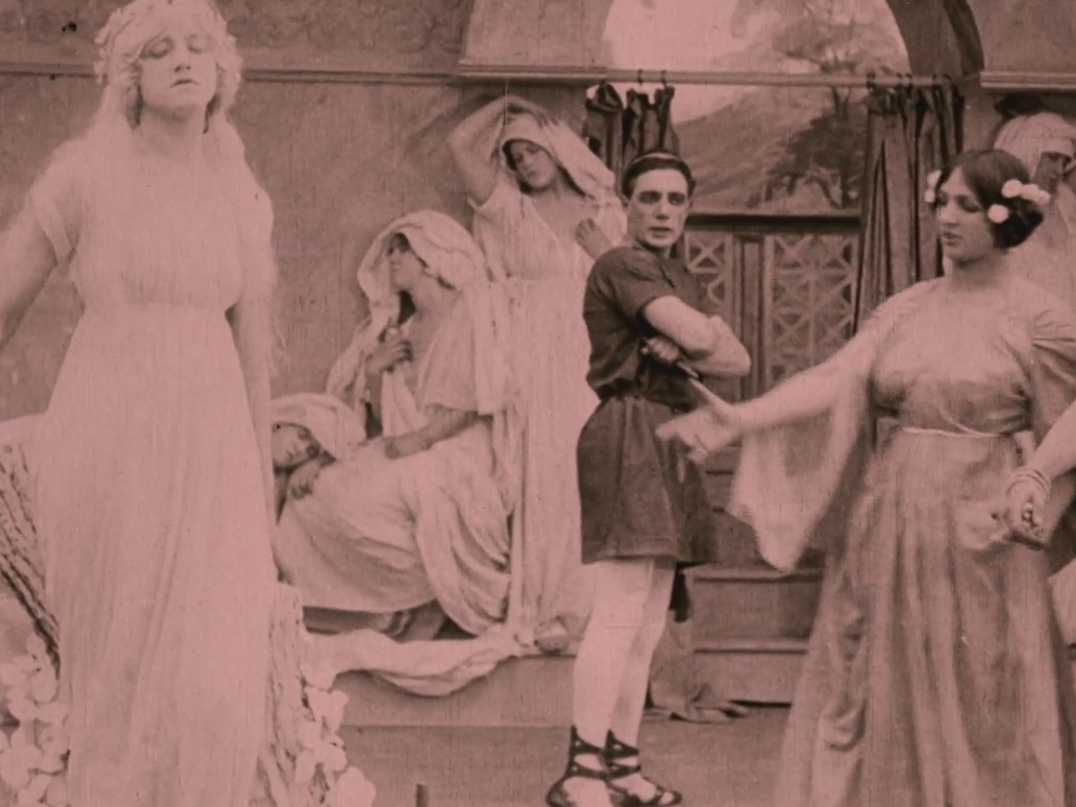
Story of Pygmalion and Galatea. Based on the Roman poet Ovid's Metamorphoses. Main title. (1) Intertitles. (13) Pygmalion is seen at work on his sculpture, scorning the attentions of several women who come to see him. In the next scene various women are seen relaxing in gardens along a riverbank. Pygmalion arrives and asks Venus to bring his statue to life. He is then seen returning to his studio and is teased by some women. On arrival at his studio he is disappointed to find his statue is still of stone. He offers a prayer to the goddess and the statue comes to life. A maid(?) sees what has happened and calls to other women who are amazed at what has happened (601ft) (Shotlist)


Production Country: British
Production Company: Ivy Close films
BFI Category: Fiction
Source: N/A

Cast

Director: Elwin Neame

Ivy Close (Galatea)

Extras: Alma Taylor, Chrissie White

Distribution: Hepworth

Credits

[Based on the poem by]: Ovid

Film Technical Information

Original Length: 625 ft.
Length of BFI Viewing Print: 601 ft.
Support: Viewable
Colour
Format: 35 mm

Comments on the print:

The print at the BFI of Pygmalion and Galatea (Elwyn Neame, Ivy Close Productions, 1912) is unique, as far as we can tell. The BFI has a 35mm black and white positive viewing print of 601 feet, preserved in 1983 from a tinted nitrate positive print of 725 feet, printed on stock of 1924. A ProRes version is available of unknown duration. NB the digital version on our website ihas one tint throughout the film. Based on descriptions in the press (see The Cinema, December 1912, supplement Films, p. 69), the original length was 625 ft and the film thus looks fairly complete. The print has English intertitles. In the past, the film was listed tentatively by the BFI as A Sculptor's Romance

Visual Resources

Pygmalion
Slide Image failed to load...
Pygmalion (Albert Guillaume, s.a.) Vintage French postcard. 7178, Braun & Cie Editeurs, Salons de Paris. 1910s.

1 - Introduction to website & project

In this introductory essay, we explain the layout and features of the Museum of Dreamworlds website, in order that you can see how to navigate it and make it useful for you. We explain the methods behind our inquiries and survey some of our research findings. We also indicate here some of our project’s other activities and future resources that we will be creating until and beyond the end point of the project in November 2027. We will be developing and extending this introduction as we continue to analyse the antiquity films in the BFI. At this stage, the website is also a work in progress so we would greatly welcome any questions you may have as well as suggestions for corrections, clarifications, additions or improvements, or notification of any malfunctions. We can be reached at: museumofdreamworlducl@gmail.com

1912- Sculpture and the Pygmalion myth: Pygmalion and Galatea

Among the silent antiquity prints in the BFI, we have recently been able to identify the 1912 British film Pygmalion and Galatea, previously considered lost. The original story for the film’s representation of the Cypriot sculptor Pygmalion is Publius Ovidius Naso’s Metamorphoses (1-8 AD). Two recent studies by Victor Stoichita and Paula James have productively explored the centrality to cinema of Ovid’s mythic tale in which the stone of Pygmalion’s creation is transformed into female flesh. Yet, closer in time to the film lies the influence of nineteenth-century ‘Pygmalionism’ in art and theatre, as well as the myth’s development in earlier European cinema