1912- Sculpture and the Pygmalion myth: Pygmalion and Galatea
By IVO BLOM with MARIA WYKE
Within the archival collections of the British Film Institute, we have recently been able to identify the 1912 British film Pygmalion and Galatea, previously considered lost. We were helped in elements of the identification by members of the association Domitor,[1] which specialises in early cinema research. The original story for the film’s representation of the Cypriot sculptor Pygmalion is of course Publius Ovidius Naso’s Metamorphoses (1-8 AD). Two recent studies by Victor Stoichita and Paula James have productively explored the centrality to cinema of Ovid’s mythic tale in which the stone of Pygmalion’s creation is transformed into female flesh. Yet, closer in time to the film lies the influence of nineteenth-century ‘Pygmalionism’ in art and theatre, as well as the myth’s development in earlier European cinema. But first the film itself.
Pygmalion and Galatea (Elwyn Neame, Ivy Close Productions, 1912)
The film opens with Pygmalion in his studio busy at work on his sculpture of a woman clad in voluminous drapery. He scorns the attentions of several frivolous women who come to see him as he adores his sculpture of female beauty. In the next scene shot on location, various women are seen relaxing in gardens beside a riverbank. Pygmalion arrives there, planning to ask Venus to bring his statue to life. At Venus’ court, the goddess is evidently troubled by the competition in beauty that Pygmalion’s request will entail (figure 1). Yet she does light a symbolic fire indicating that she will give life to his statue. Returning to his studio, however, Pygmalion is disappointed to find his statue is still of stone. Praying to the goddess, at first he doesn’t notice when the statue starts to come to life. When he does, he is awestruck. A woman, one of Pygmalion’s suitors from earlier on, sees what has happened and calls to the others who are amazed at what they see. They all praise Venus for this miracle (figure 2). Real women feature in Pygmalion and Galatea as suitors of the sculptor, witnesses to his approach to Venus and celebrants of her generosity. In addition, the sculptor’s studio curiously displays actresses in elaborate drapery posed against its walls as if they too were decorative statues. They have been whitened to stress their ambiguity. This play within the film between real and man-made women is notable as is its relative conservatism with regard to the exhibition of female flesh.
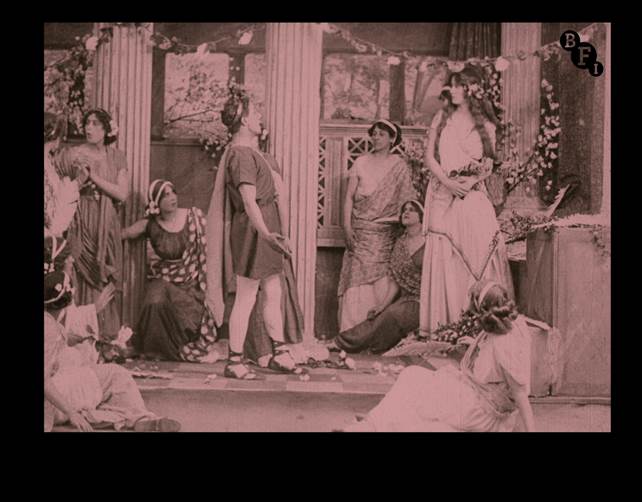
Figure 1. Pygmalion at the court of Venus entreating life for his statue. Pygmalion and Galatea (1912). Print BFI National Archive.
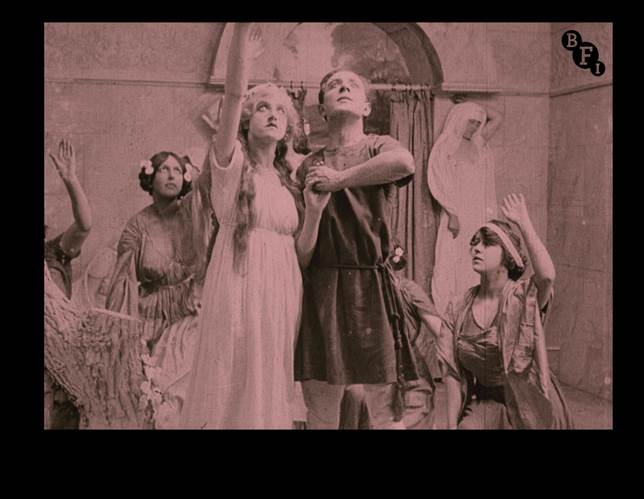
Figure 2. All praise Venus after the statue of Galatea has come alive. Pygmalion and Galatea (1912). Print BFI National Archive.
The British film Pygmalion and Galatea was made by the company Ivy Close Films, shot at the studio of the director Cecil Hepworth in Walton-on-Thames, and distributed by him. The director of the film was British filmmaker Elwin Neame (1885-1923), father of the later filmmaker, producer and screenwriter Ronald Neame and of author and screenwriter Derek Neame. The female star of the film was Neame’s wife Ivy Close (1890-1968), who in 1908 had won a beauty contest run by the tabloid Daily Mirror, and was then promoted as ‘the most beautiful woman in the world’ - as many British early twentieth-century postcards of her confirm. Neame, a reputed portrait photographer, married Close in 1910 and started out as a director in the British film industry under the aegis of Hepworth. In 1912, Close and Neame founded their own production company, Ivy Close Films, with Hepworth acting as distributor. According to the BFI catalogue and IMDb, the company made 13 or 14 films during the years 1912-1915, including The Lady of Shalott (1912) and Sleeping Beauty (1912). Neame was often not only director but also cinematographer and screenwriter of the films. Many of the couple’s films are now lost. In addition to Pygmalion and Galatea, the BFI only has a print of Sleeping Beauty, plus an attractive poster of the film can be found in the collection of the Eye Filmmuseum. It is clear that in Pygmalion and Galatea Ivy Close plays Galatea – the name given only from the nineteenth century to the statue that comes alive. Among the extras there may have been the Hepworth actresses Chrissie White and Alma Taylor, but we do not know yet who played Pygmalion. After her career at Hepworth, Close would briefly act in American cinema but returned to act in British silent films of the late teens and early twenties, being directed by e.g. Maurice Elvey and Percy Nash, and performing opposite such popular male actors as Matheson Lang and Gerald Ames. Yet, Close’s most famous part in film history is in the French film La Roue (1923) directed by Abel Gance.
But what is the context for the short film Pygmalion and Galatea beyond its production history? What is the significance to it, and to silent cinema more broadly, of the myth of Pygmalion?
The art of realism and its gendering
In his study The Pygmalion Effect. From Ovid to Hitchcock (2008), Victor I. Stoichita writes: ‘The history of the Cypriot sculptor who falls in love with his work, which the gods, in an extreme moment of magnanimity, decide to bring to life, is the first great story about simulacra in Western culture’ (Stoichita, 2008: 3). As Stoichita explains, in the myth of Pygmalion his statue is not a copy of a human female, but the ‘fruit of his imagination and of his “art” [..], a fantasy’ (Stoichita, 2008: 3). Stoichita here clearly draws attention to the fantastic or fictional aspect of the Galatea statue, which is crucial to analysing representations of the myth of Pygmalion from art works to films. Yet Stoichita himself also acknowledges the close relationship established by the Roman poet between the statue and human flesh, noting that in Ovid’s original tale the statue is made of ivory, not marble, which already suggests a kind of carnal whiteness, instead of pure inanimate white (see also James, 2011: 18). It is in this mix of fantasy and realism that lies the essence of the mythological statue and its representations. Stoichita acknowledges how representations of Ovid’s tale are strongly intermedial. In his discussion of works like those of Gérôme, he observes how painting encompasses sculpture. But there is also the issue of representing stillness in the art of movement: that is, how the medium of cinema encompasses the visual arts. Relevant in this context, though not mentioned by the author, is Oskar Messter’s filmic experiment Akt-Skulpturen. Studienfilm für bildende Künstler (1903), of a real nude couple posing as if they are statues who don’t move (as this was not permitted). Yet the couple stands on a gyrating disc that shows them from all sides, a living sculpture, distinguishing the film medium from paintings of nudity.
In her monograph Ovid’s Myth of Pygmalion on Screen: in Pursuit of the Perfect Woman (2011), Paula James considers among other things how the Ovidian tale and its later representations engage with gender and sexuality. She pointedly remarks that in the second series of influential paintings on the Pygmalion tale by Edward Burne-Jones we see in the first picture the Three Graces, yet in the Renaissance these handmaids of Venus were used as signs outside brothels. Their presence in the work of Burne-Jones thus suggests that Ovid’s tale is not as innocent as it may appear but has a sexual dimension. A common topos in paintings is the sculptor’s embrace of his creation once she has come alive as Galatea. James observes that in Ovid’s epic poem Pygmalion and Galatea have a child nine months after her animation (James, 2011: 1). The embraces depicted regularly in paintings may then sexualise the ‘birth’ of the sculptor’s creation. Ovid also explains his tale as following on from the shameful lives of the women of Cyprus who behave like prostitutes and scorn Venus. It is Pygmalion’s abhorrence of their behaviour that propels him to ask Venus for a bride like the ideal of femininity he has been attempting to create in his statue. Within this moralising framework, art is presented as a masculine activity, and real women are wholly inferior to those created by men.
Pygmalionism in nineteenth-century art & theatre
To understand better the strategies of the 1912 film Pygmalion and Galatea, we need to focus on what shortly preceded the film and may well have created the cultural platform for it - that is the immensely popular ‘Pygmalionism’ in the art and theatre of the nineteenth century. In The Ancient World on the Victorian and Edwardian Stage (2009), Jeffrey Richards makes clear that even if the subject was well-known in former centuries, the nineteenth saw a wave of Pygmalionism, full of lifelike statues, artists falling in love with their works, and statues coming alive: ‘The obsession with statues of women became a classifiable form of erotomania dubbed by Havelock Ellis “Pygmalionism” after the mythical Greek sculptor. This stemmed in part from the view that sculptures should be as lifelike as possible. As John Ruskin put it, “It is the function of the best sculptor – the true Daedalus – to make stillness look like breathing, and marble look like flesh.”’ (Richards, 2009: 66). The Pygmalionist trend was soon mocked by caricaturists such as Honoré Daumier, who let Galatea (1842, Minneapolis Institute of Art) immediately reach for a pinch of her maker’s snuff as soon as she was revived.
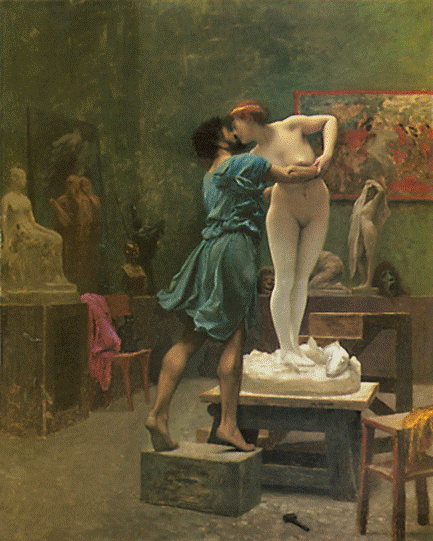
Figure 3. Pygmalion and Galatea (Jean-Léon Gérôme, 1889, private collection). Source: https://commons.wikimedia.org/wiki/File:Pygmalion_and_Galatea_(G%C3%A9r%C3%B4me)_front_1.jpg
_front_1.jpg)
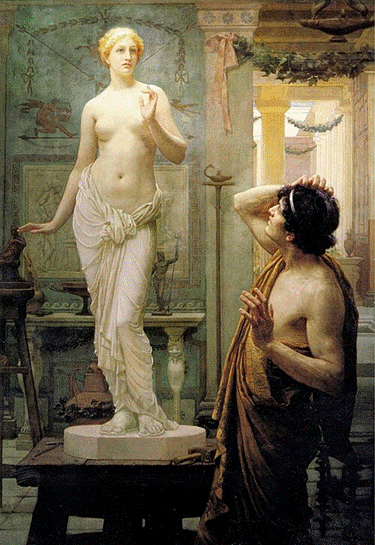
Figure 4. Pygmalion and Galatea (Ernest Normand, 1886, Atkinson Art Gallery, Southport, UK). Source: https://commons.wikimedia.org/wiki/File:Pygmalion_and_Galatea_(Normand).jpg
.jpg)
Important reference points for Pygmalionism in nineteenth-century art include three paintings by the French artist Jean-Léon Gérôme, who, with Working in Marble (1890, Dahesh Museum of Art, NY), Pygmalion and Galatea (1890, Metropolitan Museum of Art, NY, figure 3), and Pygmalion and Galatea (1889, private collection), painted the live model becoming a statue as well as the statue becoming a live woman that causes the sculptor to hold her in a passionate embrace. Other artists like Giorgio Bargellini in Italy (Pigmalione, 1896, Galleria Nazionale d’Arte Moderna, Rome) and Ernest Normand in the UK (Pygmalion and Galatea, 1886, Atkinson Art Gallery, Southport, figure 4) accentuated the awe of the artist during the act of his statue’s metamorphosis. Within the British context, Edward Burne-Jones' four-part cycle on the Pygmalion myth, depicted twice in 1867–1870 (private collection) and in 1875-78 (Birmingham Museum and Art Gallery), are also key works. Furthermore, in addition to art, the British stage was also an important site for the phenomenon, in particular because of the stage play Pygmalion and Galatea (1871) written by W. S. Gilbert and first performed at the Haymarket Theatre in 1871, with William Kendall and his wife, Madge Robertson (figure 5). It was an enormous success achieving a run of 184 performances (Richards, 2009: 72-75) . Afterwards more Pygmalion plays inevitably followed, including a British stage version after Franz von Suppé’s popular operetta Die schöne Galathée (1865). Popular revivals of Gilbert’s play occurred in the 1880s starring Mary Anderson and Lily Langtry (Richards, 2009: 82-89, 92-93). In the works of both Gilbert and Von Suppé, Galatea becomes a statue again at the end – in Gilbert’s case she decides herself to become stone again, while in Von Suppé’s it is Pygmalion who implores Venus to turn her back into stone after discovering that she is cheating on him with his assistant Ganymede, an outcome which is also visible in early twentieth-century French postcard series, like those by A & S (Saint-Just) that depicted famous operas and operettas (figure 6). In Ovid’s epic, this second metamorphosis does not happen, but according to Jeffrey Richards this alternative ending better fitted nineteenth-century male morals (Richards, 2009: 73), in which women would return to their pedestals after having been liberated from them.
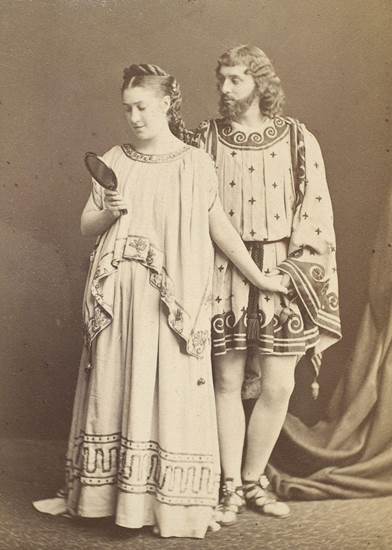
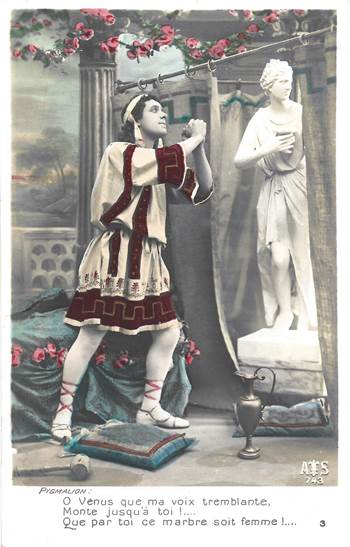
Figure 5. Postcard of William Hunter Kendal and his wife Madge Kendal in the W. S. Gilbert play Pygmalion (1871). Source: https://upload.wikimedia.org/wikipedia/en/b/b1/Kendals-Pygmalion-1871.jpg
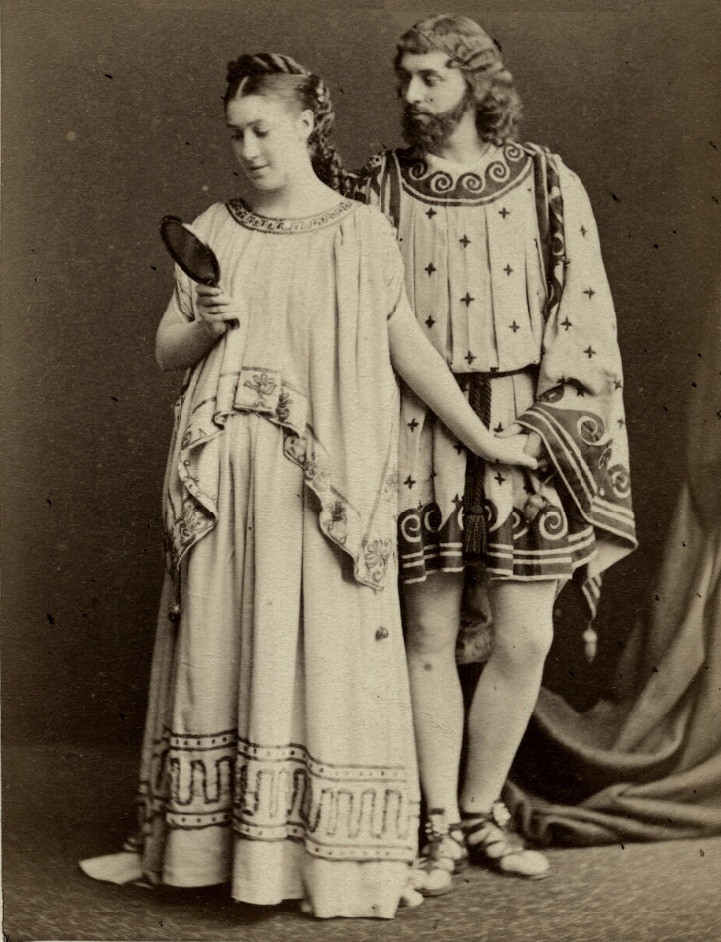
Figure 6. A French postcard produced by A & S (Saint0-ust) in the 1900s-1910s depicting Pygmalion’s plea to Venus in the Von Suppé operetta Die schöne Galathée (1865). Source: https://www.flickr.com/photos/truusbobjantoo/54981957094.
Early cinema and Méliès
Right from its start, cinema (the medium of motion) was paradoxically fascinated with stillness (cf. Adriaensens, Jacobs, 2017, Adriaensens, 2018, Wiegand, 2016-1&2).[2] It frequently referenced the theatrical traditions of tableau vivant that not only quoted famous examples of the visual arts but also imitated them utilising performers who wore whitening or bronze paint to imitate sculpture. And thus names like Grecian statues, marbres vivants, poses plastiques, living statues, etc. were used for this kind of theatrical entertainment. Almost coinciding with this phenomenon, and very popular in the 1890s, cinema started and immediately names like ‘Living Pictures’ and images animées were coined to describe the new technology. A genre of pre-1900 filmmaking even caught the tableau vivant-craze by using quotations of famous paintings or sculptures as the start or end point for shorts. These films ‘quoted’ in particular nineteenth-century academic paintings by the likes of Jean-Léon Gérôme, Alphonse de Neuville and others (see Blom, 2023 for Gérôme & early cinema, and Blom, 2021 for De Neuville & early cinema). Yet, in early cinema, the contrast between the stillness of art and the sequential motion of the pictures on screen was stressed by making art works come alive: characters would step out of an embedded pictorial frame or statues would become real persons and leave their pedestals. The rise of nineteenth-century Pygmalionism spurred the practice of tableau vivant, and consequently, the animation of paintings and sculptures on the screen (Adriaensens, Jacobs, 2017: 29-33).
The interest in Pygmalionism across the visual arts became so pronounced that it was mocked in various quarters including by Georges Méliès on film. By the late nineteenth century, Méliès was the owner and chief conjurer of the Theatre of Robert-Houdin, staging spectacles of magic for the middle classes of Paris. After seeing the Lumière brothers exhibit their Cinématographe in December 1895, he quickly set up a glass-house studio to create short motion pictures that he projected in the theatre during changes of scene and sold on for exhibition in music halls, café-concerts and fairgrounds. The magician constructed complex scenes of transformation through the careful manipulation of his film stock, such as through superimposition (layering images to denote the epiphany of the supernatural) and stop-motion (stopping the camera and adjusting his set to achieve a seemingly abrupt appearance, disappearance or fantastical substitution). Méliès thus treated the new technology as an instrument to augment the amusement of his stage illusions. Coordinated on the stage of the Robert-Houdin, his stage spectacles and motion pictures were equally designed to fool the eye with grotesque bodies and surreal visions, using both theatrical and cinematic tricks and effects.[3]
Trickery is manifest in Méliès’ film The Magician (Le Magicien, 1898, figure 7), which is number 153 in the Star Film Catalogue while Pygmalion is number 156. Only part of the film refers to the Pygmalion myth, but it announces the tricks Méliès would also use soon after in Pygmalion. After several earlier events with a magician (played by Méliès himself) conjuring up a Pierrot from a box, and Pierrot aghast when his table full of food and drink disappears, a Greek sculptor appears. He finds a bust of a Greek woman, puts it on a pedestal and starts to sculpt. Through the device of stop-motion editing, the bust then magically changes into the upper half of a real woman who throws down the sculptor’s tools, thus delivering a wry twist to Ovid’s myth. By another radical cut in the editing, the bust then changes into a full-length statue of a woman playing a lyre (performed by a real woman). The sculptor is struck with love and wants to embrace her but, after another cut, the statue disappears and another classical statue of a woman appears, in a different pose. The frustration of the sculptor’s desire is repeated: he tries in vain to embrace the statue, but she suddenly shifts into a sitting position, as if pouring wine into a glass, and showing off one nude leg. Finally, the mysterious woman disappears in a cloud of smoke (a typical theatrical trick in contrast to Méliès’ cinematic device of stop-motion) and a devil dressed in Renaissance attire (Méliës himself, who often played devils in his films) kicks the amorous sculptor on the bottom, thus mocking not only male love but also Ovid’s tale and its representations in academic art like that of Gérôme. Here it is the film director who orchestrates events thus usurping and undercutting the role of the goddess Venus in the original tale. For Méliès, the power of transformation belongs to cinema which was often criticised in this early period as the invention of the devil.
Trickery is equally manifest in Méliès’ Pygmalion and Galatea (Pygmalion et Galathée) of 1898. The film made by Méliès’ Star Film Company reflects on the apparatus of the kinematograph and the desire of male spectators to touch the female bodies that the new technology seemed to bring alive on screen. It opens with Méliès himself performing the role of the sculptor, who chisels at the statue of a woman before a backcloth painted perspectivally to suggest an elaborate classical interior leading to a colonnaded impluvium. The statue is posed on a plinth labelled ‘Eros’ (in ancient Greek script). When the artist drops his tools in erotic frustration and prays to heaven, the statue miraculously turns into a real woman who bows to her maker, steps off her plinth and takes up a pose on another inscribed in Greek with the name ‘Galathea’. The sculptor’s attempts to embrace her trigger multiple screen tricks, as Galatea disappears and then reappears elsewhere on the set or divides into upper and lower halves, requiring him to chase demeaningly after her body parts. The scene ends with the mischievous woman having now put herself back together and repositioned herself on the plinth as a statue where she began, while the exasperated sculptor gestures in despair screen centre.
Ovid’s version of the myth of Pygmalion operated in the visual arts and performance cultures of the nineteenth century as a metaphor for the power of male artistic creativity, the idealization of women or the tactile eroticism of art and, across the whole history of cinema in the twentieth and twenty-first centuries, for the capacity of the modern medium to animate still images. Méliès’ film, however, which might have been the first film adaptation of Ovid’s tale, is both chaotic and comic, and works against the grain of the Ovidian account (figure 8) as well as the trope of the ideal woman who is out of reach. As with Ovid’s version in his epic poem, the female statue comes alive, but now on screen every time the sculptor tries to embrace her, cinema’s stop-motion technique is used, as in Le Magicien, to keep changing the place of the woman and frustrating the male. Right when Pygmalion is about to kiss Galatea, she wilfully steps back onto her pedestal and becomes a statue again. Through her magical acts of self-dismemberment, this creation disrupts the traditional arts, ridicules the artist, and suggests that the new artform is astonishing – a powerful new attraction that can deceive the eyes of spectators (Adriaensens, Jacobs, 2017: 33-37; Adriaensens, 2018: 27-33). While Méliès celebrates moving images, he mocks Ovid’s tale but even more so its erotic representation in the nineteenth-century artworks of academicians.[4] The contrast between Gérôme and Méliès could not be greater, and perhaps it was for that reason that, at the 2021/22 exhibition Enfin le cinema! at Musée d’Orsay in Paris, the guest curator Dominique Païni put these two versions of the Pygmalion myth in opposition to each other in the first room of the exhibition (see also Païni, 2021 and Lehmbeck, 2021). In the hands of the magician Méliès, cinema playfully takes on the high arts of painting and sculpture and trumps them.
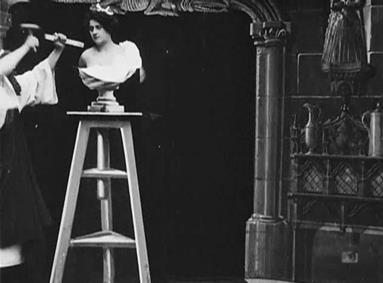
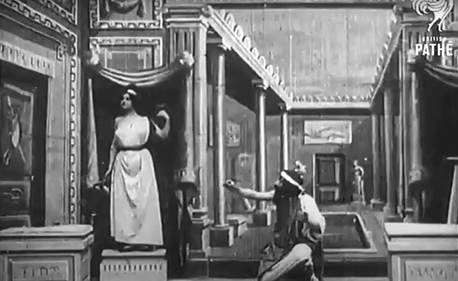
Figure 7. Le Magicien (Georges Méliès, 1898). Source: https://commons.wikimedia.org/wiki/File:M%C3%A9li%C3%A8s,_Le_magicien_%28Star_Film_153,_1898%29.jpg
Figure 8. Pygmalion et Galathée (Georges Méliès, 1898). Source: https://www.imdb.com/title/tt0223975/mediaviewer/rm4150171906/?ref_=tt_ph_1, copyright Pathé.

Connections of art, theatre and previous cinema with the 1912 film Pygmalion and Galatea
It is this rich history of nineteenth- and early twentieth-century representations of Pygmalion and his desire in art and film that provides the cultural context for the BFI’s film Pygmalion and Galatea. It is immediately clear that Neame’s is a serious and rather subdued version of Ovid’s tale. The manifest eroticism and passionate gestures of nineteenth-century paintings such as Gérôme, Bargellini and Normand have been traded for a chaste and tranquil visualisation, closer to, say, the paintings by late nineteenth-century British artistst like he Anglo-Dutch antiquarian Lawrence Alma-Tadema and his British contemporaries like John William Waterhouse. Indeed, in the studio of Pygmalion depicted on screen, we can observe female extras posing as statues that decorate its walls (figure 9). They are reminiscent of the sleeping or reclining ethereal women in the paintings of British artists such as Frederick Leighton (Flaming Youth, 1895, Museo de Arte de Ponce, Ponce, Puerto Rico), Henry Ryland (Two Classical Figures Reclining/ Rêverie, 1890, unknown collection) and Albert Moore (Apples, 1875, private collection; Beads, 1874, National Gallery of Scotland, figure 10; and Reading Aloud, 1883, Kelvingrove Art Gallery and Museum, Glasgow). They also recall the languid women clothed in Grecian draperies in William Blake Richmond’s painting Electra at the Tomb of Agamemnon (1874, Art Gallery of Ontario, Toronto) and, finally, the loose-haired nymphs and Ophelias in the work of Waterhouse. Perhaps these changes were deliberately undertaken as a British reaction to the heavily eroticized version of the tale in French art but also following on the mockery evident in Von Suppé’s operetta and Méliès’s early films.
It is also striking that the film ends with praise of Venus for the metamorphosis of stone to flesh that she has perpetrated, but we are not shown what happens afterwards: the life together of the sculptor and his statue-made-flesh and, as Ovid explains, the birth of a son nine months later. Descriptions of Neame’s film in the press confirm that the ending of the print in the BFI corresponds with that of the original version, so there appears to be nothing missing from the print.[5] The female extras oddly posing as statues against the studio wall may remind us of the passage early in Ovid’s tale in which he mentions that the women of Cyprus, having scorned Venus and behaved like prostitutes, were turned into stone. The women who annoy Pygmalion in Neame’s film are treated by him as if they are no more than nasty flies, even if their lasciviousness is of a quite chaste kind involving no more than flirting and teasing. As in Ovid’s tale, here too within a moralising framework, real women are presented as inferior to those men have created for themselves and deserving of punishment for their apparent brazenness.
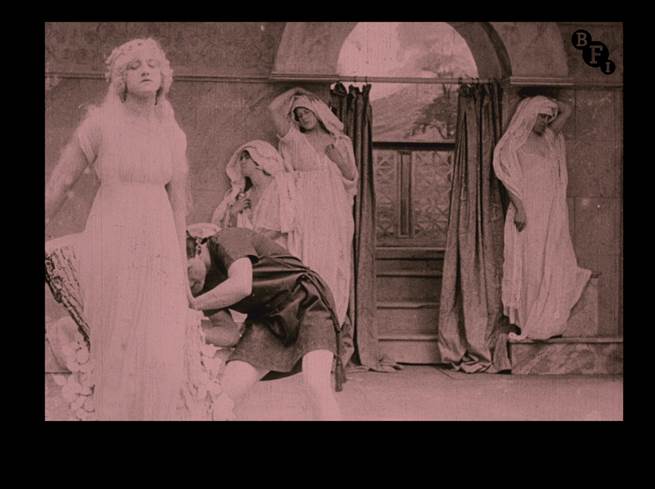
Figure 9. Pygmalion and Galatea (1912). Print BFI National Archive.

Figure 10. Albert Moore, Beads (1874, National Galleries of Scotland). Source: https://commons.wikimedia.org/wiki/Category:Paintings_by_Albert_Joseph_Moore#/media/File:Albert_Joseph_Moore_(1841-1893)_-_Beads_-_NG_1019_-_National_Galleries_of_Scotland.jpg
Analysing Ovid’s tale, Victor Stoichita points to the poet’s emphasis on the haptical elements of the metamorphosis (Stoichita, 2008: 14-15) - the warmth of the statue’s hand, its breath, as well as the start of speech and the rosy colour of flesh emerging. Yet, in cinema, in particular in the last seconds of Neame’s film, it is motion that is most evident. Ivy Close, who up till then has posed with complete stillness in the film, visibly starts to breath, to open her eyes and move her arms. She turns to the astonished sculptor, stretches her arms out to him and steps down from the pedestal. A woman who has witnessed this transformation calls in all of her friends who express their awe. Galatea now raises an arm up to indicate they should give thanks to the goddess Venus. While all the other women humbly kneel, Pygmalion and Galatea look upwards, where Venus must be. The other women then rise and also look up stretching their arms up to Venus, while Pygmalion admires his beautiful creation who has come alive and is also in love with him.
However chaste Pygmalion and Galatea might be in its style, it nonetheless uses the classical myth to celebrate the power of film to move – mechanically and affectively. That power, however, continues here to be gendered as male while women are merely the vehicles for its expression.
Footnotes
- ^ A special thanks to Tony Fletcher and Dr Anushrut Ramakrishnan-Agrwaal.
- ^ Vito Adriaensens and Steven Jacobs, as well as Daniel Wiegand, have researched in particular the theme in early cinema of sculptures coming alive, such as in Méliès’ Pygmalion et Galathée (1898) and, indirectly, also his Le Magicien (1898), as well as in some erotic shorts from the Austrian company Saturn Film.
- ^ On Méliès, see for example Gaudreault, 1987 and 2022.
- ^ This strategy compares with that in the plot of Von Suppé’s operetta, in which the artist’s infatuation is also mocked and the woman returns to being a statue on a pedestal.
- ^ ‘Films. Supplement to The Cinema’, Cinema News and Property Gazette, December 1912, p. 69. Here the film is listed as a Hepwix (Hepworth) production. It was released December 5th, 1912.
Adriaensens, V. (2018) ‘Ovidian violence: Georges Méliès’s explosive screen bodies’, in Marina Dahlquist et al. (eds.), Corporeality in Early Cinema: Viscera, Skin, and Physical Form. Bloomington: Indiana University Press, pp. 27-33.
Adriaensens, V. and Jacobs, S. (2017) ‘The Sculptor’s Dream: Living sculptures in early cinema’, in Steven Jacobs et al. (eds.), Screening Statues: Sculpture and Cinema. Edinburgh: Edinburgh University Press, pp. 29-45.
Blom, I. (2021) ‘Histoire’, in: Dominique Païni, Paul Perrin, Marie Robert (eds.), Enfin le cinéma ! Art, images et spectacles en France, 1833-1907. Paris: Réunion des Musées Nationaux/ Grand Palais, pp. 114-117.
Blom, I. (2023) Quo vadis?, Cabiria and the ‘Archaeologists’: Early Italian Cinema’s Appropriation of Art and Archaeology. Turin: Kaplan.
Gaudreault, A. (1987) ‘Theatricality, narrativity, and trickality: Reevaluating the cinema of Georges Méliès’, Journal of Popular Film and Television 15(3), pp. 110-119.
Gaudreault, A. (2022). ‘Animated pictures according to Georges Méliès: A sober and unpretentious remediation, Or when Méliès took a stand against - the cinema!’, in Mario Slugan and Daniël Biltereyst (eds.), New Perspectives on Early Cinema History: Concepts, Approaches, Audiences. London: Bloomsbury Academic, pp. 21-40.
James, P. (2011). Ovid’s Myth of Pygmalion on Screen: In Pursuit of the Perfect Woman. London: Continuum.
Lehmbeck, L. (2021). ‘Sculpture’, in Dominique Païni, Paul Perrin, Marie Robert (eds.), Enfin le cinéma ! Art, images et spectacles en France, 1833-1907. Paris : Réunion des Musées Nationaux – Grand Palais, pp. 242-247.
Païni, D. (2021), ‘Le hasard demeure le voile à soulever’, in Dominique Païni, Paul Perrin, Marie Robert (eds.), Enfin le cinéma ! Art, images et spectacles en France, 1833-1907 (Paris : Réunion des Musées Nationaux – Grand Palais), pp. 15-19.
Richards, J. (2009) The Ancient World on the Victorian and Edwardian Stage. London/New York: Palgrave MacMillan.
Stoichita, V. (2008). The Pygmalion Effect. From Ovid to Hitchcock (Chicago/London: University of Chicago Press). Translated from the French edition L'Effet Pygmalion: Pour une anthropologie historique des simulacres. Genève: Droz, 2008.
Wiegand, D. (2016-1). ‘Früher Film, Tableau Vivant, und die “Attraktion des Schönen”‘, in J. Schweinitz, D. Wiegand (eds.), Film Bild Kunst: Visuelle Ästhetik des vorklassischen Stummfilms. Marburg: Schüren, pp. 83-116.
Wiegand, D. (2016-2). Gebannte Bewegung Tableaux Vivants und Früher Film in der Kultur der Moderne. Marburg: Schüren.