
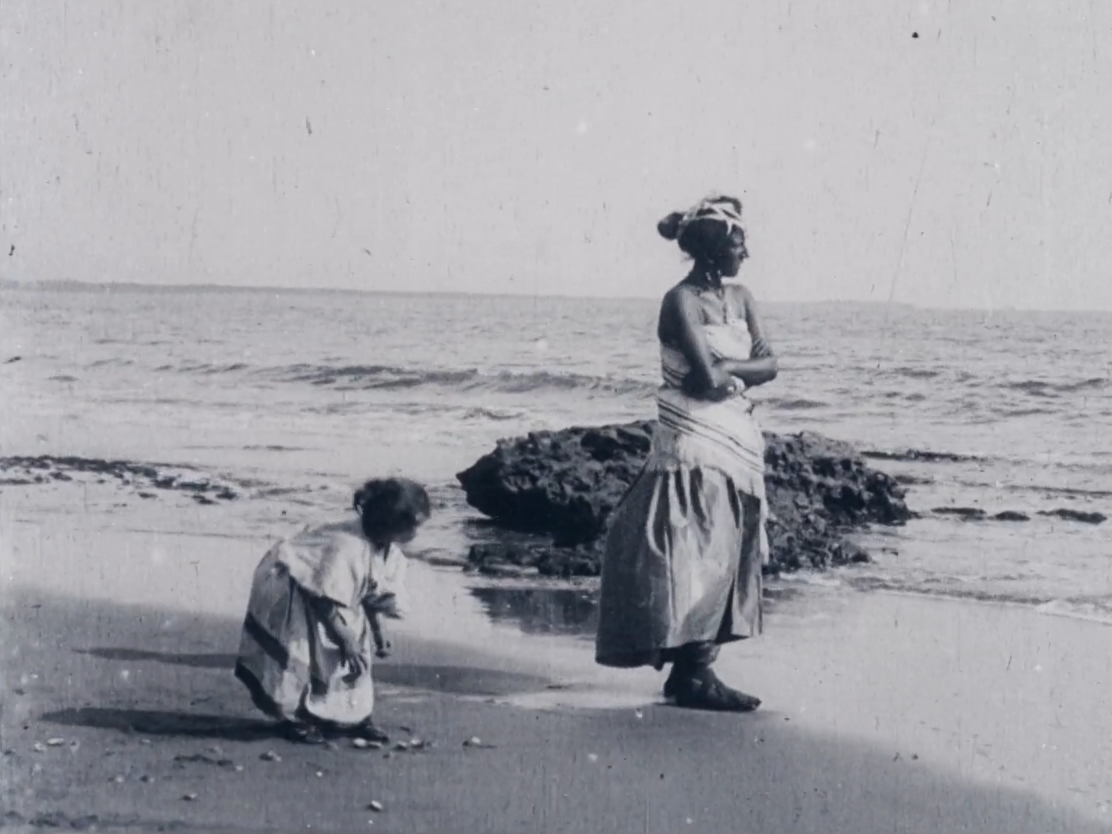
Patrizia e schiava (original)
1909
Alternative Titles
Patrizierin und Sklavin (Alternative), Afra (Alternative), Patricia and the Slave (Alternative)
BFI identifier
58215Synopsis
An African slave girl kidnaps her mistress's child, who is then abandoned and cared for by mermaids until returned to her mother. A man talks to a woman by a well, and looks despondent when she and her friend refuse his advances and leave (25). Marcella, a Roman matron, is shown skins by a trader. The trader lines up a row of slave girls and Marcella buys Afra, an African princess (122). Afra is instructed to look after Marcella's child (164). Afra and the child on a beach. The slave-master orders her to carry out her duties (179). A boat carrying Marcella is rowed to a pier where she disembarks with her servants (248). She greets her child on the seashore; Afra bows to her but gives her a sullen look (269). A party of Afra's followers arrive and find her on the seashore, scolding the child; she escapes with them and they take the child (368). The slave-master runs after them in vain (431). Marcella is being tended by slaves at her villa when the slave-master brings the news of the escape and kidnapping. From the terrace they watch the marauder's ship leaving, pursued by a boatload of soldier (534). [Section missing: the marauder's boat is wrecked by a storm]. The soldiers return in their boat (592). Marcella pines in her garden (642). Soldiers bring the news to her; she despairs until a friend tells her to ask the gods (713). Marcella leaves gifts at the statue of the Goddess of the Sea - the statue points to an inset showing the child playing with mermaids on some rocks (844). Marcella arrives by litter at the entrance to the mermaids' home and enters a cave (882). In a subterranean passage, she hears the child's voice. She emerges onto the seashore, where the mermaids give her back her child (928). She returns with the child back up the cliffs and through the cave (956). She reaches her litter, where people throw flowers and acclaim her (985ft). Note: The title used in Britain is a mistranslation. A literal translation is `Patrician and slave'. There is second viewing copy (Joye: Rome N24, 988ft) with no title, German intertitles and without the shots of mermaids. (Shotlist)
- Production Country: Italy
- Production Company: Cines
- BFI Category: Fiction
- Source: N/A
Cast
N/ACredits
Production Company: Cines
Film Technical Information
- Original Length: 351 m
- Length of BFI Viewing Print: 988 ft
- Support: Viewable
- Black and White
- Format: 35 mm , Digital Betacam
Comments on the print:
Patrizia e schiava (director unknown, Cines 1909) aka Patrizierin und Sklavin aka Afra. The alternative title Patricia and the Slave, mentioned in the British trade paper The Bioscope, is a misunderstanding of the original title as the film is about a Roman patrician named Marcella. In 1984 a tinted BFI nitrate print (c. 1000 ft.), entitled Patrizierin und Sklavin, stemming from the Joye Collection (see our Introduction on this site) and therefore possessing German intertitles, was preserved in a 35 mm black and white safety print (988 ft.). A second 35mm nitrate print, called Afra and already acquired in 1935, was preserved in 1981 as a 35 mm safety print (986 ft.). The Joye print lacks some elements, such as the shots of the vision of the rocks where the Naiads are caring for Lucina as well as shots of the Naiads themselves and many additional shots of Marcella in and near the grotto.
However, two longer and more complete tinted versions are owned by the Cineteca del Friuli in Gemona, both preserved in colour showing the original tinting and toning. One print is based on a nitrate copy (290 m.) from the Swedish Film Archive in Stockholm and was restored by Haghefilm. Gemona also has a slightly longer print, taken from a nitrate (321 m.) from the National Film and Sound Archive of Australia (Canberra) and preserved by the George Eastman House. The shots are slightly longer. We see more of the boats during Marcella’s trip and during the pursuit of the Numidian boat, as well as of the grotto scene, but it lacks an original opening title, in contrast to the Stockholm version. The colouring of individual shots is also slightly different. The English intertitles in both versions are in blue, which was common for Cines at the time. According to FIAF, the film archives of Madrid, Lausanne, CNC and Bologna also have material on the film. The film originally measured 351 metres (source: Aldo Bernardini, Il cinema muto italiano, Vol. 1905-1909, 1996: 362-4).