
1909- Patrizia e schiava (Cines)
By IVO BLOM and MARIA WYKE
Patrizia e schiava, known as Patrician and Slave or Afra in its Anglophone distribution (director unknown, Cines 1909) is one of the earliest films on Roman antiquity made by the Rome studio Cines. It is also an interesting film in several respects. Many props referring to ancient Roman furniture and sculpture used in this film would be recycled for years by the company and its associated organisations like Palatino Film and Unione Cinematografica Italiana. The aesthetically attractive ancient world to be found in this film therefore became the foundation for subsequent Cines’ films about Rome regardless of the period in which they were set. Patrizia e schiava, however, also appears disturbingly comfortable with the ancient institution of slavery and a racist representation of Africans. As in the British film about Pygmalion (see our text on Pygmalion and Galatea on this site), divine intervention creates a happy ending for the protagonist but here it also serves to construct a colonialist allegory about Italy’s victory over supposed dangers from across the sea.
The structure of Patrizia e schiava
Members of Marcella’s household gather at a fountain in the gardens of her Roman villa. In an interior salon, the patrician is shown new merchandise by an Oriental trader. The old trader lines up a row of slave girls and Marcella buys the only dark-skinned one - Afra, who an intertitle declares was once a proud African princess. Despite her initial refusal, Afra is instructed to look after Marcella's child Lucina. In a series of scenes located by the seashore, Marcella is rowed in an elaborately constructed boat to an equally decorative pier where she disembarks with her companions. She greets her child on the shore for whom Afra is now sullenly responsible. A party of Afra's followers, who have been searching a long time for her, arrive on another boat and she escapes with them taking the child in retaliation for her enslavement. At her villa, the distraught Marcella is brought the news by the slave-master of her child’s kidnapping. From the villa’s terrace, her household watch the marauders’ boat departing and its pursuit by a boatload of Roman soldiers. Although the search party returns empty handed, we learn that the marauders’ boat has not sailed away but been wrecked in a storm. Weeping in her peristyle, Marcella is advised to ask the gods for help. Going to a temple, she prays before a statue of the Goddess of the Sea. The statue suddenly comes alive and points to a temple wall on which is miraculously projected an image of little Lucina playing by some rocks with a group of Naiads, servants of the goddess (figure 1). Marcella hurries by litter to the seaside grotto of the Naiads and dares to enter it. In a subterranean passage, she hears her child’s voice and, once she arrives down at the rocks, the Naiads return the child to her delighted mother (figure 2). Marcella returns with her child back up the cliffs and out through the opening of the grotto. When she arrives back at her litter, her household celebrates the bold rescue by waving branches of flowers and acclaiming her bravery.
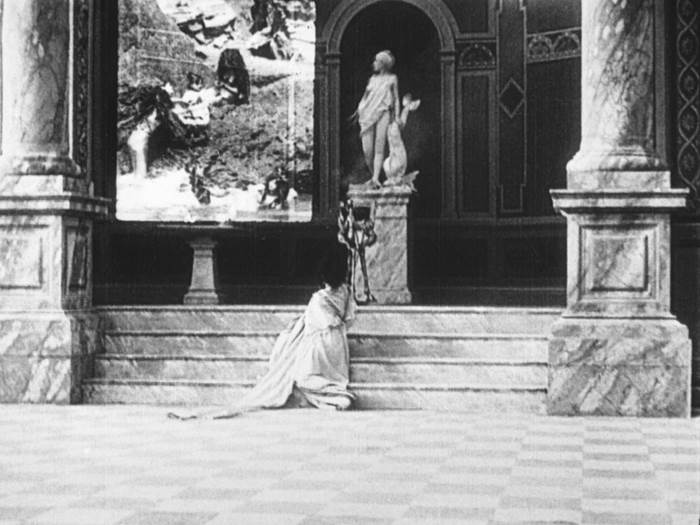
Figure 1. The vision of the Naiads looking after Lucina. Patrizia e schiava (1909). Collection La Cineteca del Friuli, Gemona, Stockholm version.
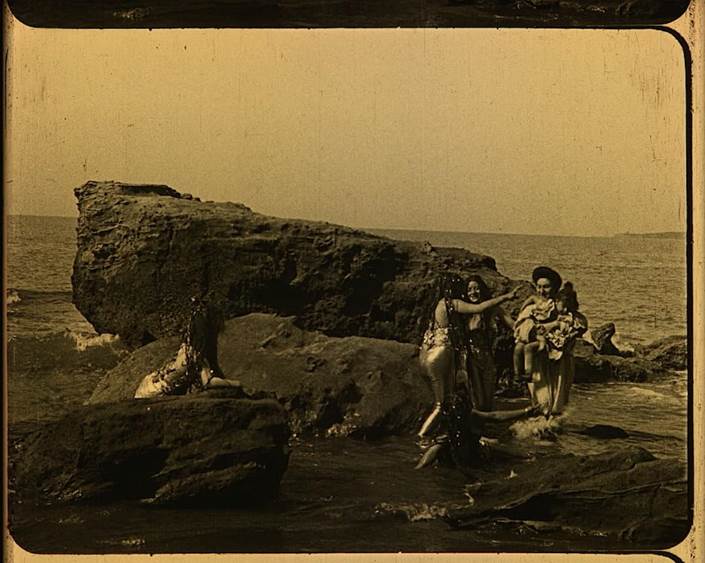
Figure 2. Marcella finds her child with the Naiads. Patrizia e schiava (1909). Collection La Cineteca del Friuli, Gemona, Canberra version.
The BFI National Archive has a version of the film with German intertitles, preserved in black-and-white, stemming from the Joye Collection, plus a version acquired in the 1930s called Afra.[1] The Joye version, also available at the Cineteca Nazionale in Rome[2]has German intertitles but has no opening title (Joye: Rome N24, 988ft). This version lacks some elements, such as the shots of the vision of the rocks where the Naiads are caring for Lucina as well as shots of the Naiads themselves (Fig. 1 and 2) and many additional shots of Marcella in and near the grotto. Apparently, the shots of the Naiads were not deemed fit for the young gymnasium students to whom Abbé Joseph Joye originally showed his films.[3] However, two complete tinted versions are owned by the Cineteca del Friuli in Gemona. The first print has at various points sepia, yellow or green tints and English intertitles in blue (figure 3). Its provenance is a nitrate copy (290 m.) from the Swedish Film Archive in Stockholm. It was beautifully restored by Haghefilm. Gemona also has an equally exquisite, slightly longer print, taken from a nitrate (321 m.) from the National Film and Sound Archive of Australia (Canberra) and scanned by the George Eastman House. Shots are slightly longer and we see a little more of the boats during Marcella’s trip (figure 4) and the pursuit of the Numidian boat as well as during the grotto scene, but it lacks an intertitle indicating the film’s title. The colouring is also slightly different, and here the English intertitles are in blue. The film archives of Madrid and Bologna also have material from the film – Cineteca di Bologna has an incomplete print. The film originally measured 351 metres (Bernardini, 1996: 362-4). For this article we used mostly the Canberra print from Gemona, plus the blue intertitle and the vision of the grotto from the Stockholm print.
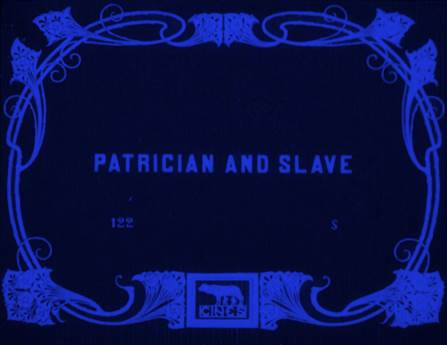
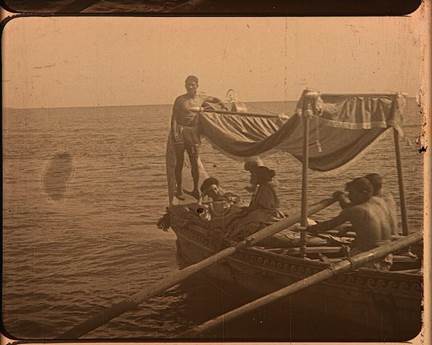
Figure 3. Opening title of Patrizia e schiava (1909). Collection La Cineteca del Friuli, Gemona, Stockholm version.
Figure 4. Marcella’s boat trip in Patrizia e schiava (1909). Collection La Cineteca del Friuli, Gemona, Canberra version.
Innovation and authenticity in art direction
The Cineteca di Bologna possesses an earlier Cines drama on Roman antiquity, La rivale (1908), which is all shot within a limited number of studio sets mainly composed of painted backdrops. It may well be the earliest surviving film by the studio on the Roman past.[4] Patrizia e schiava, however, displays new avenues taken in scenography. The interiors possess far more three dimensionality (such as the large temple interior with its stairs) and the villa rooms contain multiple copies of ancient furniture and sculpture quite close to originals in museums. The film also utilises various exteriors shot on real locations, such as views of Marcella’s boat, adorned at its bow with a swan-shaped figurehead, that docks at a jetty flanked with decorative statuettes of Nike or Victory (figure 5), the sandy beach from which Lucina is abducted, the peristyle garden of Marcella’s villa where she grieves, the balcony from which her household look out for the departed marauders, the soldiers’ ship, adorned with a lion’s figurehead, that gives chase and returns in vain, the passageway and rocks where Marcella finds her child again as well as the cliff opening where she arrives and leaves in her litter. Around the same time in France, combinations of real exteriors with studio-built interiors had become a novelty in dramatic film (see e.g. our texts on Bélisaire from 1910 and on early dramas by Itala Film), but Patrizia e schiava is surely also an early example of these new developments.
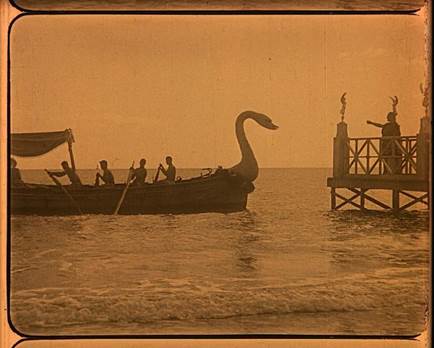
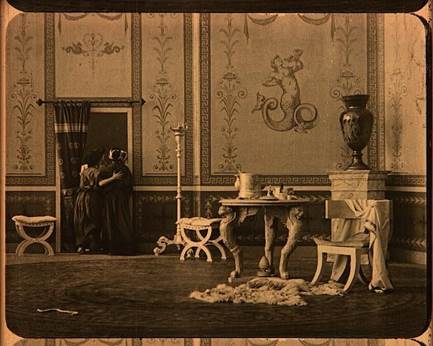
Figures 5-6. Jetty and interior scene. Patrizia e schiava (1909). Collection La Cineteca del Friuli, Gemona, Canberra version.
In 1909, the year of the film’s release, Enrico Guazzoni started his career at the Cines company. Even if two other directors, Mario Caserini and Enrique Dos Santos, were also employed there at that time, it is remarkable how often many props return in Guazzoni’s films from 1911 onward that first appear in Patrizia e schiava. Looking closely, it is possible to recognize a number of them (figure 6): the sella curulis or folding stool, the tall candelabrum or candle holder standing against the wall, the mensa delphica or tripod table with lions’ faces and claws, and the cathedra chairs with their outward bending legs and curved backs. And that is not all: in the garden (figure 7) we can spot two statues of putti spouting water that make a return in Guazzoni’s films Marcantonio e Cleopatra (1913) and Fabiola (1918).[5] The litter that takes Marcella to the cliff face through which she will find her lost daughter (figure 8) is exactly the same as in Guazzoni’s films Agrippina (1911), Bruto (1911) Quo vadis? (1913), Cajus Julius Caesar (1914) and Fabiola, and even returns in the 1924 version of Quo vadis? directed by Georg Jacoby and Gabriellino D’Annunzio, when the Christian girl Lygia is abducted on the street and the litter is smashed to pieces by Ursus and his helpers.[6] All the details of the litter match, such as the roof that looks like an inverted tondo with its rosettes, the winged Nikes, and the border that resembles the antefixes of Roman roofs.
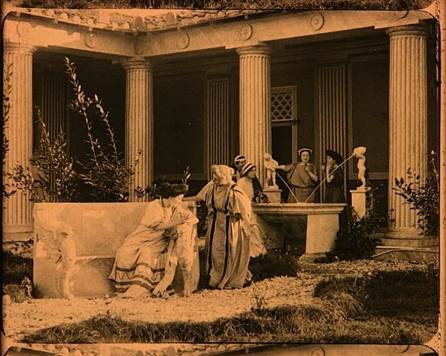
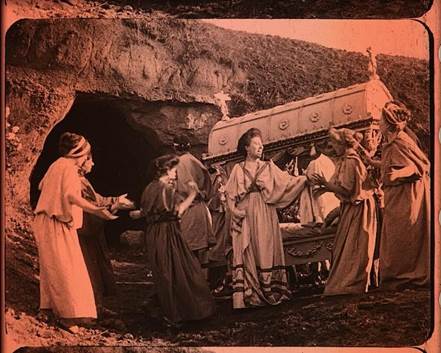
Figures 7-8. Patrizia e schiava (1909). The peristyle and Marcella’s litter. Collection La Cineteca del Friuli, Gemona, Canberra version.
The typical Roman-styled fences with diagonally crossed trellises that are visible in Patrizia e schiava return in all the Guazzoni films on Roman antiquity. The winged Nike statuettes on the roof of the litter have already appeared in Patrizia e schiava itself as decoration on the jetty where the Roman matron’s boat docks. In Guazzoni’s subsequent films, these statuettes return as decoration on the ship of the Roman empress Agrippina in the eponymously titled film, and two of them appear as decoration on Petronius’ balcony ramp in the 1913 Quo vadis? feature film. Finally, the boat with the swan figurehead with which Fabiola and Agnes flee Rome in Fabiola is the same one that is visible in Patrizia e schiava, made almost a decade earlier.[7] Plus, three remaining original stills from Mario Caserini’s lost film Messalina (1910, figure 9), made one year before Guazzoni’s films Agrippina and Bruto, reveal that Caserini was also using the same chairs, folding stools, table, herms, fences and winged Nike statuettes (now as decoration on the fence). So either all of these props were already in use before Guazzoni started directing films at Cines or he may have been working there on Patrizia e schiava uncredited, as his earliest credited films on antiquity date from 1911.
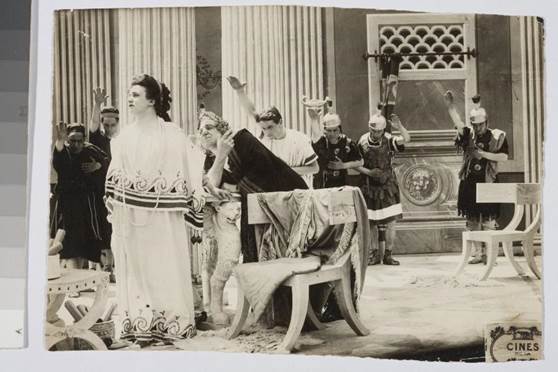
Figure 9. Messalina (1910). Original publicity still. Collection Museo Nazionale del Cinema, Torino.
These elements were used in Patrizia e schiava to enhance the feeling for spectators that they were seeing a credible vision of ancient Rome. By their frequent reuse at Cines, they would come to be interpreted as ready markers of an authentic antiquity and help satisfy rising expectations from audiences about the scenography of historical dramas. Before the 1910s, set design was freer and coarser in its detail; by 1910, sets became more accurate and closer to original objects and murals in archaeological collections like those in Naples and Rome (e.g. MANN and the Vatican museums), if still relatively simple in execution (see also Blom, 2023). Although no specific period of Roman history is mentioned as the setting for the story told in Patrizia e schiava, the subsequent films from Cines that use the same materials range in the timeframe of their plotlines and characters from the first century BC to the fourth century AD. For Cines at least, the accumulation of markers of authenticity was more important than their adaptation to quite different periods of Roman history. The materiality of the ‘authentic’ Roman world created at Cines tended to remain the same.
A colonialist rescue fantasy
The Italian title of the film (‘Patrician and her Slave’) and its opening sequence at the fountain suggests that it will contain a drama of love played out across social divides. A male identified as a lowly slave by his bare feet, plain dark clothes and disturbing neck restraint expresses his unrequited love for one of Marcella’s female companions. Many early dramas set in Roman antiquity had plots concerning star-crossed love between slaves or between owners and their slaves. Yet it is not this slave who matters in the film and the institution of slavery is not challenged here, instead it is utilised to justify the racialised presentation of a threat to domestic tranquillity. Patrizia e schiava tells in intimate and fantastical terms a version of the colonialist story that will later drive the epic film Cabiria (1914), where a Roman child is kidnapped and eventually rescued from the shores of Africa during the wars between Rome and Carthage.
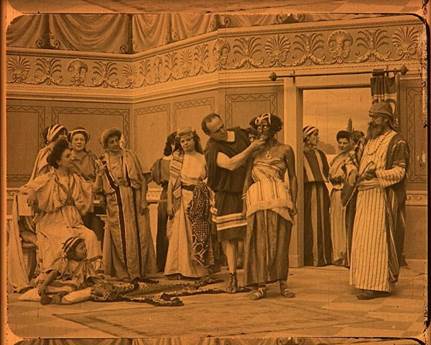
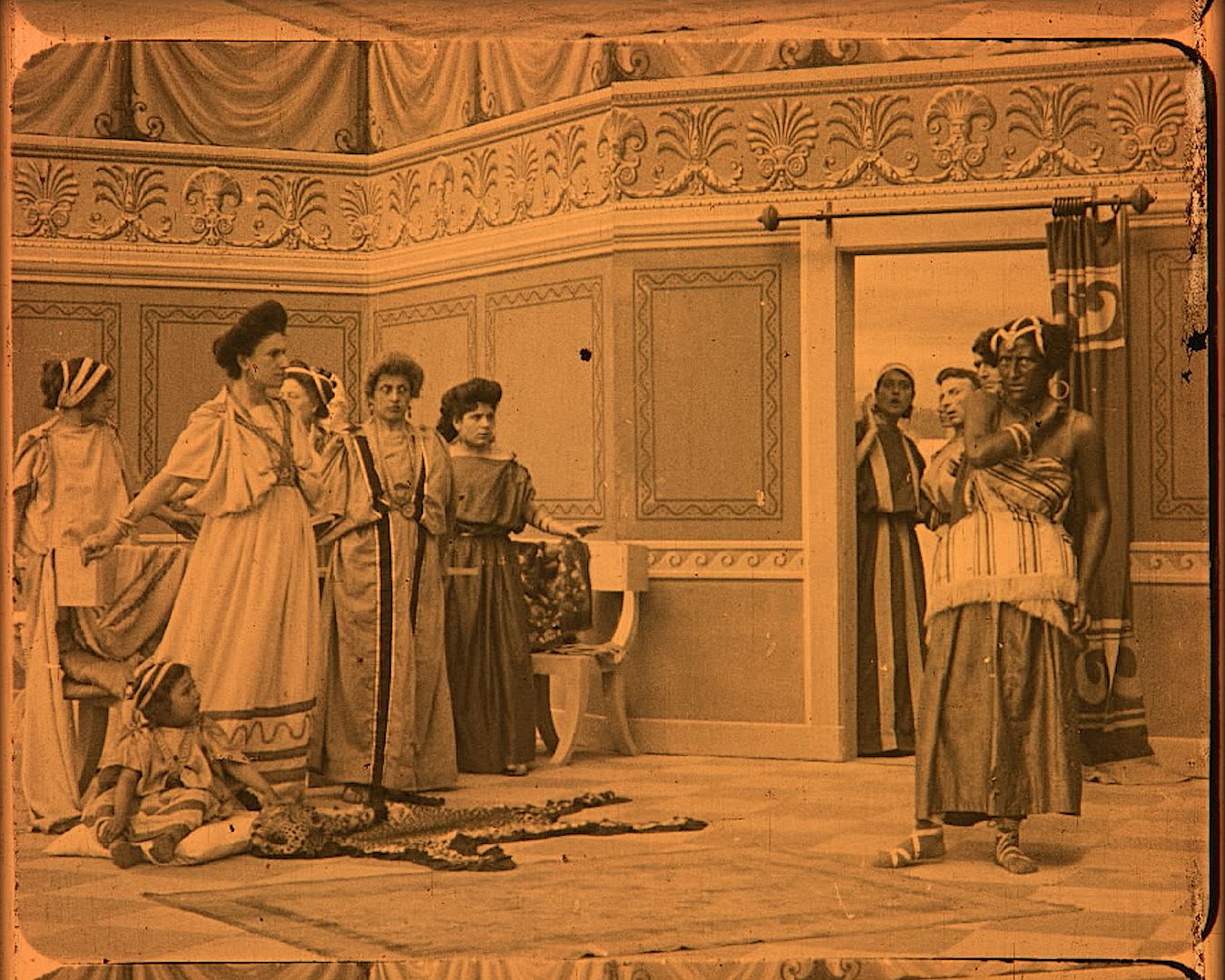
Race, understood as the classification of people according to meanings derived from their physical appearance, was not a principle deployed in the Roman practice of enslavement. Slavery was mainly based on which territories Rome had conquered.[8] Yet, in the film’s second scene, the slave whom Marcella buys is heavily racialised. The scene’s composition, with its orientalised slave trader and the examination of the slaves’ teeth, recalls nineteenth-century paintings such as Jean-Léon Gérôme’s Slave Market (1866), but now the sale takes place not in the ‘Orient’ but in a Roman villa and the slave who is sold is black not white (figure 10). The introductory intertitle describes her as ‘the Numidian princess Afra’. The costume of the actress who plays Afra – the stripped bodice matched by the vertical lines of the ribbons in her hair and the large, hooped earrings - marks her out from the other slaves as exotic. Her blackface makeup is highlighted by her bare shoulders and arms. Her gestures, when she at first refuses to take care of Marcella’s child Lucina (meaning ‘Light’), demonstrate her capacity for defiance. And her own name Afra (meaning ‘woman from Africa’) signals that this slave embodies the dangerous African Other come to darken Western shores (figure 11). Afra shows none of the tenderness toward her ward that would be shown by the blackface Maciste in Cabiria (Giovanni Pastrone,1914), nor his alignment with the imperial ambitions in Africa of ancient Rome and contemporary Italian nationalism.[9]
|
|
Scholars have understood the epic narrative of Cabiria, involving the rescue of a Roman girl from the shores of Africa during the Second Punic War, as deeply intertwined with contemporary Italian rhetoric of empire in Africa (however open to ambiguity the figure of Maciste might seem). Through its spectacular recreation of a glorious Roman imperial past, the film endorses the modern Italian rhetoric of a return to former Roman territories in Africa, a rhetoric of return that had supported its war in Libya in 1911-1912 and the continued possession of colonies there (Agbamu, 2024: 107-26). The reconstruction of an unspecified Roman past in Patrizia e schiava seems to be implicated in an earlier, rawer rhetoric that sought to build Italian national identity through representations of a danger to the homeland of racial contamination perceived to emanate from Africa.
The film’s innovation in shooting exterior sequences at the seashore dramatizes the supposed civilisational superiority of Rome endangered at its boundaries. The patrician’s leisure craft, at which Afra makes threatening gestures, is elaborately constructed and Marcella’s authority is demonstrated in the way she reclines elegantly in it in the shade of a tasselled canopy. In contrast, the boat of the Numidian marauders, come to find their princess, is much smaller and plainer. They appear silhouetted against the sky, a disordered group of long-haired, half-naked men shaking their spears (figure 12). Their retaliatory kidnap of little Lucina demonstrates the vulnerability of the aestheticized Roman world that we have seen the film so beautifully construct. Resolution, however, comes not through military victory (a boatload of soldiers give chase in vain), but by a miraculous storm that wrecks the Numidian boat and consequently keeps the child on Italian soil, now under the protection of sea nymphs thanks to the intervention of the ‘Goddess of the Sea’. The intervention of the goddess and her wondrous servants (who look a great deal like the mermaid in the trick film of Georges Méliès of 1904 La sirène, and the merry mermaids in Arnold Böcklin’s painting Das Spiel der Najaden, 1886, figure 2) raises an Italian colonialist narrative of rescue from racial contamination to the grand and authoritative level of classical myth.
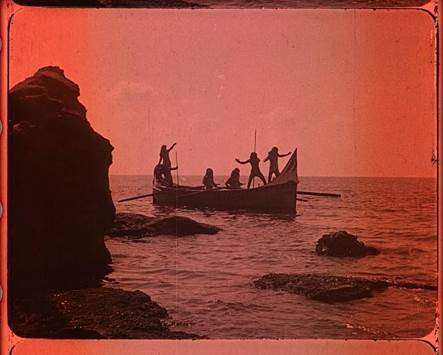
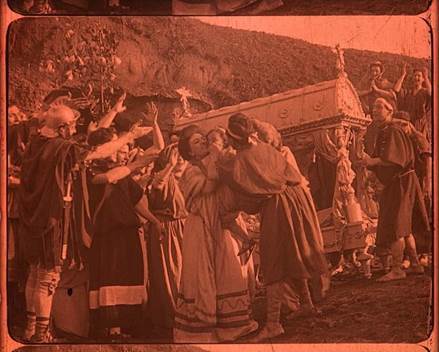
Figures 12-13. The Africans arrive on the Italian coast. Everybody’s joy over the found child. Patrizia e schiava (1909). Collection La Cineteca del Friuli, Gemona, Canberra version.
The visual trick of the statue that comes alive and the superimposition on the temple wall of moving images (figure 1) both indicate within the plotline where Lucina is safely playing but, with their emphasis on movement and the technologies of cinema, these devices also work self-referentially to claim for the relatively new medium of film effectiveness as a vehicle for the creation of colonialist mythologies. Later, Gabriele D’Annunzio would seem to reference the affective power of cinema when he wrote in 1914, in the preface to the programme for Cabiria, of how ‘the breath of war converted the people into a type of flammable material’. But, for now, it is with peace not war that the small-scale, domestic drama of Patrizia e schiava ends. As a princess, Afra has been humiliated by her capture and reduction to the status of slave, while the convenient storm has done away with her and her Numidian subjects entirely. The Roman mother is emblematically reunited with her child. The people celebrate her bravery and determination that has led to this happy ending (figure 13).
Reception
Patrizia e schiava was presented at the first World Film Contest in Milan of October 1909 where, in addition to films from all the main Italian studios like Cines and Ambrosio, foreign films from France, Germany, Sweden and the USA were shown at the prestigious cinema-theatre Radegonda. In addition to Patrizia e schiava, two other films set in antiquity were screened: Nerone produced by Ambrosio and The Way of the Cross produced by Vitagraph. As Giovanni Lasi wrote in the catalogue for the film festival Cinema Ritrovato of 2009: ‘The Milan event never opened its doors again, but its positive consequences went beyond just the competition’s immediate success: with the first World Competition Italian cinema finally shed its provincial limits and acquired international visibility, foreshadowing its ascent in the international marketplace.’ (Lasi, 2009). The festival, which is held in Bologna, showed the shortened Joye print at the time of its celebration of hundred years since the film’s release.
On release, Patrizia e schiava was very favourably reviewed both inside and outside Italy. When it came out in Naples in November 1909, Luigi Marone wrote in the journal La Cine-Fono e la Rivista Fono-Cinematografico: ‘The film is simply splendid. Whoever sees it, remains impressed by so much intensity of effects, so much truth in the real settings. The shot with the vision of Marcella, the one of the sea, the one with the Naiads, they are of an incomparable beauty. In order to stage certain scenes, Cines even purposely built two galleys and on the seaside a period styled jetty. It couldn't have been done better.’[10] The British trade paper The Bioscope fully agreed with this and wrote in November 1909: ‘Stories of ancient Rome naturally lend themselves to a display of stage-craft, to the skill of the costumier, and to the histrionic ability of the actors, and Patricia [sic] and the Slave is no exception to the rule. Palatial palaces, rugged sea-coasts, marvellous subterranean passages, and gorgeous costumes, pass before the gaze from first to last in a series of pictures, remarkable alike for their photographic quality, artistic setting and marvellous staging. […] Throughout the film there is abundant evidence of that true artistic instinct which is possessed by the Italian school in a more marked degree than by any other, and there is strong testimony to the touch of a master hand.’[11] Although The Bioscope includes a summary of the plot and refers to ‘the Numidian maiden’, it is blind to the colonialist anxieties that drive Patrizia e schiava. Its review merely acknowledges that Italy is claiming a significant place in global film markets for the extraordinary artistry with which it constructs its Roman worlds. When Cabiria was released five years later by the Itala studio, the Italian press understood its reconstruction of Roman victories in Africa as an incitement for modern Italy to war and empire. But, even then, The Bioscope for 30 April 1914 saw the epic only in artistic, not ideological, terms as a triumphant answer to critics of the picture theatre.[12]
Footnotes
- ^ Patrizia e schiava was the first film ever acquired by the BFI National Archive. It was obtained in 1935, catalogued under its English title Afra and given the vault location number 1A (with thanks to Pantelis Michelakis for drawing our attention to the film’s unique archival status).
- ^ All the Italian Joye nitrate prints were printed on black and white safety at the Cineteca Nazionale, on instigation of the AIRSC (Associazione italiana per le ricerche di storia del cinema), before being shipped to London.
- ^ The Jesuit priest Abbé Joseph Joyce gathered an enormous collection of - mostly short - early European and American films, which he showed to his students of the Borromäeum gymnasium in Basel, Switzerland. This is one of the biggest collections on early cinema worldwide, now part of the collection of the British Film Institute. See Cosandey, 1993.
- ^ Part of the sets were reused in the Cines film Dall’amore al martirio (1911).
- ^ Based on original ancient statues found at the House of the Vettii in Pompeii, now at the MANN museum in Naples.
- ^ The two directors used a much more ornate and bigger litter for Nero, however, when he watches the human torches. This litter was copied ad litteram from Henryk Siemiradzki’s painting Nero’s Torches (1876). The version from Patrizia e schiava is reminiscent of the one on Prospero Piatti’s painting I funerali dei Cesare (1898). The only real Roman litter that survives is in the Montemartini Museum in Rome, the so-called Capitoline Lectiga, but it is actually a nineteenth-century reconstruction that employs ancient elements.
- ^ The ship with the swan’s neck figurehead is visible already on Henryk Siemiradzki’s painting Following the Example of the Gods (1879) and Ettore Forti’s painting The Embarkment of a Roman Queen (before 1897).
- ^ However, ethnic stereotyping and a form of proto-racism is visible in Roman attitudes to the peoples it conquered, for which see Issac 2013, pp.169-224.
- ^ On Maciste and his ambiguous status as an African mulatto in Cabiria (1914), see Reich, 2013.
- ^ Luigi Marone, La Cine-Fono e la Rivista Fono Fono-Cinematografico, Naples, 85, 20 November 1909.
- ^ The Bioscope, London, 25 November 1909.
- ^ See Maria Wyke’s analysis on this website of the British distribution of Cabiria.
Agbamu, S. (2024) Restorations of Empire in Africa: Ancient Rome and Modern Italy’s African Colonies. Oxford: Oxford University Press.
Bernardini, A. (1996). Il cinema muto italiano, 1905-1909. Rome: Centro Sperimentale di Cinematografia/La Nuova ERI.
Blom, I. (2023) Quo vadis?, Cabiria and the ‘Archaeologists’: Early Italian Cinema’s Appropriation of Art and Archaeology. Turin: Kaplan.
Cosandey, R. (1993). Welcome Home, Joye! Film um 1910. Aus der Sammlung Joseph Joye (London). KINtop Schriften 1. Basel: Stadtkino; Basel/ Frankfurt: Stroemfeld/Roter Stern.
Lasi, G. (2009) ‘Patrizia e schiava. A hundred years ago: The films of 1909’, catalogue Cinema Ritrovato 2009, Bologna, Cineteca di Bologna, s.p. https://ilcinemaritrovato.it/en/film/patrizia-e-schiava/
Reich, J. (2013). ‘The metamorphosis of Maciste in Italian silent cinema’, Film History, 3 (25), pp. 32-56.