
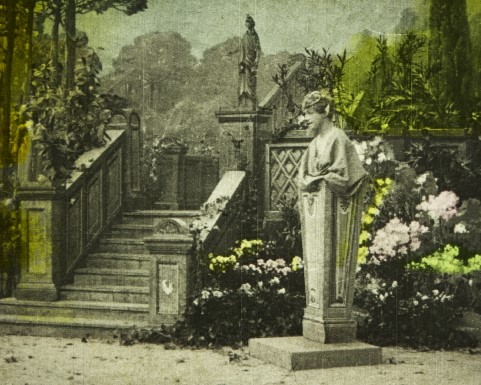
Amour d’esclave (original)
1907
Alternative Titles
A Slave's Love (Archive)
BFI identifier
27139Synopsis
Ancient Athens. Polymos falls in love with the slave Chloë. No main title. Polymos is bored by the attention of merchants and their rich goods. He dismisses them angrily. His wife, Chrysis, sends for the slave girl Chloë to dance for Polymos. Polymos is much taken with the dance and the dancer and goes to embrace her only to be separated by his wife who dismisses Chloë. However, once Chrysis has gone, Polymos follows Chloë into the garden. There he observes her giving flowers in an offering to the God of nature, Pan. She kisses the statue. Polymos makes his presence known and they embrace in a long kiss. They part blowing kisses to one another. Polymos retires to his bed. Chloë enters his quarters and places some perfume on a dying fire which then bursts into flame. Polymos dreams of Chloë dancing with a corp de ballets and veils (291-443). Polymos awakens and embraces Chloë. However, Chrysis enters the room and orders Chloë to be taken to the dungeons. Once there, Chloë is offered poison or death by whipping on a post. She chooses the poison and drinks it. Polymos enters the cell and stops the guard from whipping Chloë. She dances for Polymos once more but dies in his arms. He realizes she has taken poison and drinks it himself to be united in death with her. His wife enters and is stricken by his death (632ft). Note: English intertitles
- Production Country: France
- Production Company: Pathé Frères
- BFI Category: N/A
- Source: N/A
Cast
Georges Dorival (Polymos)
Darenne Bennard (Chloë).
Credits
Director: Albert Capellani
Film Technical Information
- Original Length: 210 m
- Length of BFI Viewing Print: 192 m
- Support: Viewable
- Black and White
- Format: 35 mm
Comments on the print:
Stéphanie Salmon writes: Three copies were examined for the Museum of Dreamworlds project: the BFI copy (192 m.), the Dutch Eye Filmmuseum’s print (203 m.), and the 2024 4K digital restoration by the Fondation Jérôme Seydoux-Pathé (210 m.). Derived from the original negative, the latter is presented in black and white. The BFI and Eye copies appear to be based on original coloured distribution prints, even if the BFI version was preserved in black and white. In 1908, the original length of the film was presented as being 210 metres, of which 160 m. was coloured. Intertitles were in the classic Pathé red style. The colouring-in of elements such as the brazier’s flame helps to convey the intended effect: when the fire is stoked as Polymos sleeps, the coloured flame marks his entry into the dreamscape (figure 8). Also colouring-in was added to the costumes of Polymos (yellow) and Chloë (green) within otherwise blue tinted shots. Eye’s version of the dream scene ends with an explosion of colours in the fabrics the dancers twirl (figure 4). The BFI and Eye copies contain few intertitles. They are nevertheless original and correspond to the film’s narrative structure. Thus, we find ‘Kus der liefde’ (The Kiss of Love) in the Dutch print and ‘A Dream. Awful Reality’ in the English print. Compared to the negative, it appears that the two original prints have not been re-edited.
Pantelis Michelakis adds: The film is held in eight archives (FIAF 1204), the Library of Congress on 35mm, the Cineteca del Friuli on 16mm, the BFI, and further elements at the Cinémathèque française, the Filmoteca de Catalunya (whose copy is incomplete at 200 m), the Deutsche Kinemathek (which holds a 35mm nitrate print), the CNC at Bois d’Arcy, and Eye. Among the Library of Congress’s non-access elements is a 35mm nitrate stencil colour positive, alongside an acetate dupe negative and a Betacam SP; a further incomplete print there runs to 518 ft in one reel, lacking main title and credits, catalogued as A Slave’s Love under LCCN 2006642150 with the inventory titles ‘Unidentified Tempereau’ and ‘Unidentified hand colored drama’, its plot summary a translation of the description in Films Pathé frères, supplément, May 1907, 202–3. The MARC medium fields describe the AFI/Tempereau preservation elements as black and white, the stencil colour nitrate being a separate element, which is why the digital viewing copy is in colour.
Printed Materials
Visual Resources
