
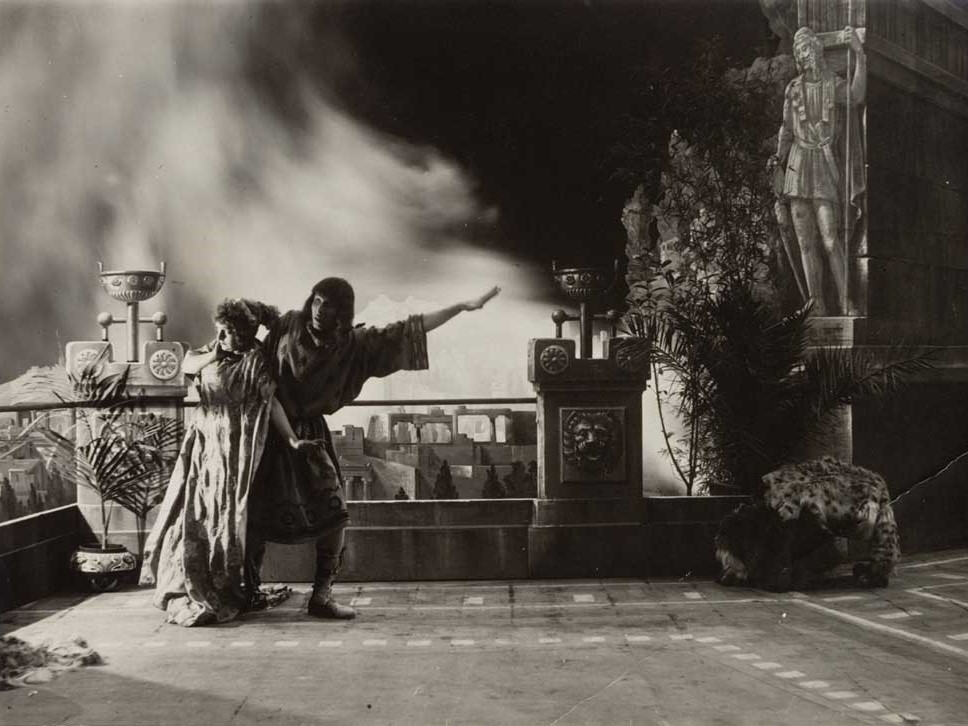
Caduta di Troia, La (original)
1910
Alternative Titles
The Fall of Troy (Alternative), La Chute de Troie (Alternative), Trojas Fall (Alternative)
BFI identifier
135963Synopsis
HISTORICAL DRAMA. The story of the Trojan war. Rl.1. Homer sings to the Greeks of the exploits of the heroes of the Trojan war. Menelaus, King of Sparta, takes leave of his wife Helen, departing by chariot. Paris, son of Priamus, King of Troy, arrives as Ambassador and is received by Helen. Paris is greatly struck by her beauty. His advances are repelled by Helen, but the goddess Venus comes to his aid and they are wafted in a gigantic seashell to Troy. The news is carried to Menelaus by a servant, and to avenge the insult, the Greeks declare war on Troy. They lay seige to the city but are repulsed. Priamus and the populace rejoice (812). Rl.2. The Greeks feign return, leaving behind a wooden horse which is supposed to be dedicated to protect them on their return voyage. The Trojans decide to remove it into the city and demolish part of their defences to draw the sacred effigy into the city. A spy carries the news to the Greeks whose fleet is anchored at the mouth of the River Xantus. They quickly embark and make for Troy. That night, the Greek warriors hidden in the horse emerge and fire the city. The Greeks enter by the dismantled gate and fierce fighting ensues amidst the falling buildings. Paris and Helen seek to escape but are discovered by Menelaus and his men. Paris is killed by Menelaus in single combat and Helen is captured, to be removed in bonds to Sparta (935). (1747ft) NOTE: The Archive also has another viewable copy, incomplete (1201ft) in Joye 599/600. This starts with a complete reel 2 (829ft) with no intertitles. Reel 1 (787ft) follows but not in the correct order, and with the beginning missing up to and including the arrival of Paris. The earliest scene shows Paris wooing Helen in a garden. There is one German intertitle.
- Production Country: Italy
- Production Company: Itala Film
- BFI Category: Fiction
- Source: N/A
Cast
Giulio Vinà (Paris)
Madame Davesnes (Helena)
Ermete Novelli
Borgono
Francesco Casaleggio
Credits
Director: Giovanni Pastrone, Romano Luigi Borgnetto
Production Company: Itala Film
Script: Giovanni Pastrone
Based on the works by: Homer
Photography: Segundo de Chomón
Designer: Romano Luigi Borgnetto
Film Technical Information
- Original Length: 600 m
- Length of BFI Viewing Print: 1745 ft
- Support: Viewable
- Black and White
- Format: 35 mm
Comments on the print:
Pantelis Michelakis adds: Seven further titles for the film are listed by FIAF. Although the original length is cited as 600 m, 605 m was declared on censorship visa no. 7892, Museo Nazionale del Cinema, Turin. The BFI holds a second, incomplete copy from the Joye collection, 599/600, at 1201 ft, reel 2 complete at 829 ft with no intertitles and reel 1 following at 787 ft out of order, lacking the opening up to the arrival of Paris, with one German intertitle. Marotto and Pozzi identify the BFI elements as follows: LJ, a first-generation nitrate positive from the Joye collection, tinted and toned, with German flash titles, disordered and depleted at an undated point by the extraction of frames, and conserved and restored in London after 1976; and L, a black-and-white safety positive of 532 m with English intertitles, assembled in London in the 1960s from two 1958 dupe negatives struck from two tinted nitrate positives since destroyed. The film is held in nine archives (FIAF 5424): the Museo Nazionale del Cinema, Filmoteca Española, Cineteca del Friuli and Cineteca di Bologna on 35mm, the Museum of Modern Art and the Deutsche Kinemathek on 16mm, the BFI, with further non-access 16mm elements in Berlin, and copies at the Cinémathèque française and Eye. FIAF credits the writing to Oreste Mentasti and the photography to Giovanni Tomatis, whereas the BFI catalogue gives the script to Pastrone and the photography to Segundo de Chomón, an attribution that needs settling.