
THEME - The set designs for classical antiquity from the Turinese film studio Itala (1909 to 1911)
By IVO BLOM
In this article, I focus on four of Itala Film's first silent films, which precede the famous film epic Cabiria (Giovanni Pastrone, Itala 1914), but which already develop an iconographic vocabulary on antiquity, especially through the search for scenic elements. All prints used stem from the collection of the British Film Institute, but will be compared with prints from Italian archives. First, I’ll focus on the film Giulio Cesare (Giovanni Pastrone, Itala 1909, MNC copy), which will be contextualised by its roots in theatre and painting, but also its recycling of sets, costumes and even actors from a previous Itala film, Principessa e schiava (Itala, 1909). Both films mark Itala's debut in films about Roman antiquity. I will compare the studio’s strategy with my previous research on the literary, theatrical and pictorial roots of early Cines films on Antiquity as well as ‘Roman’ set designs and their recycling in Cines films from 1909 onwards, as published in my recent book Quo vadis?, Cabiria and the ‘archaeologists’ (2023). Confirmation of this recycling by Itala Film can also be found in two films both set in ancient Greece: the famous film La caduta di Troia (Giovanni Pastrone, Romano Luigi Borgnetto, Itala 1911, Eye) and the lesser-known Clio e Filete (Oreste Mentasti, Itala 1911, BFI), with the latter reusing parts of the scenography and costumes of the former. This analysis considers the sources of the ancient worlds designed by Itala and Cines, the style of their reconstruction, the use of recycled materials, the differences between the two Italian studios, and what all this says for Italian filmmakers’ visions of the ancient world around 1909 to 1911.
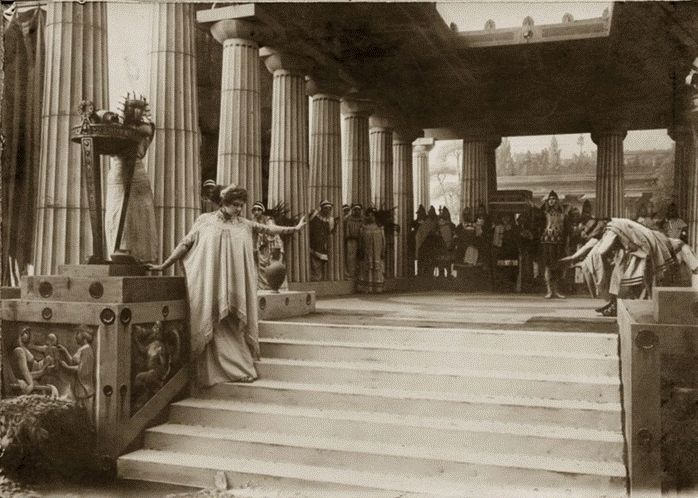
Figure 1. The Palace of Sparta (interior). La caduta di Troia (Itala 1911, set photo). Courtesy Museo Nazionale del Cinema, Turin..
The rise of Itala and the shifting film world
In his 2013 chapter, ‘The “Pastrone System”: Itala Film from the Origins to World War I’, Silvio Alovisio gives a thorough overview of the development of the Turin-based film company Itala Film, which together with companies such as Ambrosio, Savoia and Pasquali turned the Northern Italian city into one of the most important centres of the booming early cinema industry, not only on national but also on international level (Alovisio, 2013).
As Alovisio indicates, Itala Film was founded in 1908 on the remnants of the former Carlo Rossi & Co. studio which had been founded in 1907. The young Giovanni Pastrone, already hired by Rossi as artistic director, would soon become an important manager at Itala Film as well. During the 1908-1909 film crisis, due to overproduction and fast expansion, Itala also faced difficulties, but producer Carlo Sciamengo, who reasoned the Italian market on its own was too small to survive, managed to set up an important international distribution network with France, the UK, Russia, and particular the United States, and this in an era when the Edison trust MPDA tried to block foreign imports as much as possible. While in the Italian film industry no sharp divisions in labour existed in the early years, Itala already introduced some, even if not consistently. As a producer as well as film director at Itala, Pastrone had great control over all the films it made, also the films he did not direct or only co-directed. He closely overviewed the preparation and production of Itala’s films.
In 1911-12 Pastrone substantially expanded the studio by hiring new staff from France and from Turin’s regional theatre, but also lured Ermete Zacconi, one of the monstres sacrés of the Italian stage, to act in Itala productions like the sensational drama Padre (1912). Yet, the bread and butter of Itala, as for so many early companies, was comedy. Hiring a French actor from Pathé, André Deed, Itala was most successful with Deed’s farcical, anarchic, slapstick-comedies, full of chases and destruction that featured his character Cretinetti. Yet, inspired by the novelty of the French film d’art films (that had started with the 1908 film L’Assassinat du Duc de Guise and which were based on famous novels or plays, and performed by famous actors from the stage), Italian film companies also started to focus on the genre of historical dramas. Moreover, in addition to studio sets, the Italians were able to benefit from their country’s wealth of original historical settings of medieval castles, century-old city centres, and remnants of Roman Antiquity, or the natural scenery of mountains, rivers and the seaside. This interest in historical drama developed side by side with ever longer films, an increase in the use of extras, and an increase in the depth and the scale of set design. Doubtlessly inspired by French shorts set in Roman or Greek Antiquity, such as the Pathé-films Les Martyrs (1905), Amour d’esclave (1907) and La Vestale (1908), the Italians turned their focus towards their own ancient past, resulting at Itala in films such as Principessa e schiava and Giulio Cesare (both 1909) and at Ambrosio in the major production Nerone (1909), which was an international success and boosted the trend.
Itala’s 1911 film La caduta di Troia, lasting half an hour when short films of a maximum of 15 minutes were the norm, shook up the era of the short film. While formerly each film in a programme was interchangeable with another one and thus publicity per film was limited, with the introduction of the longer films, an increase in the number and variety of film publicity materials occurred, including posters, photos, and now even separate programme booklets on individual films. A hierarchy within the film programme was introduced, with a build-up towards the longer film within the programme, preceded by, for example, a newsreel, a travelogue, short comedies and dramas, while a short comedy or short farewell would usually round off the evening. This change was accompanied by a move from fairground cinemas and small local film theatres to ever more luxurious permanent cinemas. Historical productions like La caduta di Troia played a major part in this shift. The success of this film was also confirmed by Itala’s competitor, Milano Films, which soon after launched another Homer adaptation, L’Odissea (1912), even longer than the Itala production. All of this upward spiral would culminate in the prestigious Cines feature-length films on Roman Antiquity of 1913, especially Enrico Guazzoni’s Quo vadis?, as well as Itala’s own superproduction Cabiria (Giovanni Pastrone, 1914), which lasted over three hours, and just like Quo vadis? was not only shown in cinemas but also in opera houses and legitimate theatres. By 1913-14, the feature film including many epics set in antiquity had become the main focus of the industry but also of cinema owners and audiences. This change also resulted in exclusivity contracts that led to the practice of staging spectacular premieres.[1]
Giulio Cesare (1909) and its theatrical, pictorial and cinematic roots
The film Giulio Cesare, whose direction Aldo Bernardini in his repertory work Il cinema muto italiano assigns speculatively to Giovanni Pastrone (Bernardini, 1996: 210-212), mostly follows the plot of William Shakespeare’s canonic play of 1599, even if in a condensed form. Returning safe and sound from his expeditions, to the relief of his beloved Calpurnia, Caesar is flattered by Mark Antony’s plan to crown him emperor. Yet, Brutus, here in the film Caesar’s illegitimate son and a stark Republican, abhors this idea. He allies with the Republicans led by Cassius to kill Caesar. A gladiator overhears the plot and warns Calpurnia, who herself has had a dream about Caesar’s assassination. Caesar first gives in to Calpurnia not to go to the Senate, but he cannot refuse Brutus’s invitation and is brutally killed in the Senate, the final dagger thrust being from his own son. Mark Antony rouses the populace against the killers, who flee the city followed by an angry mob. At the Battle of Philippi, Caesar’s ghost appears to Brutus, accusing him of the murder. Together with the defeat of his army, this is too much for Brutus, who commits suicide.
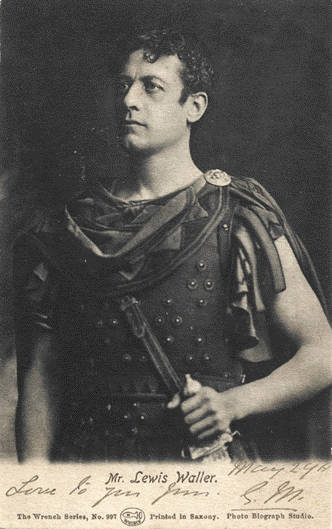
Yet, we might ask why this reliance on Shakespeare when the play was hardly performed in Italy in the early twentieth century. A rare performance was given at the Teatro Argentina in Rome from 19 December 1905 by the Compagnia Stabile. While initially praised by the Turin-based daily La Stampa in December 1905,[2] in an article defending the play against its unpopularity in Italy opposite other plays by the Bard, later in 1906 the same newspaper heavily criticised the staging and the performance of the play, both of which were considered ‘mediocre’.[3] No staging of Julius Caesar took place at all in Turin in the period just before Itala made its film. On the other hand, there were a few important performances outside Italy that the film could have been inspired by. First of all, this was Herbert Beerbohm Tree’s staging of Julius Caesar that opened on 22 January 1898 at the newly-built His Majesty’s at the Haymarket, with himself as Mark Antony and Lewis Waller as Brutus. While Julius Caesar had been more popular in the early rather than the late 19th century in Britain, Beerbohm Tree’s version was an enormous success. Not in the least because of the collaboration of the Anglo-Dutch painter Lawrence Alma-Tadema, who designed the sets and costumes for the play, and was renowned for his well-researched depictions of Roman Antiquity (Trippi, 2016; Richards, 2009: 162). In 1900, two years after it opened, Tree boasted that already 242.000 people had seen his staging of Julius Caesar (Richards, 2009: 169).
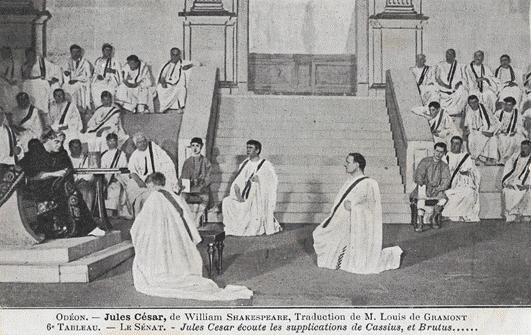
Another foreign success was the staging of Julius Caesar in Paris, at the Théâtre de l’Odéon, where, from 4 December 1906, a translation and re-elaboration of Shakespeare’s play could be seen and heard, with Edmond Duquesne as Caesar, Maxime Desjardins as Brutus, Philippe Garnier as Cassius, and Édouard de Max as Mark Antony. Lucien Jusseaume had designed the sets, while music by Gustave Doret was added, conducted by Émile Bretonneau.[4] The play was well publicised, including a large set of postcards, showing the various acts of the play - a by the early 1900s a common mechanism for publicising Parisian theatre.
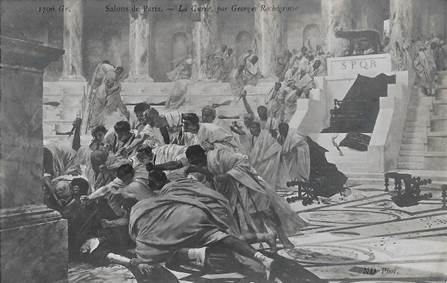
In addition, our understanding of the Itala film’s design is enriched by investigation of its relations to pictorial traditions, as historical films frequently drew on history paintings for their iconography. It is very clear the assassination of Caesar in the Senate is a key moment in the film. The violent act and the frenzy of the killers was already expressed well in a painting quite close to the moment in the film, namely La Curée/ L'assassinat de César (1887, Grenoble, Musée des Beaux-Arts) by Georges-Antoine Rochegrosse (Houssais, 2013 :67, fig. 25).[5] Yet, the background in Rochegrosse’s canvas is much vaster in its dimensions and ambitions than that of the film. While considering the depiction of Caesar’s death in 19th century painting, one of the most famous examples is Jean-Léon Gérôme’s Mort de César / Death of Caesar (1867, Walters Art Museum, Baltimore). Still, this painting rather shows the moment after, when the assassinating senators leave the Senate and the corps of Caesar, the face covered, is shown bottom left beneath the statue of Pompey. Moreover, the space is shrouded in darkness, while the killers are in the light but also at a distance, thus denying us access to their emotions. It is exactly this painting, proliferating through endless reproductions, that would be cited in the 1908 American film Julius Caesar by J. Stuart Blackton, produced by The Vitagraph Co. of America one year before the Itala production. Two years after the Itala film, Enrico Guazzoni would cite the painting again in his short film Bruto/ Brutus (Cines, 1911), which also closely follows the Shakespeare play (Blom, 2023: 78-81).
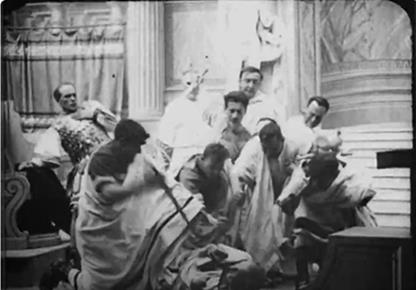
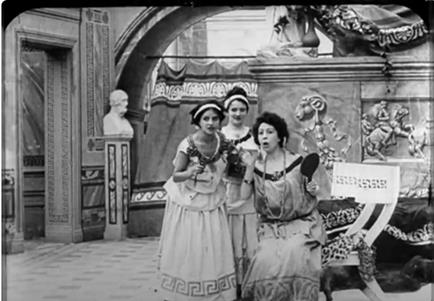
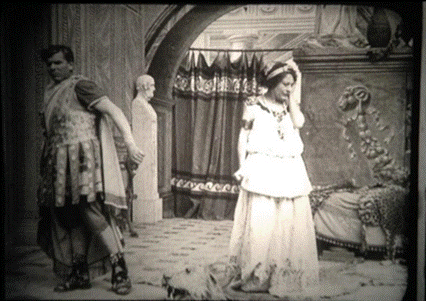
So the influence of painting and theatre seems less significant for Itala at this point than the closer, rather more prosaic and intra-medial influence of another Itala production, Principessa e schiava, made just a few months before Giulio Cesare. While Giulio Cesare is set in the late Republican era of Roman Antiquity, Principessa e schiava takes place at an undefined time, somewhere during the age of Imperial Rome. The name of the emperor is not mentioned, but as the hero Vitellius returns from fighting the Dacians, we may situate the tale some time after 98 A.D., when Trajan conquered Dacia (present-day Romania). Yet, the similarity in set design and (re-)use of props between the two films confirms a general trend in scenography in early Italian films on Roman Antiquity. In this period film makers tended to recycle key props and set designs to signal ancient Rome (and even more so Greece, as we will see later on), generally without much of an attempt to make a set more specific to the specific period or place in which a plot was set.
The opening shot in Giulio Cesare with Calpurnia anxiously awaiting Caesar’s return, shows a room with an arc on top and an ornate curtain in the background, through which Caesar and his fellow men will enter. Left, a large ornate door opening is visible, flanked by a pedestal with a Grecian bust on top (a Greek philosopher or writer), while on the right in the background, we can see a large frieze with a ram’s head and garland. Exactly, all of these elements were already displayed earlier on in Principessa e schiava in the scene where the hero Vitellius rejects the aristocratic Fausta, despite her repeated attempts at seducing him. Later on in that earlier film, while sitting in the garden on a large exedra-like bench, close to the marble exedra benches Lawrence Alma-Tadema so often depicted in his late 19th century paintings, such as Autumn (1874, Walker Art Gallery, Liverpool), Fausta notes the arrival of Vitellius and his beloved Dacian slave Aida. She first hides, then appears and in vain tries to disqualify the other woman, swearing revenge for the insult. She falsely accuses Vitellius of having assaulted her, so Vitellius and Aida are jailed but manage to escape. It is the same bench that returns, even though in another outdoor setting, when, in Giulio Cesare, Brutus, after the killing of Caesar, reflects on his next steps. The throne-like part of the bench was also used elsewhere in Giulio Cesare, for instance as Caesar’s special chair in the Senate. In short, this recycling that also occurs in other films of the period, as indicated for the company Cines in my latest monograph (Blom, 2023), suggests that Italian early film studios operated with a visual grammar for Roman antiquity regardless of when or where a Roman film was set. An arch, a curtain, a bust, a frieze, a bench were regarded as sufficient to mark out the Roman world into which film audiences were being invited. After a while, audiences even expected such markers to be there.
The Greek world: La caduta di Troia compared to other sources and to the film Clio e Filete
In terms of how Itala films were made in this period and its strategy of recycling, an interesting comparison can be made between the rather well-known Itala production La caduta di Troia/ The Fall of Troy (Giovanni Pastrone, Romano Luigi Borgnetto, Itala 1911, Eye) and the subsequent lesser-known production Clio e Filete/ Cleo and Philetes (Oreste Mentasti, Itala 1911, BFI), both showing the conflict of Greece with other ancient cultures. The two films are linked in a number of ways: the director of Clio e Filete was also the scriptwriter for La caduta di Troia; the (co-)director of Caduta went on to direct Cabiria (1914) while the main actress in Clio e Filete, Lydia Quaranta, would later play the title character in Cabiria. As Cristina D’Osvaldo has indicated in her chapter, ‘Cinema muto Italiano e la critica inglese' (D’Osvaldo, 1992: 78), British distributor Walter Tyler, impressed by the success of La caduta di Troia, launched Clio e Filete in the UK, claiming that considering its use of the masses of extras, the quality of its mise-en-scene, and the performance of the actors, Clio Filete was its equal.
Whereas Clio e Filete survives only in a black-and-white print unique to the BFI, for this comparison I was able to investigate four different prints of Caduta from four archives: 1) a Dutch titled, tinted safety print within the Desmet Collection of the Eye Filmmuseum, 2) an Italian titled, tinted safety version restored in 2005 by the film archives of Bologna, Turin and Gemona and based on nitrate prints such as the Dutch one, 3) a black-and-white safety by the British Film Institute, and 4) a black-and-white safety at the Cinémathèque Française. The latter is a peculiar, wrongly edited version, which, moreover, has one shot that deviates from the other versions. In the other versions, after Helena has said goodbye to her husband Menelaus and walks back to the palace, we see the same peacock passing by we have seen at the beginning of the shot. In the French version the animal has mysteriously disappeared. Apparently, the shot was taken twice and another version ended up in this film’s print (a shot which according to the print originated from the Cineteca Italiana in Milan). The British version has more luminosity in its shots than in the Dutch and Italian version.
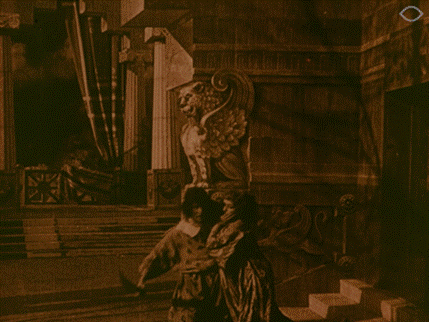
The vastness and depth of the sets of La caduta di Troia is striking. This is particularly evident in the scene where we see the throne room of the palace of Sparta when Paris meets Helena while her husband is away. An original set photo, kept by the Museo Nazionale del Cinema, shows the film’s crew posing in the empty set, while the columns, the steps and objects like braziers work as depth cues and create the effect of deep staging. Another set photo depicting the scene of the meeting even increases this feeling of depth by placing actors and extras in a row receding into the background. The dimensions of the palace of Sparta catch the eye, but so do those of the palace of Troy. This is already visible on a set photo depicting Paris and Helena watching the fire of Troy from above. The film print itself even enhances this spectacle through the red tinting of the shot. Notable is a side wall built up in obliqueness at which end a painted cut out represents a statue of a hero resembling Paris carrying a spear.
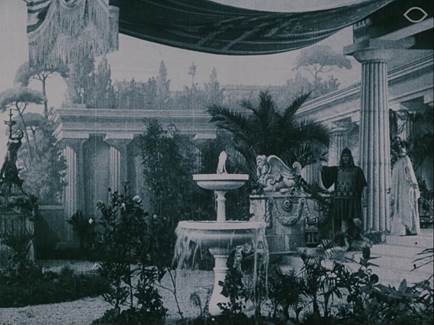
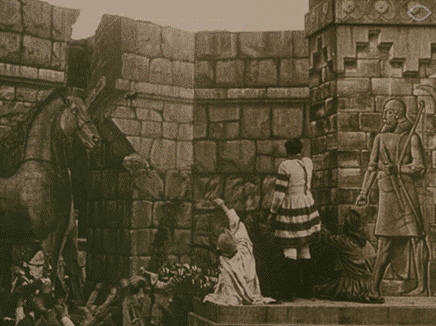
When analysing the style of the depiction of Sparta versus Troy it is clear that the set design by Luigi Borgogno is meant to create a maximum of difference between the two cities and to stress the Otherness of Troy. The exterior and interior of the palace of Sparta breathes classicism, even neoclassicism, as Elisabetta Gagetti has stated in her article, ‘Omero e la decima musa: Le mura di Troia’ (Gagetti, 2007) – she compares the palace garden to Lawrence Alma-Tadema’s painting A Difference of Opinion (1896). Whereas the city of Troy and its palace present a strange mixture of Assyrian art, Greek elements and rather Roman-like elements as well. When the Trojans pull the Trojan Horse inside the city walls – a remarkable flat cut-out that wobbles even as it is brought in – we might notice a frieze which is clearly inspired by Assyrian art. Behind a bearded hunter we notice what looks like a woman dressed in a long robe and with ornate curly hair. Instead, it is a royal eunuch, as is depicted in a scene at the so-called Black Obelisk of Shalmaneser III (859–824 BCE), now at the British Museum (Aruz, Graff and Rakic, 2014; Cohen, Kangas, 2010). [6] Instead, the unusual odd tunica the Trojan populace wears, similar to the Roman tunica Brutus wears in Giulio Cesare, combined with long pants, set an authentic note. The Greeks and Romans considered pants to be the dress of barbarians. In the case of Itala, you would almost think the dress code has to do with the cold temperatures in the Turinese film studios of Itala.
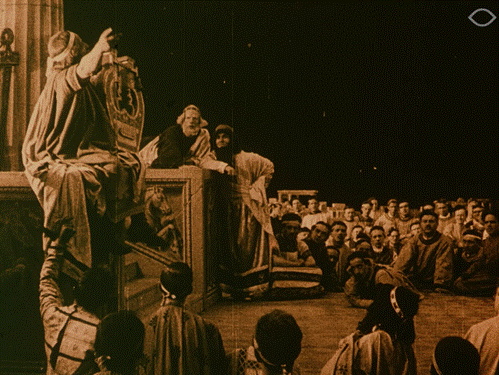
When considering sources for La caduta di Troia, of course Homer’s Iliad is paramount. By 1910, Italians were familiar with the Italian translation by Vincenzo Monti, first printed in 1810, and afterward countlessly reprinted, also in schoolbook versions. Moreover, the film even has a prologue with a large Greek audience listening to Homer’s telling of the story of the Trojan war. Yet, the original Iliad stops at the funeral of Hector, and leaves out the story of the Trojan Horse, the burning of Troy and the massacre of its inhabitants These events are rather told in two lesser-known sources, the so-called Little Iliad en the Iliou persis. While Homer’s Odyssey hardly talks about Troy’s demise, it is much later, most famously in Virgil’s Aeneid, that the story of the Trojan Horse and the destruction of Troy is narrated. Yet, Pastrone’s film skips most of the ten years of the Trojan War (omitting the deaths of Patroclus, Hector and Achilles), and retakes the story at the moment Odysseus comes up with the ruse of the Trojan Horse, pretending the Greeks have sailed away but secretly hiding a small number in the horse to open the city gates of Troy for the Greek army to enter. The film's interest obviously lies in Troy's fall and the opportunity it provides for the spectacle of destruction, a common topos in antiquity films like all of the Last Days of Pompeii film adaptations.
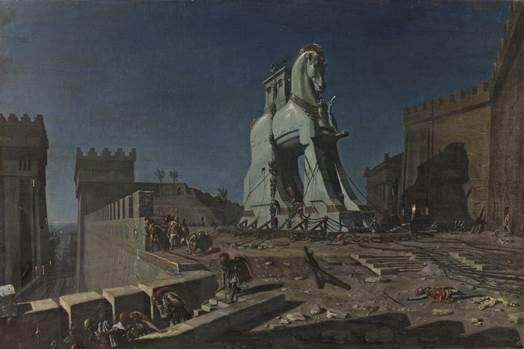
Figure 13. Le Cheval de Troie (H.P. Motte 1874). Wadsworth Atheneum Museum of Art, Hartford. Source: .https://commons.wikimedia.org/wiki/File:Henri-Paul_Motte_-_Le_Cheval_de_Troie.jpg?uselang=fr
Pictorial sources are also worthwhile considering. Symbolist painter Gustave Moreau endlessly depicted Helena on the walls of Troy, between 1885 and his death in 1898. Yet, already in 1865, British painter Frederick Leighton did his version of Helena on the Walls of Troy (private collection). While the Trojan Horse had inspired European artists for centuries, such as Giovanni Domenico Tiepolo in La processione del cavallo di legno dentro Troia (1760, London, National Gallery), it was Henri-Paul Motte’s Le Cheval de Troie (1874, Wadsworth Atheneum Museum of Art, Hartford) which became the 19th century’s most famous version. It won Motte a medal at the Paris Salon and also meant his breakthrough in artistic circles as a history painter (Blom, 2023: 176). Later, Motte’s Baal dévorant les prisonniers de guerre (Algiers, Musée des Beaux-Arts) would be the inspiration for the exterior of the Temple of Moloch in Pastrone’s Cabiria, which imitates Motte’s giant gate in the form of a winged monster head through which people enter and whose enormous hands on either side seem to usher the people in (Blom, 2022: 177-178). Another painter who later would be essential for the interiors of Cabiria, in particular the boudoir of Sophonisba and the Temple of Moloch, is Georges-Antoine Rochegrosse (Blom, 2023: 171, 200-211). In 1883 Rochegrosse painted Andromaque (Rouen, Musée des Beaux-Arts), a bloody and macabre depiction of the massacre of the Trojans by the Greeks. In vain Andromache, widow of the Trojan hero Hector, tries to save her son Astyanax, who will be killed by being thrown off the city walls. An anonymous Greek warrior is already standing at the head of the stairs to perform the gruesome act, while at the feet of the stairs we see corpses and decapitated heads. In contrast to (Dutch-)British painters such as Alma-Tadema and Leighton, French history painters such as Rochegrosse and Gérôme found it no problem to depict the horrors of Antiquity in as gory a manner as possible. Pastrone’s La caduta di Troia is less explicit in the gory details of ancient warfare as the French depicted them, but neither does it fully embrace the dolce-far-niente of British painters of Roman Antiquity like Alma-Tadema, Waterhouse and Godward nor that of Italians like Muzzioli and Vasarri. The film does not abstain from killing and death. It also clearly builds on multiple architectural elements of the dreamworlds of nineteenth-century French, British and Italian painters imagining Antiquity.
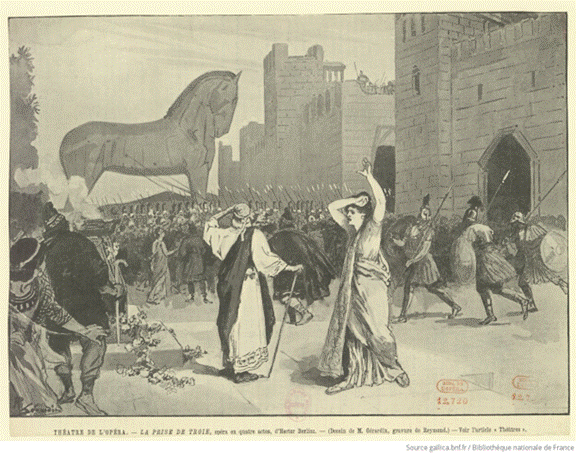
Figure 14. Opera La Prise de Troie (H. Berlioz, version Paris 1899). Source: Gallica, https://gallica.bnf.fr/ark:/12148/btv1b53117607m.r=la%20prise%20de%20troie?rk=107296;4
Given its importance to Italian culture, opera also needs to be considered. Already in 1856-1858, the French composer Hector Berlioz wrote the two-part opera Les Troyens, based on the Aeneid. The two parts were entitled La prise de Troie and Les Troyens à Carthage. The second part was already performed in 1863 preceded by an abbreviated version of part 1, but a full version of the first part was only performed post-mortem in 1890, together with part 2 and in a German version at Karlsruhe. In Paris, La prise de Troie would first be staged at the Théâtre de l’Opéra on 15 November 1899, but by then the opera was considered outdated, while there was also criticism in the French press of lead singer Marie Delna (Cassandra) and the partly dysfunctional Trojan Horse, mounted on rollers.[7] Yet, a print by Auguste Gérardin of the horse being drawn towards the Trojan city gate during the opera shows some similarities with the film in its ‘en profil’ depiction of the horse, moved towards the city gate on the right.[8] Although the Turn based daily La Stampa marked ‘I Troiani’ as an important point-of-reference within the career of Berlioz, no news was published on any staging at Turin in the years before Pastrone’s film.[9] Nevertheless, formal similarities are clearly there, as I will also point out below.
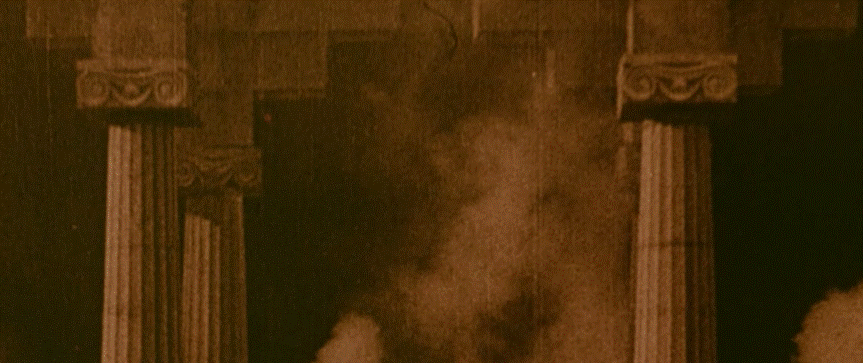
Figure 15. Detail of capitols at the Palace of Troy. La caduta di Troia (Itala 1911, print Eye).
In the Spartan part of La caduta di Troia, Helena wears a combination of peplos and chiton reminiscent of Greek statues that show this combination of dress for women. In the Trojan part, she wears a highly decorated, thick textile and a loose-fitting dress. It does not seem to be based on the costumes for the 1899 version of the opera, designed by Charles Bianchini,[10] but instead is reminiscent of the early 20th century velvet creations designed by Mariano Fortuny. The architecture of Troy, the capitals in the main hall of the palace (say, Priam’s throne room, although we don’t see him in the film) are halfway Ionic capitals from Greece and the fantasy-like capitals in the set design of the 1899 opera. The strange openings between the columns in Troy’s palace look like a kind of flipped gable, for which no authentic precedent could be found, at most a mirrored version in the stairs of the Persepolis Palace of Darius (4th c. BCE). As Troy’s architecture was partly derived from Aegean architecture, it might have made sense for the set designers to follow, for example, the illustrations in the book by the German archaeologist Engelbert Drerup, Omero. Le origini della civiltà ellenica (Drepup, 1910) which had been published in Italy shortly before Pastrone’s film was made. Yet, apart from a vague similarity with the triangular opening above Troy’s city gate, similar to the tombs of Atreus and Clytaemnestra in Mycenae, and also a vague similarity to a reconstruction of the city walls of Tyrins, the film doesn’t offer too many elements in common with Drerup’s study. Possibly, Pastrone and his scenographer Borgogno thought modern conceptions of Otherness a more important criterion than archaeological authenticity.
Despite the rather loose take in La caduta di Troia on earlier traditions for the architecture of Troy, its spectacular scenography of La caduta di Troia proved highly effective to Itala. It is very clear that a subsequent Itala production, Clio e Filete, directed by Oreste Mentasti and realised a few months after in 1911, reused sets, costumes and props from the earlier film. Clio e Filete tells about how king Diomedes promises the hand of his daughter Clio to the brave Philetus. Diomedes welcomes the Barbarian leader Haxar but the latter explodes with rage when he cannot get the hand of Diomedes’ daughter. He attacks Diomedes’ city and captures Clio, who proudly resists him. Philetus rescues the wounded king and flees with him. Later, he bravely enters the city and the palace, strikes down Haxar and flees with Clio. Just as Haxar and his cronies are about to catch the couple, the throne room collapses on them and the betrothed couple manage to flee from the burning city. The names of the characters signal an ancient setting where once again Greek is pitted against an Other, but time and place remain unspecified.
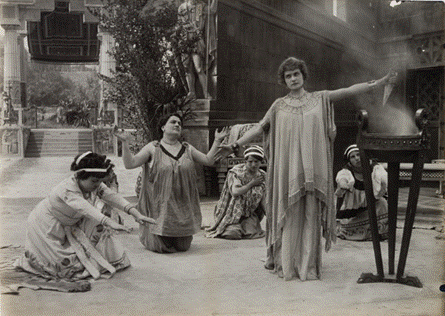
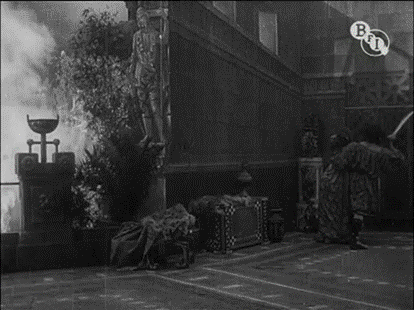
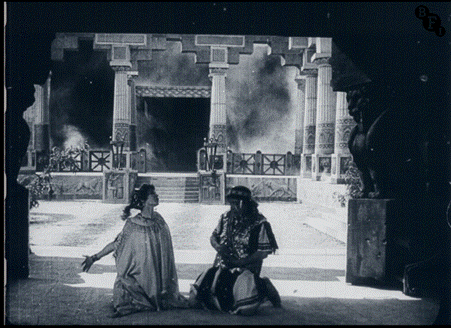
Despite the nominally Greek setting of this invented plot, the oblique wall displaying the Paris-like statue on the terrace of Troy’s palace in La caduta di Troia returns in the palace of Diomedes in Clio e Filete, although it is combined with new set pieces, such as in the scene when Clio is menaced by Haxar. During the nighttime scene in which Philetus re-enters the city, we recognize parts of the scenography of the city of Troy in La caduta di Troia, when the Greeks leave the Trojan Horse, set fire to the city and start to kill the Trojans. A statue of a Greek-like warrior with helmet, shield and spear on the right in the image returns in almost the same position in Clio e Filete. Also, a pedestal with a form of brazier, is reused in the same shot. Moreover, on the left in the same shot in Clio e Filete we also recognize a part of the Assyrian-like frieze in La caduta di Troia mentioned above. The outer walls of Troy return in Clio e Filete, now presented as the inner side of the walls of the supposedly Greek city of Diomedes, with the city gate at exactly the same position. The main hall of Diomedes’ palace is partly retaken from the throne room in Troy in La caduta di Troia, with, in the back, the same Doric columns, the same odd openings between the columns and almost the same stairs, while in the foreground right a same sphynx with lion’s head and wings is used.
A remarkable difference, though, is that the lower part of the columns in Clio e Filete are highly decorated, a bit like the upper part columns in the 1899 opera version of Berlioz’ La prise de Troie. In addition to this reuse of sets, Clio e Filete also recycles costume, as Clio’s dress is exactly the same combination of peplos and chiton Helena wears in Sparta in La caduta di Troia. Closer inspection may even reveal reuse of Helena’s jewellery and hairbands in Clio e Filete. Also the brazier, prominently placed in the interior of the palace of Sparta in La caduta di Troia, returns in Clio’s rooms in Clio e Filete. The low tables with their checkerboard motif at Agamemnon’s palace in La caduta di Troia return in Clio’s rooms as well, while the two sets also both contain a rug of a polar bear (although we may well ask how Ancient Greeks obtained polar bear skins). Tiger and leopard skins, also visible in the two films, make more sense then, even if belonging to animals that were uncommon in Greece, but were easier to get hold of through trading. So, in a supposedly Greek city, Greek characters are nonetheless positioned in sets that in the earlier film had signalling Otherness. Here Otherness is now projected not through the reused sets but through the bizarre get-up and props of Haxar and his barbarian hordes.
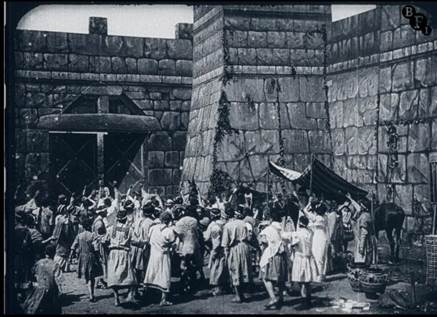
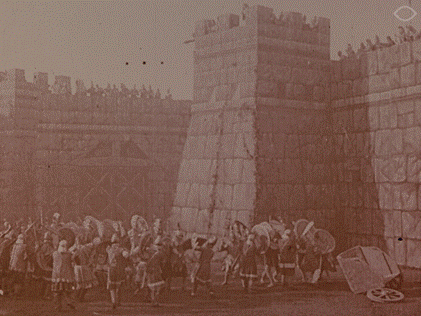
Finally, while La caduta di Troia was widely distributed, well publicized and reviewed in the West world, it may help our understanding of these strategies to know a little bit more about the reception of Clio e Filete, a film that surely to our modern eyes looks inferior. In October 1911, the Italian critic of La Vita Cinematografica, wrote that Pozzini (the actor playing king Diomedes) lacked majesty, while Alex Bernard (Philetes) was gesticulated too much. The journal also criticised the disorderly masses and extras just passing the screen to break the monotony of the scene. ‘Too bad, we repeat!’, as La Vita Cinematografica wrote. ‘Because subject matter, grandiose décors and splendid staging allowed for something truly artistic.’[11] Instead, the British trade press was wild about the film. At the time, The Bioscope wrote: ‘Set in a period of magnificence, full advantage has been taken of the fact and, as is usual in Itala production, accurate costuming, with attention to the smallest detail, magnificent building, realistic fighting, and realism par excellence have been embodied. Wonderful sums up the whole production.’ The Bioscope considered the film to be even better than La caduta di Troia, although their comparison of the two films may perhaps have had more to do with promotion than criticism.[12] In the USA, Moving Picture World, accepting the supposed Greekness of the film and concurring with The Bioscope reported: ‘The same qualities that were found in the Itala film The Fall of Troy are seen in this magnificent Grecian picture, in two reels (2,000 feet) telling the poetic love story of Cleo.’ The journal found the film at least on a par with the previous one.[13] In his book Giovanni Pastrone (1985) Paolo Cherchi Usai confirms this: ‘The two feature films [La caduta di Troia and Clio e Filete] won moderate public acclaim in the motherland, but caused uproar abroad. [... The New York impresarios, who had been addicted to the Pathé backdrops for years, breathed new air and were inflamed with enthusiasm.’ (Cherchi Usai, 1985:36). In conclusion, it may be that by 1911, Italian critics, acclimatised to elaborate staging, required more from their antiquity films while foreign critics were less demanding.
Scenography
The film industry’s development of scenography is one of the remarkable features of the fast development of antiquity films in Italy between around 1909 and 1914. In his text ‘Set design’ (2005), Ian Christie wrote:
The early film d’art style was essentially on a chamber scale, filling the frame with unusually rich and suggestive detail, and adopting the scenic conventions of Henry Irving’s “pictorial” theatre and its equivalents in other countries. But in Italy it began to be applied to much larger and more spectacular subjects, notably those set in the ancient world, Ambrosio’s Nerone (1909), Itala’s La Caduta di Troia (1911), Ambrosio’s second version of Gli ultimi giorni di Pompei (1913) and Cines’s Quo vadis? (1913) traced a rising graph of scenic and spectacular ambition, typically involving a combination of interior and exterior sets, with model shots for fire and volcano effects. History painting remained a crucial reference source, as did the 19th -century stage traditions of representing Ancient Rome, supplemented by the evidence of new archaeological findings.
Christie sees all of these elements culminating in Itala’s epic Cabiria (1914), with its exotic landscapes, its monumental sets and mass choreography of, for example, the Temple of Moloch and the siege of Cirta, and its innovative slow, curved tracking shots confirming the vastness and richness of its scenography. Christie observes: ‘The scale of Cabiria’s sets and crowd scenes would leave an indelible mark on all subsequent spectacle cinema, from D.W. Griffth to DeMille and Fritz Lang.’ (Christie, 2005: 586).
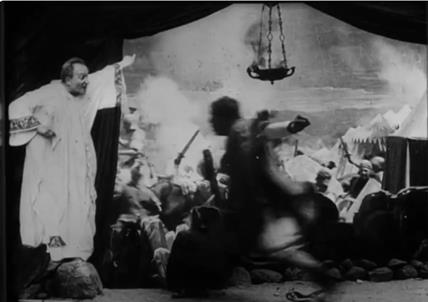
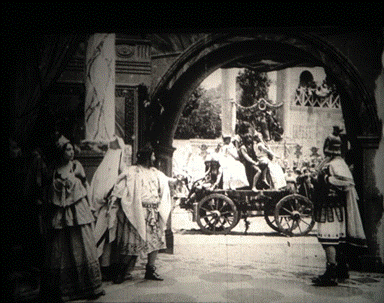
Indeed, when comparing the fast development in scenography at Itala between the two antiquity films from 1909 and the two from 1911 at Itala Film, the change is enormous. Both films of 1909 already experimented with staging in depth by showing action going on in the background, while people in the foreground react to this, thus making an explicit link between foreground and background. In Giulio Cesare this happens for instance during Caesar's triumphal march, with the whole parade passing a huge arch, similar to the British painting A Roman Triumph (1883) by Frank William Warwick Topham (Leicester Museum & Art Gallery). It also occurs towards the end of the film, when the ghost of the murdered Caesar appears to Brutus while in the back soldiers are fighting the Battle of Philippi (in which Mark Antony’s army strikes down the army of Caesar’s assassins). Overcome with guilt and accepting his losses, Brutus commits suicide – a simultaneity which is a clear reduction of what happens rather in sequence in the Shakespeare play. In Principessa e schiava, through an arc of the emperor’s palace, we see a Roman parade moving by that includes a cart transporting the conquered ‘Barbarians’. As the cart includes the female slave with whom the hero has fallen in love, Fausta, the emperor’s daughter, immediately shows her jealousy of the girl. This dialogue between fore- and background is a typical novelty in the development of film language at that time, as Barry Salt has made clear in his monograph, Film Style & Technology (Salt, 1992: 102-104).[14] Salt also remarks this manner of staging was rather an European development and rarer in American films: ‘From a general point of view one could consider the European use of space behind to be an attempt to get more variation in the image during the course of the shot (and of the film) to make up for that variety which was otherwise provided in American films by the greater use of cutting’ (Salt, 1992: 104).
While the two films of 1909 still remain within the scale of a relatively small room (even if sometimes using larger spaces outdoors), La caduta di Troia and Clio e Filete show vast interiors and exteriors, such as the interiors of the palaces of Sparta and Troy and the exteriors of the palace of Sparta and the city walls of Troy in La caduta di Troia. An increase in depth and three-dimensionality in the 1911 films is also remarkable, even though flatness still occurs with for instance the Trojan Horse – a flatness that is even more noticeable when the Horse is pulled into the city of Troy.
Conclusion
The four Itala films analysed show how just in the period of a few years, Itala’s film productions changed, in particular concerning their scenography. At the risk of launching a teleology, you could say the makers were building up towards the mega-sets of the mega-production of Cabiria, which would take most of Itala’s efforts during 1913 and was launched early 1914. It is also clear that, compared to their representations of ancient Rome, in which an often unchangeable and archetypical repertory of sets, props and costumes was already in use (partly based on real objects in museum collections or from ancient sites like Pompeii), Itala’s scenographers took even more liberties and invested substantial exoticism in their representations of Greece, and even more so in relation to Troy. Combining Assyrian art, Greek and Roman art, and phantastic elements for Troy in Caduta and the city of Diomedes in Clio e Filete was no matter of concern. It is also clear that for Cabiria, Pastrone and his crew invested much more research, as I have explained in my latest monograph, Quo vadis?, Cabiria and the ‘Archaeologists’ (2023). It is also remarkable that Cabiria had highly original sets that were not based on former film sets, recycling set pieces, props and costumes, but was rather based on (reproductions of) French history painting, but also the state of archaeology at the time, even when also using e.g. Assyrian or Egyptian art to profile the Otherness of the cities of Carthage and Cirta, and to mark them as different from each other. Yet, on the whole, and considering in particular the ‘Roman’ films by Cines, Ambrosio and Pasquali, by 1913-1914 a shift had taken place in early Italian filmmaking, indicating a greater concern for the archaeological and historical record and therefore providing for spectators a more authentic and varied ancient world on screen.
Footnotes
- ^ For the general shifts in the film world in c. 1908-1914, including the major changes in distribution and film exhibition, see my monograph, Blom, 2003.
- ^ La Stampa, 22 December 1905, p. 1.
- ^ La Stampa, 9 January 1906, p. 5. In hindsight, and despite La Stampa’s critique of 1906, the Compagnia Stabile at the Teatro Argentina in Rome reported in 1909 that Julius Caesar had been its second best play (36 performances) since its start, after D’Annunzio’s La Nave (84 performances, more than the double of Julius Caesar). La Stampa, 19 July 1909, p. 5.
- ^ L’Illustration théâtrale, 8 December 1906, special issue.
- ^ Rochegrosse’s illustrations for a 1900 edition of Gustave Flaubert’s novel Salammbô would be pivotal for the iconography of Sophonisba’s boudoir and the interior of the Temple of Moloch in Pastrone’s Cabiria. Blom, 2023: 169-2011. One may also consider Vincenzo Camuccini’s painting La morte di Cesare (1793-1818, Naples, Museo di Capodimonte), but this lacks the chaotic scene of Rochegrosse and Pastrone, instead well showing the faces and emotions of all involved, and quite rigidly choreographed ‘en profil’, as if every participant should be recognizable and able to emote. See also Lübbren, 2023: 41-49.
- ^ For other representations of royal eunuchs at the Assyrian court, see for example https://www.britishmuseum.org/collection/object/W_1850-1228-8. For a bearded hunter in Assyrian art, see e.g. https://www.britishmuseum.org/collection/object/W_1856-0909-9. For the Assyrian elements in the set design of Cabiria, see Blom, 2023: 248-253, 259-261. For my research into this I owe thanks to Julien Monerie (Université Paris 1 Panthéon-Sorbonne), and Vicky Donellan and Gabriella Micale (both British Museum).
- ^ Auguste Germain, ‘Les Théâtres’, La Vie au grand air : revue illustrée de tous les sports, 26 November 1899, p. 132.
- ^ Auguste Gérardin, Théâtre de l'Opéra. La prise de Troie, opéra en quatre actes, d'Hector Berlioz. Etched by Reymond. Le Théâtre, 1 January 1900, pp. 6- 15, contains several photos of the opera, including the Trojan Horse before Troy on p. 13. In 1905 the opera would be reprised at the Théâtre Antique in Orange, in 1906 at the Théâtre de la Monnaie in Brussels.
- ^ La Stampa, 19 January 1905 and 16 August 1905.
- ^ La prise de Troie : trente-six maquettes de costumes, par Charles Bianchini (s.a.).
- ^ La Vita Cinematografica, Turin, No. 17, October 10, 1911. Quoted in Bernardini, Martinelli, 1995: 98.
- ^ The Bioscope, London, September 14, 1911. Quoted in Bernardini, Martinelli, 1995: 98-99.
- ^ The Moving Picture World, New York, Vol. 9, No. 10, September 16, 1911, p. 778. Quoted in Bernardini, Martinelli, 1995: 99.
- ^ Salt refers to an earlier article by Ben Brewster in this respect. See Brewster, 1992.
Caduta di Troia, La (original)
1910
HISTORICAL DRAMA. The story of the Trojan war. Rl.1. Homer sings to the Greeks of the exploits of the heroes of the Trojan war. Menelaus, King of Spa…
Clio e Filete (original)
1911
Phyletes rescues Clios, his betrothed, from the rapacious Haxar. Haxar, returning in triumph from conquest, asks for Clios as his wife, but her fathe…
Giulio Cesare (original)
1909
The rise and fall of Julius Caesar. Calpurnia welcomes her husband, the triumphant Caesar back to Rome. Caesar, confiding his tyrannical aspirations …
Principessa e Schiava (original)
1909
Ancient Rome. Roman princess is jealous of general's love for captured slave girl. Roman general Vitellius returns after conquering the Dacians, …
Alovisio, S. (2013) ‘The “Pastrone System”: Itala film from the origins to World War I’, in Bertellini, G. (ed.) Italian Silent Cinema: A Reader. New Barnet: John Libbey, pp. 87–96.
Aruz, J., Graff, S.B. and Rakic, Y. (eds.) (2014) Assyria to Iberia: At the Dawn of the Classical Age. New York: Metropolitan Museum of Art.
Bernardini, A. (1996). Il cinema muto italiano, 1905-1909. Rome: Centro Sperimentale di Cinematografia/La Nuova ERI.
Bernardini, A. and Martinelli, V., (1995) Il cinema muto italiano. 1911. Vol. 1. Rome: Centro Sperimentale di Cinematografia/ La Nuova ERI.
Blom, I. (2003) Jean Desmet and the Early Dutch Film Trade. Amsterdam: Amsterdam University Press.
Blom, I. (2022) ‘The pictorial turn: Intervisuality and recycling in Fabiola (Enrico Guazzoni, 1918)’. In Blos-Jáni, M. et al. (eds) Intermedial Encounters: Studies in Honour of Agnes Pethö/Intermediális találkozások: Tanulmányok Pethő Ágnes tiszteletére. Cluj-Napoca/Kolozsvár: Scientia Kiadó, pp. 125-136. https://research.vu.nl/en/publications/the-pictorial-turn-intervisuality-and-recycling-in-fabiola-enrico/
Blom, I. (2023) Quo vadis?, Cabiria and the ‘Archaeologists’: Early Italian Cinema’s Appropriation of Art and Archaeology. Turin: Kaplan.
Brewster, B. (1992) ‘Deep staging in French films, 1900–1914’, in Elsaesser, T., Barker A. (ed.) Early Cinema: Space – Frame – Narrative. London: BFI Publishing, pp. 45–55.
Cherchi Usai, P. (1985) Giovanni Pastrone. Florence: La Nuova Italia.
Christie, I. (2005) ‘Set design’, in Abel, R. (ed.) Encyclopedia of Early Cinema. London/ New York: Routledge, pp. 584-587.
Cohen, A. and Kangas, S.E. (eds.) (2010) Assyrian Reliefs from the Palace of Ashurnasirpal II: A Cultural Biography. Hanover, N.H.: Hood Museum of Art/University Press of New England.
D’Osvaldo, C. (1992) ‘Cinema muto Italiano e la critica inglese’, in: V. Martinelli (ed.), Cinema italiano in Europa, 1907-1929. Rome: AIRSC, pp. 75–81.
Drerup, E. (1910) Omero. Le origini della civiltà ellenica. Bergamo: Istituto Italiano d’Arti Grafiche.
Gagetti, E. (2007) ‘Omero e la decima musa: Le mura di Troia’, in: Iconografia 2006: Gli eroi di Omero. Rome: Quasar, pp. 269–279.
Houssais, L. (2013) Georges-Antoine Rochegrosse. Les fastes de la décadence. Moulins: Musée Anne de Beaujeu/Éditions mare & martin.
Lübbren, N. (2023) Narrative Painting in Nineteenth Century Europe. Manchester: Manchester University Press.
Richards, J. (2009) The Ancient World on the Victorian and Edwardian Stage. London/New York: Palgrave MacMillan.
Salt, B. (1992) Film Style and Technology: History and Analysis. 2nd ed. London: Starword. First published 1983.
Trippi, P. (2016) ‘All the world’s a stage’, in Prettejohn, E. and Trippi, P. (eds.) Lawrence Alma-Tadema: At Home in Antiquity. Munich/London/New York: Prestel, pp. 172–185.