
1917- L’Esclave de Phidias and the dialogue between antiquity, cinema, and landscape
By AYLIN ATACAN
The figure of Phidias, perhaps the most celebrated sculptor of ancient Greece and born around 500 BC in Athens, was the artistic genius responsible for two of antiquity’s most iconic statues: the Athena Parthenos and the colossal Zeus at Olympia, considered one of the wonders of the ancient world.[1] Phidias was not simply a craftsman; he embodied the pursuit of perfection in form, harmony in composition, and beauty as an expression of divine truth.[2] These ideals echo not only in marble and bronze but, centuries later, in celluloid, in a film called L’Esclave de Phidias, or in its Anglophone distribution The Slave of Phidias (Fig. 1).[3]
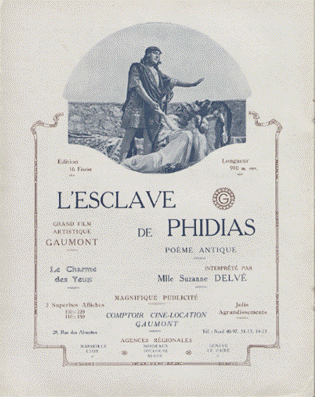
Figure 1. Le Film. No. 46, 4th year, 29 Jan. 1917
Over the centuries, Phidias and his works have remained a profound source of artistic inspiration. Today, the latest significant finding related to Phidias is his workshop at Olympia, where it is believed he crafted the chryselephantine statue of Zeus (Fig. 2).[4]The archaeological site reveals a layering of history: a Byzantine Basilica was later built over the ruins of this workshop, transforming an artistic space into a religious one. This process of adaptation mirrors what we will see in the film, where a modern villa is transformed to represent an ancient Greek house. Archaeologists uncovered tools, terracotta moulds, and notably, a small black oinochoe (wine-cup) inscribed on the bottom with the words Φειδίου εἰμί (Pheidíou eimí), meaning ‘I belong to Phidias’. In The Slave of Phidias, we will encounter a fictionalized version of this workshop. The film does not rely strictly on archaeological findings but instead imagines the creative environment of the sculptor. Intriguingly, the film features a slave girl who, much like the inscribed cup, feels a profound connection to Phidias-as if she ‘belongs’ to him. In the film, Phidias is portrayed as a tormented creator in search of the ideal model for the goddess- a muse he eventually finds in the slave girl Callyce. What unfolds is both melodrama and meditation: a conflict between inspiration and jealousy, between public duty and private desire.
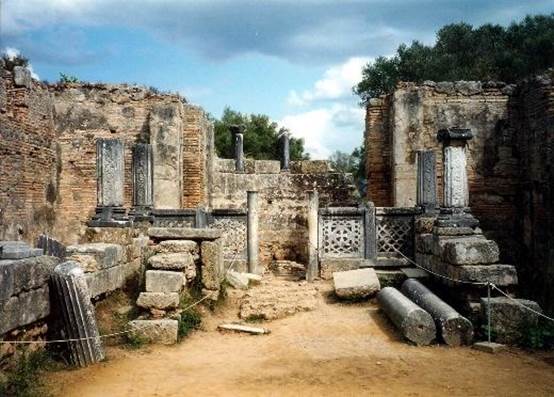
Figure 2. Archaeological remains of the workshop traditionally associated with the sculptor Phidias, Olympia, Greece (2005). CC BY-SA 2.0.
Léonce Perret and The Slave of Phidias
The Slave of Phidias mentioned as ‘an ancient poem’ in its French reviews,[5] is a series of re-enacted tableaux (Le Courrier Cinématographique, 10 February 1917, p. 6). Contemporary reviews praised the film for its poetic softness, elegant tableaux, and evocative settings that seemed to conjure up the lyricism of antiquity (Le Film, 12 February 1917, p. 13) These were not mere studio sets, which brings us to consider the filmmaker behind the scenes Léonce Perret. First noticed as an actor in Gaumont productions, Perret quickly became a writer and director, while continuing to act in many of his own films.[6] From 1909 to 1916, he was, alongside Louis Feuillade, the main author of the Gaumont studio.
Perret often filmed outdoors, promoting cinematic realism through natural light, landscape, and depth. He made extensive use of natural settings and, trying new techniques, he did not limit himself to shooting in Paris or on the Côte d’Azur, locations where Gaumont had well-equipped studios at its disposal (Fig. 3). His mise-en-scène is defined by carefully composed frames, refined lighting strategies, and a recurrent use of backlighting that functions almost as a visual signature. Perret also employed mirrors with ingenuity, expanding spatial perception and introducing unexpected viewpoints. In his films, backlighting in particular is often taken to expressive extremes: figures are rendered as dark silhouettes against intensely illuminated backgrounds, skylights, sunlit courtyards, or open seascapes, while foreground spaces remain in shadow, whether indoors or beneath dense foliage. This nuanced articulation of space into zones of contrasting illumination allowed Perret to exploit depth of field to its fullest, enhancing both the spatial and emotional resonance of his scenes.
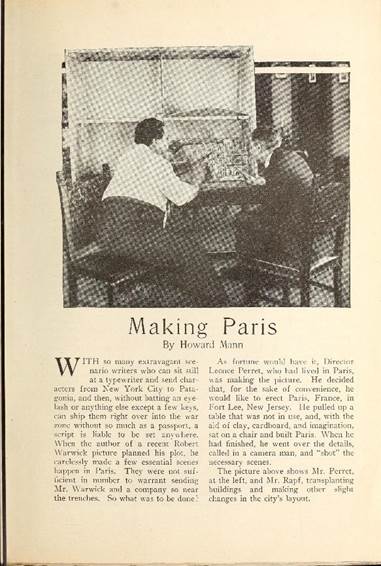
Figure 3. Perret, at the left, and Mr. Rapf, transplanting buildings and making slight changes in Paris’ layout. Picture-Play Magazine. Vol 6. Mar.–Aug. 1917. New York: Street & Smith. p. 203.
During Perret’s most active years as actor and filmmaker, the adaptation of ancient myths into cinematic narratives became a common means of legitimising cinema as a serious art form (Michelakis, Wyke, 2013). Early filmmakers drew upon visual conventions rooted in antiquity, incorporating classical architecture and motifs derived from painting and scholarly illustration. To support a creative vision that merged historical reference with artistic invention, these visual conventions were integrated into filmic spaces as both two-dimensional imagery and three-dimensional décor. Over time, such stylistic devices developed into recognisable representational codes linked to specific classical themes. These codes came to define both public and domestic settings inspired by antiquity, characterised by monumentality, ornamental richness, natural vegetation, and historically evocative costumes.
In The Slave of Phidias, nature and vegetation emerge as particularly prominent motifs, reflecting Perret’s aesthetic sensibilities (Figs. 4–5). This classical visual language is reinforced through the choice of Villa Maryland as a filming location, where architectural grandeur and abundant greenery combine to evoke an imagined landscape of ancient Greece.
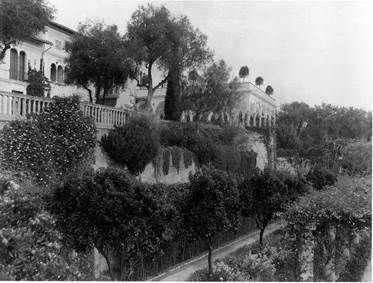
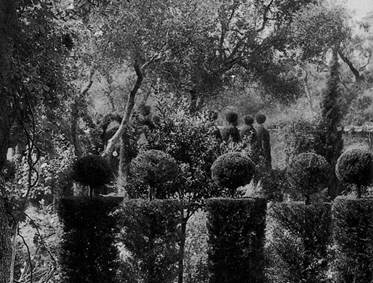
Figure 4. Photographs displaying the vegetation in the grounds of the Villa Maryland. Source: Country Life Magazine Archives, via https://landarchconcepts.wordpress.com/villa-maryland/
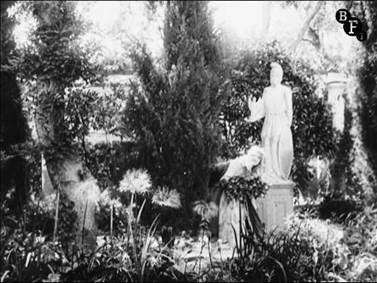
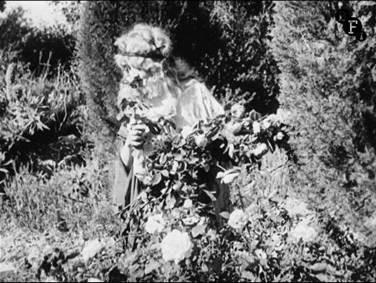
Figure 5. Screenshots displaying Callyce and the gardens of the villa of Phidias, L’Esclave de Phidias (Gaumont, 1916). BFI print.
Villa Maryland, Harold Peto and the reinvention of the Italianate garden
Villa Maryland was built in 1904 for Arthur Wilson (1836–1909) and his wife Mary Smith (1843–1927). The residence comprises approximately 30 rooms, including 18 bedrooms, distributed across roughly 2,500 square metres, and is set within an extensive estate of over 40,000 square metres of gardens and terraces (Figs. 6–7). The Wilsons, close personal friends of Edward VII, were prominent figures within the English expatriate community and were renowned for hosting grand social receptions. Following Mary Wilson’s death in 1927, the villa was inherited by their daughter Muriel, a well-known society figure of the period who attracted the attention of several prominent men, including Winston Churchill. Churchill, then a young man, was a frequent visitor to the villa during his unsuccessful courtship of Muriel. During the First World War, the Wilson family welcomed wounded soldiers from the Queen Victoria Hospital in Nice for lunches and afternoon tea, offering them respite in the villa’s gardens. The property remained in the Wilson family until Muriel’s death in 1964. Today, Villa Maryland is owned by Paul Allen, co-founder of Microsoft.
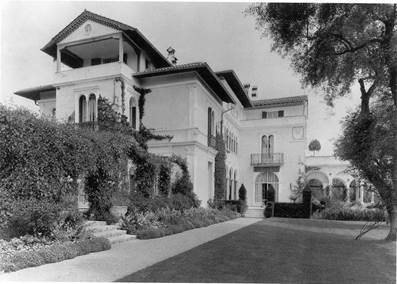
Figure 6. Villa Maryland, photographed in the mid-20th century, Source: Country Life Magazine Archives, via https://landarchconcepts.wordpress.com/villa-maryland/
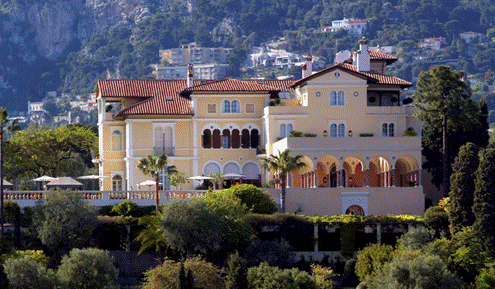
Figure 7. Villa Maryland in 2023. Photo by Frantz Bouton. Source: https://www.nicematin.com/alpes-maritimes/
The house itself was designed in the Florentine style by Messrs. Pethaux & Messiah. Despite significant competition, the Wilson's villa and their gardens were reckoned to be among the loveliest on the Riviera and Maryland was featured in Country Life Magazine (Fig. 8) and Vie A La Campagne (Fig. 9). The gardens were designed by the famous English landscape architect Harold Peto (1854–1933). He was far more influential for his gardens than for his buildings.
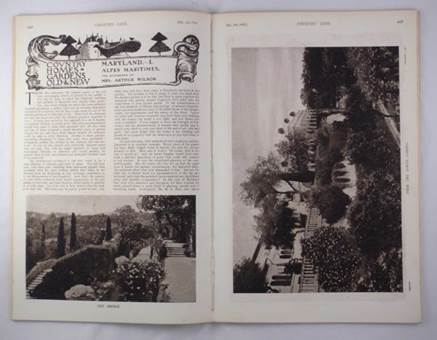
Figure 8. The issue featuring a ten-page illustrated article on Maryland, Alpes-Maritimes, with black-and-white photographs of the house and gardens, Country Life Magazine, December 3, 1910.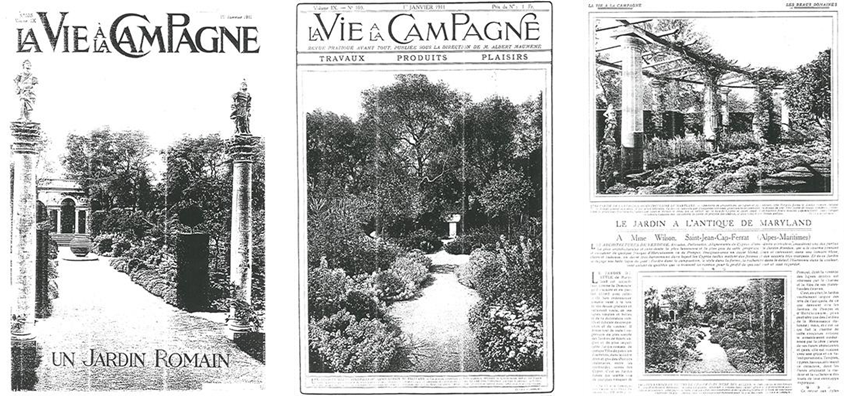
Figure 9. ‘A Roman garden’. Anonymous photograph of Villa Maryland circa 1911. The antique garden of the Villa Maryland. All from La Vie à la campagne, 1 January 1911, n. 103
From around 1880, at the onset of what would later be recognised as the Edwardian golden age, the Peto–George architectural practice rose to prominence among London’s wealthy elite. At the same time, international interest in Italian Renaissance gardens began to grow. Peto engaged enthusiastically with these landscapes, closely studying Italian models and developing a parallel fascination with architectural ornament and embellishment.
The principal gardens designed by Peto in the early twentieth century are widely acknowledged for their strong affinity with Italian culture. His own garden at Iford Manor in Wiltshire is particularly celebrated as one of the finest examples of the Italianate garden tradition in England (Whalley, 2005: 256). Peto’s distinctive approach may be characterised by a sensitive synthesis of formal and informal planning, a balanced integration of hard and soft landscape elements, a reconciliation of Italianate and Picturesque traditions, the careful placement of artefacts and sculptural features, and the successful adaptation of the Italian style to a more intimate, human scale.[7]
In 1892, at the age of thirty-eight, Peto left England due to ill health and sought a more favourable climate in the south of France, where he established a new architectural and landscape practice along the Mediterranean coast. There he designed a series of notable gardens, including Isola Bella in Cannes and the villas Sylvia, Maryland, and Rosemary at Cap Ferrat. During this period, a contemporary approach to garden design began to take shape, one that combined country-house architecture constructed from local materials with informal plantings of wildflowers, all framed within an Italianate compositional structure. This emerging style gained international visibility through its promotion in architectural and horticultural journals.
Central to Peto’s design philosophy was the deliberate use of contrast. He juxtaposed dominant formal hard landscaping with subordinate, more naturalistic soft planting, while also playing with contrasts of form, texture, and colour. His frequent incorporation of ancient artefacts served as a means of connecting past and present, embedding historical resonance within modern living landscapes and creating a tangible dialogue between antiquity and contemporary life.
A connoisseur of classical architecture and a master of its integration, Peto was particularly drawn to elements such as loggias, temples, colonnades, canals, well heads, treillage, balustrades, pergolas, sarcophagi, and ornamental urns and vases – many of which are visible in Perret’s film (Figs. 10a–b). Through the careful orchestration of these features, he shaped gardens that appear simultaneously ancient and immediate, rigorously controlled yet infused with romantic atmosphere (Figs. 11a–b). In this respect, one could say that Peto’s aesthetic philosophy closely parallels that of the original Phidias: both demonstrate a reverence for classical form, a sensitivity to light and spatial harmony, and a belief in beauty as a vehicle for enduring meaning. Peto’s gardens, rich in classical references and sculptural presence, thus provided an ideal visual and conceptual framework for Perret’s silent-era meditation on art, creativity, and inspiration.
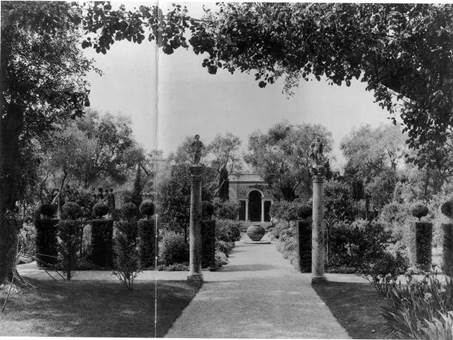
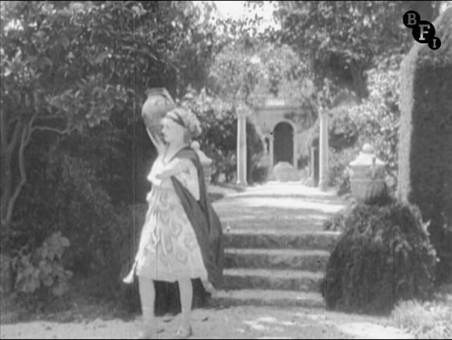
Figure 10 a. Photograph showing the vegetation and architectural elements of the garden. Source: Country Life Magazine Archives, via https://landarchconcepts.wordpress.com/villa-maryland/
Figure 10 b. Screenshot showing a scene taken from almost the same angle, but closer, from L’Esclave de Phidias (Gaumont, 1916). BFI print.
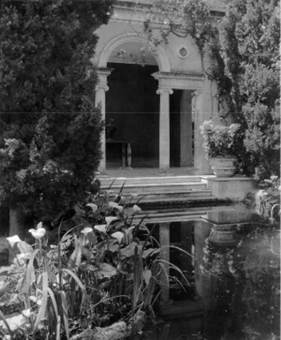
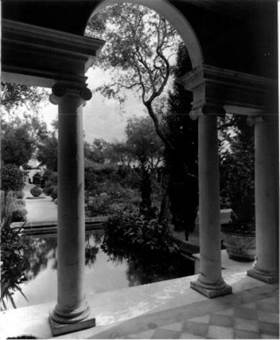
Figure 11 a. Photograph showing the fishpond. Source: Country Life Magazine Archives, via https://landarchconcepts.wordpress.com/harold-peto-temple-and-fishpond-restoration/
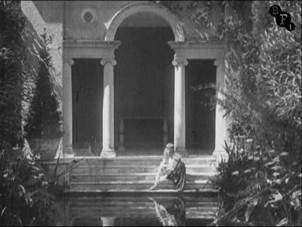
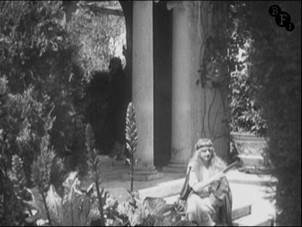
Figure 11b. Screenshots showing the scenes taken from the fishpond, from L’Esclave de Phidias (Gaumont, 1916). BFI print
Conclusion
The Slave of Phidias operates not merely as a historical melodrama but as a complex act of cultural translation, in which antiquity is reimagined through early twentieth-century artistic sensibilities. By bringing together archaeology, landscape architecture, and silent cinema, the film establishes a dialogue across time, linking the sculptural ideals of ancient Greece with the visual ambitions of modern filmmaking. Phidias, long revered as the embodiment of classical perfection, is not treated solely as a historical figure but as a symbolic archetype: the artist in pursuit of an unattainable ideal. This pursuit finds resonance in Léonce Perret’s cinematic practice, which similarly seeks harmony between form, light, and emotional expression. Just as Phidias worked chryselephantine materials to give physical presence to the divine, Perret works with light, shadow, and landscape to give visual life to myth. Cinema becomes, in this sense, a new sculptural medium, one capable of animating still forms through movement and illumination.
The choice of Villa Maryland and its gardens is central to this process. Designed by Harold Peto, the landscape embodies a carefully mediated antiquity, one that does not replicate the ancient world but evokes its spirit through classical fragments, Italianate composition, and the orchestration of nature. Peto’s gardens, with their interplay of architecture, vegetation, water, and light, function as living scenography. They collapse historical distance, allowing the ancient to appear momentarily present within a modern setting. In this way, the villa becomes not just a filming location but an active participant in the film’s meaning. What emerges is a layered palimpsest of artistic aspiration: Phidias shaping stone in pursuit of divine beauty; Peto shaping land to reconcile past and present; and Perret shaping images to legitimise cinema as an art equal to sculpture and architecture. Each operates within different material constraints, yet all share a belief in beauty as a timeless force capable of transcending its moment of creation.
Ultimately, The Slave of Phidias suggests that antiquity survives not through faithful reconstruction but through imaginative reactivation. By filtering classical ideals through landscape and cinema, the film demonstrates how the ancient world continues to inform modern creativity. From the marble dust of Olympia to the sunlit terraces of Cap Ferrat, and finally to the flickering screen, antiquity is not fixed in the past, it is continuously reshaped by those who seek, like Phidias, to give form to the eternal.
Aylin Atacan
Footnotes
- ^ The Athena Parthenos, a colossal gold and ivory statue of the goddess Athena created between 447 and 438 BC, originally stood in the naos of the Parthenon. It was a chryselephantine sculpture of the goddess of Athena that was approximately 11.5 meters tall. The statue depicted the goddess standing upright, wearing a helmet, a peplos (i.e. a kind of ancient Greek dress), and a breastplate. See also Leipen, 1971 and Lundgreen, 1997.
- ^ For detailed discussion of Phidias, see also Davison, 2009 and Pollitt, 1999.
- ^ See Ivo Blom’s sister essay on this website concerning L’Esclave de Phidias for the melodramatic plot of the film, its theme of sculptors and their models, its relationship to painting, the importance to it of music and its relevance to its production in wartime France.
- ^ Chryselephantine refers to a type of sculpture, especially prominent in ancient Greece, made with gold and ivory, often built around a wooden frame. Ivory was used to represent flesh and gold drapery and hair. tThese costly magnificent statues were usually of gods and heroes and created for temples. The term comes from Greek chrysos (gold) and elephas (ivory) and later comes to describe luxurious Art Deco sculptures combining bronze, ivory, and other materials.
- ^ For the reviews, see Blom’s essay on this website.
- ^ On Perret’s career, filmography and stylistic contributions to cinema, see Bastide and Gili 2003 and Taillé 2006.
- ^ For more information on Peto’s garden design, see Whalley, 2007.
Bastide, B. and Gili, J. A. (eds.) (2003) Léonce Perret. Association Française de Recherche sur l’Histoire du Cinéma/ Cineteca di Bologna.
Davison, C.C., and Lundgreen, B.(2009) Pheidias: The Sculptures and Ancient Sources. Bulletin of the Institute of Classical Studies Supplement 105. London: Institute of Classical Studies. Edited by G.B. Waywell.
Leipen, N. (1971) 'Athena Parthenos': A Reconstruction. Toronto: Royal Ontario Museum.
Lundgreen, B. (1997) ‘A methodological enquiry: The great bronze Athena by Pheidias’, Journal of Hellenic Studies, 117, pp. 190–197.
Michelakis, P., & Wyke, M. (eds.) (2013) The Ancient World in Silent Cinema. Cambridge: Cambridge University Press.
Pollitt, J.J. (1999) Art and Experience in Classical Greece. Cambridge: Cambridge University Press.
Taillé, D. (2006) Léonce Perret cinématographiste. Niort: Association Cinémathèque en Deux-Sèvres.
Whalley, R. (2005) ‘Harold Peto: Shadows from Pompeii and the work of Sir Lawrence Alma-Tadema’, Garden History, 33(2), pp. 256–273.
Whalley, R. (2007) The Great Edwardian Gardens of Harold Peto: From the Archives of Country Life. London: Aurum.