
THEME - Christian Martyrdom in Early French and Italian Cinema (1910-1911)
By IVO BLOM
This analysis treats three of the early films on martyrdom in Roman antiquity that survive in the BFI National Archive: La Fille du centurion (Radios, 1910), Dall’amore al martirio (Cines, 1910) and Santa Cecilia (Cines, 1911). The first two were released in 1910, the last in early 1911, and all three are responsive – in different ways – to general conceptions of Christian martyrdom and their representation in nineteenth- and early twentieth-century culture. Yet, if all were produced more or less at the same time, striking national and stylistic differences can be traced across the three films.
Christian martyrdom and its representation in nineteenth- and early twentieth-century culture
In Christianity initially, martyrdom meant enduring sacrifices, hardships and physical suffering in honour of God, but later the term was used almost exclusively for Christians who were killed for their faith (as Saloul & Van Henten observe in their study, Martyrdom: Canonisation, Contestation, and Afterlife [2020]). The first Christian martyrs in that sense were the apostles of Jesus, with the exception of John who died in exile. Yet, soon after the deaths of the apostles, stories spread of Romans like Cecilia and Sebastian who converted to Christianity, were killed for their beliefs and later on were canonised as saints. Most such stories about Christian saints are not historically verifiable. These hagiographies were endlessly copied over the course of centuries and would become the basis of the so-called Legenda aurea (Golden Legend), consisting of 153 hagiographies compiled by the Veronese bishop Jacobus de Voragine in the thirteenth century (Voragine, 2021). However, not all saints died a martyr’s death. Constant factors in the lives of saints were their performance of miracles and their religious epiphanies, not necessarily the manner of their death.
In the early history of Christianity, Christian martyrs were tortured or killed by stoning, beheading, crucifixion, death at the stake, or by the attack of wild animals in the arena. The period of early Christianity before the reign of Emperor Constantine, from around 100 to 313 CE, is considered the ‘age of martyrs’ but their stories varied even then as well as subsequently: 'On the one hand, there is the canonisation of martyrs as heroes of a group: clusters of martyrs are formed and the texts about them are fixed step by step. […] At the same time, we should acknowledge that martyr figures are contested as well, not only because they are commemorated by competing communities but also because those who are martyrs in the eyes of inside-groups can be traitors or terrorists for others. […] In many cases acts and practices of martyrdom, with their relations to material and ritual culture, create ‘landscapes of memory’, wherein the canon and its writings play a certain, but not the only and not always the decisive approach.' (Saloul, Henten, 2020: 11-12)
According to Catholic catechism, the figure of the martyr is diametrically opposed to that of the apostate - that is someone who has betrayed the faith. Martyrs are venerated to this day as saints, and blessed and commemorated through prayers, services and Eucharistic celebrations on the anniversary of their death. This cult of martyrs is one of the forms of private and public expression of the Christian faith, which was already rooted in the first communities that had to establish their new doctrines as a challenge to the traditions of Judaism and of paganism under the Roman empire.
In more recent centuries, the martyrs of Roman antiquity have also been presented more broadly as good examples of strength, virtue, persistence, faith and self-denial, in order to inspire contemporary audiences to behave in the same way. While sometimes physical, gory and bloody in medieval depictions (Welie-Vink, 2020), during the Counter-Reformation more chastened versions of the lives of the saints appeared. In the academic art of the late nineteenth century more explicit, shocking versions returned (although not always with the ambition of ethical exemplarity), such as Jean-Léon Gérôme’s The Return of the Felines (1902), in which the remains of the slaughtered martyrs are shown, or Léon Bonnat’s Martyrdom of St. Denis (1886), with the saint searching for his head after his beheading.
The conventional setting for narratives of early martyrdom was where the Eucharist was celebrated in secret, usually in the Roman catacombs. The persecuted Christian community would make signs to each other, such as the emblem of a fish, to communicate their shared faith. Often in nineteenth-century literature featuring Christian martyrs such as Quo vadis (1895, first published in 1896) by Henryk Sienkiewicz and Fabiola (1854) by Cardinal Wiseman, personal circumstances like rejection and a consequent desire for revenge lead to the persecution of all Christians in Rome. Although it is clear from the historical record that persecution of the Christians under later emperors like Diocletian was much more drastic, Nero is regularly portrayed in novels like Quo vadis as the ultimate Antichrist and depraved persecutor of the Christians. In Arrigo Boito’s 1924 opera Nerone (which premiered posthumously as Boito had already died in 1918), Nero’s reputation as the principle persecutor of the Christians still persists, and this also applies for the 1924 adaptation to screen of Quo vadis, in which German film star Emil Jannings plays the emperor as a satanic grotesque (see the analysis of Nero films on this website by Maria Wyke).
In some cases, such as with the two main characters Vinicius and Lygia in the novel Quo vadis, they manage to escape persecution by fleeing Rome, but both main and secondary characters often lose their lives due to pagan hatred towards them – including the coldness of the Roman mob, the indifference of the elite and the cruelty of the emperor. Nevertheless, some non-Christian protagonists, as in the British play The Sign of the Cross and its later film adaptations, develop a love for their Christian beloved that is stronger than their fear of death, and they voluntarily choose to die with their beloved in the arena.
The lives of the saints served as the original model for the Western Christian narrative and, therefore, they played a significant role in early cinema alongside the biblical stories of the Old and New Testaments, even if the number of such films was limited. According to François de la Bretèque in his 1992 article ‘Les films hagiographiques dans le cinéma des premiers temps’, films about saints are linked to their feast days and, certainly, to Catholicism (Bretèque, 1992). It is striking that early cinema partly adopted the structure of the hagiographic tales while also putting its own unique spin on them.
A notable feature of the hagiographic narrative is its lack of continuity and motivation; scenes are presented as discontinuous moments. The story is condensed into a series of highlights, with symbolic attributes playing a key role in identifying the individual saint. Each saint possesses a specific attribute and is consistently depicted with it - by which they can be recognized. Since the focus in the narrative is often on key scenes, the number of shots in a film—whether one or many—is immaterial, provided that the climax (such as the martyrdom) is retained. The narrative is thus elastic; the omission of certain episodes within a film does not disrupt the story, as long as the essence remains intact. Furthermore, a saint's story does not function as a biography; the priority is to provide a worthy example. Consequently, witnesses within the story follow that example—by converting, for instance—acting as models for us, whether readers and viewers. The ‘villains’ are not ultimately punished; instead, they facilitate the saint’s martyrdom, enabling the saint to ascend to heaven and eventually to be canonized. In this context, the Passion of Christ often serves as the model for saints who, following Jesus’ example, refuse to waver in their faith, choosing self-sacrifice and death with the afterlife in mind.
Narrative shifts do occur in early cinema; the saint is individualized and—through the photographic image—portrayed as a flesh-and-blood human being. Their story is typically presented in a linear and continuous fashion, giving the film more of a biographical character. Modes of representation also evolve. Whereas Passion films rely heavily on frontality—maintaining a strong link to earlier visual traditions such as religious prints or fine art—films about saints increasingly strike a balance between looking at the camera and looking at fellow actors, resulting in the saint’s oblique gaze.
Early twentieth-century France was marked by a strong anti-clericalist tendency, resulting in the breaking of ties with the Vatican in 1904 and the enactment of the Law of the Separation of State and Church in 1905, as Thierry Levebvre notes in his 1992 article, ‘Le cinéma français et la séparation des Églises et de l’État : L’utilisation du crucifix comme accessoire du film’ (Lefebvre, 1992). Yet this tendency is scarcely visible in early French cinema, Lefebvre observes, citing Michèle Lagny on how cinema is not a one-on-one reflection of what happens in society but of representations of that society. In contrast to French literature, the stage or even postcards, early cinema seems instead to obscure or even deny the anticlerical tensions of French society. While only in rare cases did criticism of the Catholic Church appear in early cinema, Catholic religious symbols like crucifixes were often left out or at least rendered in small dimensions in order not to draw too much attention to them. In general, a form of neutrality towards the Church was maintained. Yet interestingly, as Lefebvre notes, by around 1909 to 1910, morality becomes more important in early French film. Plots follow the trajectory of first abuse, violence and familial disruption and then repentance, pardon and reunion of the family - narratives to which the Church was also quite favourable. Laic themes such as work, family and motherland coincide with religious thematics like pardon and redemption.
The Maison de la Bonne Presse organisation in Paris was particularly active in depicting early Christian martyrdom. In addition to many written texts, such as its own books and magazines, around 1900 this Catholic organisation published various lantern slide series about the martyrdom of saints such as Cecilia and Tarcisius. A selection of these was later converted into a series of postcards. Bonne Presse also made several films in this genre. The urge to incorporate Christian messages into historical settings that previously had no connection with them was so great that in 1910, Émile Sicard's opera/play Héliogabale also contained an important element of Christian martyrdom, which was absent from Roman sources, but also absent from the French 1910 Film d'Art film as well as the 1911 Gaumont film about the life of this debauched Roman emperor (see my text about the film Héliogabale on this website).
In contrast to France, where officially there was a separation of Church and State since 1905, the situation in Italy regarding the relationship between cinema and religion was rather different. In Italy, the Catholic Church embraced the medium—with some exceptions—and steered it toward a separate, widespread network of parish halls, as Aldo Bernardini has demonstrated in his article, ‘Les catholiques et l’avènement du cinéma en Italie ; promotion et contrôle’ (Bernardini, 1992). These venues screened only educational and morally uplifting films, as well as those featuring biblical or mystical themes—in short, religious propaganda and control. Objectionable scenes were cut from mainstream releases, yet there were also initiatives to establish in-house film production for these venues, such as Troncone in Naples and, later, Unitas in Turin. Due to a lack of investment, Unitas eventually folded and Centauro Film took over the studio. For a time, separate film magazines were also published that indicated which films were suitable for parish halls.
To demonstrate how the Catholic Church embraced cinema as a medium, Bernardini cites some of the earliest initiatives, such as: the filming of Pope Leo XIII by William Dickson in 1897; an Italian Passion film (1901) inspired by French examples (though this story may be apocryphal, as no evidence for it has yet been found); and Deposizione di un martiro, a short film from 1903 by Rodolphe Kanzler, chair of the Pontifical Committee for the Catacombs and director of the Christian Museum at the Vatican. Kanzler built a reconstruction of a catacomb next to the Domitilla Cemetery. This film about martyrdom predated the making of the first official Italian fiction film, La presa di Roma (Filoteo Alberini, 1905), by two years.[1] Apart from these initiatives, the Catholic Church was a major force within the film industry - the cardinals themselves as well as Catholic Leagues protesting against theatre, film, and postcards that were too lustful. Yet even behind the screens, the Church was active, particularly in Rome (more so than in cities like Turin). The Roman company Cines was closely connected to the Vatican, as Bernardini confirms: ‘Even if the matter was not loudly proclaimed, it is clear that the production of our main Roman and national film company, Cines (closely tied to the interests of the Vatican via the mediation of the Banco di Roma), could not stray too far from the commonplaces of the dominant ideology and morality.’ (Bernardini, 1992: 9)
It is perhaps not surprising that a number of films in the BFI National Archive deal with early Christian martyrdom, given that many of its Roman antiquity prints from France and Italy originate from the Joye collection, named after the Swiss Jesuit priest Joseph Joye, who showed these films to his Catholic gymnasium students. The BFI possesses prints of Les Martyrs (Pathé, 1905), Martire Pompeiana (SAFFI Comerio, 1909, although it deals with a secular martyrdom), The Way of the Cross (Vitagraph, 1909), Dall’amore al martiro (Cines, 1910), Le Martyre (Gaumont, 1910), San Paolo (Milano, 1910), La Fille du centurion (Radios, 1910), Santa Cecilia (Cines, 1911), Quo vadis? (Cines, 1913) and Quo vadis? (UCI, 1924).[2]
La Fille du centurion/ The Centurion’s Daughter (Radios 1910, dir. Gaston Roudès)
La Fille du centurion manifests some of the familiar features of Christian martyrdom narratives on film but, unusually, has a happy ending. While the ending of the film is missing from the BFI print, the British journal The Bioscope describes its intriguing climax. As little is known about Radios, the company that released La Fille du centurion, or about the close relationship of Radios to the company Éclipse, some discussion here is given over to the film’s production background and some investigation has also been undertaken into its director and main actors.
The BFI print and the film’s unusual features
Outside a Roman villa, the slaves of the centurion Vicinius prepare for the return of their master (note that this name is a variation on ‘Vinicius’, a well-known character from the novel Quo vadis and its filmic and theatrical adaptations). Vicinius’ daughter and one of his slaves fall in love with each other (figure 1) and they secretly meet later on a wooded hillside (figure 2). Afterwards, the daughter follows the slave and discovers that he is a Christian. She watches as he attends an open-air sermon delivered before a cave by a figure who is briefly identified in the German intertitles as the Apostle St. Peter. When the centurion discovers later on that the slave has been missing, he orders that he be whipped on his return for failing to do his duties, despite pleas for mercy from his horrified daughter. After the beating, other slaves who try to help are beaten too, while the Christian slave is left for dead. The daughter helps him to the cave where she had seen St. Peter preaching. Encountering the Apostle, and with the help of her lover, she converts to the Christian faith and is baptised in a river. Back outside the Roman villa, her father receives a message from Emperor Nero ordering the arrest of the Christians, so he sends his troops into action. When the daughter and her lover hear of this plan, they run to the cave to warn the other Christians of the imminent danger. Here the film breaks off.
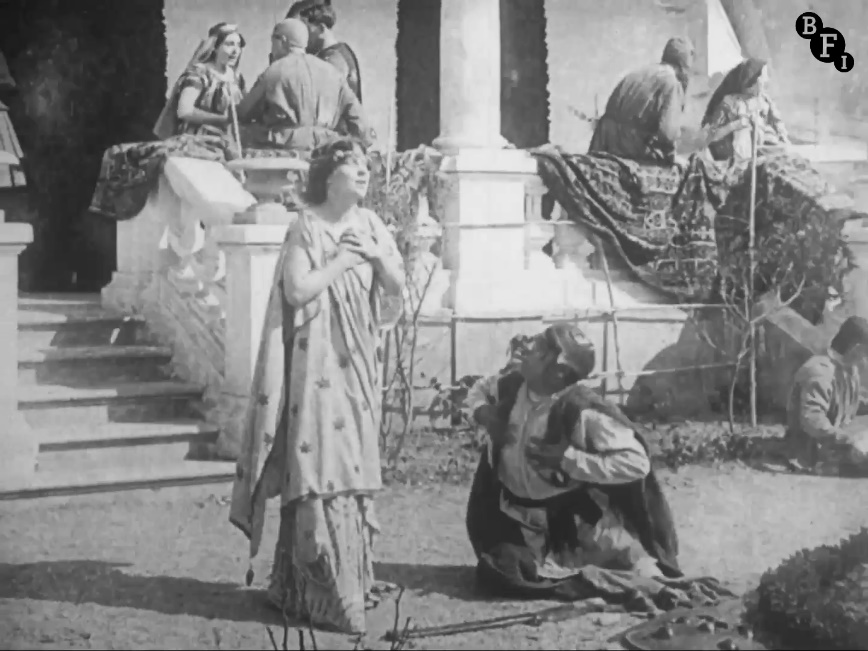
Figure 1. The slave and the centurion’s daughter expressing their love, La Fille du centurion (1910). Courtesy of BFI National Archive.
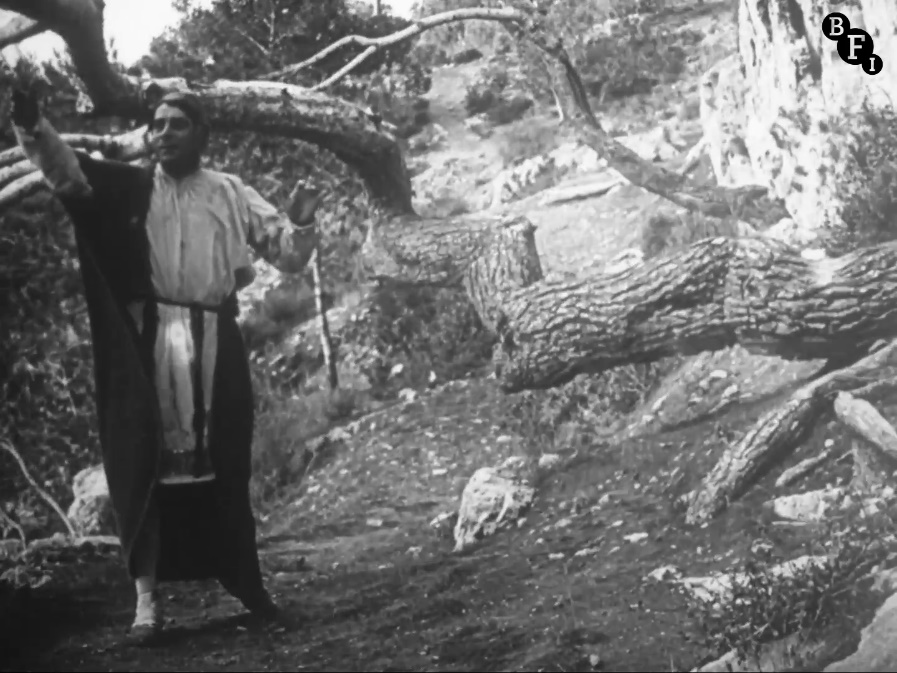
Figure 2. The enamoured slave, after his encounter with the centurion’s daughter, goes to the Christian meeting, La Fille du centurion (1910). Courtesy of BFI National Archive.
The BFI catalogue notes the incompleteness of its print (211 m., while the original length is 290 m.) and, indeed, the end is missing from it. The description of the film in the British trade paper The Bioscope of 1910 indicates how the film finishes: ‘Nero sends a written command that all the Christians shall be secured and brought before him, and the Centurion sets out to fulfil the Emperor’s command. The slave and his bride escape and give warning of the coming seizure, but the apostle reassures them, and begs them to stay “for the Master’s sake”. The Centurion and a legion of soldiers arrive, but on the former finding his daughter present, he is first moved to anger, but is finally convinced by the eloquent preaching and message of the apostle, tears up the order of Nero, and kneeling at the preacher’s feet is himself received in the church he came to persecute.’[3]
This ending is quite an unexpected deviation from many of the martyrs’ tales, which normally end with their death, either eaten by wild beasts in the arena, decapitated, or burned alive as human torches (in the novel Quo vadis and its filmic adaptations of 1913 and 1924 all the Christians perish except for the two fictional protagonists Vinicius and Lygia). In some cases, Roman fathers are even forced to condemn their sons who have converted, as in the Gaumont production Le Martyre (Louis Feuillade, 1910). Yet, in the Radios film, Christian faith overcomes evil, at least locally and within the span of the plot – we don’t know what happens to the father and the couple afterwards. While the description in The Bioscope mentions Nero as the responsible emperor, following the invention of the tradition of Nero as the first and the key persecutor of the Christians, the journal does not mention the names of the centurion, his daughter, the slave or the apostle, nor do we see Nero or the city of Rome. Moreover, The Bioscope smoothens out the class difference between the young female patrician and the slave, by explaining that the man is a captive who was once a prince in his own country – a device Henryk Sienkiewicz already used in his novel Quo vadis (1896), in which the captive Lygia is a former princess of the Lugii or Lygians, a tribe from North-East Europe. The names of Vicinius and Nero are mentioned in an intertitle alongside Nero’s order, but that is, alas, a German-written one frame-title, so difficult to read in the print’s current condition.
The director and actors and their theatrical backgrounds
The BFI print stems from the Joye Collection (see our Introduction to this website), hence the German intertitles of the print he must have originally bought in Switzerland or Germany. The opening title lists the director, Gaston Roudès, and the four main actors and their theatrical provenance: Mlle Duc of the Théâtre Sarah Bernhardt; M. Bressol of the Théâtre des Variétés; M. Doubleau of the Théâtre du Chatelet; and M. Roudès of the Théâtre de la Gaité. Bressol plays the slave and Duc the daughter.[4] Doubleau, whose first name we do not know and may have played the father, is a relatively unknown actor whose known roles on stage (all minor ones) were from an earlier period in the later 1880s and 1890s at the Chatelet, e.g. La Chatte blanche (1887); Peau d’âne (1891); La Fille prodigue (1893), and Michel Strogoff (1897). He would later act in French silent cinema, e.g. in the Gaumont short Fauves et bandits (Jean Durand, 1911), as Dantès’s father in Le Comte de Monte-Cristo (Henri Pouctal, 1914, released in 1918), and in minor parts in Mères françaises (Louis Mercanton & René Hervil, 1917), Travail (Pouctal, 1919) and Le Carilloneur (René Coiffard, 1922). We know that Fernande Duc acted at least from 1902 as supporting actress in various stage plays with Sarah Bernhardt, such as Théodora and La Samaritaine (both 1902). Duc followed Bernhardt when the latter founded her own theatre, the Théâtre Sarah Bernhardt. There Duc played minor parts in e.g. Théroigne de Méricourt (1902), Varennes (1904), La Vierge d’Avila (1906), Adrienne Lecouvreur (1907), La Belle au bois dormant (1907) and La Courtisane de Corinthe (1908). Duc and Bernhardt played together once more in La Tosca (1909), which was performed at the Théâtre de la Porte Saint-Martin – so one year before Duc acted in La Fille du centurion. She was married to film director Louis Mercanton and died prematurely, in 1913.
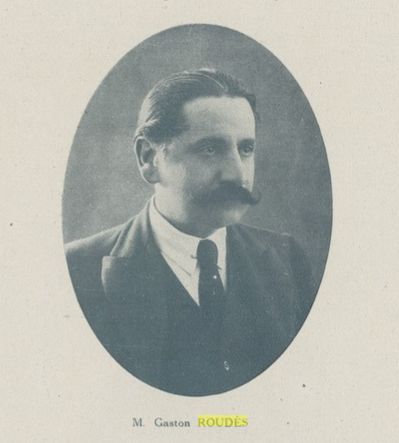
Figure 3. Gaston Roudès. La Cinématographie française, 1920. Source: Gallica.
Gaston Roudès and Pierre Bressol, however, are better known names in film circles. Gaston Roudès (1878-1958) (figure 3) started out as a supporting stage actor, at least from 1905 onwards, at the Théâtre de la Gaité. In 1907-8, he performed on behalf of the Théâtre de la Gaité and Théâtre de la Porte Saint-Martin at the theatre of Cherbourg, as ‘jeune premier röle’. It is not entirely clear exactly when Roudès began his career as a film director, but La Fille du centurion must certainly have been one of his earliest films. In 1911, one year after its release, Roudès would make his mark as the director of one of Joë Hamman’s earliest westerns, La Pouce (1911), produced by the company Éclipse and released in France in October 1911. At Éclipse, Roudès also acted in Sa petite fille (1911), directed by himself, while he also acted in L'Assassinat d'Henri III (Louis Mercanton, Henri Desfontaines, 1911). After that, he would focus strictly on filmmaking and would become a prolific French filmmaker in the 1910s, 1920s, and early 1930s, starting with his use of famous stage actors such as Sarah Bernhardt and the brothers Jean Mounet-Sully and Paul Mounet in historical films (La Reine Elisabeth, 1912; Oedipe-roi, 1913). Roudès would direct over sixty films and also wrote at least fifteen film scripts.[5]
Pierre Bressol (1874-1925), originally Pierre Dubois, played at the Théâtre des Folies-Dramatiques in 1906-7 in Paris, before debuting in 1908 at the Société Française des Films Éclair, where he was immediately launched in the lead of the six-part serial Nick Carter, le roi des detectives (1908), directed by Victorin-Hippolyte Jasset, and based on a popular pulp magazine detective hero. The series was such a success, including internationally, that in 1909 a sequel was made, Les Nouveaux exploits de Nick Carter, again directed by Jasset, while a theatrical version of Nick Carter was staged at the Théâtre de l'Ambigu that same year. Yet, at some point in 1910, Bressol must have been lured via Radios to the company Éclipse, because soon after playing in La Fille du centurion, released in France in May 1910, Bressol would develop his own Nat Pinkerton detective series at Éclipse, which began its release from February 1911, with the first episode entitled Les Cavaliers noirs (1911).[6] Here, Bressol was not only the main actor but also the director of the various episodes. Until 1914, Bressol would direct and star in some thirty Nat Pinkerton detective films, all for Éclipse. After 1914, Bressol’s productivity quickly diminished, but he still made films, now for Pathé and less often for Éclair. In conclusion, we can see that both the director and the main actor of La Fille du centurion had already had a significant stage career behind them when they started working on La Fille du centurion. Bressol, moreover, had already become a major film actor with his Nick Carter series for Éclair, while Roudès was at the start of his film directing career. Instead, for Fernande Duc, who had trained as a stage actress, this may have been her only film role.
The company Radios
As so little is known about the company Radios, apart from the information Youen Bernard provided in his unpublished thesis on the smaller French production companies (Bernard, 1993/94),[7] and a short text by Laurent Mannoni in Richard Abel’s Encyclopedia of Early Cinema (Mannoni, 2005: 131), we reached out to the members of Domitor, the association for the study of early cinema. In particular, Jean-Claude Séguin and Stephen Bottomore gave us helpful detail, while Frank Kessler provided us with access to the most relevant pages of Bernard’s thesis. Bernard indicates that the company Société Générale des Cinématographes Radios was officially founded on 24 July 1907 in Paris, and had its basis in 2, Rue de la Tourelle in Boulogne-sur-Seine (Paris), where later Eclipse would have one of its studios. The brand name Radios was already deposited on 26 June 1907 by the Société Clément-Maurice et fils, Mesguich et Dumien (see also (Mannoni, 2005: 131).[8] The name had nothing to do with radios (transmitters) but rather with the radiation of the light beam in film projection. In addition to film production, the company made it clear in its founding papers it also had ambitions in film exhibition, but the latter never materialised. At the time, films were still sold, even if film rental would soon become the norm. In contrast to the big French companies Pathé and Gaumont, Radios was never involved in phonography. Most shares were in the hands of Jules Dumien, who was also administrator of the company from the summer of 1907. In 1908, however, the company Éclipse bought most of the shares in Radios. Officially, it gave Radios the freedom to keep control of its film production. Yet, Bernard notes that it is difficult to tell whether Radios from then on still had such freedom or became instead a kind of subsidiary of Éclipse.
Production at Radios started early on, as it is clear that cinematographer Félix Mesguich, one of the founders, and the main cinematographer of its travel films, had already undertaken an expedition to Casablanca in the summer of 1907. He would travel all over the world to film Radios’ non-fiction films. While data for 1907 are scarce, Bernard concludes that by 1908 Radios had a fully equipped studio, produced 83 films in all kinds of genres, and – in contrast to La Fille du centurion - all of its fiction films were studio-based. Until March 1909, Radios presented its films separately. Afterwards, new titles were indicated in the press as part of the Éclipse output once it had taken control (figure 4). Radios did not suffer an abrupt death in 1910 or 1911, but slowly petered out, as Bernard observes.[9] Thanks to inventories of Radios, Éclipse and the partner company in the UK, Urban, that were published in the French trade paper Ciné-Journal, we have a fair understanding of what these three studios produced around the years 1907 to 1909. The companies used different numbers, making it easy to distinguish between the three; e.g. Radios films began with 4000.[10] While initially favouring drama, from 1908 comedy became an additional genre. Gradually, the steady increase in the number of films released slowed down, when films became longer on average although still on one reel of no more than 15 minutes. It seems that in 1910 Éclipse ordered Radios to focus on dramas (which were then two-thirds of its entire production for that year), while Éclipse itself focused on comedy and non-fiction. Considering film length, Radios’ longest film of 1910, Pour être reine, was 368 metres, on a par with medium-sized companies but much smaller than the average length of films released by big companies like Pathé and Gaumont.
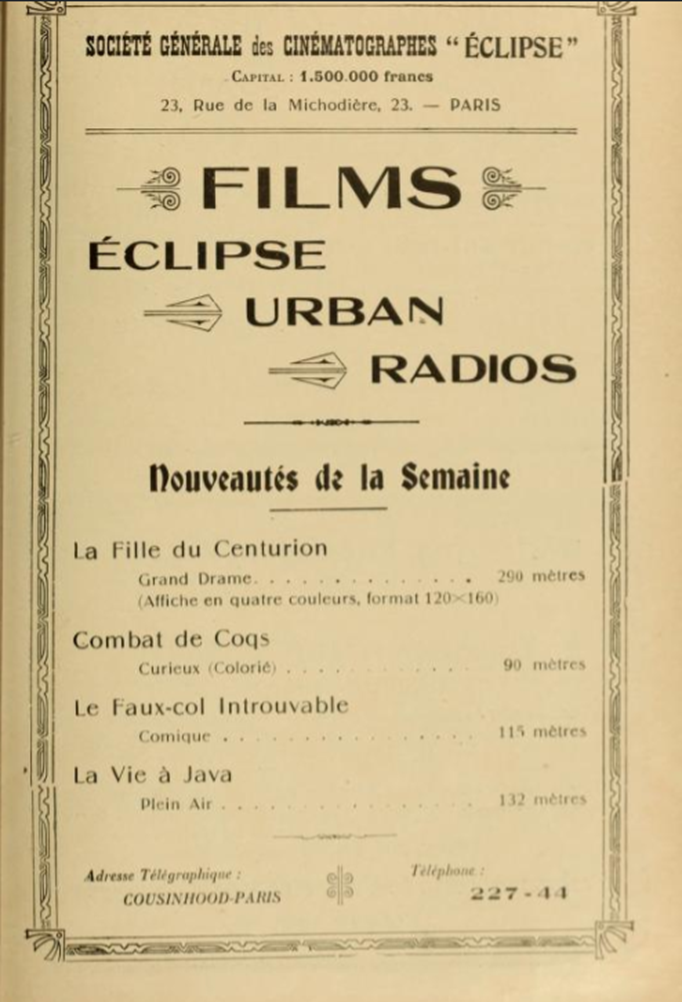
Figure 4. La Fille du centurion. Ciné-Journal, 89, 7 May 1910.
In addition to Bernard’s valuable information concerning distribution, it is clear from the French, British and American trade papers like Moving Picture World, The Bioscope and Ciné-Journal (figure 4), that Éclipse, Radios and Urban had a joint distribution system for the United States. The Ciné-Journal ad in figure 4, dated 7 May 1910, makes it clear that, at these three companies, in addition to drama, comedy and nonfiction were also important genres. Together with Pathé and Gaumont, they were members of the Motion Picture Patents Company Trust led by Thomas Edison, which surely must have eased the distribution of their films there, as the Trust’s distribution company General Film redistributed the Trust’s films all over the United States.
In France, La Fille du centirion came out in early May 1910, in the UK towards the end of April 1910 (so before France), and in Germany on 2 June 1910.[11] When La Fille du centurion was being made in 1910, Radios and Éclipse were working closely together. Ciné-Journal states that, by 1910, the address of the office of Radios was the same as that of Éclipse: 23, rue de la Michodière, in Paris. Éclipse and Radios produced combined publicity but Ciné-Journal treated their films separately in its list of 'Nouveautés Cinématographiques' within the same issues. With regard to distribution, Radios also had contact with the companies Ambrosio and Raleigh & Robert, as early cinema scholar Jean-Claude Séguin pointed out.[12] In France around 1910, Raleigh & Robert distributed Italian films released by Ambrosio (Blom, 2023: 84, 86). As Séguin confirmed to us, the collaboration between Éclipse and Radios also meant a fertile exchange of actors – which is visible in Bressol’s collaboration on La Fille du centurion. Séguin’s colleague Stephen Bottomore pointed out to us that, according to FIAF Treasures,[13] the BFI has some seventeen Radios productions in its collection, while there are also a few in the collection of the Dutch Eye Filmmuseum. While Bernard stresses the nonfiction output of Radios always remained in the minority, both BFI and Eye mainly have various travel films among their Radios cluster. Yet, both archives also have some dramas and comedies produced by Radios, e.g. Eye has the dramas Châtiment de Corse (1907), Pour l’amour d’une femme (1909), and Par amour de son enfant (1911).
Still many questions remain unsolved: did Radios continue to shoot its films in Rue de la Tourelle in Boulogne after 1908, or did they also use Eclipse’s second studio at Courbevoie? Where exactly were the outdoors scenes of La Fille du centurion filmed? Was it perhaps in the woodlands of Fontainebleau with its many rocks? By 1910-11, Éclipse was often using actors from the Parisian theatres, such as Pierre Daltour, Romuald Joubé et Henri Etiévant, Colonna Romano, and Jeanne Grumbach. But how frequent was the exchange of actors between the two companies? Though Éclipse and Radios may have tried their hand in creating their own films on antiquity with Bélisaire and La Fille du centurion, it is also clear that historical cinema was in the minority both at Eclipse and Radios, certainly in comparison with, Pathé, Gaumont and the company Le Film d’Art. That makes La Fille du centurion all the more unusual as a production.
The look of the film
The exterior of the Roman villa at the opening of the film (figure 1) may have been built on the backlot of the Radios studio, probably the one in Rue de la Tourelle , while no interior scenes occur that would call for studio filming.[14] Almost all the later scenes, such as the first rendez-vous between the daughter and the slave in the hills (figure 2), the apostle preaching before the entrance to a cave, the castigation of the slave, and the daughter being baptised at the riverside (figure 5), were all filmed outside in hilly woodlands, near huge rocks, or near a river, in short at real locations. Apparently, this alternation of staged and real settings was not only a novelty that was becoming popular by 1909-1910 (see my essay on the Éclipse film Bélisaire, made in the same year as La Fille du centurion). This was also a feature of Roudès’ own films, as he writes in a letter published in the journal La Cinématographie française (30 October 1920): ‘I am very much in favour of shooting outdoors, because in addition to my studio, we dispose of mobile electrical equipment – and so we have done for my latest Gallo-Films like Irène. Thus we have been able to shoot at the Gobelins studios, at a fashionable restaurant, and at Paul Poiret’s. Still, I think the studio is indispensable. First of all for the research into and experiments with filming takes, furthermore for certain sets that a scenario requires, and for certain kinds of lighting of apartments that otherwise would have been impossible.’ Yet, what is so remarkable in La Fille du centurion is that not one shot was created within an interior. We do not see the inside of the villa nor that of the cave – so there are no catacombs on show in this film, in contrast to Italian films like Santa Cecilia (see below) or Quo vadis? (1913). Of course, La Fille du centurion was clearly a modest production, with straightforward cinematography (there are no pans for instance) and the acting is not very individualised. Yet, the company made the effort to shoot in real locations, which nowadays adds to the film’s interest.
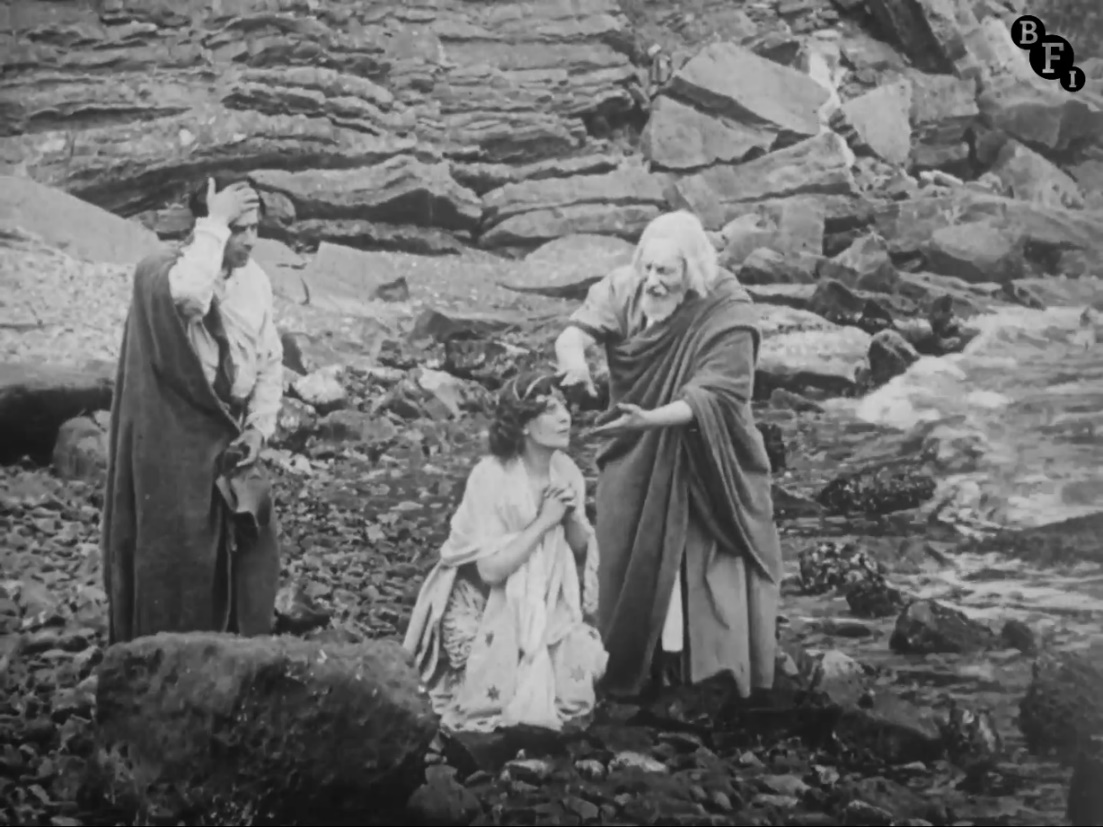
Figure 5. The baptism of the centurion’s daughter, La Fille du centurion (1910). Courtesy of the BFI National Archive.
Dall’amore al martirio/ From Love to Martyrdom (Cines 1910, director unknown)
Dall’amore al martirio (Cines 1910, director unknown) is typical of early films about Christian martyrdom from the Italian production house Cines. Its plotline conforms to the structures of familiar nineteenth-century fictions about martyrdom, such as that of Wilson Barrett's play The Sign of the Cross (1895). Here a vindicative patrician woman causes the martyrdom of a Christian girl and the Roman patrician who has fallen in love with her. Out of love, the man converts to Christianity and joins her in her dreadful fate. A remarkable feature of the film, as might be expected from a production house based in the capital city, is its novel combination of real exteriors of Roman ruins with interiors made up of painted backdrops, as well as its reuse and adaptation of sets and props such as ‘Roman’ furniture introduced in previous films.
Narrative and film print
Dall’amore al martirio is concerned not with the conversion of an unnamed Roman girl (like La Fille du centurion) but with that of a Roman patrician named Marcus Lycinius. The film begins in his luxurious home where we observe his proud and cruel character (somewhat like that of Marcus Superbus, the Prefect of Rome in the play The Sign of the Cross, whose adversary is the hunter of Christians Licinius). Marcus revels in the movements of a dancer, violently dismisses the jealousy of his watchful mistress, and orders the whipping of a slave who attempts to protect her. From the entrance to the villa (which is much more elaborately Roman in its detail than the façade used in La Fille du centurion), the mistress spies on Marcus attempting to woo the young girl Livia whom she then follows along a country lane. Some notable camera pans display her lurking at the edges of a deep cave, where she spots Livia at worship in her Christian community. The mistress hastens to Marcus with the news, and he takes his revenge on Livia by denouncing her to the Praetor (no emperor is involved in this martyrdom narrative). The scene of denunciation clearly demonstrates the Italian film’s much greater interest than the French in the politics of Roman authority - in its use of the title for a Roman magistrate, in the layout of this public setting and the presence of multiple extras dressed as Roman soldiers.
Once again, the camera moves to an outdoor setting to show the soldiers arresting the Christians as they emerge from the cave mouth. The ruins of monumental buildings are used very effectively to represent the exterior of the grim prison into which the Christians are marched. Inside, in a much more artificial interior set, Marcus visits Livia and describes to the terrified girl the fate that awaits her. Special effects are here deployed to show the vision of a winged Angel holding a palm. The vision reassures Livia and renders Marcus prostrate. She offers him her cross to kiss. When Marcus goes to the Praetor to confess his conversion, he too is arrested and joins Livia and the other Christians in the prison. There he is baptised by a Christian elder (St Peter is not specified in the intertitles). The final scene shows Marcus and Livia before a painted backdrop depicting pagan Rome (a temple clearly visible high on a hill). After being stripped ignominiously of their jewels and their outer garments, they walk together between the jeering crowds to the back of the screen. Unlike La Fille du centurion, there is no happy ending to this martyrdom film.
Dall’amore al martirio was known in Italy also under the titles Amore e martirio and Martiri Cristiani. The Naples based magazine Lux announced the film as available for screening from 28 June 1910 and indicated a length of 330 metres (figure 6).[15] The BFI print (the provenance of which is unknown) measures 1009 feet, which is almost the same length (about 308 metres). The film was originally catalogued at the BFI under the title ‘Marcus Lycinious’ (which is the title incorrectly displayed in the opening credits of this print). The correct identification of the film was made by Aldo Bernardini and confirmed when it was screened by Domitor in March 1989. The film has English intertitles and was preserved in black and white. The British print may be slightly incomplete but it is possible, just as in the important source play The Sign of the Cross (1895), we are only meant to see the suggestion of the martyrs’ upcoming death, and not their demise itself.
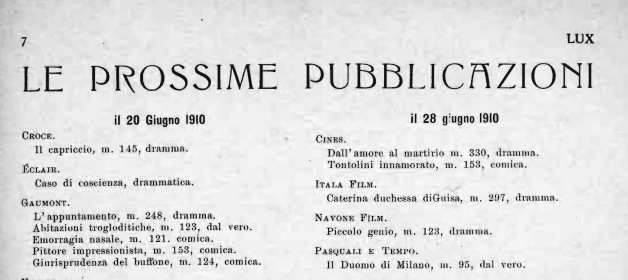
Figure 6. Lux, Naples, No. 50, 19 June 1910.
Literary and visual connections
Dall’amore al martirio seems to have a much more sustained relationship with nineteenth-century fictions of martyrdom than La Fille du centurion. The plot is reminiscent of Wilson Barrett’s stage play The Sign of the Cross (1895), first performed from March 1895 in St. Louis, Missouri, and from August 1895 in London. The play was a huge success on both sides of the Atlantic and inspired various film adaptations, such as the 1914 American silent version by Famous Players, with William Farnum in the lead. The action of the play, like that in Sienkiewicz’s novel Quo vadis (1896) and its subsequent stage and screen adaptations, unfolds in Neronian times. In both play and novel, the main character is called Marcus just as he is in Dall’amore al martirio. In all three cases, the main character is a violent and at times cruel Roman patrician, who is tamed by his deep and passionate love for a Christian girl and converts. While in The Sign of the Cross and Dall’amore al martirio, the couple dies the death of a martyr, in Sienkiewicz’s version they survive and escape to Sicily, leaving decadent Rome behind. Many early films, whether French, Italian or American, follow the martyrdom plot from Barrett’s play, such as The Way of the Cross (Vitagraph, 1909) and Le Martyre (Gaumont, 1910), even if in slightly modified versions. Just as in The Sign of the Cross, an angel prevents Marcus from becoming too brutish with the girl. Instead, his violent nature is tamed and he converts, as love conquers all even at the risk of death.
Dall’amore al martirio starts with a familiar image of decadent Rome (figure 7), showing an opulent Roman banquet, with drunken guests and a lascivious female dancer who is lusted after by the males as she cavorts in a diaphanous dress. Clearly this opening was intended to create a contrast with what should be the ‘right path’ of Christianity. Yet some duplicity is at work here, as the exhibition of immorality within a moral context provided a means to show a hint of nudity in cinema. Cinema thus could counter accusations against it of immorality by indicating a trajectory from debauchery, drunkenness and violence to restraint, sobriety and piety even while spectators were invited to enjoy the scene of debauchery placed momentarily before them. Of course, literary sources like the novel by Sienkiewicz had already created such images, but the visual arts had also. Thomas Couture’s Les Romains de la Décadence (1847, now Musée d’Orsay, Paris) was painted decades before the Polish author wrote his novel. In the later nineteenth century, images of decadent Roman banquets were a cherished theme in artworks created by painters like Lawrence Alma-Tadema and Roberto Bompiani. Such images of Roman decadence were also created for the early stage adaptations of Sienkiewicz’s novel that were performed in Rome in 1900 and in Paris in 1901, as well as book illustrations for Quo vadis designed by Ulpiano Checa and Jan Styka. Moreover, Roman banquets had already been depicted in frescoes excavated at Pompeii and at times much more graphically than in their later neoclassical variations, frescoes to which some of the wall decorations in the opening scene bear a resemblance, such as to the so-called Fourth Style in mural painting in Pompeii, e.g. at the House of the Vetti where there are similar depictions of women costumed in flowing garments.
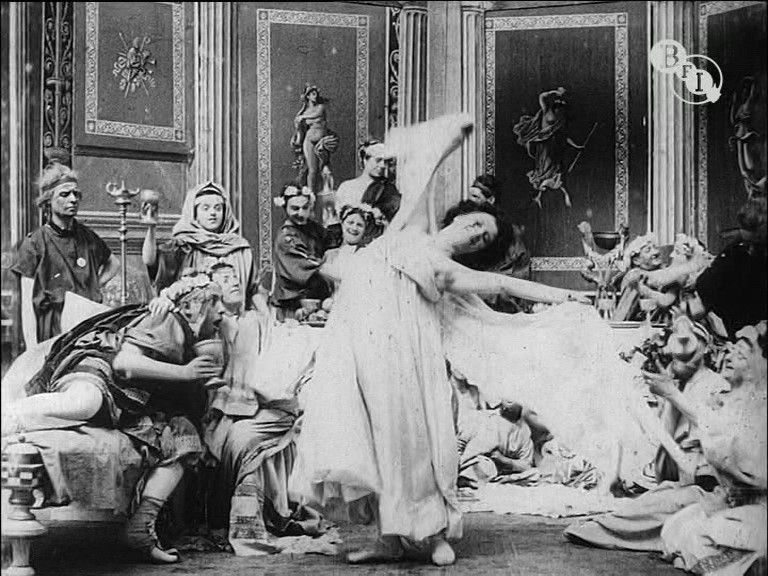
Figure 7. Opening scene of Dall’amore al martirio (Cines, 1910). Courtesy of BFI National Archive.
Interior sets
At the time of the film’s UK release, on 2 June 1910, the British trade paper The Bioscope wrote: ‘This is a truly magnificent production – one of those historical dramas for which the Cines Company is justly famous. Full of life and action, the film deals in a stirring way with the life of the early Christians in Rome, and the story is the more interesting by reason of the love romance woven around it. The staging and mounting are, as usual, superb.’ It is quite curious to observe that, despite this praise for the staging of antiquity films produced by Cines, Dall’amore al martirio partly recycles sets already used in what may have been the Roman studio’s first film on Roman antiquity, La rivale (1908) - a film which we can view today thanks to a print that survives at the Cineteca di Bologna.
Already in the opening scene of Dall’amore al martirio containing the banquet and the dancer, it is clear that the panels on the walls, with their decorations made up of dancing women with fluttering garments framed by painted columns, are exactly the same as ones already used in La rivale (compare figures 7 and 8). Moreover, the other scene set inside Marcus’ elegant home, where his jealous mistress denounces the girl to Marcus, has the same frieze with sphynxes and curls on top, the same painted curtains, and the same wall decorations in Fourth Style Pompeiian murals as in La rivale (fig. 7-10).
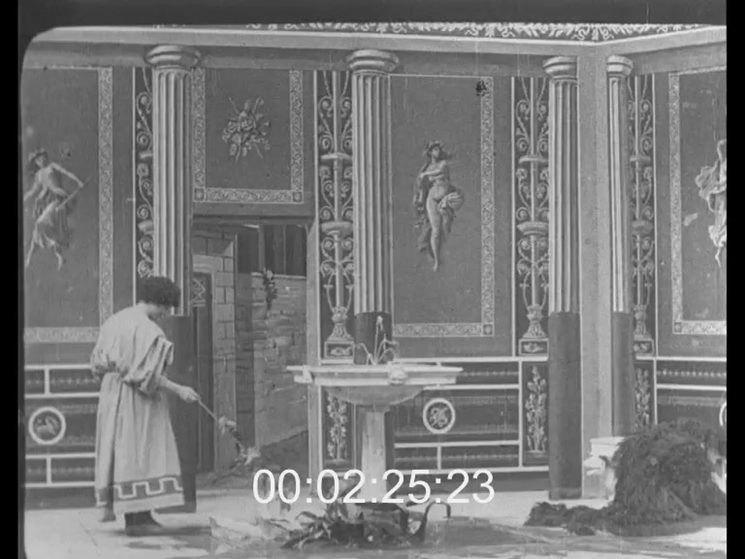
Figure 8. La rivale (Cines, 1908). Courtesy of Cineteca di Bologna.
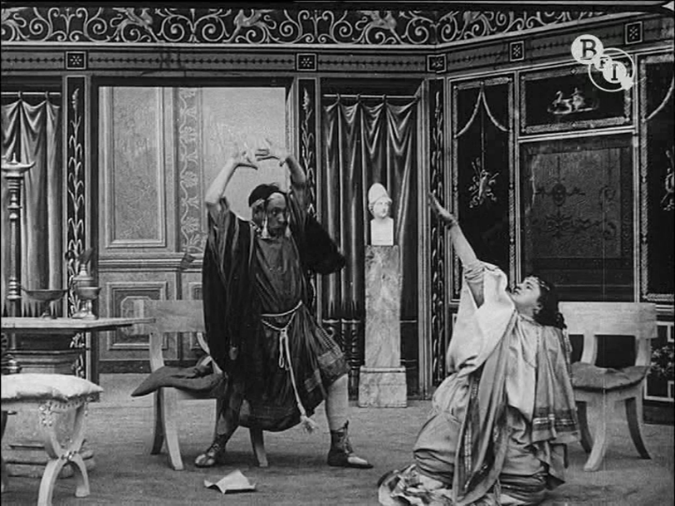
Figure 9. Dall’amore al martirio (Cines, 1910). Courtesy of the BFI National Archive.
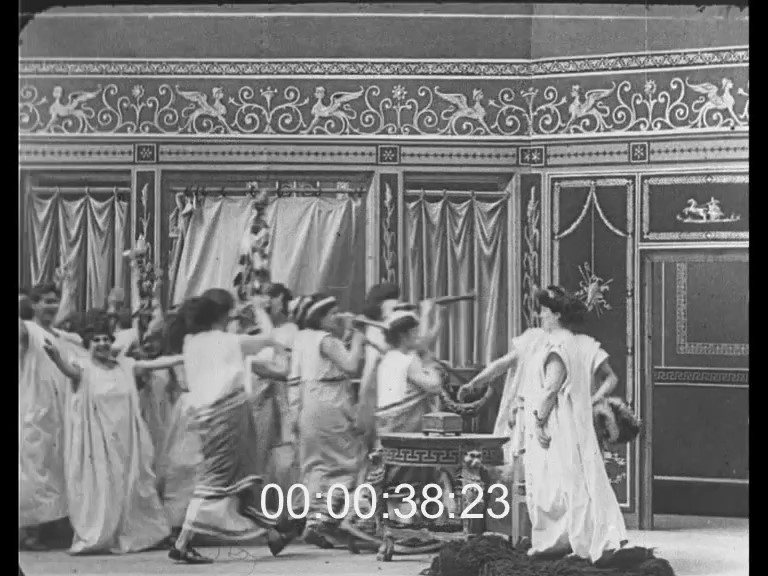
Fig. 10. La rivale (Cines, 1908). Courtesy of Cineteca di Bologna.
Yet, La rivale, a film which doesn’t suggest a particular historical time as its setting apart from Roman antiquity at large, utilises a simpler set design and more traditional film style à la Pathé before 1910 than Dall’amore al martirio and it is more traditional also than the 1909 Cines film Patrizia e schiava that was made just one year later (see our text on this film on the website). Clearly the dreamworld of ancient Rome constructed by silent cinema was changing quickly in this period. The soberly decorated rooms of some sets in La rivale make place for richly decorated rooms, filled with all kinds of Roman furniture. While La rivale already had some pieces of furniture like the sella curulis folding stool (although smaller in size than later props of this kind), Dall’amore al martirio recycles various other pieces of Roman furniture introduced in Patrizia e schiava, such as a cathedra chair with its outward bending legs, a candelabrum, a monopod table and a larger kind of folding stool. Also reappearing from the 1909 film in the following year’s Dall’amore al martirio is the Minerva-like bust on a pedestal, which first appears next to Marcella in the opening scene of Patrizia e schiava (figures 11-12). The bust looks quite like the famous statue of Athena of Velletri, a Roman copy of a lost Greek bronze of c. 430 BC by Kresilas, now at the Musée du Louvre.[16]
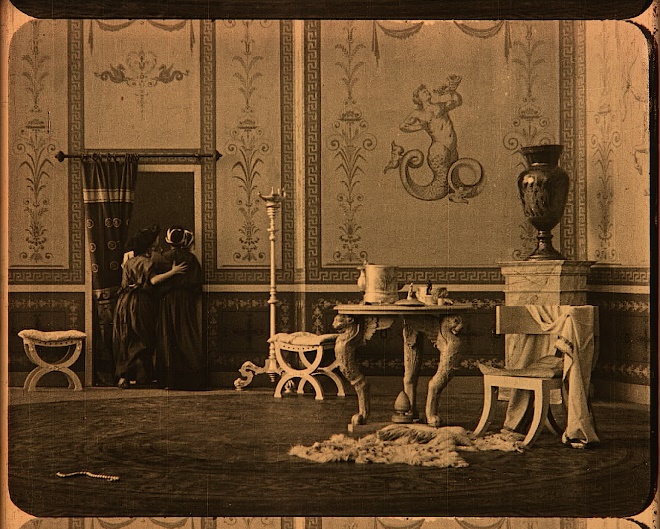
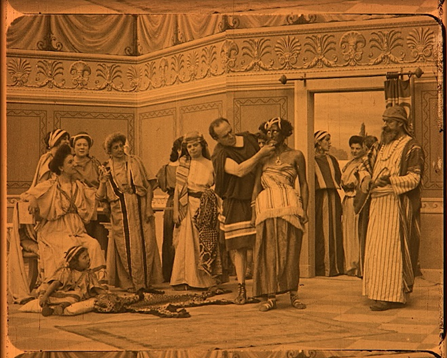
Figs. 11-12. Patrizia e schiava (Cines, 1909). Courtesy of La Cineteca del Friuli.
What may have been new in Dall’amore al martirio is the statue of Athene or Minerva Giustiniani, a small copy of a Roman original now at the Vatican Museums (figure 13 and see also figure 23), based on a Greek bronze sculpture of the late 5th–early 4th century BCE. It is visible on the left in the frame, when Marcus goes to denounce Livia to the Praetor and again when he returns to state he is a Christian too and will therefore be ordered to undergo the same fate. The statue returns in three Cines films of 1911: Agrippina, Santa Cecilia and Virginia (figure 14, 15 and 22, see my discussion of Santa Cecilia below). In most films, the statue operates just as a marker of Roman antiquity to the average film spectator, but within the setting of Dall’amore al martirio it also expresses Roman authority as this is the goddess of wisdom. Agrippina, Santa Cecilia and Virginia all recycle one of the sets of La rivale and Dall’amore al martirio (figures 9-10) but add furniture from Patrizia e schiava, such as the mensa delphica table, the cathedra chairs, the large vase visible in figure 11, and real instead of painted curtains (figures 14-15).
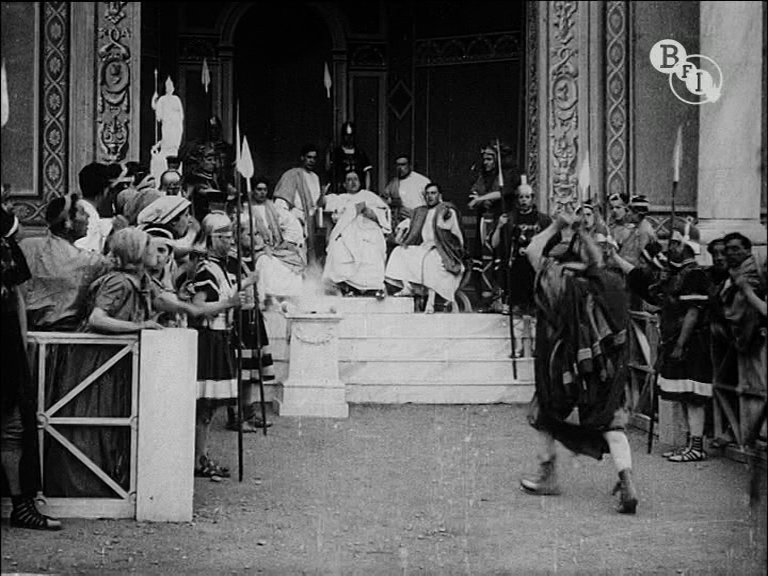
Figure 13. Dall’amore al martirio (Cines, 1910). Courtesy of BFI National Archive.
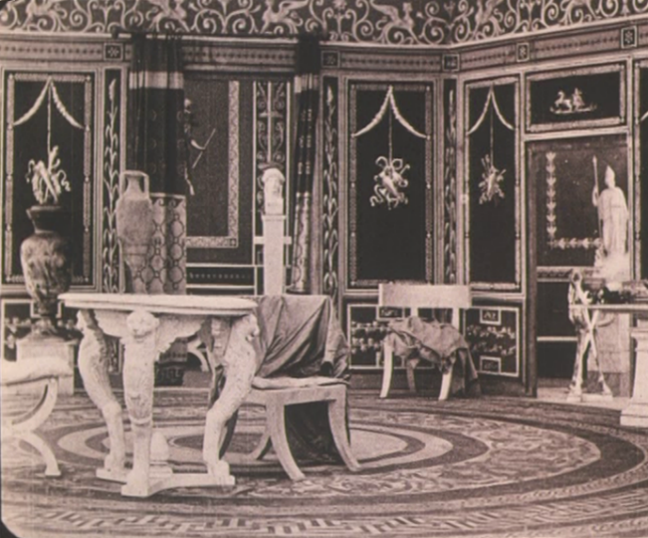
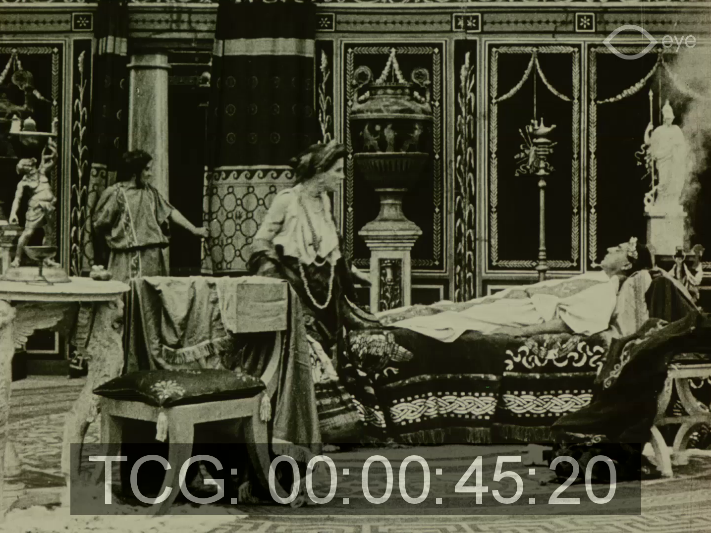
Figs. 14. Virginia (Cines 1911). Collection Cineteca di Bologna. Fig. 15. Agrippina (Cines 1911). Courtesy of Eye Filmmuseum.
Location shooting
While we can discern small additions, changes and developments in the design of interior sets across the Cines films from 1908 to 1911 that reconstruct Roman antiquity, changes to the way exterior scenes are shot are more dramatic. All the exteriors of La rivale are painted backdrops, with painted facades, balconies and doors of houses, painted trellis and brick-stone walls, and painted temples and streets rendered in condensed perspective. Instead, Dall’amore al martirio follows the novelty introduced by Cines in Patrizia e schiava of using real exteriors with considerable emotional affect. These outdoor scenes create very remarkable effects when we see the Christians going to or leaving their place of worship (its expected secrecy is highlighted by the manner in which they seem almost to fade in and out of the black mouth of a large cave, figure 16)[17], or when the Christians are brought by Roman soldiers to prison (its threatening grimness is highlighted by the height and material reality of its outer walls, figure 17). The exteriors may well have been shot near some Roman aqueducts. Archaeologist Valerio Astolfi (Sapienza Università di Roma) kindly suggested that they may have been filmed at or near the Via del Mandrione (Torpignattara), where the aqueducts Claudio, Marcio and Felice meet.[18] Personally, I would consider the Ponte Lupo at the Aqua Marcia near Tivoli as another possibility. Unfortunately, the reference book by Aldo Bernardini is silent about the locations and the few available trade papers from 1910 equally say nothing about them. As their architecture is not clearly defined, it is difficult to say where exactly these shots were taken, but they do add an important dimension to the film. They sharply contrast with the artificiality of the painted backdrops used for the interiors, including those of the prison.
I am sure that this kind of location shooting at ancient Roman locations in or near the city of Rome added surplus value to the film, despite the oddity that we see ruins and not perfectly built Roman architecture. In fact, Roman ruins had been utilised in the visual arts of the Renaissance that represented martyrdom in order to suggest that such heroic sacrifice would lead to the collapse of pagan Rome (as in the painting of Saint Sebastian that Andrea Mantegna produced in 1480). Even if cinema goers at the time might not have known where exactly the outdoor filming took place, as no iconic, recognizably Roman architecture like the Colosseum or the Forum Romanum is put on display (Blom, 2025) the location shooting and use of real ruins may well have increased their sense that this was an authentic narrative of Roman martyrdom made in a genuinely Roman landscape.
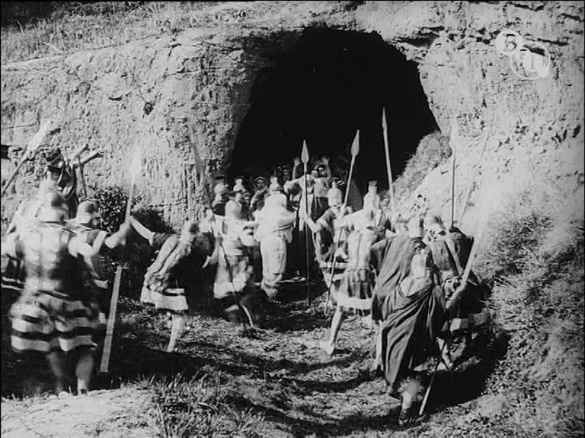
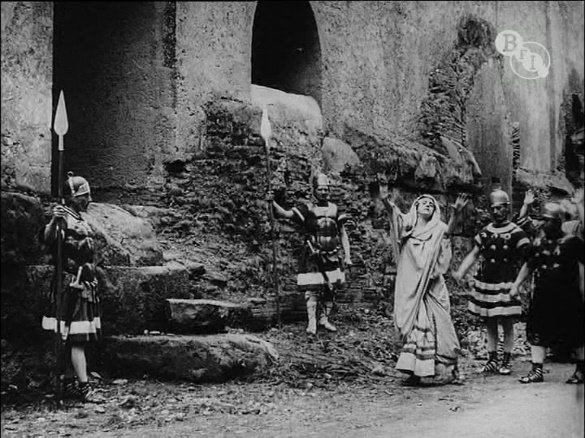
Figs. 16 & 17. The catacombs and the way to the prison. Dall’amore al martirio (Cines, 1910). Courtesy of the BFI National Archive.
Santa Cecilia (Cines 1911, Enrique Santos)
Finally, my third film Santa Cecilia (Enrique Santos, Cines 1911) is embedded in larger Catholic traditions in visual arts and popular visual culture based upon the Saint’s hagiography but also deviates interestingly from them. The film shows the maturity achievable in Cines’ productions on Roman antiquity through its keen attention to details of Roman architecture, domestic spaces and objects.
The tradition for St Cecilia and the film’s deviations from it
The early Italian film Santa Cecilia from 1911 draws on nineteenth-century romanticised fictions of martyrdom at the same time as it is rooted in the rich visual tradition for the venerated virgin martyr Saint Cecilia. From the sixteen century, Saint Cecilia has been known primarily as the patron saint of music and musicians, based on a brief reference in her fifth-century Passio Caeciliae where she is described as singing to the Lord at her wedding feast. She is therefore often depicted, as in Raphael's painting The Ecstasy of Saint Cecilia (ca. 1514-17) in the Pinacoteca in Bologna (figure 18), surrounded by musical instruments, and similarly in others by painters such as Guercino, Gentileschi and later also Waterhouse. The film may be touching on that conception of her when it displays two women playing lyres both at the Saint’s wedding ceremony and in her interrupted nuptial banquet.
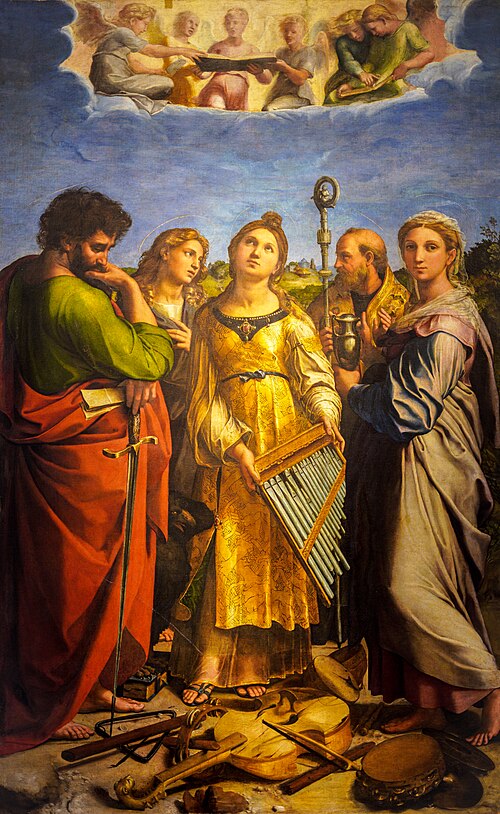
Figure 18. Raphael, The Ecstasy of Saint Cecilia (c. 1514-17, Pinacoteca di Bologna). Wikimedia Commons, https://commons.wikimedia.org/wiki/File:Saint_Cecilia_by_Raphael.jpg

According to the Passio Caeciliae, that was taken up in the Legenda aurea, the story of Cecilia takes place in Rome and is strongly focused on how the Saint protects her virginity better to serve God. She is secretly a Christian who renounces sex even in marriage. In their article, ‘The Saint as an Astute Heroine: Rhetoric and Characterization in the Passio Caeciliae’ (2016), Annelies Bossu et.al. argue that ‘Although Caecilia is determined by traditional gender patterns (forced marriage), her elaborate rhetorical skills allow her both to obtain a position of control in the marriage and to achieve the two aims central to her self-definition: the preservation of her virginity and the conversion of her audience.’ (Bossu et al., 2016: 449) Indeed, when forced by her parents to marry the pagan Roman Valerianus, thanks to her skills as orator, she persuades him on their wedding night not to have sex with her because she already has a lover in the form of a protective angel of God. If he accepts baptism from Pope Urbanus, then she will provide visual proof to him that her ‘lover’ is an angel. Otherwise, the angel’s fury will strike him. After Valerianus’ conversion and witnessing of the angel, Cecilia manages to convert his brother, Tiburtius, too thanks to her rhetoric skills. On discovering this turn of events, the prefect of Rome, Almachius, has the two men beheaded. Brought before the prefect, thanks once more to her rhetorical abilities, Cecilia manages to convert others until she too is tortured and suffers a martyr’s death, her chastity intact. The Passio describes how the prefect sent men to behead her in her home, but she miraculously survived the attempt for three days and asked that her house be dedicated to the church (Bossu et al., 2016).
While already depicted in medieval times such as at Ravenna, Cecilia’s martyrdom is famously depicted in the Oratorio di Santa Cecilia in Bologna, which contains a cycle on Saints Valerianus and Cecilia (1505-06), painted by Francesco Francia, Lorenzo Costa, Amico Aspertini, Bartolomeo Ramenghi and others. Cecilia was said to have been buried first in the catacomb of Callisto on the Via Appa Antica and later her relics were transferred to the Church of Santa Cecilia in Trastevere and placed under its altar. To this day she is venerated there and her feast is celebrated every 22 November. In 1599 Stefano Maderno’s sculpture of the quite untheatrical and unsanitized corpse of the murdered saint was made and added to the church’s altar (figure 19). Its unusually naturalistic representation, based on a brief opening of Cecilia’s tomb, immediately made Maderno an acclaimed artist. Maderno’s Santa Cecilia became a prototype on which many later artists based their own works and the image of the corpse of Cecilia in the Cines film bears some resemblance to it too (figure 20). After the sixteenth century, the martyrdom of Saint Cecilia remained popular in religious art, such as in early seventeenth century works by Carlo Saraceni (1610), Domenichino (1612), Orazio Riminaldi (c. 1620-25), and Francesco Guarino (c. 1650), as well as later works by e.g. Andrea Pozzi (1810), Étienne Gautier (1878), Luis de Madrazo (1852), Théobald Chartran (late 19th c.), and Gustave Moreau (c. 1897) .
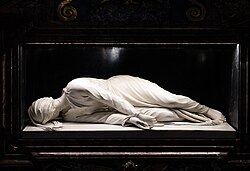
19. Saint Cecilia (Stefano Maderno 1599, Santa Maria in Trastevere, Rome). Wikimedia Commons, https://commons.wikimedia.org/wiki/Category:Death_of_Saint_Cecilia_(Maderno)#/media/File:Stefano_Maderno_-_Martyrdom_of_Saint_Cecilia_-_Church_of_St._Cecilia_-_Rome.jpg

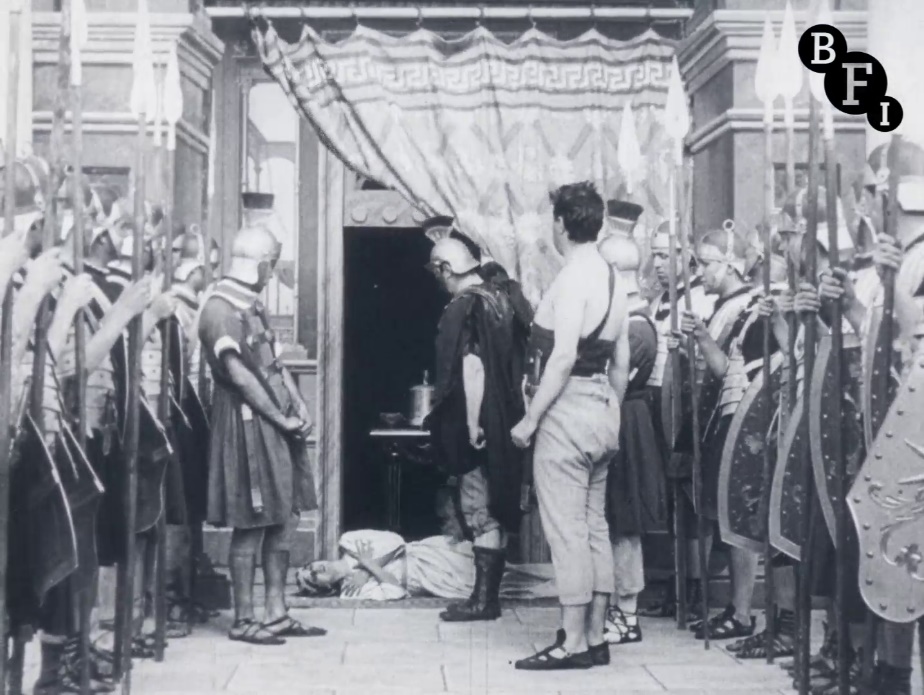
20. The body of the dying Cecilia is exposed by the Roman soldier sent to dispatch her, Santa Cecilia (Cines, 1911). Courtesy of the BFI National Archive.
As mentioned at the start of this account of martyrdom on film, religious propaganda was another important reason why images of saints and their martyrdoms continued to circulate in the public memory and be available as inspiration for early filmmakers. The martyrdom of Saint Cecilia was for instance also depicted in a series of cards from 1913 by the French Catholic publishing house Maison de la Bonne Presse, based on a series of lantern slides from 1910. As mentioned above, in the early twentieth century, La Bonne Presse was very active in publishing books, magazines, slide series and postcard series to spread the Catholic message, for example with series on Christian martyrs such as Saint Cecilia (figure 21), Tarcisius and Quo vadis. They also made films, including one on Cecilia. Belgian scholar Bart Moens has written extensively about their work, including in his doctoral project, which will be published by Brepols in 2026 (Moens, 2019; Moens, 2020).
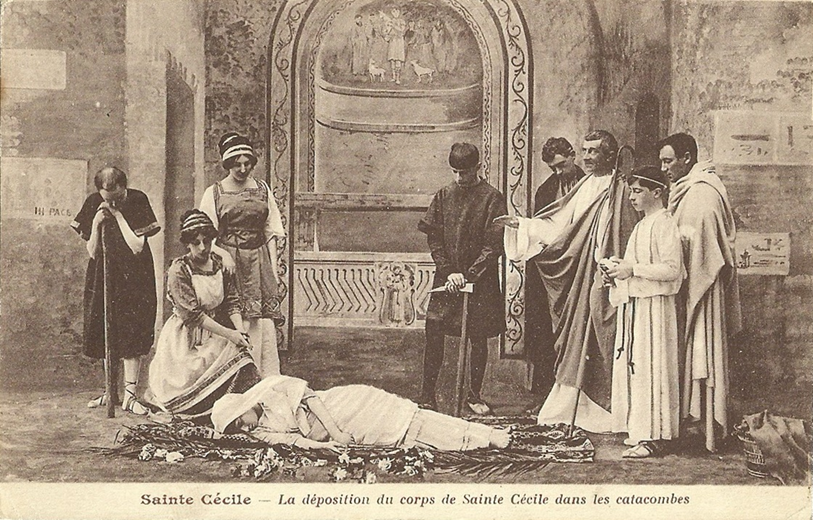
Figure 21. Sante Cécile. Maison de la Bonne Presse, 1913. Collection of the author. The pose of the dead Cecilia reminds of Maderno’s sculpture.
Contrary to the religious tradition whose origins lie in the narrative of the Passio, the film Santa Cecilia, directed by Enrique Santos (at the time together with Guazzoni and Caserini one of the three main directors at Cines) is strikingly different. As in so many early films about Christian martyrdom, it is the personal jealousy and revenge of a pagan man or woman that causes the martyrdom of the Christian protagonists, or even, as in the novels Fabiola (1854), The Sign of the Cross (1895) and Quo vadis (1896), of the whole Christian community in Rome. As the English intertitles in the BFI print are quite spare, in order to describe the most interesting features of Santa Cecilia I here draw on the fulsome summary of the film published by the studio in the Naples’ journal Cinema on 20 February 1911 (reproduced in (Bernardini, Martinelli, 1995: 154). From it, and an examination of the film’s scenes, it would seem that even a film about a specific saint cannot escape the nineteenth-century fictive structures that had put melodrama into martyrdom.
The film opens completely against the hagiographic record with a love triangle (while Valerius’ brother Tiburtius is absent from the whole storyline). Cecilia, the beautiful and wealthy daughter of the Cecili, has embraced the Christian faith in secret, even before the film begins. Only an intertitle briefly alludes to her conversion. She has consented to become the wife of Valerianus but has inadvertently aroused the love of Quintus Lentulus. In a beautifully apportioned and wealthy domestic space filled with family and friends, and with the camera closer to the actors than in either La Fille du centurion or Dall’amore al martirio, we observe how the tribune Valerianus hides in an alcove to watch with excitement the rejection of Lentulus and then Lentulus hides in the same alcove to observe with outrage the loving couple in conversation. Deep space composition and performance are clearly assets in this film, even within just the space of one room. Like the jealous mistress in Dall’amore al martirio and in a similar countryside setting, Lentulus follows his rival to a cave mouth but now the camera enters the cave to show us how the Bishop Urbanus baptises the tribune and presents him with a small cross (an important prop later in the film). No vision of an angel is offered here, despite its importance in the Passio - instead, like Vinicius in Quo vadis, this tribune converts for love and is truly passionate about it.
Lentulus denounces his rival as a Christian to the Prefect of Rome whom we see composing a decree for Valerianus’ arrest. That brings an element of suspense to the subsequent presentation of the marriage between Cecilia and Valerianus and the groom’s arrest at the nuptial banquet. Both scenes, however, also display some interest in reproducing the specific rituals of a Roman marriage. Even the English intertitles refer to Roman custom and include in Latin the vow of a Roman bride as she enters the home of the groom: ‘ubi tu Caius, ego Caia’. The prop of the small cross is used strikingly in the next scene, where Valerianus brazenly kisses it after hurling aside the dish with which he has been invited by the Prefect to pour an offering to the Roman gods. There is a strong sense created here and elsewhere in the film of the materiality of and contrast between Christianity and paganism. Next, after Valerianus has been killed, the camera movingly captures in the light and shadows of the sun, Cecilia’s expressions of grief over the body of her beloved and the comforting embrace she receives from Urbanus. The camera arrives at the mouth of a cave and follows the Christians as they solemnly descend into the Catacombs. It moves in closer still when they place the body of Valerianus tenderly inside a sepulchre. The presentation of these Catacombs is elaborate in its design.
Finally, Cecilia is arrested in a countryside setting. Both the studio’s publicity and the film’s English intertitles are careful to stress that having courageously confessed her faith, Cecilia is permitted to die in her own home because of her patrician background and in contrast to the expectations raised by works like Quo vadis and The Sign of the Cross that martyrdom must occur in the arena under the cruel gaze of an emperor. Again antique props are used effectively when the decree of death is read from a tablet, and Cecilia’s distraught father tries to give her a bowl with which to offer prayers to the Roman gods. A curtain is drawn back and the camera comes in closer to show the lingering death of the prostrate Saint. The tail end of a review in the London-based Bioscope for 2 February 1911 suggests that a small element of the BFI print might be missing here (provenance unknown, its length is 249 m. vs. the 377 m. of the original): ‘Then, as her weeping friends gather round her body, the symbol of the Christian faith appears over the spot where the martyr lies in her last sleep, and the sorrowing throng fall on their knees in reverent awe before the Cross’. Such a vision might have been considered a useful substitute for the missing angel of the Passio, a vision which also brings the film in line with the strategies of the play The Sign of the Cross and its film adaptation from 1909 The Way of the Cross (see the analysis by Jon Solomon of that American film on this website).
The same Bioscope article praised the film warmly: ‘To the already long list of successes achieved by the Cines company must be added the film under review, St. Cecilia. […] the story as here presented lacks nothing in its careful treatment. The film has been produced in a most perfect manner, while of the acting it is impossible to speak too highly.’ This is perhaps because the closeness of the camera permits spectators to engage with the emotions expressed on the faces of the studio’s actors. The actor who plays Lentulus has recently been identified by us as Aldo Sinimberghi (figure 22). The praetor is played by Gastone Monaldi. Cecilia is played by Fernanda Negri Pouget (figure 23) and her lover, Valerianus, by Amleto Novelli. After performing in films such as Messalina (Mario Caserini, 1910) and Virginia (released in 1911, shortly before Santa Cecilia), Novelli became the key interpreter of heroic and noble Romans at Cines. He would repeat this role in later films, for example as Marcus Antonius in Bruto (1911), as Marcus Vinicius in Quo vadis? (1913) and as Julius Caesar in Cajus Julius Caesar (1914), all three directed by Enrico Guazzoni.[19]
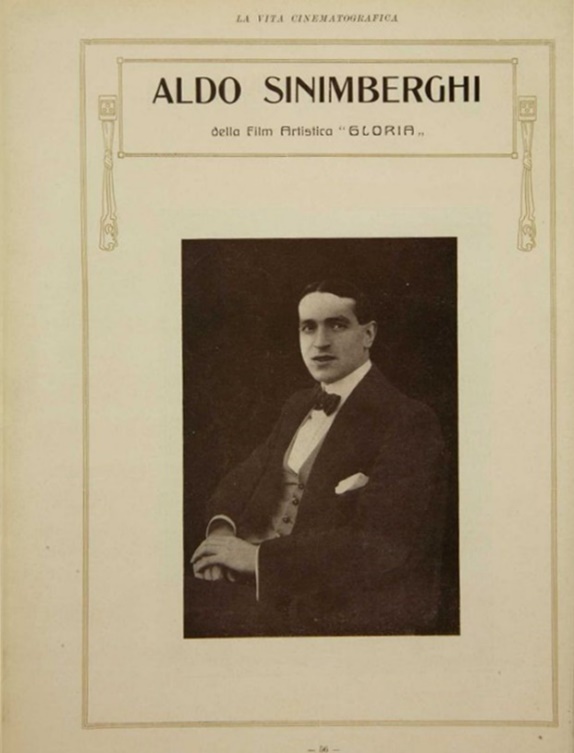
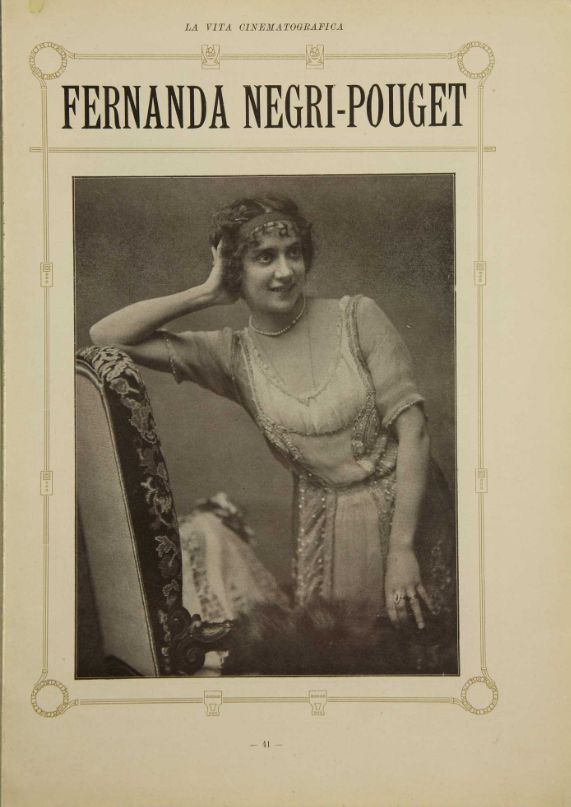
Figure 22. Aldo Sinimberghi, Gloria Film, La Vita Cinematografica 23-24 December 1913.
Figure 23. F3rnanda Negri Pouget, Ambrosio, La Vita Cinematografica, 23-24 December 1913.
The reception of the film Santa Cecilia, however, was rather mixed at the time. A journal published in Turin reported, clearly with some distaste for the Catholicism with which Cines was associated and from the perspective of industrial rivalry with Rome: ‘And then what's the point of reproducing such catacombesque putridities of an over-exploited Christian traditionality, with its attendant tortures, fanaticisms on both sides and inconsistencies?’[20]
Roman domestic scenography
Santa Cecilia contains a remarkable number of props recycled from earlier Cines’ films now put to fresh use, such as the statue of Minerva Medica (figure 24), braziers, furniture, curtains and even complete architectural structures. These features appear in other Cines films from 1911 that reconstruct ancient Rome (despite their narratives being situated in a variety of historical periods), such as Virginia, Agrippina and Bruto, and reappear in later films, such as the two versions of Quo vadis from 1913 and 1924. The statue of Athena Giustiniani or Minerva Medica (Vatican Museums, Rome, figure 25), a Roman marble copy of a Greek bronze statue, often recopied as early as the eighteenth century, while plaster casts from the late nineteenth and early twentieth centuries were often exhibited at world exhibitions. As a familiar image that signals through the goddess the political authority and the religion of ancient Rome, the statue was also used in other early films by Cines, such as Virginia (1911, figure 26), Agrippina (1911) and, as we have seen, Dall’amore al martirio. In the opening scene set in the house of Cecilia’s parents, the statue stands in the alcove where first Valerianus and then Lentulus overhear Cecilia’s conversations (figure 27). Along with the other carefully crafted props, exquisite furnishings and elaborate wall decorations, it marks this space as belonging to members of the pagan Roman elite. It is effectively used to frame the narrative when it reappears prominently in another part of the house of the Cecili towards the end of the film, as Cecilia declares her Christianity before her shocked parents and refuses to worship the gods of the Romans (figure 24). Similarly, a tripod brazier bearing eagles’ heads holding rings and adorned with garlands stands in the foreground of the frame before the statue in the same scene of Cecilia’s confession of her Christianity. Cecilia’s father takes a bowl sitting at the feet of the statue and invites his daughter to make a ritual offering with it, pointing to the material indicators of Roman religion – the brazier and the statue of the goddess. The brazier returns in many Cines films, including Agrippina (1911) and both versions of Quo vadis from 1913 and 1924.[21]
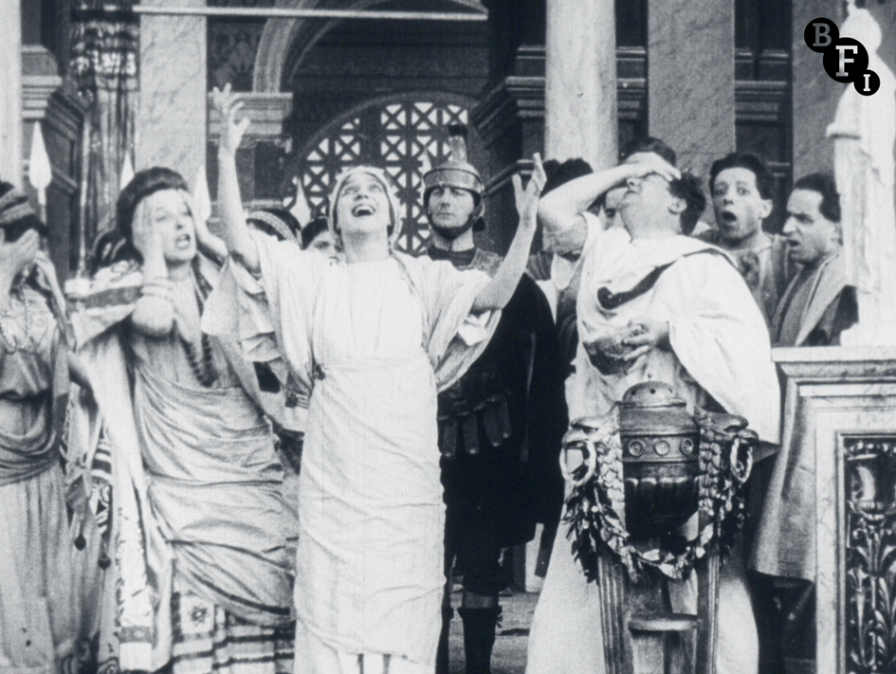
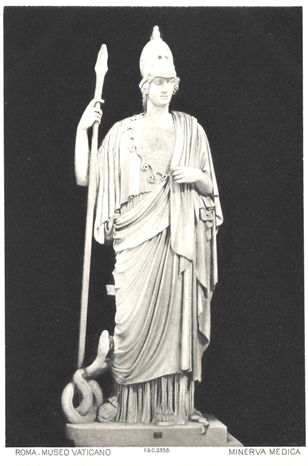
Figure 24. Santa Cecilia (Cines 1911). Courtesy of the BFI National Archive. Cecilia (Fernanda Negri Pouget) declares her conversion to Christianity. Mark the Minerva statue and the brazier at the right.
Figure 25. Athena Giustiniani/ Minerva Medica (Vatican Museums, Rome). Postcard, F&C 2598. Collection Ivo Blom.
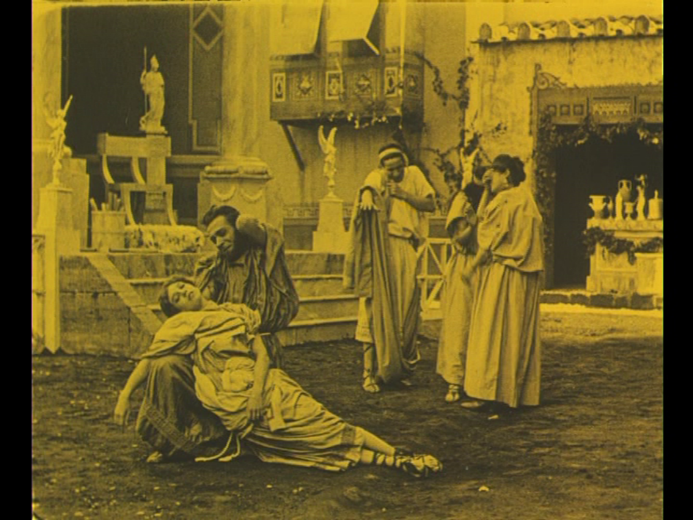
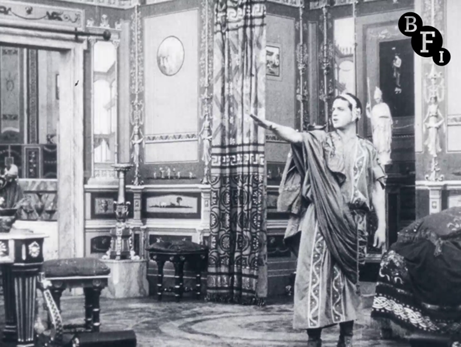
Figure 26. Virginius (Amleto Novelli) holds the body of his daughter Virginia (Fernanda Negri Pouget). The Minerva statue is housed at the back, Virginia (1911). Collection Cineteca di Bologna.
Figure 27. Lentulus (Aldo Sinimberghi) swears revenge after being rejected by Cecilia. Mark the murals with fantasy architectural decorations next to the doorpost, behind Lentulus’ head the Minerva statue, and in the foreground left part of the ornate table, Santa Cecilia (1910). Courtesy of the BFI National Archive.
Returning to the elaborate opening scene at the house of the Cecili, there is also a massive, ornate table visible on the left side of the frame (figure 25). The table reappears in the 1913 version of Quo vadis, both in Nero's palace and in Petronius' house marking their wealth and importance. All in all, Cines was gaining a reputation for the antiquarian eye with which it designed its ancient Roman sets, which is also clear in the Roman interior in the opening scene, with the fantasy architecture reproduced in the wall decorations standing out. It harks back to Pompeian frescoes of the so-called Fourth Style. The fantasy architecture is even more visible in the final shot in which Cecilia’s mother holds her dying daughter, surrounded by despairing relatives (figure 28). The curtain in the opening scene of the film is also clearly visible in its closed and open state to conceal and reveal the martyr as she lies dying. Curtains with the same patterns as in Cecilia’s house were also used in, for example, the 1911 film Agrippina and the 1913 film Quo vadis?.
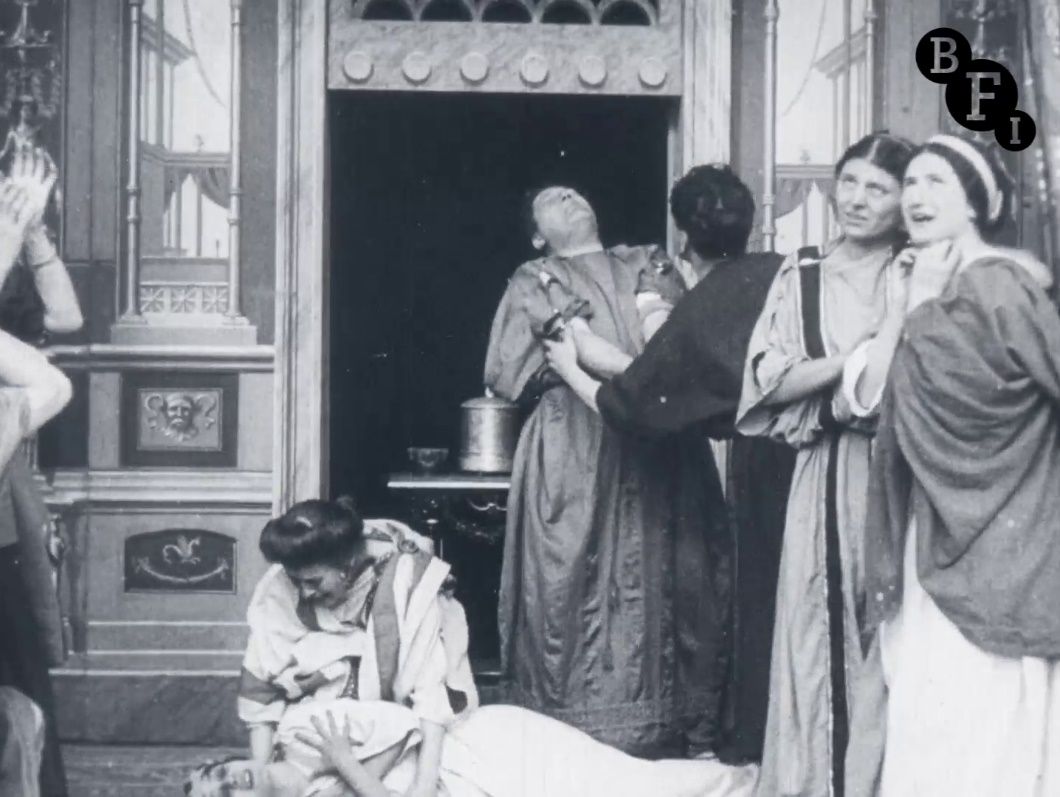
28. Santa Cecilia (1910). Courtesy of the BFI National Archive.
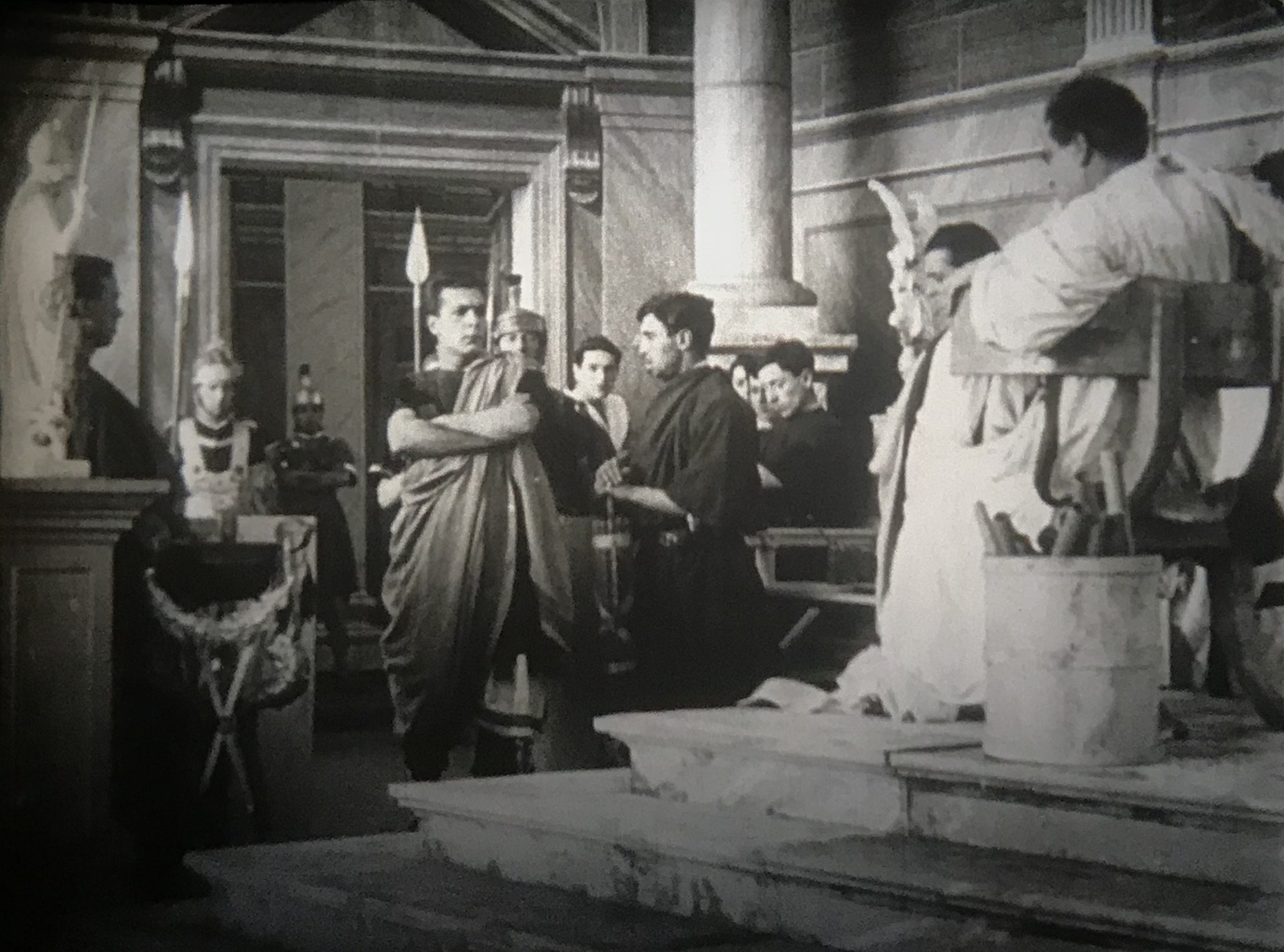
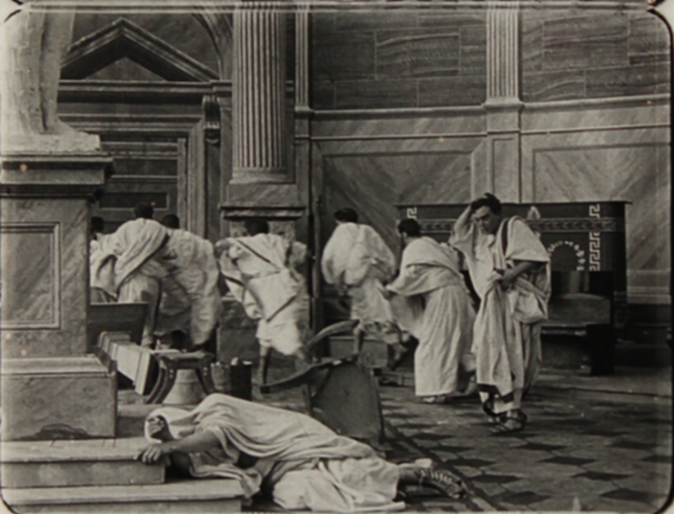
Figure 29. Santa Cecilia (1911). Valerianus (Amleto Novelli) before the praetor. Courtesy of BFI National Archive.
Figure 30. Bruto/ Brutus (1911). After the murder on Caesar in the Senate. Courtesy of BFI National Archive.
The hall in Santa Cecilia where the Prefect sits on high and delivers his decree for the imprisonment and death of Valerianus carries over its entrance a tympanum and is decorated with pilasters on either side. Its design as a means to signal the space in which Roman political power is exercised is a variation on the two almost identical sets of the Roman Senate in Agrippina and Bruto, both from 1911 (figures 29-30; see also Blom, 2003 for more information on reuse of sets at Cines).
The Christian catacombs
Santa Cecilia contains some extraordinary shots of scenes set both inside and outside the Christian catacombs around the city of Rome. As in many other, earlier and later, Cines films, the camera captures the outside of a real cave to represent the entrance into the secret meeting place of the Christian community. In the case of Santa Cecilia, the location is where the Christians gather and Valerianus is baptised, but it also the location where he is buried – and therefore it functions this time quite literally as a catacomb. The interior where Valerianus is baptised is clearly a studio-based construction painted to look like the inside of a cave, following the new industry practice since 1909-1910 of alternating artificially constructed studio interiors with real exteriors shot on location. Yet, the sequence in which Valerianus is carried through the catacomb and buried in a sepulchre looks convincingly like it has been shot in part inside a real catacomb, as, when they descend the entrance steps, sunlight falls on the Christians and casts their shadows (figure 31). Could this element have been shot in one of the catacombs that still survive around Rome to heighten the authenticity and realism of the film? Or was it at all possible at the time, given the limits of artificial lighting, to create such a naturalistic effect? If studio-constructed, then this scene was a major effort to imitate real catacombs and natural light.
When the Christians process solemnly further into the catacomb (figure 32), the construction of the passageway, with its arches and vaults, seems to imitate the kind of brickwork to be found at the Catacomb of Priscilla. Yet, at the spot where Valerianus’ body is lowered into a sepulchre (figure 33), the décor seems again to be studio-based – the wall murals are too perfect to be genuine. Yet, in the careful antiquarian manner that was becoming a distinctive feature of Cines films, the painted murals do reference those to be found in real catacombs, like the three men in the burning furnace at the Catacomb of Priscilla (even if there they are dressed differently) or the praying figures in the fresco of ‘The Sacrifice of Isaac’ at the Catacomb of San Callisto. The depiction of birds in the overhanging arch also bears a resemblance to those at the Catacomb of San Sebastiano, including in the pagan mausoleum of Clodius Hermes that lies beneath it.
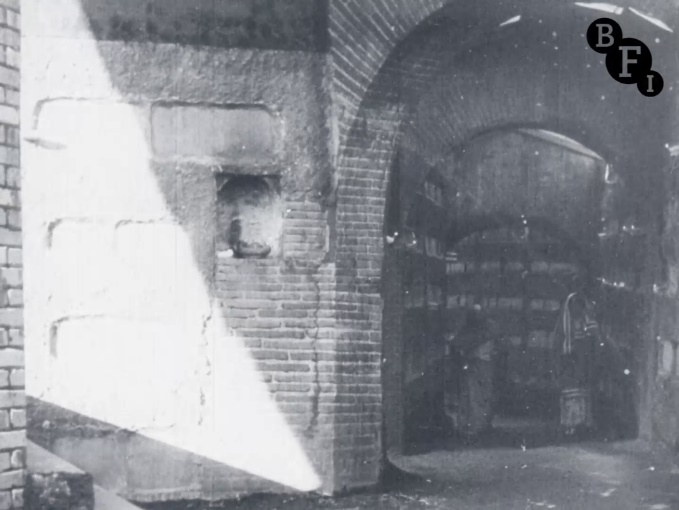
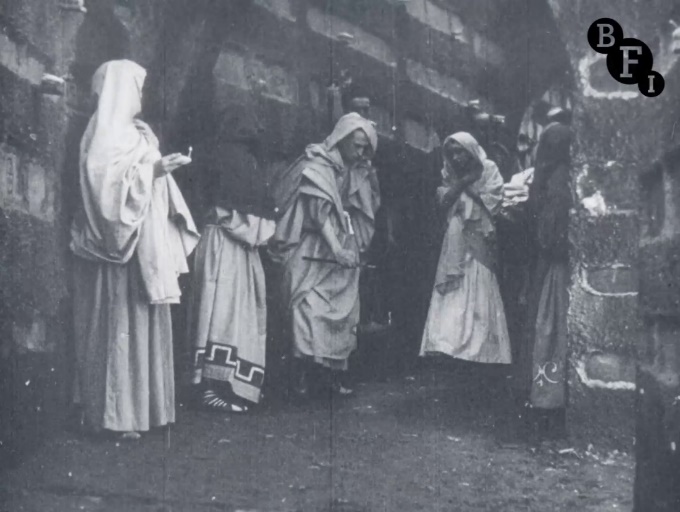
Figure 31. Entrance to the catacomb, Santa Cecilia (1911). Courtesy of the BFI National Archive.
Figure 32. The body of Valerianus carried towards his sepulchre, Santa Cecilia (1911). Courtesy of the BFI National Archive.
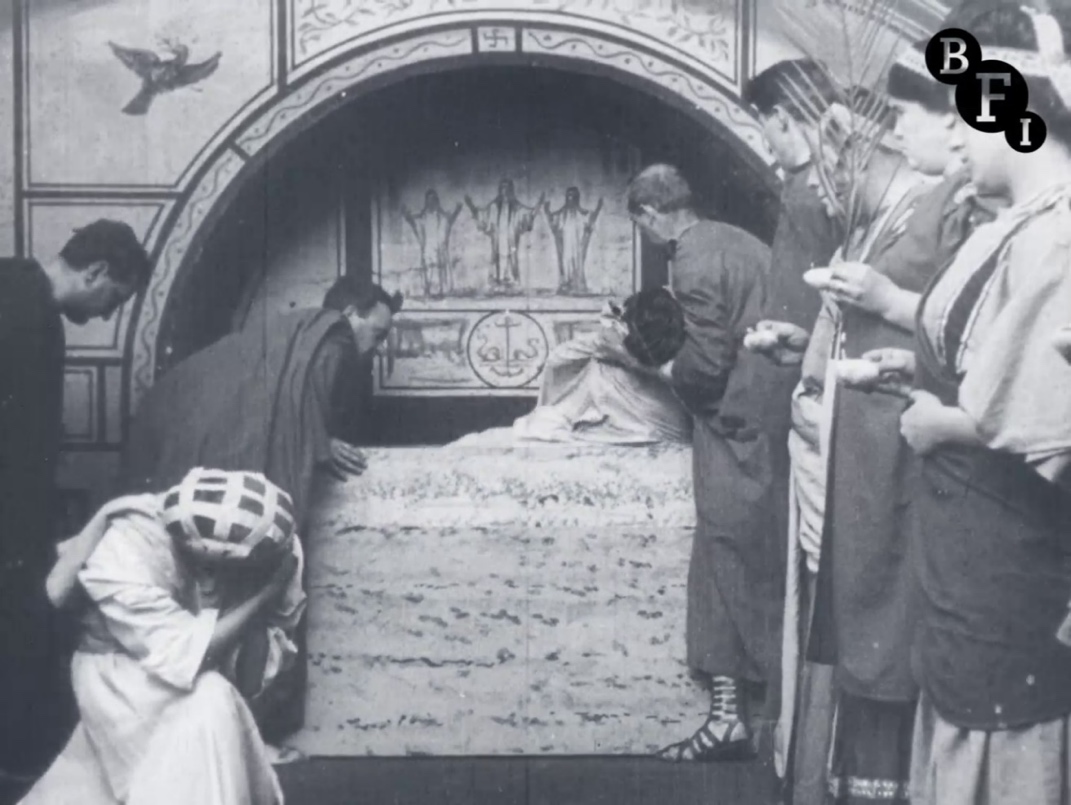
Figure 33. Cecilia mourning Valerianus as he is deposited in his marble sepulchre, Santa Cecilia (1911). Courtesy of the BFI National Archive.
Before the film Santa Cecilia, the interior of catacombs was either represented by means of painted backdrops, as in The Way of the Cross (Vitagraph 1909),[22] or only the outside structure was shown, as with the cave entrance in Dall’amore al martirio (1910). In San Paolo (Milano, 1910), real monuments representing the exterior of the catacombs, such as the Tomb of Cecilia Metella and the ruins of the Villa of Maxentius on the Via Appia Antica, were alternated with studio-designed interiors in which no wall decorations or brick structures are visible.[23] The constructed interior of the catacomb in the French film Le Martyre was inspired by the painting Les Martyres dans les Catacombs by Jules Lenepveu (1855, Musée d’Orsay), as the film’s script also confirms.[24] The background in Lenepveu painting, however, is reminiscent of certain real catacombs like the Cappella di Santa Cecilia at the Catacomb of San Callisto.[25] In La Fille du centurion, we do not see the interior of a catacomb, as the preaching of the Apostle takes place outside the cave entrance and the baptism of the woman at the edge of a river. After Santa Cecilia, Cines used real exteriors for its catacombs in Quo vadis? (Enrico Guazoni, 1913), such as the familiar type of cave entrance and a hill topped with cypresses, but reverted to studio-constructed interiors. However, these interiors are larger and possess a greater degree of three-dimensionality than in previous films, showing action simultaneously in the fore-, middle- and background, as well as at higher and lower levels accentuated by flights of stairs. The location, as specified in an intertitle, is the Ostrianum (on the Via Nomentana at Rome).
Returning to Santa Cecilia, we may conclude that there is a distinctive drive towards greater realism in its interior shots of the catacombs, which could be put down to the fact that it originates in the Passio of a venerated saint rather than in a nineteenth-century novel that concerns the fictional Christian Lygia. Even where the film seems to offer a studio-based reconstruction of a catacomb interior, it allocates a few moments to the labour of four Christian men who struggle to lift an apparently heavy marble slab and then push it over the tomb of Valerianus. Again, not just through its sets, but also through its props, the film invites spectators to understand it as an authentic account of early Christian martyrdom.
Conclusion
In conclusion, this analysis of three films about martyrdom all released in 1910 or 1911 demonstrates that, while the practice of remembering martyrs continued to be a living feature of Christian worship in the early twentieth century, the representation of Christian martyrdom on screen could not resist the draw of its nineteenth-century fictionalisations – whether they were performed on the stage, narrated in a novel or magazine or depicted in paintings and on postcards. Yet, these three films are also differentiated from each other by the national cultures in which they were produced (here France and Italy), the degree to which studios engaged with Catholic institutions (there appears to be no direct connection between the publishing house La Bonne Presse and the French studios Radios or Éclipse, but Cines was supported by the Vatican’s bank), their relative proximity to the key sites of martyrdom around Rome, and their relationship to new cinematic technologies such as location shooting around genuine ruins of ancient Rome or the elaboration of an antiquarian eye for historical sets and props in which to place martyrs and their persecutors. These deviations from the hagiographic tradition and even within the fictionalised tradition exemplifies the argument made by Ihab Saloul and Jan Willem Van Henten and touched upon at the beginning of this analysis, that ‘in many cases acts and practices of martyrdom, with their relations to material and ritual culture, create “landscapes of memory”, wherein the canon and its writings play a certain, but not the only and not always the decisive approach’ (Saloul, Henten, 2020: 12). Early cinema can be regarded as one of many modes of commemoration of Christian martyrs, contributing to a culture of remembrance that is not fixed but creates, recycles, reinterprets and sometimes contests sacred texts and their multiple receptions, whether in high or popular culture.
La Fille du centurion, Dall’amore al martirio and Santa Cecilia demonstrate the emergence around 1910 of the location shooting of exteriors, and of a marked divergence of strategy between French and Italian films about Christian martydom. While France would have had enough Roman architecture at its disposal for filmmakers to use real Roman ruins, in particular in the southern regions, at Radios the makers of La Fille du centurion instead chose unidentifiable natural sites with rocks and rivers. These may have been closer to hand, but it is noticeable that they also do not include any shots of interiors. Playing out a melodramatic fiction of Christian martyrdom in an undefined natural space may have been more palatable to French audiences than the Italian strategy of introducing strong elements of antiquarianism, localism and authenticity.
Using Roman ruins as locations in Dall’amore al martirio may seem surprising at first but situating modern humans within classical ruins had precedent in the visual arts (such as in images of Pompeii) as did the use of ruins in paintings set in the Roman past to signal proleptically the fall of pagan Rome. Dall’amore al martirio demonstrates how a film company based in Rome could exploit the novelty of using real locations effectively. Together with Santa Cecilia, it also demonstrates the specific strategy adopted by the Cines studio, and greatly praised in reviews, of using an antiquarian eye in its set designs and utilising copies of ancient Roman furniture to increase the feel of historical authenticity. Both films demonstrate, however, that Cines regularly recycled across its films the props, costumes and sets it used to construct a Roman dreamworld regardless of the specific historical period in which their narratives were set.[26] The representation of the interior of the catacombs in Santa Cecilia is clearly more sophisticated than in previous films (due to its sacred subjectmatter) and suggests some veracity too, as it partly borrows from the decorative schemes of real catacombs in or near Rome. It also demonstrates how Cines could recycle props across films yet draw attention to their materiality in this particular context in order to enhance the drama of how first Valerianus and then Saint Cecilia courageously renounce the practices of pagan worship and suffer inevitably a martyr’s death. Finally, Santa Cecilia marks a first peak in the production of antiquity films by Cines, having been released in the same year as the other Cines films set in Roman times Dall’amore al martirio, Virginia, Bruto, and Agrippina.[27] Despite still having the duration of a one reeler, it shows the maturity with which Cines was now evocating the Roman past, thus creating the cultural foundations on which the 1913 sensational epic feature Quo vadis? would be built.
Footnotes
- ^ Oddly enough, this film's climax is the breaching of the Porta Pia, which was defended at the time by papal troops led by Kanzler's father.
- ^ On this website, Les Martyrs is analysed by Valentine Robert, Martire Pompeiana by Maria Wyke [pending], The Way of the Cross by Jon Solomon, San Paolo by Maria Assunta Pimpinelli, Quo vadis? (1913) by Giovanni Lasi [pending] and Quo vadis (1924) by Aylin Atacan. Maria Wyke discusses both the Quo vadis adaptations in her analysis of Nero films.
- ^ The Bioscope, 28 April 1910, p. 5. Unfortunately, no script of the film survives within the collection of the BnF (Bibliothèque national de France).
- ^ IMDb ignores the film and does not mention it in the filmographies of the actors and director.
- ^ For the information on the stage plays mentioned here, see the site Les Archives du spectacle, https://lesarchivesduspectacle.net/.
- ^ The film still exists in the Desmet Collection of the Eye Filmmuseum.
- ^ Bernard wrote his unpublished thesis Les petites maisons de production cinématographique françaises de 1906 à 1914 in 1993-4. This was his ‘Diplôme d’études approfondies’ (DEA), nowadays the equivalent of a research master’s thesis, at the Université Paris II, Sorbonne-Nouvelle.
- ^ Maurice had been the organiser of the famous Lumière screenings at the Grand Café in Paris on 28 December 1895 and had been the technical supervisor of the Phono-Cinéma-Théâtre at the Paris World Fair. Maurice’ son Léopold was a co-founder. In 1919 he would open the CTM laboratories. Mesguich had been a famous Lumière cinematographer.
- ^ Until 1914, Radios films were still indicated in the British press under the Radios name. See Kinematograph Year Book 1914. Communicated by Stephen Bottomore to author, 18 November 2025.
- ^ With these numbers, one may also reconstruct the Radios output in the Urban catalogues, which do not list the company’s name but do mention the numbers.
- ^ The Bioscope, 28 April 1910. The journal indicated the film as an Urban release. Ciné-Journal, 89, 7 May 1910. Der Kinematograph, 175, 4 May 1910. The film was announced in Germany as an Éclipse production.
- ^ Jean Claude Séguin to the author, 18 October 2025. For additional information on Radios, Dumien and La fille du centurion, see Séguin’s site GRIMH. For Radios: https://www.grimh.org/index.php?option=com_content&view=article&layout=edit&id=15496&lang=fr; for Jules Dumien: https://www.grimh.org/index.php?option=com_content&view=article&id=15497:1896-1906-figures-dumien-jules&catid=62&lang=fr&Itemid=127; for La fille du centurion: https://www.grimh.org/index.php?option=com_content&view=article&layout=edit&id=15501&lang=fr.
- ^ Treasures from the Film Archives, https://www.fiafnet.org/pages/Publications/Treasures-From-Film-Archives.html.
- ^ For a picture of the studio, see the wonderful site Cinétourist, https://www.thecinetourist.net/eclipse.html.
- ^ Lux, Naples, No. 50, 19 June 1910. This release date was confirmed in Aldo Bernardini’s reference book Il cinema muto Italiano, Vol. 1910 (Bernardini, 1996: 132).
- ^ Already in Roman times many marble and plaster copies of the head of the Athena were in circulation, of which examples can be found nowadays in museums like the Glyptothek in Munich.
- ^ The caves are not presented explicitly as catacombs, i.e. burial places. In some early films like the Gaumont film Le Martyre (1911), the Christians preach and are baptised in caves, not in the catacombs where they are also buried. In La Fille du centurion, Peter preaches outside a cave. In the Cines film, we do not see the interior of the cave or catacomb, we are only asked to imagine it.
- ^ Information passed on to the author by Professor Eric Moormann (University of Nijmegen).
- ^ We have also identified that Cecilia’s mother is played by Adele Bianchi Azzarili, who plays the title role in another Cines film of 1911, Agrippina. Afterward, Novelli would play against type as the Oriental vengeful lover of the young Christian Agnese in Fabiola (Guazzoni, 1918).
- ^ La Cinematografia Italiana ed Estero, Turin, 15/20 March 1911, cited in Bernadini and Martinelli, 1996: 154.
- ^ The 1924 version was made by the cartel UCI, into which Cines had by then been merged.
- ^ See the analysis of that film on this website by Jon Solomon.
- ^ Maria Assunta Pimpinelli discusses the real Roman ruins utilised in the film in her analysis on this website.
- ^ See the outline of Le Martyre, deposited 28 September 1910. BnF, 4-COL-3 (1679).
- ^ This film also ends with another pictorial reference, mentioned in the film script: La jeune martyre by Paul Delaroche (1855, Musée du Louvre).
- ^ This method of recycling was often adopted in the early years of reconstructing antiquity on screen both by Cines and other early film companies like Pathé and Itala (see my analyses of Cléopâtre, Saffo, and four Itala films on this website).
- ^ Antigone was released in the same year and, although it adapts Greek tragedy to screen, it also adopts ancient Roman elements in its art direction.
Dall'amore al martirio (original)
1910
Marcus Lycinius is in love with a young girl, Livia. His jealous mistress finds out that Livia is a Christian and has her arrested. Marcus tries to m…
Fille du centurion, La (original)
1910
The slave and daughter of a centurion become Christians in Rome. Main title and credits (13). The slaves of the centurion Vicinius attend to their du…
Santa Cecilia (original)
1911
The story of the Christian martyr Saint Cecilia. Unknown to her parents, Cecilia, a Roman patrician, has become a Christian. She has two suitors for …
Bernard, Y. (1993/94). Les petites maisons de production cinématographique françaises de 1906 à 1914. Paris: DEA, Université Paris II, Sorbonne-Nouvelle.
Bernardini, A. (1992), ‘Les catholiques et l’avènement du cinéma en Italie; promotion et contrôle’, in R. Cosandey, A. Gaudreault, and T. Gunning (eds.), Une invention du diable? Cinéma des premiers temps et religion/ An Invention of the Devil ? Religion and Early Cinema. Sainte Foy/ Lausanne: Les Presses de l’Université Laval/ Éditions Payot, pp. 3-11.
Bernardini, A. and Martinelli, V., (1995) Il cinema muto italiano. 1911. Vol. 1. Rome: Centro Sperimentale di Cinematografia/ La Nuova ERI.
Blom, I. (2003) Jean Desmet and the Early Dutch Film Trade. Amsterdam: Amsterdam University Press.
Blom, I. (2023) Quo vadis?, Cabiria and the ‘Archaeologists’: Early Italian Cinema’s Appropriation of Art and Archaeology. Turin: Kaplan.
Blom, I. (2025). ‘Roma antica reale e costruita nei film della Cines (1909-1924). Luoghi, architettura, oggetti di scena’, Immagine – Note di storia del cinema, 27, pp. 135-170.
Bossu, A., De Temmerman, K., Praet, D. (2016), 'The Saint as an Astute Heroine: Rhetoric and Characterization in the Passio Caeciliae', Mnemosyne, 69, pp. 433-452.
Bretèque, F. de la (1992), ‘Les films hagiographiques dans le cinéma des premiers temps’, in R. Cosandey, A. Gaudreault, and T. Gunning (eds.), Une invention du diable? Cinéma des premiers temps et religion/ An Invention of the Devil ? Religion and Early Cinema. Sainte Foy/ Lausanne : Les Presses de l’Université Laval/ Éditions Payot, pp. 121-130.
Lefebvre, T. (1992). ‘Le cinéma français et la séparation des Églises et de l’État: L’utilisation du crucifix comme accessoire du film’, in R. Cosandey, A. Gaudreault, and T. Gunning (eds.), Une invention du diable? Cinéma des premiers temps et religion/ An Invention of the Devil ? Religion and Early Cinema. Sainte Foy/ Lausanne : Les Presses de l’Université Laval/ Éditions Payot), pp. 212-222.
Mannoni, L. (2005) ‘Éclipse’, in Abel, R. (ed.) Encyclopedia of Early Cinema. New York: Routledge, p. 199.
Mannoni, L. (2005). ‘Clement-Maurice’, in R. Abel (ed.), Encyclopedia of Early Cinema. Milton Park/ New York: Routledge, p. 131.
Moens, B. (2019). Emotions on Demand: Structures of Sentiment in Lantern Slide Sets and Their Performance. Brussels: Dissertation Université Libre.
Moens, B. (2020). ""Composing ‘the artistic projection of the future": the religious life model slide sets of Maison de la Bonne Presse', Early Popular Visual Culture, 18.3, pp. 255-282.
Saloul, I. and van Henten, J-W. (2020). ‘Introduction’, in idem (eds.), Martyrdom: Canonisation, Contestation, and Afterlife. Amsterdam: Amsterdam University Press, pp. 11-30.
Voragine, J. de (2021). The Golden Legend: Readings on the Saints. Princeton, NJ: Princeton University Press, 2012/ 1993.
Welie-Vink, W. van (2020). Body Language: The Body in Medieval Art. Rotterdam/Utrecht: nai010/ Museum Catharijneconvent. Exhibition catalogue.