
1924- Material and Celluloid Architecture: Armando Brasini and Nero's monumental palace in the epic Quo Vadis
By AYLIN ATACAN
Silent films depicting antiquity utilized a range of representational strategies to vividly reconstruct Graeco-Roman architecture, thereby facilitating a temporal transport for audiences to the ancient past. One of the most prominent techniques was monumentality, which was used to create impressive sets and reflected advancements in film technology. This approach became a recurring feature in many films of the 1920s. The main set for the silent epic Quo Vadis (1924) set in the reign of the emperor Nero was the monumental palace created for the exhibition Mostra dell'Agricoltura, dell'Industria e delle Arti Applicate (Exhibition of Agriculture, Industry, and Applied Arts) held in 1923 at the Galoppatoio inside the Villa Borghese gardens in Rome. The architect Armando Brasini-renowned for his eclectic style rooted in Fascist architecture-designed the exhibition spaces. Brasini’s work drew inspiration from ancient Roman and Italian Baroque architecture, incorporating elements that evoked the poetic quality of ruins, a hallmark of Giovanni Battista Piranesi’s visionary drawings. This essay explores Brasini’s architectural contribution to the film, with a focus on the representation of Nero’s palace, and examines his influence on the rise of a monumental aesthetic in silent films portraying antiquity.
In 1923, architect Armando Brasini designed an exhibition pavilion for Rome’s International Exposition, blending grandeur with archaeological fantasy (fig.1). Unusually, this temporary structure later found new life as Nero’s opulent palace in Quo Vadis (1924), one of Italy’s most impressive epic films of the silent era. This essay explores how Brasini’s architectural style-originally intended to celebrate modern Rome’s imperial heritage- was reimagined through the cinematic lens to evoke ancient architecture. Central to this investigation are the following questions: How did Brasini’s architectural vision shape the monumental aesthetics of the film? In what ways did his designs draw upon the influences of ancient Roman, Baroque, and early Fascist styles?
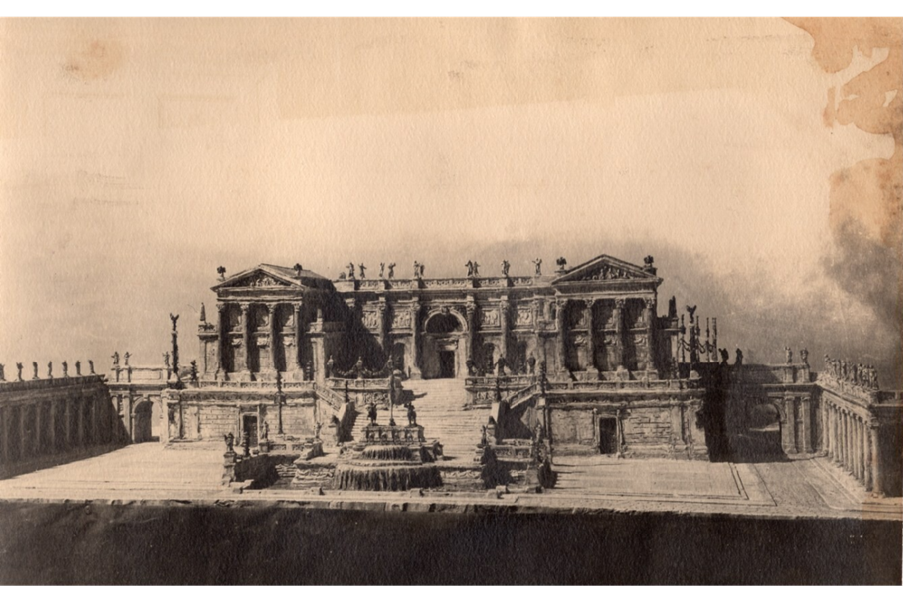
Figure 1. Brasini’s perspective drawing displaying the monumental structure created for the exhibition, Archivio Centrale dello Stato (ACS), Fondo Armando Brasini, Ref. 48/309.1–8, protocol no. 4207/2025. With permission of Ministero della Cultura.
Video Clip 1. Representation of Nero’s palace (Quo Vadis, 1924)
First, the essay briefly situates the use of Brasini’s pavilion in the history of cinema’s architectural reconstructions of ancient Rome. It then analyzes the historical and artistic contexts of Brasini’s work, before returning to the film Quo Vadis. Through this case study, it highlights the fluid boundaries between architecture, spectacle, and historical imagination in silent antiquity films.
Toward the Cinematic Evolution of Quo Vadis
The film Quo Vadis was based on the novel by Henryk Sienkiewicz who captivated a global audience with his enduring masterpiece (Wyke, Woźniak, 2021; Blom, 2023) First published in 1896, this sweeping historical novel, set against the tumultuous backdrop of Nero’s Rome, quickly became a worldwide phenomenon. Translated into numerous languages, it garnered acclaim for its vivid depiction of early Christianity’s moral triumph over the excesses of imperial decadence. Scholars such as Woźniak have highlighted how Sienkiewicz’s portrayal of early Christian martyrdom resonated deeply with contemporary concerns about moral and national identity in partitioned Poland (Woźniak, 2021). Meanwhile, Maria Wyke emphasizes the novel’s crucial role in shaping modern popular visions of ancient Rome, particularly through its later cinematic adaptations (Wyke, 1997). Meticulously grounded in historical scholarship and enriched by Sienkiewicz’s immersive experiences in the Eternal City, his novel Quo Vadis weaves a compelling narrative of faith, love, and defiance, one that continues to resonate across cultural and temporal boundaries.
The genesis of Quo Vadis was deeply intertwined with Sienkiewicz’s enduring fascination with Rome as both a physical and symbolic landscape. During his final visit to the city in the early 1890s, he reportedly explored its ancient ruins and sacred landmarks, often accompanied by the writings of the Roman historian Tacitus. Tacitus’s accounts of Nero’s reign helped shape the novel’s historical framework (Pomeroy, 2017; Frenz, 1999:41; Reichardt, 2004, 642)
Yet the novel’s inspiration extended beyond textual sources to the evocative power of Rome itself. The city’s architectural and urban landscapes profoundly influenced Sienkiewicz’s vision. The Church of Domine Quo Vadis, the panoramic views of St. Peter’s Basilica, the tranquillity of Tre Fontane, and the verdant Alban Hills all contributed to the novel’s rich tapestry. Sienkiewicz himself recounted that the novel took definitive shape during a pivotal walk with the Polish painter Henryk Siemiradzki, who introduced him to the small chapel of Domine Quo Vadis on the Via Appia, a moment that crystallized the novel’s title and symbolic foundation (Woźniak, 2021: 175).
Similarly to Sienkiewicz’s effort to bring his narrative to life through architectural detail, the various film adaptations of Quo Vadis also employed architectural representation to create vivid, immersive experiences for audiences. The novel has been adapted into film six times (1901, 1913, 1924, 1951, 1985, 2001) (Skwara, 2013).[1] Among these, the 1924 Italian silent film, directed by Gabriellino D’Annunzio and Georg Jacoby, stands out for its attempt to emulate the novel’s rich visual and thematic interplay. This adaptation was noted for its grand production scale and its ambition to reconstruct Ancient Rome with visual authenticity. The film’s elaborate sets, designed to evoke the opulence of Nero’s Rome, were central to its construction of a historical verisimilitude and to its influence on subsequent epic films (Nowell-Smith, 1996; Solomon, 2001). The filmmakers drew upon historical research and artistic collaboration to depict scenes of persecution and palace life that echoed the iconography of Roman art and classical architecture (Abel, 2004). In doing so, the 1924 adaptation became a foundational work in the cinematic genre of the historical epic, blending literary fidelity with striking visual spectacle that was focused on the ingenious reuse of Brasini’s exhibition spaces.
By analyzing Brasini’s innovative approach such as his use of Piranesi-inspired monumentalism and his adaptation of historical forms, I argue that architecture functioned not merely as a backdrop but as an ideological and narrative tool in silent cinema. Brasini’s role in designing the exhibition, whose monumental structures were repurposed for the film, provides a compelling case study at the intersection of art, architecture, and cinematic storytelling.
Before cinema emerged as a dominant medium for both mimicking reality and presenting reality itself, other artistic devices had already been employed for storytelling and for visualizing ancient Roman cities. The cinematic vision represents the ultimate advancement and expansion of visual culture, radically transforming the way people perceive and interpret visual narratives about the past. Bakker, in his book Entertainment Industrialized: The Emergence of the International Film Industry, 1890–1940 (2008), states that cinema, as an innovative medium, spread and was adopted throughout the Western world more rapidly than the steam engine or the railroad.
Even though the Quo Vadis of 1924 stands as one of the most remarkable examples of adaptations of antiquity to screen, the cinematic screen began introducing audiences to antiquity just a year after the official release of the cinematograph. The 1896 Lumière production Néron Essayant des Poisons sur des Esclaves (Nero Testing Poison on His Slaves, directed by Georges Hatot) [2] presented a story about the cruelty of Nero and is considered the first cinematic glimpse of antiquity on screen (Morcillo, Hanesworth, and Marchena, 2015).[3] In the early years, filmmakers favoured themes of melancholy, drama, and loss. These subjects were often developed in narratives depicting the decadence and eventual downfall of a city. Given this context, Nero’s delirious personality and his infamous role in the burning of Rome and the persecution of Christians made him an ideal subject for filmmakers, as his reign mirrored the sense of destruction and decay that audiences could relate to on both personal and societal levels. The visualization of ancient cities played a central role in the emergence of Italian cinema in particular, and that cinema then shaped how narratives about antiquity entered the new medium in other nations. The popularity of antiquity as a cinematic theme fuelled the rapid expansion of Italy's film industry in the late 1900s and early 1910s. Ancient Rome became a central theme during this period. As Wyke (2021) points out, Italian entrepreneurs recognized the potential of filmmaking as a powerful medium to assert a connection to the past and present it to a broad, collective audience within the public space of cinema. Faced with this diverse audience-transcending regional, class, political, age, and gender divides- the financiers of Italian film saw a unique opportunity to foster a sense of unity for the recently formed nation. Film reconstructions of ancient Rome provided a distinct narrative, reimagining the city through intricate three-dimensional architectural sets and meticulously detailed depictions of period furnishings, costumes, statuary, and props.
Historical sets were constructed to narrate events from antiquity within its spatial and cultural contexts.[4] Known as the Italian Historical Epic or the peplum, this new genre quickly gained recognition and success as a cultural phenomenon. A pioneering and highly successful example of the Italian historical epic from this era is La Caduta di Troia (The Fall of Troy, directed by Giovanni Pastrone and Romano L. Borgnetto for Itala Film), released in 1911 to widespread acclaim across Europe and America.[5] The success of the film largely depended on the elaborate sets that mimicked classical architecture. Besides the adaptation of Quo Vadis? (produced by Cines in 1913), Gli Ultimi Giorni di Pompei (The Last Days of Pompeii, produced by Ambrosio in 1913) stood out as another notable example of the genre. The genre reached its zenith in 1914 with Cabiria (produced by Itala Film), credited to Gabriele D’Annunzio, the most celebrated Italian poet of the time, but directed in fact by Giovanni Pastrone.[6] These three landmark examples of early Italian silent cinema, Quo Vadis, Gli Ultimi Giorni di Pompei and Cabiria, shared several common characteristics. Their plotlines were derived from historical novels about Roman history, and the prestige of antiquity helped legitimize cinema as an emerging art form. Additionally, they placed significant emphasis on the creation of elaborate mise-en-scène and historically detailed settings.
The ultimate moments of artistic grandeur in the Italian silent era were marked by historical films such as the 1924 remake of Quo Vadis? (produced by Unione Cinematografica Italiana) and the 1926 remake of Gli Ultimi Giorni di Pompeii (produced by Società Anonima Grandi Film). The earlier versions of these films had already achieved international success, and it is possible that producers believed the new versions could rescue the failing Italian film industry. While this strategy seems logical, it may also reflect the industry's struggle to innovate. Revisiting past successes could indicate creative stagnation or a desperate attempt to recapture former glory, an approach that appears in the end to have been insufficient to address the structural challenges faced by Italian cinema during the decline of the silent era.
The decline of the Italian silent film era not only marked the end of a cinematic chapter but also reflected broader cultural shifts in the arts and in the styles of architecture during the early 20th century. While the film industry grappled with the challenges of innovation and structural transformation, the same period witnessed the emergence of figures like Armando Brasini, whose architectural contributions resonated with the grandeur and historical reverence seen in silent epics of the 1920s like Teodora and Quo Vadis. His work demonstrates an intersection between cinema, architecture and ideology that provides a deeper understanding of the artistic climate of the time. So, better to understand the miniature architectural world created on the set of Quo Vadis, it is essential first to explore the vision of Brasini.
From Architecture to Spectacle: Armando Brasini as Architect and Set Designer
Armando Brasini (1879-1965), an architect and urban designer active in the early 20th century, played a role in shaping the architectural language of his time. His oeuvre stands as a prominent exemplar of the Fascist period, embodying a design ethos characterized by monumentality, historical references, and ideological symbolism. Rejecting modernist architecture, Brasini favored a style rooted in Baroque traditions and inspired by Piranesi’s monumental visions. This synthesis of historical grandeur and visionary artistry defined his architectural approach, positioning him as a ‘traditionalist’ architect (Billiani, 2021:111) who simultaneously celebrated and reimagined classical forms. In alignment with Brasini’s design principles, I will begin with the significant influence on his work of Giovanni Battista Piranesi.[7] Piranesi’s legacy is unmistakable in Brasini’s approach to the interplay between past and present, reality and imagination, and functionalism and monumentalism.
In the years surrounding World War I, scholarly discourse increasingly framed Giovanni Battista Piranesi as an early advocate of monumental visions symbolizing national greatness. Giuseppe Morazzoni celebrated Piranesi as a pioneer who viewed ancient ruins through both an artistic and a classical Latin lens, revitalizing the allure of the Eternal City and championing the preservation of its architectural legacy. This perspective is thoroughly examined in Morazzoni’s seminal work published in 1921, Giovanni Battista Piranesi, architetto ed incisore (1720-1778), where he underscored how Piranesi’s innovative approach to depicting ancient Roman ruins contributed to a renewed appreciation of the classical past and to the imperative of architectural preservation.
This reverence for Piranesi’s work resonated strongly with early Fascist rhetoric. Carlo Galassi-Paluzzi (1926) notably aligned Piranesi’s monumental vision with Roman tradition, introducing the term Romanità (denoting the essence of ‘Roman-ness’) in his article La romanità e il romanticismo di G. B. Piranesi. As Arthurs (2012)discusses more broadly, Roman imagery was increasingly appropriated as a political tool during Mussolini’s regime. Even in the pre-Fascist era, nationalist sentiments had begun to permeate Italy’s visual culture, infusing Piranesi’s work with ideological connotations that anticipated the aesthetic and symbolic language of the totalitarian state.
Both Piranesi and Brasini demonstrated a mastery of architectural composition, effectively conveying the grandeur and scale of their designs. They employed meticulous attention to detail, whether in Piranesi's intricate etchings of fantastical structures or Brasini's renderings of monumental buildings. Additionally, both artists often utilized dramatic perspectives to amplify the impact of their drawings, through Piranesi's exaggerated viewpoints or Brasini's emphasis on monumental facades.
The Baroque also played a significant role in Brasini’s formulation of architectural principles, particularly in his emphasis on historical continuity, as will become evident in his exhibition design. Leach (2015: 285)notes that the Baroque style significantly shaped both classical and romantic traditions. It provided architectural direction during the post-World War II humanist era and addressed the evolving relationships between form, language, and ornamentation in the postmodern period. This enduring influence continues to resonate in architectural discourse, bridging various historical and cultural movements.
Between the late 19th century and the end of the Second World War, narratives and representations of the Baroque served as a vehicle for reflecting on Italy’s path to national unification and its ambivalent engagement with both modernity and tradition (Cecchini, 2022). As Italy’s last major artistic movement, the Baroque left a profound imprint on European and colonial art. Its continued relevance in modern Italy, alongside the temporal and conceptual destabilization of the Baroque itself, offered a means of negotiating the tensions of modernity while shaping a distinctively Italian visual culture. Brasini’s work exemplifies this dynamic, infusing the Roman Baroque with renewed vigour, dramatic massing, and a spirit of experimentation.
Another key aspect of Brasini's architectural language is how it found a place in Fascist visions for architecture. In Italy’s fascist period (1922-1945), the built environment blended the allure of the ancient past with the rational approach of avant-garde modernism. Throughout the Fascist ventennio, Baroque aesthetics and their interpretation through modernism were considered suitable for manifesting Italy's imperialistic aspirations (Cecchini, 2022). For Mussolini's Fascist regime, which sought to project strength and national pride, Baroque aesthetics were ideal as they conveyed the might of the state and its imperial ambitions. The bold and dynamic forms of Baroque architecture served as a visual metaphor for the power and expansionist ideals that Fascism promoted. During this era, monumental urban projects were undertaken. Their architectural style is often called simplified Baroque and neoclassical designs were frequently employed to create grand buildings. The EUR neighborhood in Rome, originally planned for the 1942 Esposizione Universale di Roma (which never took place), serves as a prime example of this approach. The area’s most iconic structure, the Palazzo della Civiltà Italiana, offers a modernist reinterpretation of the Roman Colosseum. These structures were intended to embody the aspirations of a new, strong Italy poised to stand prominently on the world stage. However, as Sebastiani (2023) discusses, the efforts to modernize Italy’s urban landscape often involved questionable decisions, including extensive demolitions and the alteration of existing structures. Through architectural propaganda, these actions created lasting scars in the urban fabric, as master plans sought to reshape historical identities, undermine the authenticity of classical monuments, update the road network, and promote Fascist ideologies.
Between 1922 and 1923, Mussolini envisioned a significant transformation of the city of Rome, characterised by a malata di romanità, a fixation on ancient Rome in particular. [8] Sarfatti, an art critic, played a key role in supporting the dictator's development of a myth of Romanness, convincing him that imperial civilization could be revived under his leadership (Notini, Nicoloso, 2022: 44). Their aim was to restore Rome's historical grandeur and revitalize its mythic aura through architecture. This vision guided the initial endeavours of the Fascist government, which prioritized the construction of new monuments to rival those of antiquity. The 1930s restoration of the Mausoleum of Augustus and the Ara Pacis Augustae (Altar of Augustan Peace) exemplifies how Fascist myth-making utilized the concept of romanità to shape the city’s identity.
Brasini embraced the challenge of realizing Mussolini's vision of a neo-imperial Rome. A close friend of Sarfatti, Brasini shared a deep enthusiasm for the Roman Empire. Sarfatti persuaded Mussolini to commission Brasini to design the Italian Pavilion for the International Exposition of Decorative Arts in Paris (fig. 2), where Le Corbusier and Pierre Jeanneret also showcased The Pavilion of the Esprit Nouveau (fig. 3). Although both architects were prominent figures of their time, their pavilion designs displayed distinctly different styles and ideologies. Brasini's design reflected a reverence for tradition and historical ornamentation, while the design of Le Corbusier and Pierre Jeanneret represented a departure from tradition, embracing modern materials and functionalist principles. These differences not only illustrate the stylistic divergence between the three architects but also highlight broader shifts in architectural ideology during the early 20th century, from traditionalism to modernism.
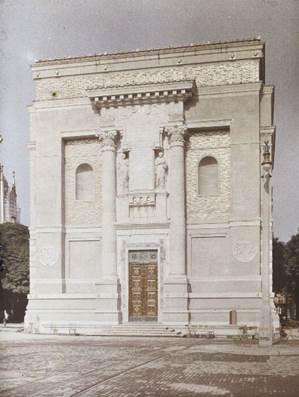
Figure 2. The Italian pavilion, Wikimedia Commons, Public Domain
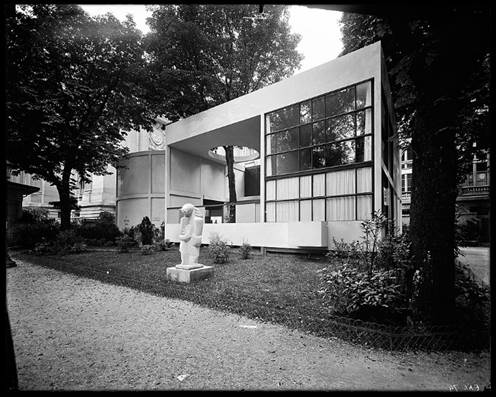
Figure 3. The Pavilion of the L'Esprit Nouveau, Wikimedia Commons, Public Domain
During the 1920s, Brasini undertook several notable projects in Rome, including the construction of the Church of the Sacred Heart of Mary in Parioli and the expansive Complesso del Buon Pastore (Complex of the Good Shepherd) on Via di Bravetta. His architectural activity expanded further in the 1930s with the design and construction of the headquarters for the Istituto Nazionale per l’Assicurazione contro gli Infortuni sul Lavoro (INAIL) on Quirinal Hill, as well as the monumental Ponte Flaminio. Each of these works exemplifies Brasini’s capacity to integrate grandeur, functionality, and historical reference into his designs, leaving a lasting imprint on Rome’s urban fabric.[9]
Given this architectural background, Brasini’s repertoire is distinguished by its eclecticism, seamlessly blending influences from ancient Roman architecture, the visionary engravings of Piranesi, and the exuberance of the Baroque. As Tafuri (1991: 13-15) discusses, such eclecticism played a crucial role in shaping Italian architecture during this period. Brasini’s body of work encompasses a wide range of urban design projects, including ambitious proposals for Rome, public buildings, monuments, bridges, and, notably, set designs-demonstrating the breadth and versatility of his architectural vision.
During the Fascist era, visual propaganda played a crucial role in shaping public perception of the regime and in reinforcing its ideals. Mussolini personally supported the creation of Luce (L’Unione Cinematografica Educativa) in 1924, which became a state-owned company by 1925. Through Luce’s newsreels, Fascist Italy was depicted as united and peaceful, firmly on a path to becoming a modern power under the leadership of a single figure (Pomeroy, 2017). These newsreels served as a powerful tool in constructing the image of the regime as both revolutionary and harmonious, using the medium of film to present an idealized version of reality. Many of them displayed the new classicising features of the city.
Although earlier films often depicted a decadent Rome that sat uncomfortably with Fascist ideals of Roman grandeur, the creation of architectural set designs aligned with classical antiquity, portraying Roman history or mythological themes, particularly through feature films, provided a cultural backdrop for visualizing the Roman imperial revival. This use of ancient Rome in cinema helped the Fascist government promote the concept of Romanità, emphasizing the connection between Mussolini’s Italy and the ancient Roman Empire.[10] The imagery of grand monuments, imperial power, and disciplined legions reinforced the regime’s message of strength, unity, and destiny, positioning Fascism as the modern heir to Rome’s glory.
My investigation of the archival materials demonstrates that critical acclaim even outside Italy frequently centred on the visual splendour and architectural ingenuity of these projects. This sentiment is exemplified in Exhibitor’s Herald (29 October 1921: 42), an American trade magazine for the motion picture industry, which emphasized the strikingly authentic and grandiose nature of Brasini’s settings for Theodora (fig. 4).
Theodora, Goldwyn's latest importation from Italy, which was given its initial presentation at the Astor theatre, New York City, Oct. 14, from an architectural viewpoint is the most colossal spectacle yet shown upon the screen…Great pains have been taken to make the buildings and interiors true to the place and period. These are the work of Armando Brasini.
For the filming of the picture an entire hillside, many acres in extent, was purchased on the outskirts of Rome overlooking the Lake of Albano. There century old pines and cypresses formed the background for many of the scenes. Against this background were many huge sets, palaces, pavilions, gardens filled with wondrous statuary, and the colossal Hippodrome. This latter is said to be an exact reproduction of the original building actually built by Justinian in Constantinople, or Byzantium, as it was called at that time.
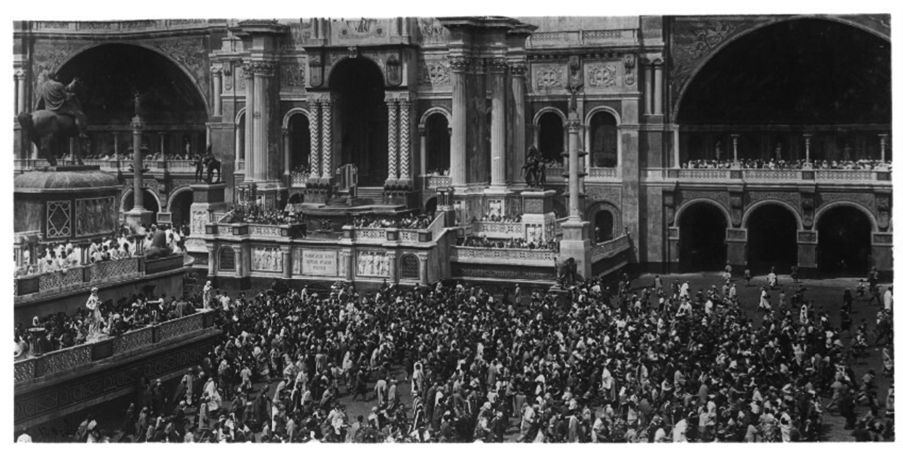
Figure 4. A scene from the set of Teodora, Archivio Centrale dello Stato (ACS), Fondo Armando Brasini, Ref. 48/309.1–8, protocol no. 4207/2025. With permission of Ministero della Cultura.
The advertisements prominently emphasized the role of Brasini, underscoring his architectural contributions with statements such as: ‘Twenty gigantic sets, reproducing forums, amphitheatres, palaces, pavilions, and gardens, built of stone, were constructed by Armando Brasini, the famous architect of the Vatican’ (Exhibitor’s Herald, 29 October 1921: 42).
Similarly, contemporary British trade reviews praised the scenic design and architectural realism of the film. For instance, Kinematograph Weekly (16 March 1922: 55) noted:
There is nothing that looks faked or illusory; not only are there scenes of incredible vastness following each other in swift succession, but also a story, a tragedy, which, though not likely to be popular, is well handled and brought through a series of climaxes to a logical and artistic denouement.
These claims underscored the architectural grandeur of Theodora, with sets meticulously designed to evoke the aesthetics of the Byzantine era. This endeavour posed a distinct challenge for Brasini, as architecture, traditionally conceived to create functional and enduring spaces, was repurposed for the ephemeral realm of film production. Rather than adhering to the practical and aesthetic principles of real-world utility, these sets were constructed as staged environments, serving solely as visual backdrops within a carefully curated ‘miniature world’ designed to simulate historical authenticity.
From Exhibition to Set: Architectural Repurposing and Cinematic Transformation in Quo Vadis
Early silent films harmonized 'visual codes' derived from antiquity (incorporating classical architecture) and visual representations found in paintings and books. To strengthen the creative vision that linked fact with fiction, these visual codes were embedded into scenes as both two-dimensional and three-dimensional decor. Over time, the codes used in silent films became 'representational codes' of specific themes that characterized public and domestic buildings following the classical tradition, including monumentality, decoration, vegetation, and garments.[11]
Among these elements, monumentality emerged as a pivotal tool for conveying power, embodying grandeur, and authority through the construction of large-scale and imposing structures. In Quo Vadis, monumentality was represented throughout by Nero’s palace. The palace we see in the film was created for the exhibition Mostra dell'Agricoltura, dell'Industria e delle Arti Applicate held in 1923 at the Galoppatoio inside the Villa Borghese gardens in Rome (Roscini Vitali, 2015). Brasini had contributed to the creation of a temporary ‘city’ designed specifically for the event. Following the conclusion of the exhibition, and before the structures were dismantled, the pavilion was repurposed as a film set for the remake. It is notable that these lavish and captivating sets were not originally conceived for cinematic purposes. Instead, the film studio acquired them directly from their owner, the Municipality of Rome, after their role as pavilions had ended. This approach represented a strategic reuse of resources, both financially and artistically.[12] By utilizing these pre-existing monumental buildings, the producers cleverly capitalized on their aesthetically rich qualities without incurring the expense of designing and constructing entirely new sets.
As selected architectural spaces appear prominently in the film, it is useful to first examine the design and features of these locations, particularly the exhibition pavilion, before analyzing how they function within the film’s narrative. The architectural layout of the exhibition reveals a highly symmetrical and organized design centered around the Piazza del Foro, which serves as the primary focal point for gathering and orientation (fig. 5). Smaller, modular exhibition zones highlight key themes such as agriculture, industry, and art, while landscaped garden areas introduce elements of leisure and nature.
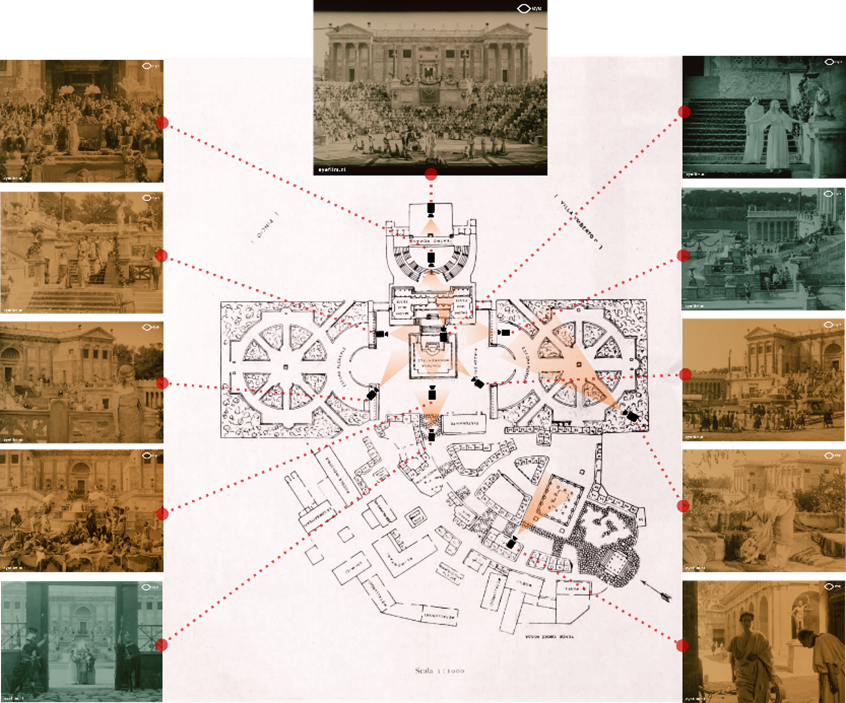
Figure 5. Exhibition layout alongside screenshots from the set, showing camera angles, Archivio Centrale dello Stato (ACS), Fondo Armando Brasini, Ref. 48/309.1–8, protocol no. 4207/2025. With permission of Ministero della Cultura.
Among the principal structures is the Pavilion of Festivals, which includes two banquet halls (Figures 6a, 6b). This pavilion becomes the central setting in the film for portraying Nero’s decadence and indulgence. The palace’s façade reflects classical influences, incorporating isolated statues reminiscent of Bernini’s colonnades, and a continuous bas-relief punctuated by imposing columns. The design is further elevated by a monumental, double-height façade, fronted by a dramatic three-ramp staircase that converges at a mid-level platform and is visually enhanced by a garden fountain (Figures 7, Video clip 2).
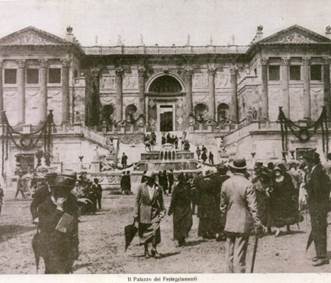
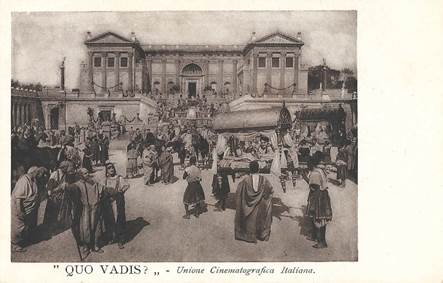
Figure 6a-b. Photograph from the exhibition showcasing the palace alongside a film still, taken from nearly the same angle, Archivio Centrale dello Stato (ACS), Fondo Armando Brasini, Ref. 48/309.1–8, protocol no. 4207/2025. With permission of Ministero della Cultura.
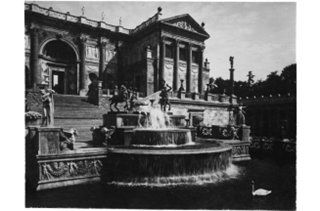
Figure 7. Photograph from the fountain, Archivio Centrale dello Stato (ACS), Fondo Armando Brasini, Ref. 48/309.1–8, protocol no. 4207/2025. With permission of Ministero della Cultura.
Video clip 2. Nero's palace and the fountain (Quo Vadis, 1924)
The overall layout features two lateral wings extending toward the forum, joined by a central structure. This central section is characterized by concave niches and a central apsidiole adorned with lozenge-shaped paintings which frames the entrance portal. In contrast to the ornate upper façade, the building’s base remains plain and merges seamlessly with the portico of the surrounding square, underscoring the integration of grandeur with structural clarity.
The film begins with a panoramic shot of Rome, defining it as the centre of the world, then zooms in on Nero and his palace as the focal point of the city (Scodel, Bettenworth, 2009; Wyke, 2017: 63) (fig. 8). The original palace, the Domus Aurea (Golden House), exemplified the architectural ambition and opulence of ancient Rome.[13] Built after the Great Fire of Rome, the Domus Aurea was constructed between 65 and 68 A.D. and transformed the Roman architectural landscape. It is perhaps more often cited as a source of inspiration for Renaissance and later art than as a monument (Warden, 1981). Nero’s palace was not merely a residence but a statement of imperial power and artistic sophistication, influencing architectural practices for centuries.
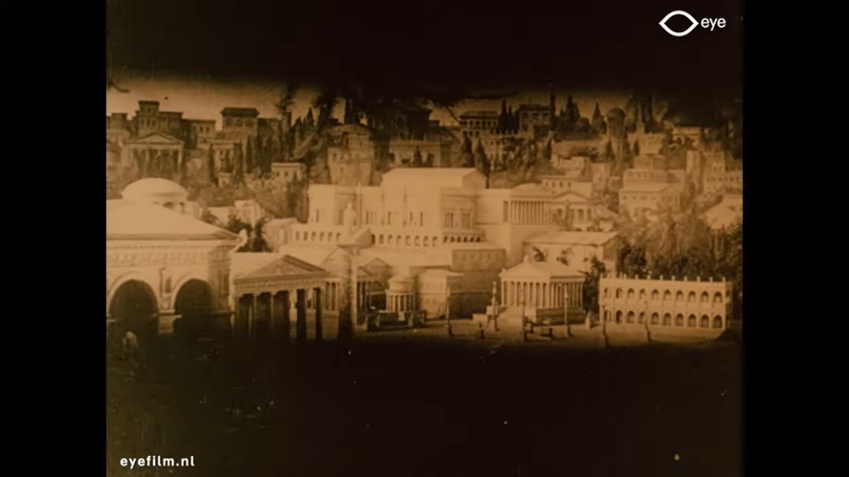
Figure 8. Screenshot of the opening scene from Quo Vadis, taken from the restored version by Eye Filmmuseum.
Significantly, many key scenes were filmed around the fountain area, as evidenced by the camera angles that highlight and dramatize this space. This monumental fountain, which serves as an extension of the palace design and connects to the building via grand staircases, becomes the focal point and a crucial visual anchor within the palace’s layout as imagined for the film. The fountain enriches the environment with its reflective waters, animating sculptural representations of nymphs, water deities, and centaurs, creating a dynamic interplay of light, shadow, and movement.
The fountain appears at the very beginning of the film, where Nero amuses himself by watching his victims being cast into the water to feed his lampreys. Nero then signs a proclamation condemning all Christians to death. Metaphorically, this site offers a close glimpse into Nero’s cruelty, and throughout the film, the fountain functions almost like the narrative’s hearth. Seen repeatedly from different angles (see Figure 8), it embodies the central locus of power, violence, and spectacle.
In the exhibition, radial pathways connect the piazza to peripheral gardens and exhibition spaces, ensuring efficient visitor circulation. In the film, these gardens with the palace prominently visible in the background serve as the setting for a key scene where Lygia, one of the main characters, first meets Empress Poppaea. The empress, who is searching for her lost child Livy, is immediately struck by Lygia’s beauty.
Behind the palace, the exhibition featured a Roman theatre designed for theatrical performances, with the stage front left open without a backdrop (Figures 9a, 9b). This rear section mirrors the grandeur of the palace’s façade, featuring a central descent leading to an imposing stage framed by tall columns adorned with statues of winged Victory, laurel wreaths, and other classical sculptures. Radial steps fan outward from the stage, forming a tiered seating arrangement for the audience. This architectural design further integrates the palace into the exhibition’s broader thematic narrative. The film studio made extensive use of the pavilion’s striking façade and grand staircase for many exterior shots, while the Roman theatre from the exhibition provided appropriately enough the dramatic setting for Nero’s performance before his courtiers.
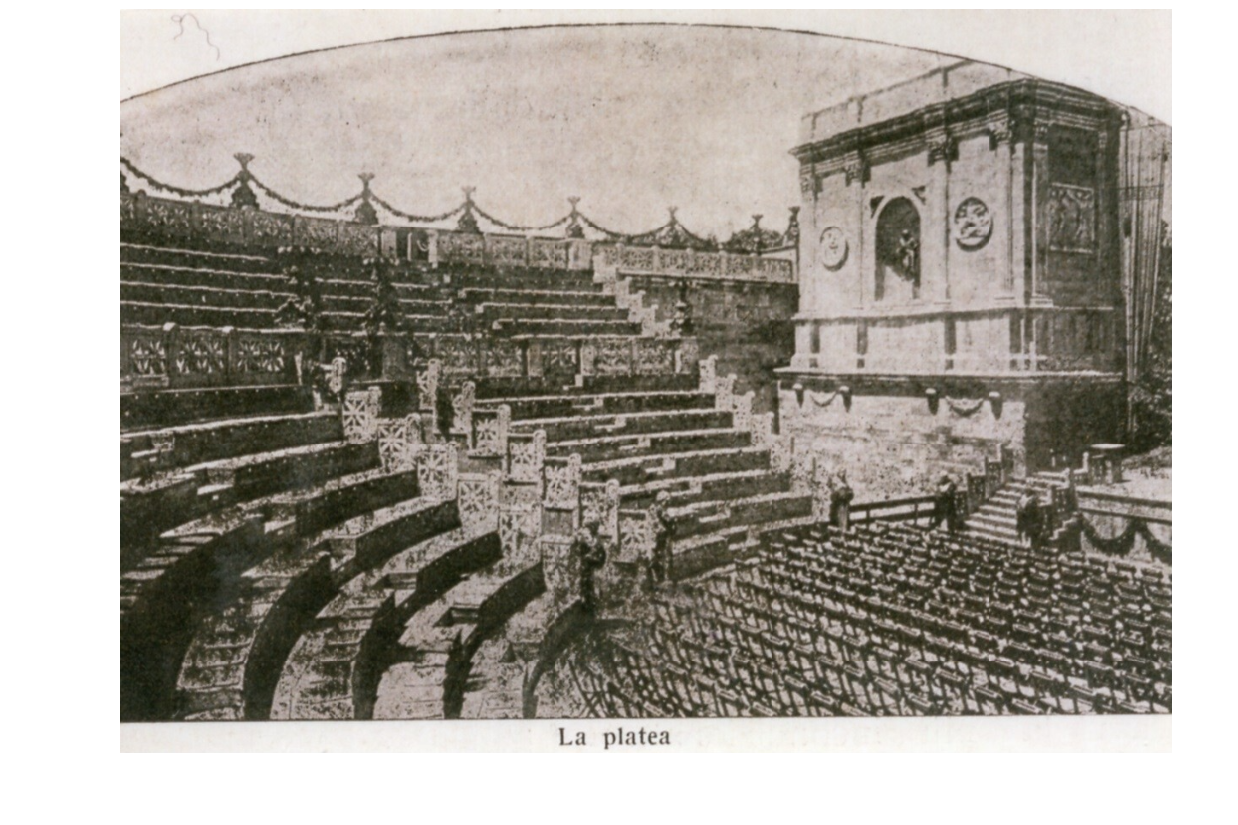
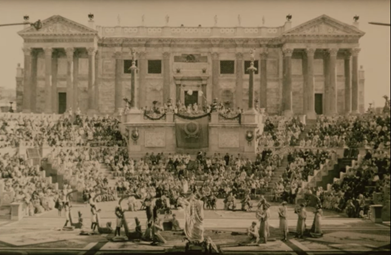
Figure 9a-b. Photograph from rear elevation of the Palace alongside a screenshot from the film, Archivio Centrale dello Stato (ACS), Fondo Armando Brasini, Ref. 48/309.1–8, protocol no. 4207/2025. With permission of Ministero della Cultura.
Additionally, in the film we see the gigantic triumphal arch which was originally used as the entrance to the exhibition and preceded by a paved avenue, dedicated to Victorious Italy at Vittorio Veneto (Figures 10a, 10b), alongside a square named Lupa Capitolina. According to Roscini Vitali in Uno scenario da film: la “Mostra del Lazio” di Armando Brasini (2015), the Piazza della Lupa Capitolina exemplifies a rich stylistic amalgamation (Figures 11a, 11b). Key features of the square include a bronze sculpture replica serving as the site’s guardian deity, a Brunelleschian-style market showcasing horticultural and floral products, the Committee Pavilion inspired by the residence of the Roman builder Bibulus, and a neo-15th-century palazzo housing the Postal Exhibition. Statues of the Augustus of Prima Porta and the Wrestler from the Baths of Diocletian stand at the boulevard’s entrance, symbolizing an imaginative vision of ‘good government’ (Roscini Vitali, 2015). As a hybrid space combining historical references and modern functions, the square was well suited to serve as a film set.
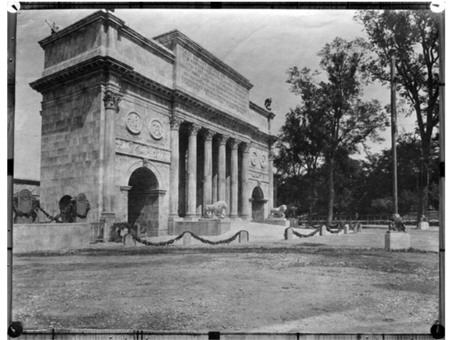
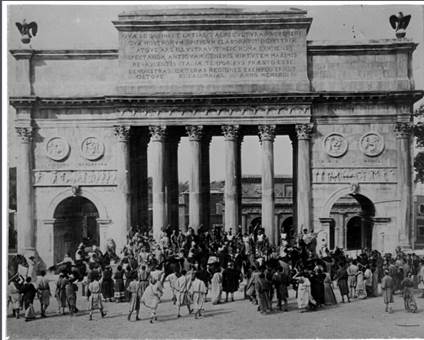
Figure 10a-b. Photograph from the triumphal arch alongside a photograph from the film, Archivio Centrale dello Stato (ACS), Fondo Armando Brasini, Ref. 48/309.1–8, protocol no. 4207/2025. With permission of Ministero della Cultura.
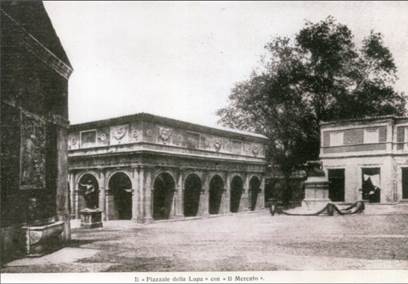
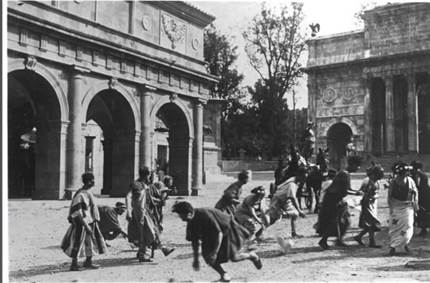
Figure 11a-b. Photograph from Piazza della Lupa Capitolina alongside a photograph from the film, Archivio Centrale dello Stato (ACS), Fondo Armando Brasini, Ref. 48/309.1–8, protocol no. 4207/2025. With permission of Ministero della Cultura.
Regarding the use of the pavilion’s interiors as film sets, our knowledge remains limited. Based on my observations of the film, some interior scenes appear to have been shot in a studio environment, and they bear striking resemblance to Brasini’s sketches for the scenic design of Nero’s triclinium in the Domus Aurea Britannicus, rather than the exhibition pavilion itself (Figures 12a, 12b). This contrast illustrates how the treatment of architectural spaces differs between their real-life function and their role within a fictional narrative.
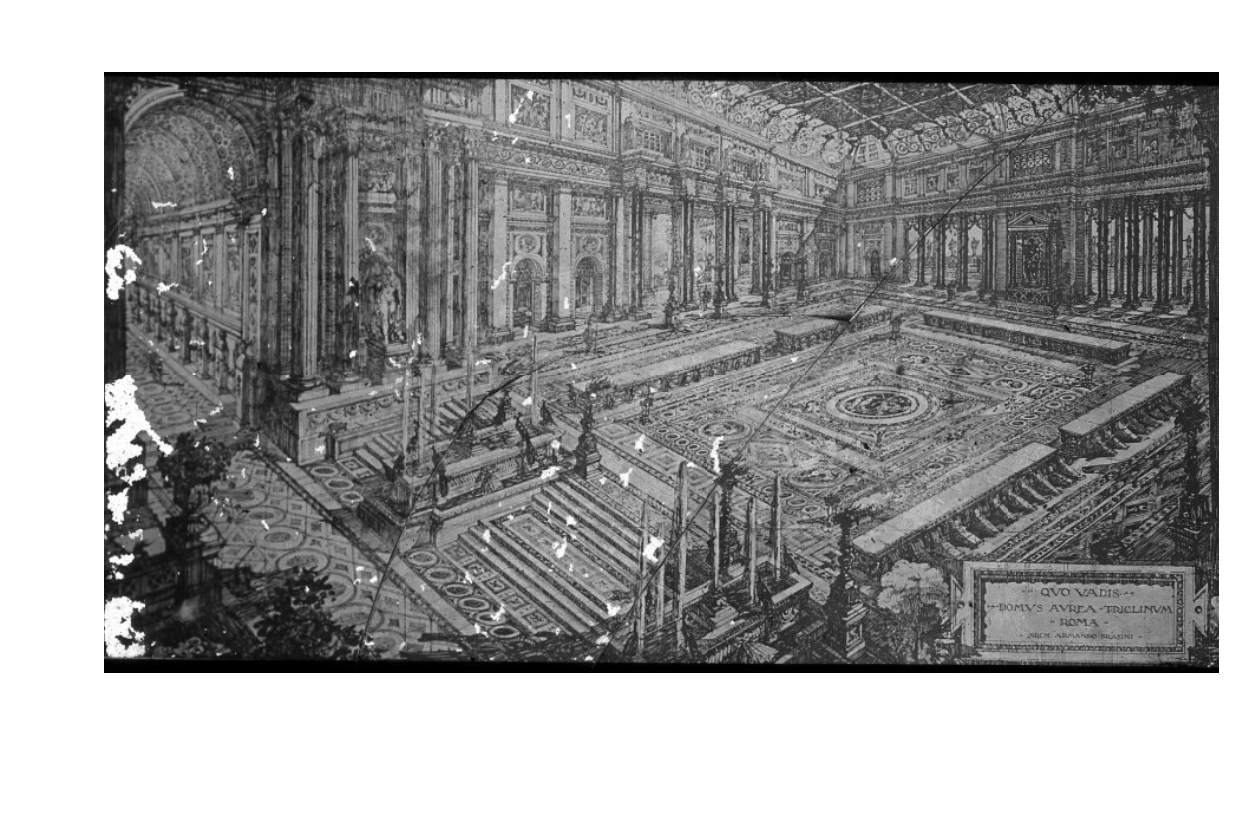
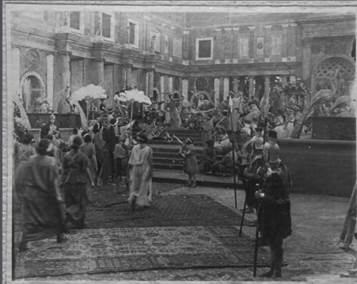
Figure 12a-b. Brasini's triclinium drawing alongside a photograph of the triclinium set from the film, Archivio Centrale dello Stato (ACS), Fondo Armando Brasini, Ref. 48/309.1–8, protocol no. 4207/2025. With permission of Ministero della Cultura.
The decision not to film actual interiors suggests that, even though this film was produced after the earliest silent period, the filmmakers still struggled to conceive of the exterior and interior as a unified whole. Interiors are presented more as hollow, cardboard-like backdrops, lacking any real spatial continuity with the exterior settings. Within these interiors, several banqueting scenes recur as a common motif in silent antiquity films. Crucial moments of Quo vadis unfold here: Lygia is forced to attend Nero’s licentious feast, where Vinicius presses his suit, and Nero, feigning paternal concern, leads her away—only to assault her himself until Poppaea intervenes and rescues her just in time. Later, within the palace, the death of Nero’s child takes place.
The architectural repurposing of the Exhibition pavilion as a film set highlights the fluid relationship between ephemeral and permanent structures, cinematic illusion and historical representation. By recontextualizing Brasini’s monumental designs, the film reinforced themes of power, spectacle, and excess that resonate with the grandeur of ancient Rome. As Schenk (2024: 44) notes, the directors Gabriellino D’Annunzio and Georg Jacoby even attempted to involve Mussolini in writing the intertitles. While the film cannot be said purely to propagate fascist ideals, the palace’s architecture by bringing classical antiquity vividly to life links the fascist present to Rome’s classical past, aligning more closely with the concept of Romanità.
However, the symbolism on screen does not fully align with the emerging fascist rhetoric about modern Italy’s connection to ancient Rome (Wyke 2024). In Quo Vadis, Nero embodies the Catholic Church’s rhetoric, representing the secular state as tyrannical and satanic, while Brasini’s architectural structures suggest grandeur and authority rather than decadence. This makes the pavilion’s monumental style more compatible with Fascist ideology than with the film’s narrative, which emphasizes Christian piety in the face of Neronian persecution. Ultimately, the pavilion’s reuse underscores the regime’s effort to connect the Fascist present to Rome’s classical heritage, even as the film’s story charts a more conflicted moral terrain.
Conclusion
Despite the success of the novel and the peplum genre, the 1924 Quo Vadis? remake became one of the most striking flops of the Italian film industry at the time (Allen, 2022: 190). The narrative was widely criticized for its oversimplification, lacking the depth and complexity necessary to engage audiences effectively. The acting, including Emil Jannings’ performance, was broadly deemed weak; his portrayal was described as exaggerated and grotesque, failing to redeem the film’s overall quality. In stark contrast, the set designs received considerable praise for their richness and complexity. The film featured neo-classical facades, colonnades, cobblestone streets, and grand classical backdrops that created a visually compelling spectacle. While the performances faltered, the visual grandeur partially compensated for the film’s narrative shortcomings.
The Italian epic film Quo Vadis occupies a unique place in cinematic history, where architecture transcended its traditional role as mere backdrop to become a central feature of narrative and ideological expression. Early film productions often prioritized visual impact over individual recognition, with set and scenery designers frequently relegated to anonymity. Studios, especially during the silent era, focused on the grandeur of the final product rather than crediting the architects and designers responsible for bringing the visual narrative to life. In contrast, Armando Brasini’s contribution to Quo Vadis? stands out as an exception. He was notably credited at the beginning of the film, underscoring his prominent role as an architect whose designs were celebrated and widely recognized, both in their original context and in their cinematic afterlife.
Contemporary periodicals documented praise for the film’s settings. Kinematograph Weekly (18 December 1924: 29) noted: ‘Signor Brasini, one of the most famous architects in Europe, was specially engaged to design a series of architectural settings’, highlighting the architect’s pivotal role.
Similarly, Bioscope (30 April 1925: 43) lauded the film's visual achievements:
The opening scenes showing Nero’s luxurious court have hardly been excelled for magnificence and, though lacking the artistic beauty of some of the earlier Cines’ settings, they perhaps more adequately reproduce the dramatic setting appropriate to the character of an Emperor who is represented as being devoid of all finer feelings, and whose ideas of beauty are summed up by the display of ostentatious opulence. The palace of Nero’s pleasant after-dinner amusement to throw slaves to fatten his lampreys; the stupendous Circus Maximus; and the city during its destruction by fire are wonderful examples of scenic construction, rendered vital and realistic by the adroit handling of dense masses of people. The sight of the populace rushing towards Nero’s palace to demand satisfaction for the destruction of the city is a wonderful example of effective stage management on a colossal scale.
As cameras moved out of studio environments to shoot on location, architectural representations began to approximate reality more closely. Meanwhile, audiences, increasingly familiar with moving images, developed a more discerning eye, expecting dramatic realism, particularly in actors’ performances, that closely approximated real life. In this context, the tangible reality of Brasini’s architectural designs contrasted with the extremely theatrical style of acting in the 1924 Quo vadis, resulting in two distinct elements that did not fully merge into a cohesive cinematic whole. Despite the film’s shortcomings in narrative and performance, its visual representation of Rome remains a notable and enduring strength.
Aylin Atacan
Footnotes
- ^ The three silent film adaptations of Quo Vadis, produced in 1901, 1913 and 1924, correspond to what are commonly known as the Transitional Phase and the Early Studio Phase of filmmaking respectively, exemplifying the evolving cinematic techniques and set designs and storytelling practices characteristic of their periods. According to the taxonomy identified by Barr (1997), silent films had three phases: the Primitive Phase (the early experimental period of cinema from the mid-1890s to 1907), the Transitional Phase (the period between 1907 and 1918, during which films became longer, and studio practices evolved), and the Early Studio Phase (the period between 1918 and 1927).
- ^ The restoration, completed in 2015 in 4K, was carried out by the Cinémathèque Française with support from the CNC-Archives Françaises du Film. The process involved nitrate 35mm positives that had been hand-coloured, with the distinct Lumière perforations still visible in the frames.
- ^ The film’s importance lies not only in its historical subject matter but also in its role as a precursor to the use of cinema as a medium for storytelling. By using a contemporary fascination with Roman history, it marked an early instance of cinema attempting to portray past events in a way that was accessible and engaging for the public. Its visual style was typical of early Lumière films, consisting of one continuous shot, but it set the stage for future cinematic interpretations of history, influencing the portrayal of ancient Rome in film.
- ^ See Neale, 1985 for more on the integration of architecture in early cinema and explores how technological advances allowed for increasingly elaborate set designs in early cinema.
- ^ The remarkable success the film achieved worldwide is confirmed by the many surviving period copies, which were rediscovered and used in the restoration of the film through the joint efforts of the Cineteca di Bologna, the National Cinema Museum, and the Cineteca del Friuli. See Blom’s essay on Itala on this website for more on the film’s set designs.
- ^ See Bertellini, 2010: Rushing, 2020; Blom, 2023 for detailed analysis on Cabiria
- ^ Born in Venice and influenced by its culture, he was part of the capriccio tradition, an artistic style that emerged in 17th- and 18th-century Italy, particularly in painting and architecture. This style involved creating imaginative or composite cityscapes, blending real and invented elements. Artists combined actual architectural structures with idealized or fantastical buildings, ruins and landscapes. The capriccio tradition often merged different time periods, locations and architectural styles to evoke a sense of grandeur, nostalgia and historical depth, even when the scenes were entirely fictional. Many artists of the Grand Tour embraced the capriccio, as it allowed them to complement the ‘real’ with additional layers of the ‘super-real’, including intuition, memory, imagination, invention and speculation. This expanded their ability to capture the full complexity of architectural spaces (Steil, 2014: 63).Fascinated by the ancient world, Piranesi favored etching and printmaking as his media. These techniques conveyed the passage of time, giving even his fictional creations a sense of historical depth.
- ^ The term was used in a critical or pejorative sense to describe a condition or attitude characterized by an excessive or unhealthy obsession with the concept of Romanità (the idea of being Roman or embodying the qualities of ancient Rome). It implies that this obsession with Roman heritage or the imperial past can lead to a distorted or exaggerated view of history, to the point of becoming ‘ill’ or unbalanced in one’s reverence for ancient Rome.
- ^ See Painter, 2005 for further discussion on Fascist-era urban planning.
- ^ Romanità, meaning ‘Roman-ness,’ was a central ideological construct of Italian Fascism, invoking the imagery and values of ancient Rome to legitimize the regime's political aspirations. From its inception, the Fascist movement utilized a symbolic language that paid homage to the Roman past while simultaneously claiming to rejuvenate its ideals in a modern context. For example, the movement’s original name, Fasci di Combattimento, derived from the Roman fasces-a bundle of rods with a protruding axe symbolizing unity, sovereign authority and military might. The fasces had also been appropriated by earlier movements, such as French revolutionaries, Sicilian peasant organizations and 19th-century socialist labour groups, but for Mussolini, it represented a synthesis of Roman imperial strength and the radical revolutionary ethos of early Fascism (Consolato 2006; Giardina and Vauchez 2000; Sternhell 1994). See Kallis, 2014 for a more in-depth discussion of Fascism and Romanità.
- ^ See Blom, 2023 for a deeper analysis of artistic representations in films.
- ^ See Usai, 1996 for more on the economic constraints of Italian silent cinema in the 1920s.
- ^ Following the devastation caused by the Great Fire of 64, Nero seized the opportunity to merge the newly cleared land with imperial estates, likely appropriating private properties and public monuments, and transformed the combined area into a vast park. For further discussion on the Domus Aurea, see MacDonald,1982; Ball, 2003; Boëthius, 1960.
Quo Vadis? (original)
1913
HISTORICAL DRAMA. A story of the persecution of the Christians by the Emperor Nero. Rl.1. [Section missing] Petronius persuades Nero to have the beau…
Quo Vadis? (original)
1924
A story of the persecution of the Christians by the Emperor Nero. Rl.1. Nero amuses himself by watching his victims being cast into the wayer to feed…
Abel, R. (ed.) (2004) Encyclopedia of Early Cinema. London/ New York: Routledge
Allen, J. K. (2022) Screening Europe in Australasia: Transnational Silent Film Before and After the Rise of Hollywood. Exeter: University of Exeter Press.
Arthurs, J. (2012) Excavating Modernity: The Roman Past in Fascist Italy. Ithaca, NY: Cornell University Press.
Ball, L. (2003) The Domus Aurea and the Roman Architectural Revolution. Cambridge: Cambridge University Press.
Barr, C. (1997) 'Before Blackmail: Silent British cinema', in Murphy, R. (ed.). The British Cinema Book, London: BFI, pp. 5–16.
Bertellini, G. (2010) Italy in Early American Cinema: Race, Landscape, and the Picturesque. Bloomington: Indiana University Press.
Billiani, F. (2021) 'Agon 3: Architecture and the arts in the public domain', Fascist Modernism in Italy: Arts and Regimes. London: I.B. Tauris, pp. 109–154. DOI: http://dx.doi.org/10.5040/9781788317603.ch-3
Blom, I. (2023) Quo vadis?, Cabiria and the ‘Archaeologists’: Early Italian Cinema’s Appropriation of Art and Archaeology. Turin: Kaplan.
Boëthius, A. (1960) The Golden House of Nero: Some Aspects of Roman Architecture. Ann Arbor: University of Michigan Press.
Cecchini, L.M. (2022) Baroquemania: Italian Visual Culture and the Construction of National Identity, 1898–1945 (1st ed.). Manchester: Manchester University Press. DOI: https://doi.org/10.2307/j.ctv29mvt4n.
Cherchi Usai, P. (1996) 'Italy: Spectacle and melodrama', in Nowell-Smith, G. (ed.). The Oxford History of World Cinema. Oxford: Oxford University Press, pp. 123–129.
Frenz, H. (1999) Literature, 1901–1967, Vol. 1. Singapore: World Scientific.
Kallis, A. (2014) 'Fascism and Romanità: Framing the ancient imperial city', The Third Rome, 1922–1943: The Making of the Fascist Capital. London: Palgrave Macmillan, pp. 73-105.
Leach, A. (2015) 'Considering the Baroque', Journal of the Society of Architectural Historians, 74(3), pp. 285–288. DOI: https://doi.org/10.1525/jsah.2015.74.3.285
MacDonald, W. L. (1982) The Architecture of the Roman Empire. New Haven, CT: Yale University Press.
Morcillo, M.G., Hanesworth, P. and Marchena, Ó.L. (eds.) (2015) Imagining Ancient Cities in Film. New York/ Abingdon: Routledge.
Neale, S. (1985) Cinema and Technology: Image, Sound, Colour. London: Palgrave Macmillan.
Nicoloso, P. (2022) Mussolini, Architect: Propaganda and Urban Landscape in Fascist Italy (1st ed.). Toronto: University of Toronto Press.
Nowell-Smith, G. (ed.). (1996) The Oxford History of World Cinema. Oxford: Oxford University Press.
Painter, B.W. (2005) Mussolini’s Rome: Rebuilding the Eternal City. London: Palgrave Macmillan.
Pomeroy, A.J. (ed.). (2017) A Companion to Ancient Greece and Rome on Screen. Oxford: Wiley Blackwell. DOI: https://doi.org/10.1002/9781118741382
Reichardt, M.R. (2004) Encyclopedia of Catholic Literature. Westport, CT: Greenwood.
Roscini Vitali, A. (2015) 'Uno scenario da film: La “Mostra del Lazio” di Armando Brasini', Ricerche Di s/Confine, 6(1), pp. 37–56.
Rushing, R. (2020) 'Cabiria', in: Luzzi, J. (ed.). Italian Cinema: From the Silent Screen to the Digital Image, London: Bloomsbury Academic, pp. 303–310. DOI: http://dx.doi.org/10.5040/9781501302640.0026
Schenk, I. (2024) A History of Italian Cinema. London: Palgrave Macmillan.
Scodel, R. and Bettenworth, A. (2008) Whither Quo Vadis?: Sienkiewicz’s Novel in Film and Television. Malden, MA: Wiley-Blackwell.
Sebastiani, A. (2023) 'The Fascist ideological placemaking: New architecture', Ancient Rome and the Modern Italian State: Ideological Placemaking, Archaeology, and Architecture, 1870–1945. Cambridge: Cambridge University Press, pp. 195–233.
Skwara, E. (2013) 'Quo Vadis on film (1912, 1925, 1951, 1985, 2001): The Many faces of antiquity', Clássica (São Paulo), 26(2): pp. 163–174. DOI: https://doi.org/10.14195/2176-6436_26-2_8.
Solomon, J. (2001). The Ancient World in the Cinema. New Haven, CT: Yale University Press.
Steil, L. (ed.). (2014) The Architectural Capriccio: Memory, Fantasy and Invention (1st ed.). London: Routledge. DOI: https://doi.org/10.4324/9781315241326
Tafuri, M. (1991) History of Italian Architecture, 1944-1985. Translated by J. Levine. Cambridge, MA/ London: MIT Press.
Warden, P.G. (1981) ‘The Domus Aurea reconsidered’, Journal of the Society of Architectural Historians, 40(4): 271–278. Available at: https://doi.org/10.2307/989644.
Woźniak, M. (2021) 'Toward mass culture: The global renown of Henryk Sienkiewicz's Quo Vadis', in S. Bill, M. Popiel, and T. Bilczewski (eds.), The Routledge World Companion to Polish Literature. London: Routledge, pp. 171–184.
Woźniak, M. and Wyke, M. (eds.) (2020) The Novel of Neronian Rome and its Multimedial Transformations: Sienkiewicz’s Quo vadis. Oxford: Oxford University Press.
Wyke, M. (1997) Projecting the Past: Ancient Rome, Cinema and History. New York: Routledge.
Wyke, M. (2017) ‘From 1916 to the Arrival of Sound: The Systemization, Expressivity and Self-Reflection of the Feature Film’, in A.J. Pomeroy (ed.), A Companion to Ancient Greece and Rome on Screen. Malden, MA.: John Willey & Sons, pp. 61-89.
Wyke, M. (2020), ‘Word and Image: Competitive Adaptation in the Feature Film Quo vadis?’, in M. Woźniak and M. Wyke (eds.), The Novel of Neronian Rome and its Multimedial Transformations: Sienkiewicz’s Quo vadis. Oxford: Oxford University Press, pp. 143-164.