Quo Vadis? (original)
1913
Alternative Titles
N/ABFI identifier
42268Synopsis
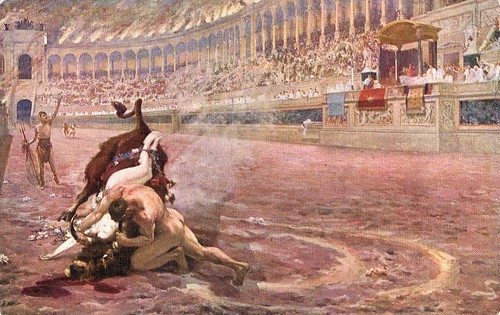
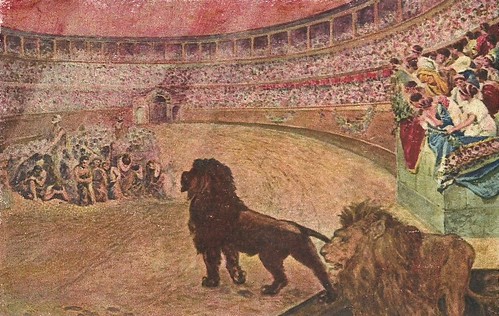
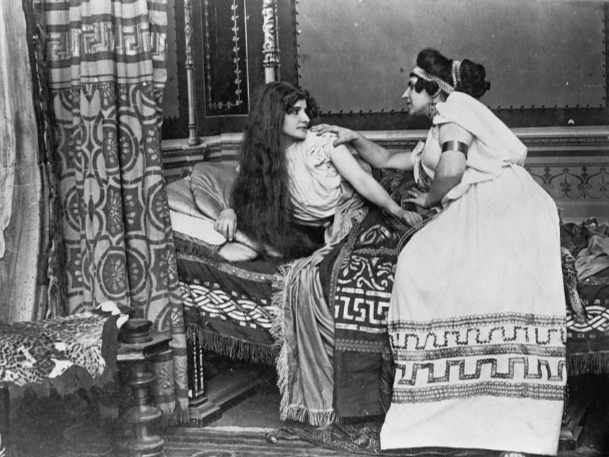
HISTORICAL DRAMA. A story of the persecution of the Christians by the Emperor Nero. Rl.1. [Section missing] Petronius persuades Nero to have the beautiful Lygia, a girl taken hostage by the Romans, taken away from the house of Aulus Plautus, her Christian guardian. Lygia is escorted from the house by Nero's guard, after a tearful farewell to Aulus and his family. She is followed by her devoted Slave Ursus, who has sworn to protect her. Aulus suspects that Vinicius, a young general in love with Lygia, is behind the abduction but he protests his innocence and confronts his uncle, Petronius, with the accusation. Petronius tells his nephew that Nero will give Lygia to Vinicius as a slave. Pleased with this scheme Vinicius bids Aulus accept Nero's will. At a feast given by nero, Vinicius pays court to Lygia. [Section missing.] Lygia dismisses Ursus and strolls with Actea in the gardens of Nero's palace where they encounter Nero's wife Poppea. Lygia begs her to intercede with Nero to have her returned to Aulus, but Poppaea decides to have her handed over to Vinicius. However, the guards taking her to Vinicius' house are overpowered by a group led by Ursus, and she is rescued. Vinicius, troubled by her disappearance, angrily rejects Petronius' offer of his own slave, Eunice. Eunice is devoted to Petronius and begs to remain in his service, even after he orders her to be flogged. A charlatan soothsayer, Chilon Chilonides, visits Vinicius and offers to find Lygia in return for money. Meanwhile Nero, upset at the death of his child, which he attributes to the influence of Lygia, blames Petronius for having brought her into his household. Petronius regains Nero's favour through flattery. Chilon reports to Vinicius that he has discovered Ursus working at a miller's house. Chilon learns from Ursus that the Apostle Peter will be preaching to his Christian followers that night. Knowing that Kygia will be there, Vinicius plans to abduct her with the aid of a strong henchman, Croton. In disguise Chilon, Vinicius and Croton follow the crowd and listen to the Apostle's speech (1897). Rl.2. Afterwards they follow Lygia back to the house where the Christians are hiding her, but their attempt to abduct her is foiled by Ursus, who kills Croton and overpowers Vinicius. At Lygia's bidding he spares the Roman's life. Vinicius recovers consciousness in the Christian's household. Influenced by the Apostle's sermon and realising that Lygia has saved his life, he feels growing sympathy for the Christian cause. Summoning Chilon, he lets it be known that the Christians have saved him from Croton, and Chilon is thrown out. Lygia modestly rejects Vinicius' declaration of his love, but later she confesses to a horrified Aulus that she is in love with the Roman. The Apostle Peter, however, rules that Christians should respect married love. Vinicius meanwhile has returned to Petronius, determined to continue his pursuit of Lygia. Chilon reveals that he knows Lygia's new hiding place. Vinicius has Chilon flogged, then forces him to lead him there. Chilon swears vengeance. Vinicius promises the Christians he will adopt their faith if they allow him to marry Lygia. The Apostle Peter brings Lygia forth and blesses their love. At another feast, called to celebrate his voyage to Antium, Nero seeks inspiration for his epic poem. With one of his guards, Tigellinus, he devises the plan of setting fire to Rome. Tigellinus leaves to carry out the plan. At the feast Vinicius tells Nero of his love for Lygia. Meanwhile the citizens of Rome flee in panic from the burning buildings. Vinicius returns to search for Lygia in the flames, but is overcome and has to be rescued. Nero arrives to witness the burning and plays his lyre while watching the destruction from his balcony. An angry crowd gathers, forcing Nero to retreat inside his palace. Petronius is obliged to placate them with promises of food and new public works. Vinicius goes with Chilon to the catacombs, where they find the Apostle Peter preaching to his followers. Vinicius asks to be baptised and is joyfully reunited with Lygia. Some days later the mob, angry at the lack of food, call for a sacrifice. Poppaea suggests that Nero should make the Christians a scapegoat to propitiate the crowd's fury (1928). Rl.3. Chilon denounces the Christians, including Glaucos, Ursus, Lygia and Vinicius. All but Vinicius are arrested. Petronius tells him to rescue Lygia and escape with her but he finds the prison well guarded. As he walks dejectedly back, he is mocked by Chilon, who has been elevated to the nobility. The day og the games arrives, when the Christians are to be sacrificed. Petronius, in disfavour with Nero, arrives to watch the spectacle and is capriciously greeted by the Emperor. Vinicius searches unsuccessfully for Lygia among the prisoners. A chariot race begins, and Nero salutes the victor. The crowd acclaims the entry of the gladiators. Nero turns down a plea from a defeated gladiator. Chilon overhears Vinicius tell Petronius of his failure to find Lygia. Meanwhile the Christians are dragged into the arena and fed to the lions. Chilon collapses when he witnesses the scene. A bull enters the arena with Lygia strapped to its back. Ursus overcomes the beast and releases her, to the joy of Vinicius. The crowd demands their release. Some days later Petronius, in disgrace with Nero, takes his own life by slitting his wrists. His devoted slave Eunice dies with him. Chilon witnesses the bodies of the Christian martyrs he has denounced and accuses Nero of burning Rome. Nero's supporters pursue him into a garden where he has time to be baptised by Paul of Tarsus before being led away for punishment by the soldiers. Next day, as the Apostle Peter and Nazaire leave Rome on the Appian Way, Peter sees a vision of Christ and realises his duty to return to Rome. Nero's soldiers revolt and proclaim Galba as Emperor. Nero, forced to flee, is killed by freed slaves after refusing the chance to take his own life. Soldiers arrive and cover the body. An epilogue shows Christ breaking the chains of several worshippers at his feet (1791). (5616ft) (Shotlist)
- Production Country: Italy
- Production Company: Cines
- BFI Category: Fiction
- Source: N/A
Cast
Amleto Novelli (Vinicius)
Gustavo Serena (Petronius)
Olga Brandini (Poppaea)
Bruto Castellani (Ursus)
Amelia Cattaneo (Eunice)
Carlo Cattaneo (Nero)
Lea Giunchi (Lygia)
Augusto Mastripietri (Chilo Chiolonides)
Cesare Moltini (Tigellinus)
Giovanni Gizzi (Petrus)
Ignazio Lupi (Aulus Platius)
Credits
Director: Enrico Guazzoni
Production Company: Cines
Script: Enrico Guazzoni
Original novel: Henryk Sienkiewicz
Photography: Alessandro Bona
Set Designer: Camillo Innocenti
Film Technical Information
- Original Length: 2250 m
- Length of BFI Viewing Print: 5604 ft
- Support: Viewable
- Black and White
- Format: 35 mm , VHS cassette, Digital Betacam, MP4
Comments on the print:
The original length of the film is cited as 2250 metres in A. Bernardini and V. Martinelli, Il cinema muto italiano. I film degli anni d'oro. 1913. Seconda parte. Bianco & Nero. Roma: Centro sperimentale di Cinematografia, 1994: p. 175. The tinited positive print in the BFI archive possesses French intertitles but carries a stock date of 1922, meaning it is a later reissue. The accessible print is 5604 ft and has a stock date of 1974. For all the elements the BFI holds, see the catalogue here. The intertitles of the BFI French reissue frequently use past tenses for narration, insert more dialogue and additionally contain illustrative pictures.
The film was restored in 1996 by the Fondazione Cineteca Italiana (Milan) and the Eye Filmmuseum (Amsterdam) with English intertitles assembled from a number of surviving sources. It was restored again in 2026 with Italian intertitles.
The Museo Nazionale del Cinema di Torino also possesses stills, posters, programmes and advertising sheets. The Library of Congress has stills and musical cues and suggestions. Eye Filmmuseum has posters, stills, and publicity materials in various languages. The Fondation Seydoux-Pathé has associated postcards and some digitised documentation.
Visual Resources