
1905 - Les Martyrs chrétiens: Early Cinema Intermediality in the Arena
by VALENTINE ROBERT
(Maître d'enseignement et de recherche, Faculté des lettres, Université de Lausanne)[1]
Literary Interplay
We are in Rome, in the year 66 of our era, some time after the fire lit by Emperor Nero. Beneath the blazing sun, filtered through the purple velums, the tiers of the circus are brimming with crowds.
Nous sommes à Rome, en l'an 66 de notre ère, quelques temps après l'incendie que l'empereur Néron alluma. Sous l'ardent soleil que tamisent les velums de pourpre, les gradins du cirque regorgent de monde.[2]
These are the opening lines of the description for the film Les Martyrs chrétiens, released in May 1905 and restored in 2024 by the Fondation Jérôme Pathé-Seydoux.[3] Hereafter in this analysis, I will use the title by which it was distributed in English - Christian Martyrs. The text appeared in the Pathé catalogue, which presented and advertised the company’s productions to early cinema exhibitors. It takes the form of an extensive four-page notice written in a highly literary style, one that is not without echoes of Henryk Sienkiewicz’s historical novel Quo Vadis? (1896; French translation, 1900): ‘The sun had risen high; its rays, passing through the purple velarium, had filled the amphitheatre with blood-colored light’ (Sienkiewicz, 1896: ch. LV); Le soleil était monté très haut dans le ciel, et ses rayons, filtrés par le velarium de pourpre, emplissaient maintenant l’amphithéâtre d'une clarté sanglante (Sienkiewicz, 1903: 504).
This widely celebrated novel—whose author was awarded the Nobel Prize in the very year the film was released—served as an explicit literary reference for Pathé. Three years earlier, in March 1902,[4] the production company had already issued another film set in antiquity under the exact title Quo Vadis?… (notably adding an ellipsis after the question mark),[5] prefaced by a catalogue notice that opened as follows:
Quo Vadis? is certainly one of the greatest literary successes of our time. This work has been translated into every language and its sale has reached millions of copies. It is, therefore, an event, so to speak, which we cannot allow to escape us. To follow the book throughout would be pretentious and impossible of realisation; so we have taken out of it, and arranged in one film, those parts which are the most interesting. (Catalogue Pathé UK 1903. London: The Pathé Cinematograph Co Ltd, May 1903, pp. 80-81]).
Quo vadis ?... est certainement un des plus grands succès littéraires de notre époque. Ce livre, traduit dans presque toutes les langues, a été tiré à des millions d’exemplaires. C’est donc, en quelque sorte, une actualité que nous ne devions pas laisser échapper. Suivre le livre dans son entier développement eut été prétentieux et irréalisable. Aussi nous sommes-nous attachés à en tirer les parties les plus intéressantes que nous avons pu grouper en une seule bande. (Catalogue Pathé: Supplément de mars 1902. Paris: Pathé Frères, March 1902, p. 19. Original French version).
This statement does more than simply refer to Sienkiewicz’s novel: It provides a justification—and indeed a definition—of film adaptation, framed in terms of ‘translation’ and synthesis. This 1901 celluloid version of Quo Vadis? actually condensed the novel’s roughly 500 pages into just 65 meters of film (approximately three and a half minutes). In doing so, it drastically and ‘attractionally’ (to lexicalize Gunning and Gaudreault’s concept)[6] selected from the book’s many episodes, following a strategy privileging key events and key images, as described by Uricchio and Pearson (Uricchio, Pearson, 1993) . Among these were a gladiatorial combat, a dance of the Gaditanes, the heroic rescue of Lygia by Ursus, and the burning of Rome as contemplated by Nero. The rescue of Lygia, for its part, evokes the visual repertoire of Ulpiano Checa’s illustrations and costumes (Blom, 2023: 34-35), while the gladiatorial scene culminates in a living picture inspired by Gérôme’s Pollice Verso,[7] only to be resolved, against all expectations, in a pollice recto happy ending.
The 1905 film Christian Martyrs is composed of three parts–significantly designated as ‘tableaux’[8]. They are respectively entitled The Martyrs (Les Martyrs), Daniel in the Lions’ Den (Daniel dans la fosse aux lions), and Belshazzar’s Feast (Le Festin de Balthazar, also translated as Belthazar’s Festival).[9] In this analysis, I will focus exclusively on the first episode, The Martyrs, including the section featuring the gladiator and his lion, which is sometimes set apart or relocated. I will not discuss the other two episodes, as they concern biblical material rather than classical antiquity. This first segment may be regarded as a kind of sequel to the 1901 Quo Vadis?, selecting episodes from the second part of Sienkiewicz’s novel, including the lion spectacle, the clearing of the circus floor by slaves, the triumphal parade of the arena fighters and their salute to Caesar, as well as the crucifixion of Christians and their devouring by lions. While in the novel, these two latter actions are distinct and involve a multitude of martyrs; in the film, due to trick constraints, they are conflated into a single figure –a martyr both crucified and torn apart by the beast.
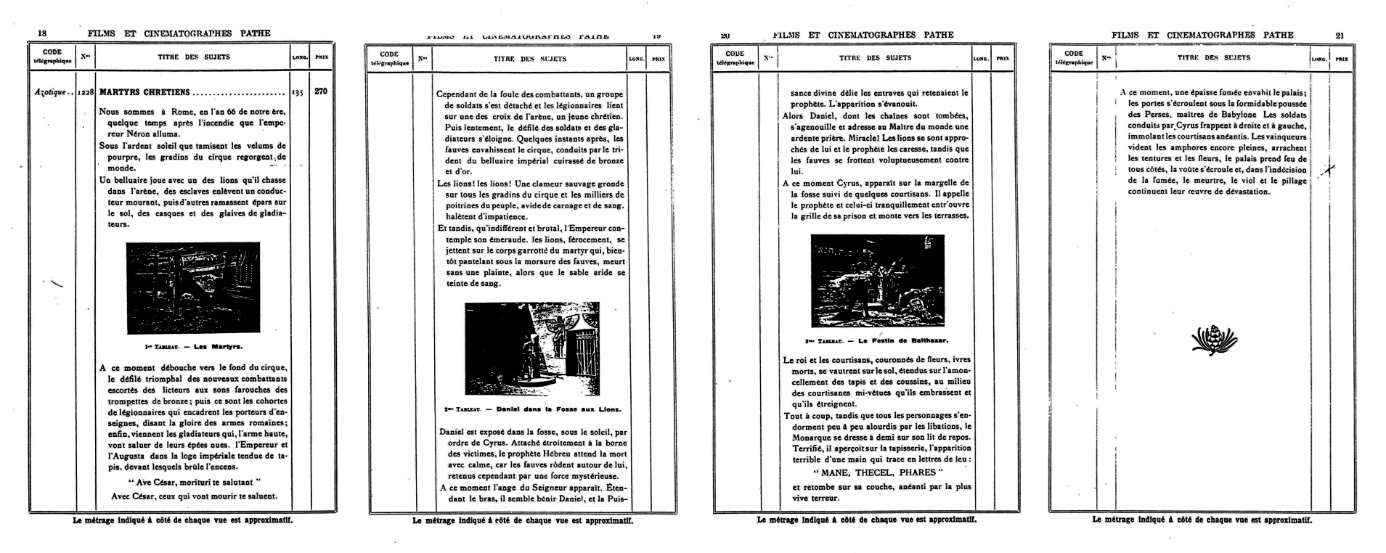
Figure 1 Catalogue Pathé: Supplément de mai 1905 (Paris: Pathé Frères, May 1905), pp. 18-21
The erudite notice in Catalogue Pathé: Supplément de mai 1905 (Paris: Pathé Frères, May 1905, pp. 18-21) strengthens ties with Sienkiewicz’s text (figure 1), preserving the specialized ancient terminology (in particular regarding Roman military ranks and weaponry), and favouring highly literary phrasing. For example: Pathé’s ‘imperial warrior clad in bronze and gold’ (le belluaire impérial cuirassé de bronze et d’or) recalls the novel centurion’s ‘iron-clad breast’ (Sienkiewicz, 1896: ch. LX) (poitrine cuirassée de fer, (Sienkiewicz, 1903: 557)). Likewise, ‘the fierce sounds of bronze trumpets’ ([les] sons farouches des trompettes de bronze) described in the catalogue about the film parade echo ‘the shrill sound of brazen trumpets’ (Sienkiewicz, 1896: ch. LXV)) (la voix stridente des trompes, (Sienkiewicz, 1903: 496)) in the novel.
Moreover, Pathé’s notice supplements the film with elements impossible to convey through the silent images, but which are drawn directly from the novel. It thus specifies the words addressed by the gladiators to Caesar –the famous Latin sentence Ave Caesar, morituri te salutant (p. 18).[10] It also evokes Nero’s emerald (not visible on screen) and indicates that the martyr (who is mostly off-screen and ultimately replaced by a dummy) ‘dies without a complaint’ (meurt sans une plainte, p. 19). Some passages even show such close similarity that they verge on pastiche:
The lions! The lions! A wild roar thunders through all the tiers of the circus, and the audience—ten of thousands strong, hungry for carnage and blood—pants with impatience.
Les lions ! Les lions ! Une clameur sauvage gronde sur tous les gradins du cirque et les milliers de poitrines du peuple, avide de carnage et de sang, halètent d'impatience. (p.19)
The walls of the building were trembling from the roar of tens of thousands of people. […] [The audience], drunk with blood and wild, began to cry with hoarse voices,—“The lions! the lions!” (Sienkiewicz, 1896: chs. LXV and LX)
Les murs de l’immense bâtisse tremblaient sous la clameur de dizaines de milliers de poitrines. […] [Le peuple], ivre de carnage et emporté par la démence, poussa des cris stridents : — Les lions! Les lions! (Sienkiewicz, 1903: 592, 508)
Sienkiewicz’s Quo Vadis? is not the only textual reference that emerges in the literary style of this catalogue notice for Christian Martyrs. One also finds reminiscences of the no-less famous novel of Edward Bulwer-Lytton, The Last Days of Pompeii, published in 1834 and seemingly translated and disseminated throughout Europe and beyond. For example, at the end of the scene, the text of the Pathé catalogue subtly shifts toward the foot of the martyr’s cross (a movement which is purely literary, the camera focusing instead on the lion rather than on the cross), to conclude with the words: ‘…while the arid sand is stained with blood (alors que le sable aride se teinte de sang, p.19). It echoes Bulwer-Lytton’s line describing the death of one of his Christian martyr heroes: ‘It was his life's blood that flowed so darkly over the sand and sawdust of the arena’ (Bulwer-Lytton, 1850: Book V, Ch. II), (C’était le sang de sa vie qui teignait de noir le sable et la sciure de bois de l’arène, (Bulwer-Lytton, 2006: 559).
We can thus identify in this catalogue text what Gaudreault and Marion call a novelization of the film,[11] in which the narrative is freely adapted both in content—since the text readily provides a range of information that the film itself never offers—and in form, where the writing ‘reasserts its literary rights’ (Gaudreault, Marion, 2005a: 128). As I have shown, it even weaves an intricated web of literary references.
My hypothesis, however, is that this catalogue notice—so prolix, informed, and carefully crafted, employing specialized Roman terminology and a literary style drawing on the most celebrated sources—was not intended solely for exhibitors, but also for showmen, that is, the narrators who accompanied the film with spoken commentary (the bonimenteurs, as they are known in French). I argue that this text was meant to be read or delivered aloud, performed alongside the images, thereby preserving the film’s literary resonance in the ears of spectators’—and thus cementing the relationship between early cinema and literature in a living, embodied form of intermediality.[12]
Performative Interplay
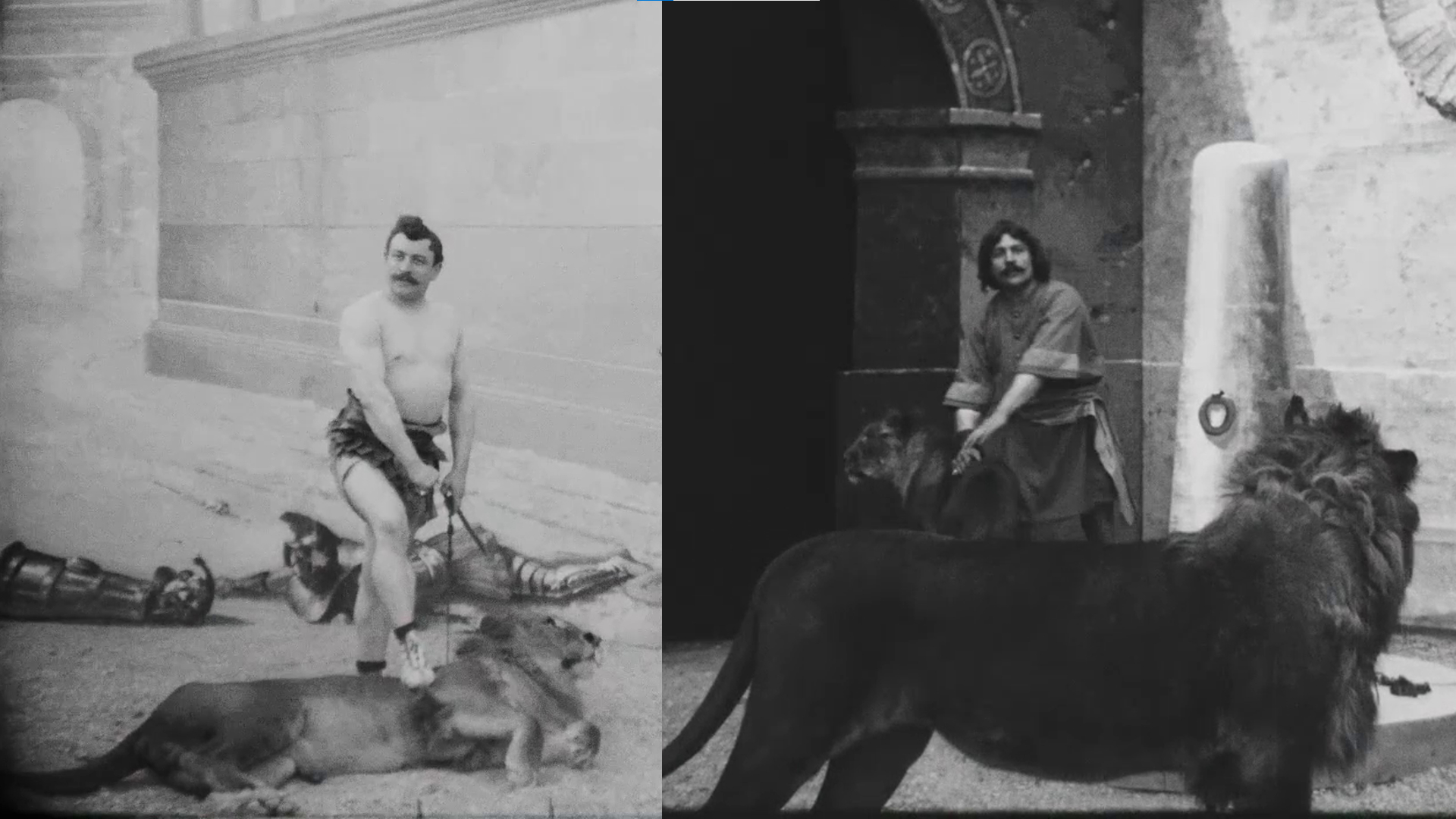
Figure 2a and b. Juliano un/covered and his lions, as a link between the two tableaux. Details of photograms from the tableaux The Martyrs and Daniel in the Lions’ Den, in Christian Martyrs (Les Martyrs Chrétiens, prod. Pathé Frères) © 1905 - Fondation Jérôme Seydoux-Pathé.
While the film’s tableaux are highly heterogeneous and lack any direct narrative connection, the staging nonetheless establishes a close link between The Martyrs and Daniel in the Lions’ Den through the reuse of the same performers—namely, the same lions and the same tamer. The latter, called Julien Simon, but performing under the name Juliano, appears more heavily disguised as Daniel, not only clothed but also wearing a wig (figure 2b); by contrast, he appears conspicuously uncovered in the arena, dressed only in a short Roman skirt that reveals the full extent of his musculature (figure 2a). His moustache, however, gives him away, and he is quickly recognized in both roles, as evidenced by a double-illustrated news brief in the Paris Journal du dimanche devoted to the Daniel in the Lions’ Den tableau—suggesting that, despite the fact that the film was sold only as a single unit in the Pathé catalogue, its tableaux could easily be separated and exhibited individually: The cinematograph […] transports us today to biblical times. Here is Daniel in the lions’ den… with real lions licking his feet… It is true that, on this occasion, the Daniel of the Bible… was none other than the tamer Juliano! (Le cinématographe […] nous transporte aujourd’hui aux temps bibliques. Voici Daniel dans la fosse aux lions… avec des lions véritables qui lui lèchent les pieds… Il est vrai que, dans la circonstance, le Daniel de la Bible… n’était autre que le dompteur Juliano!, Le Journal du Dimanche (Paris), 2nd July 1905, p. 428.)
If this conclusion trumpets the recognition of the lion trainer, it is because Juliano was already well-known to audiences. From 1894 onward, his presence became increasingly prominent at French fairgrounds and in the media. Famous for inviting all manner of participants to perform inside his lion cage (a barber to shave Juliano’s beard, dancers such as Pauline Berny or La Goulue),[13] Juliano is frequently mentioned for having been attacked by his beasts—his hand bitten (La Liberté, 21 February 1899, p.3.), his arm devoured (Le Petit Troyen, 6 September 1894, p.3.), his entire chest mauled (‘Fait divers: un dompteur blessé’, L’Indépendant: organe républicain du Cambrésis, 17 October 1902, p.2). Yet the scars so often recounted are curiously absent from the screen. Praised for his ‘incredible audacity’,[14] the training that enables him to ‘place his head in the lion’s mouth’[15] was especially acclaimed and documented. It is also one of the highlights of Juliano’s performance in the film (figure 3a and b).[16]
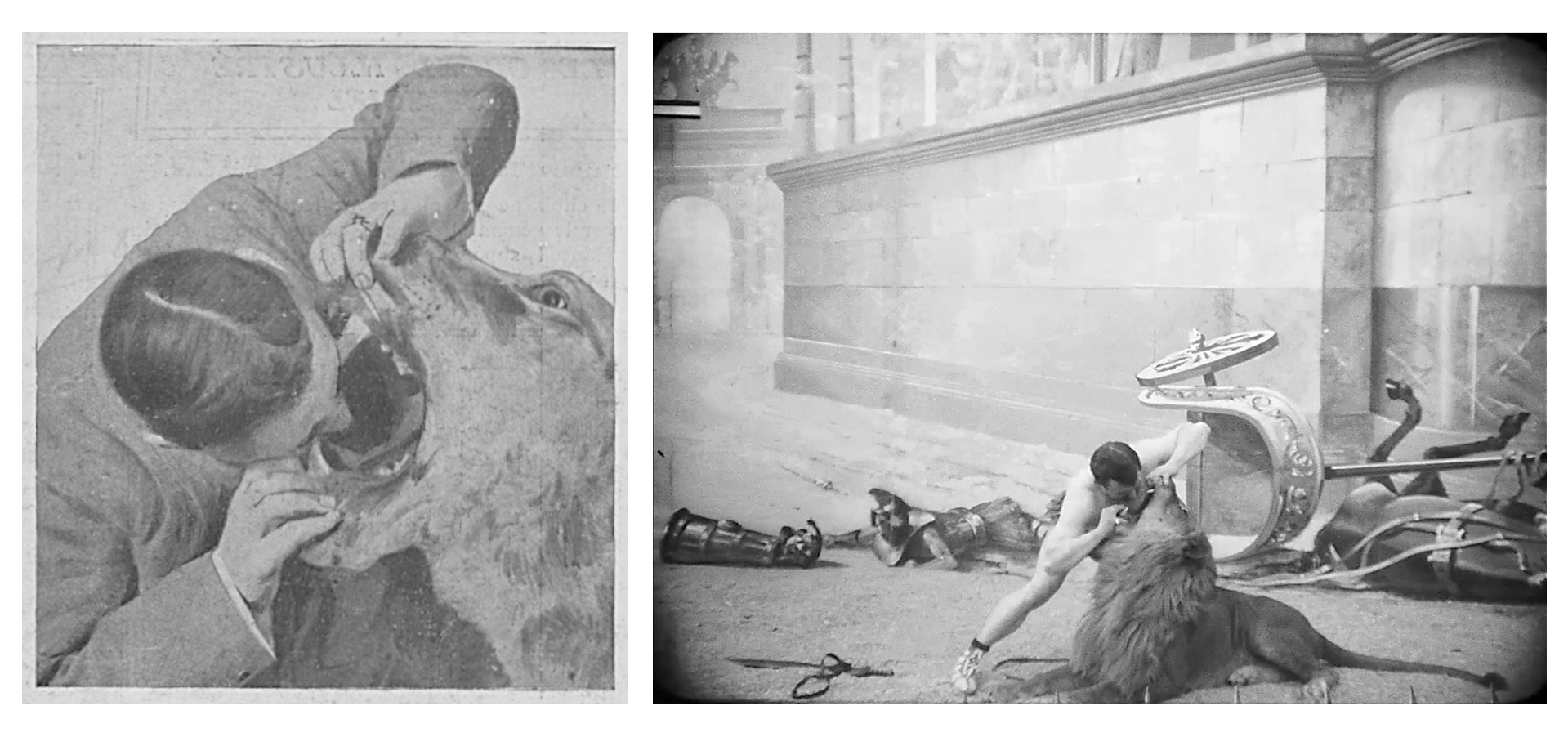
Figure 3a. Illustration of the paragon of risk in lion taming published in André Foucault, ‘Les risques du métier de dompteur,’ Le Grand Illustré, 7 January 1906, p.3. Figure 3b. Juliano’s risky ‘signature’ recorded in his cinematic performance Christian Martyrs (Les Martyrs Chrétiens, prod. Pathé Frères) © 1905 - Fondation Jérôme Seydoux-Pathé.
In fact, Pathé’s 1905 production was not the first film to feature Juliano and his lions. Two years earlier, in 1903, Mendel filmed the circus act that established the tamer’s reputation. Entitled the ‘Circle of Death’, it showcased acrobats cycling along a vertiginous circular track above Juliano’s open-air lion cage, sustained only by the centrifugal force of their deadly race.[17] Though the film is now lost, we know that the show was immortalized.[18] Moreover, the knot between circus and cinematograph would grow ever more intertwined in Juliano’s own biography, which, as Jean-Claude Seguin’s research demonstrates, would move from the cage to the screen. From wild-animal exhibitor to film exhibitor, he would become the manager not of a menagerie, but of cinemas (Seguin, 2024).
The main reason for this career shift of the ‘cinegenic’ tamer came a few months after the release of Christian Martyrs, under tragic circumstances: Juliano’s four lions were all mercilessly shot in public. Transported by train, their cage struck the roof of a tunnel, splintering it and allowing two of the lions to escape. The aftermath was brutal: two were killed after fleeing—one in the countryside by villagers, the other at a station by policemen—while the remaining pair were shot inside the cage they had never left, paralyzed with terror. The incident made the front page of Le Petit Parisien (Le Petit Parisien, Supplément littéraire illustré , 7 January 1906) and even became the subject of postcards depicting one of the dead lions, displayed like a hunting trophy among the innumerous ‘victorious’ citizens (figure 4).[19] This staging of animal domination sheds light on the contemporary fascination with the lion as a figure of threat, as well as on the underlying quest for human supremacy over it.
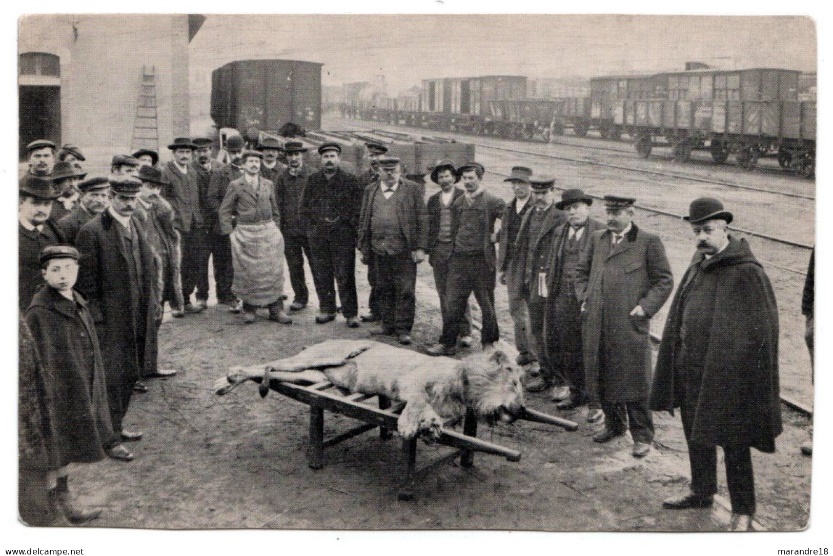
Figure 4. Juliano’s dead lion displayed in a staging of human supremacy. Postcard, unknown editor, 1905 – author’s collection.
One of the reasons why the ancient spectacle of circus games found such appeal in early films was indeed the opportunity it afforded to showcase lions. The fascination with these powerful animals, combined with the camera’s ability to capture them at close range—whether in moments of violence or of enforced submission—made them a highly sought-after attraction in early cinema. Early production companies regularly collaborated with tamers to film their animals, giving rise to a series of ‘lion films’, a kind of early genre whose reception was already being reviewed in the Ciné-Journal in 1913, under the title ‘Wild Beasts in Cinema’ (Les Fauves au cinéma).[20] Among the most notable examples of these ‘lion films’ are an August 1908 screening during which the lion's roar was ‘reproduced with the aid of a phonograph’, reportedly terrifying spectators to the point that they fled the auditorium (Phono-Ciné-Gazette, N°82, 15 August 1908); two Gaumont fiction films in which the lion was actually put to death, deliberately ‘sacrificed’ before the camera;[21] and a Walterdaw Company production of Neronian scenes during which the cameraman, John Graverl, was allegedly devoured by lions (Phono-Ciné-Gazette, N°86, 15 October 1908).
The film studied here nourished this fascination, staging the fake devouring of a Christian martyr by the beast, counterbalanced by the spectacle of control exercised by the gladiator-tamer, while the ensuing tableau of Daniel in the den frames the peace between lion and human as a divine miracle. Significantly, the devouring lion proved to be the film's most striking attraction, and prompted full-page features in two leading illustrated newspapers of the period, London’s The Sketch and Paris’s Le Grand Illustré.[22] Taking the form of what we would today call ‘behind-the-scenes’ reports, these pictorial articles dissected the cinematic trick frame by frame (figure 5), revealing what remained hidden between the shots: the substitution of the actor with a dummy filled with raw meat that had been prepared for the lion to tear apart. Associated with the lion’s mesmerizing appeal at the time and addressed to a broad popular readership, these prominent mass-circulation illustrated accounts provide a telling indication of the cinematograph’s growing fascination in 1905. They testify both to the sense of wonder generated by the medium’s spectacular and awe-inspiring power and to the growing admiration for the technological and performative skills underlying such cinematic illusions.
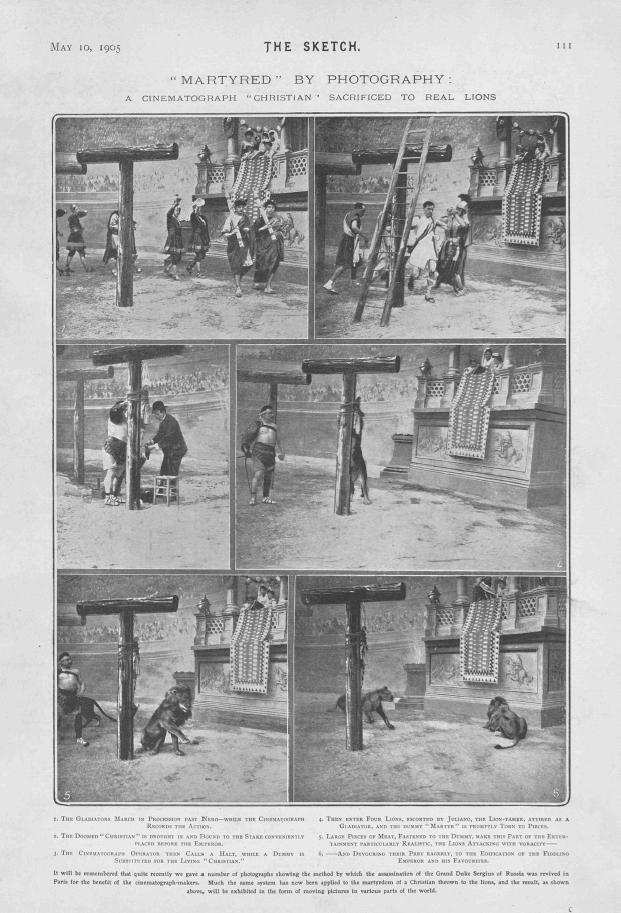
Figure 5. One of the first ‘behind-the-scenes’ reports, revealing the film and lion trick. The Sketch (London), 10 May 1905, p. 5.
Pictorial Interplay
In Christian Martyrs, the tamer-gladiator is shirtless when he thrusts his head into the lion's jaws or stands with his foot on him. But near the cross of the devoured martyr, he wears the upper part of his gladiatorial costume. And a production still preserved at the Jérôme Pathé Seydoux foundation shows the entire ensemble (figure 6a): the loincloth is completed above by the manica (meaning his armguard) and below by an ocrea (that is his greave, the piece of armor protecting his leg); his helmet rests on the ground at his feet. Taken together, along with the triumphant pose struck by Juliano (figure 6c), these elements confirm how explicit the reference is to Jean-Léon Gérôme’s mirmillo of Pollice Verso (figure 6d). This painting served as a pervasive model for early films set in antiquity, as Ivo Blom (2023, 29-105) has demonstrated. Filmic references are traceable as far back as the 1901 Pathé production Quo Vadis, released four years before Christian Martyrs and staging the famous gladiatorial duel (in reverse),[23] and culminating in the tableau vivant of the 1913 Cines film by Enrico Guazzoni. Reference to Gérôme’s Pollice Verso persists throughout the history of epic films, until Ridley Scott's Gladiator.[24]
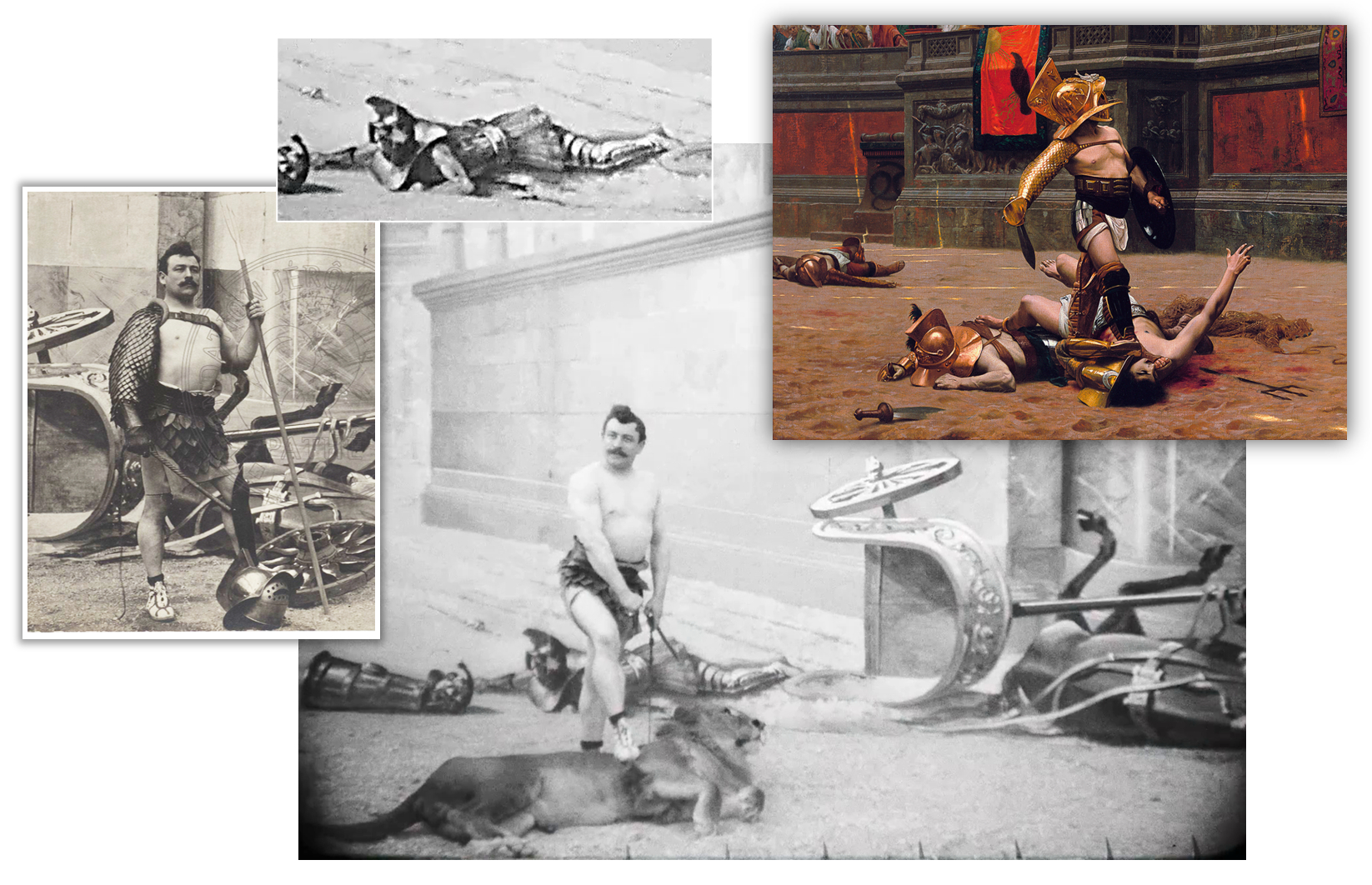
Figure 6. Gérôme’s pictorial reference shaping the cinematic image (in costume, pose and setting). 6a. Left. Pathé frères (Atelier photo), detail of production still of Christian Martyrs (1905) showing Juliano’s complete costume. Fondation Jérôme Seydoux-Pathé, PHO-P-6691. 6b and c. Middle. Details of photograms from Christian Martyrs (Les Martyrs Chrétiens, prod. Pathé Frères) © 1905 - Fondation Jérôme Seydoux-Pathé, with a focus on the demonstrative and triumphant pose by Juliano (centre) or the painted defeated gladiator on the backdrop (top). 6d. Right top. Detail from Jean-Léon Gérôme, Pollice Verso, 1872. Collection of Phoenix Art Museum © Phoenix Art Museum / DR
In Christian Martyrs, the reference does not rely solely on costume and pose; it also extends to the setting. Just behind Juliano as he duels with his lion, one can discern a direct visual quotation of Gérôme's second victim. Indeed, it is too often forgotten that, in the painting, the mirmillo places his foot on two defeated opponents lying one atop the other, including this dead figure sprawled face down beneath an oversized helmet. Pathé's set designer not only reproduced the figure but further developed it by adding the lower body and armour (figure 6b). The composition thus casts the lion in the role of the other victim, the pleading retiarius, whose fate is submitted to the famous thumbs up or down gesture of the crowd. Juliano, in turn, is positioned as the dominant heroic figure and, through this reference to Gérôme, acquires a strong symbolic and artistic resonance.
Gérôme’s imprint extends to his depiction of the ancient arena and its ‘inhabitants’ in other large-scale paintings[25] and is brought into play in various dimensions of the film — sets, costumes, and staging. The second part of the cinematic setting of the arena, in particular, which reveals the arc of the tiers to the right of the spina and the imperial box in front of which ‘those who are about to die’ come to salute, and where the crucifixion takes place, belongs to a lineage that encompasses not only Gérôme’s paintings, but also all the stage sets inspired by them, beginning with the theatrical adaptations of Quo Vadis (see Blom, 2023: 58-66). Thus, the relationship between painting and cinema must be understood in light of this third term, namely theatre, and more specifically the quintessentially pictorial and referential point of convergence represented by stage design. Indeed, emerging cinema often directly drew upon the scenic painters who worked in the theatres of the period.
Let us then consider a specific part of our film set: the overturned chariot, at the right-hand edge of the image frame, visually continuing the far end of the spina of the Circus Maximus –somewhat like a figurehead, signalling not victory but defeat. This composition, and particularly the motif of the chariot, with its archaeological accuracy, its wheel lying horizontally at the top, and the two horses sprawled on their backs, legs in the air, all rendered in a trompe-l’œil that attests to the painter-decorator’s pictorial skill, seem to constitute a direct nod to a painting that was then an inescapable point of reference (figures 7a-b).
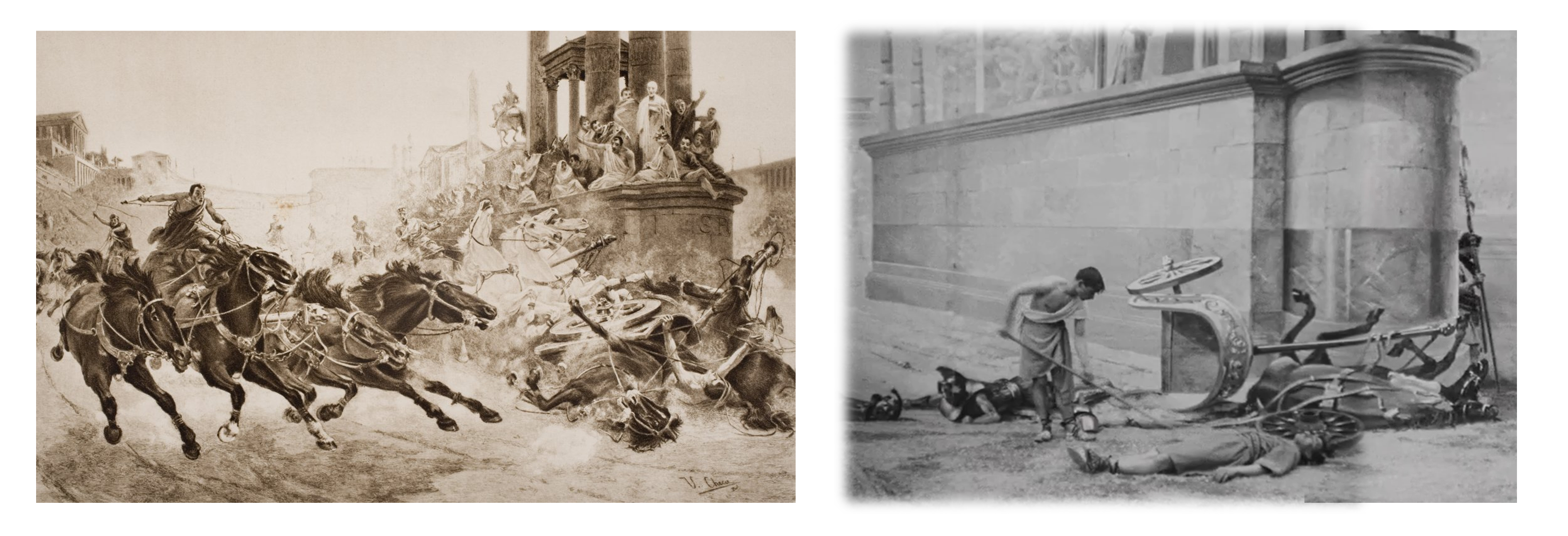
Figure 7. ‘Continuity’ between painting and cinema. 7a. Ulpiano Checa, Roman Chariot Race (Carrera de carros romanos, 1890), engraved by Maurice Deville in 1891 from the original painting, published by Léon Henri Lefèvre, reproduced here in H.G. Wells, The Outline of History, vol. I, London, George Newnes Ltd., 1920, facing p.256. 7b. The painted Roman chariot in Christian Martyrs (Les Martyrs Chrétiens, prod. Pathé Frères) © 1905 - Fondation Jérôme Seydoux-Pathé.
Entitled Carrera de carros romanos (Roman Chariot Race), this painting by Ulpiano Checa was exhibited at the 1890 Paris Salon, where it achieved a ‘universal triumph’ (Garcia, 2019: 161), immediately giving rise to a proliferation of replicas and reproductions circulating across the globe. As Ángel Benito García has documented (Garcia, 2019: 153-165), Checa indeed produced, ‘on demand, throughout his life’, countless copies and versions of his own painting in different formats and techniques (oil, watercolour, etc.), ‘with only very slight variations’ (Garcia, 2019: 153).[26] Right from the year in which it was exhibited at the Salon, the image circulated as far as the United States through postcards, which immediately turned it into an object of fascination and further circulation. The canvas was also to acquire an illustrious afterlife in print with the engraving made by Maurice Deville in 1891, published by Léon Henri Lefèvre and distributed around the world by Ernest Gambart, readily reproduced in encyclopedias and history textbooks, as well as in the press. The press also featured drawings and caricatures, whose satirical subversion testify to the popularity of the model. Among its most striking reproductions are the sculpted bronzes that materialized the painting in three dimensions (New York Daily Tribune, 2 December 1906, p. 2), and the stage curtain of the Metropolitan Opera House of St. Paul, Minnesota, which, in 1902, enlarged the painting—already impressive in its original 3 × 5 metre dimensions—to the astonishing scale of more than 11 by 12 metres (Garcia, 2019: 163). When it was used as the cover image for Lew Wallace’s novel Ben-Hur from its 1908 reissue onward (Garcia, 2019: 147, n. 217), the painting became the visual reference associated with this literary source[27] –several years before Fred Niblo and then William Wyler crystallized the novel into a cinematic imaginary.
Indeed, it is with Niblo’s Ben-Hur (MGM, 1925), followed by Wyler’s (MGM, 1959), that cinema, in the successive golden ages of Hollywood—first silent, then sound—would set out to replay the chariot race visualized by Checa in all its movement, and even to surpass it. At Pathé, in 1905, there is no attempt to set Checa’s canvas in motion; quite the contrary. Against any preconceived understanding of the cinema–painting paragone in terms of moving image versus still image, the Pathé film does not animate the painting. Where the whole point of Ulpiano Checa’s painting was to exalt movement by capturing the chariot accident at the very moment of its collapse, in all the sensationalist violence of this pictorial ‘instantaneous snapshot’, the Pathé film, by contrast, plays out the pose: the stillness of the frozen image. The 1905 Pathé film does indeed relocate this ‘pictorial moment’ within a longer temporality. But it does so by focusing on the moment after the action:[28] after the accident and the race, when it comes to clearing the track, when the chariot has come to a standstill and everything has already calmed down. It thus stages the long temporality of duration and permanence against the instantaneous. It begins where the painting stops. In doing so, it testifies—almost literally—to a relation of ‘continuity’ (or ‘continuation’) between painting and cinema, while clearly distinguishing between the two.
Another painter seems specifically to be summoned. His name is Jan Styka (1858-1925). Styka was born in Poland and became famous for being the illustrator of Quo Vadis? when the novel by his compatriot Henryk Sienkiewicz was translated into French and published by Flammarion in 1904. This pictorial work, completed between 1901 and 1904 (shortly before the writer received the Nobel Prize, and before the Pathé Film we are discussing was created), included 200 drawings and 15 paintings.[29] Styka’s numerous and well-documented pictures appear to be key references for the Pathé film production, both for the arena sets and its spectacle. In particular, Styka’s picture showing a naked and muscular Ursus overpowering the aurochs (figure 8) surely served as a reference for Juliano’s wild-beast duel, in which he performs half-naked, stripped of his Géromian attributes.
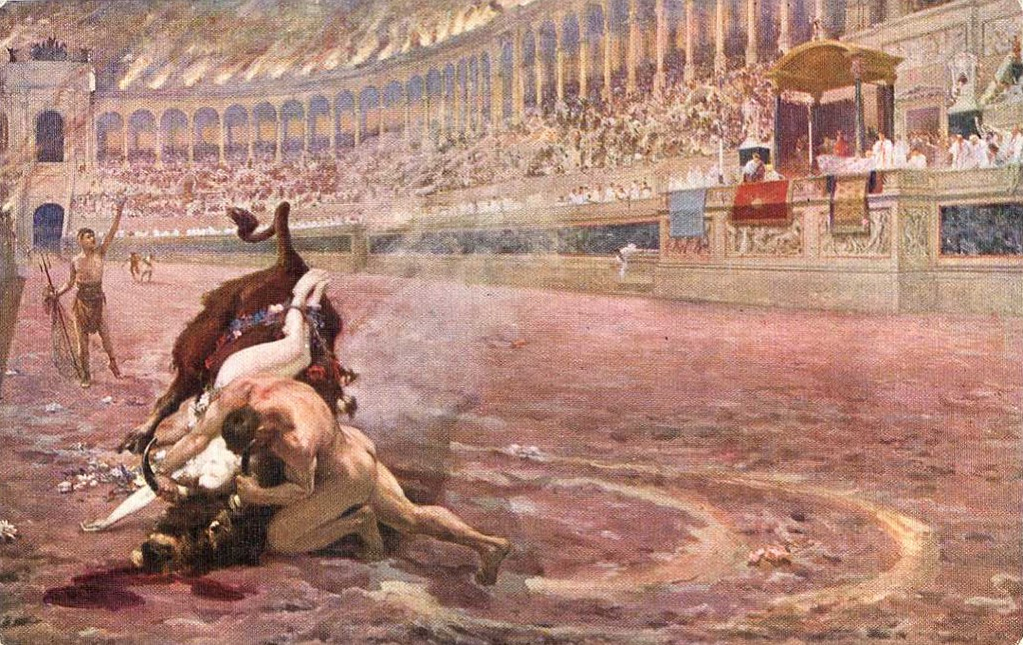
Figure 8. Styka’s Ursus inspiring Juliano? Jan Styka, Ursus Overpowering the Aurochs, 1904. Postcard reproduction, author’s collection.
Intermedial Interplay
However, the interplay with which I would like to conclude concerns an earlier painting by Jan Styka, also inspired by Sienkiewicz’s novel, albeit in a freer manner. Styka is best known for his panoramic works, and in 1897 he created the panorama The Martyrdom of Christians in Nero’s Circus, which was notably exhibited at the 1900 Exposition Universelle in Paris. More than a painting, a panorama is a full-fledged spectacle that engages the viewer in an experience now often described as ‘immersive’ and frequently connected with the cinema (Trumpener, Barringer, 2020; Huhtamo, 2013; Griffiths, 2008).[30]
One of the most remarkable features of the 1905 film production Christian Martyrs is, precisely, the camera's spectacular panoramic movement introducing the tableau entitled The Martyrs, which gradually reveals the full extent of the vast ancient arena set, together with the crowd of costumed extras parading before the emperor. The Christian martyr and the executioners who are about to crucify him and hand him over to the lion bring up the rear of the procession. It is after this sweeping pan, when the camera has settled and only slightly adjusts the reframing to the action or the movements of the lion, that the widely discussed substitution trick occurs, followed by the entrance of the lion and his gladiator-tamer Juliano now in his Gérôme-inspired costume.
While the scale and depth of the panorama is nothing to compare with the cinematic framing, and while the painting features far more nudity (with countless naked women) than the live-action staging, the reference remains undeniable. We find the same crosses, the same ladders, the wild beasts, the poses, the costumes. Moreover, the inspiration extends to the very way these images are viewed.
Once again with Styka’s work, and as is so often the case with panoramas due to the difficulties involved in their preservation, the panoramic painting has disappeared today, surviving only through reproductions, which ‘remediate’ the composition in different ways. Numerous photographs, postcards and prints circulate, cropping and reformatting the image, isolating and autonomizing specific sections of the original composition. Yet the most fascinating instance of the painting’s ‘remediation’ that I have been able to uncover is a panoramic lantern slide (figure 9), encompassing the whole composition (figure 10). We don’t know precisely the provenance of the slide but have evidence of the screening of it in the Photo-Drama of Creation, a hugely successful multimedia biblical spectacle of the early twentieth century.[31] This slide indicates not only that Styka's panoramic painting was projected onto a screen, but also that it was projected in motion, as the long slide had to pass through the projector, causing the image to scroll laterally across the screen. The motion effect produced by this slide’s framing movement thus demonstrates its proximity to the camera movement in Pathé's 1905 production (figure 11).

Figure 9. Panoramic slide projecting on screen and in movement the panoramic painting by Jan Styka, The Martyrdom of Christians in Nero’s Circus, 1899.nCrucifixion of Christians, unknown slide manufacturer, possibly directly made for the Photo-Drama of Creation on behalf of IBSA (ca. 1913) –55.9 x 8.3 cm. Brian A. Kutscher collection.
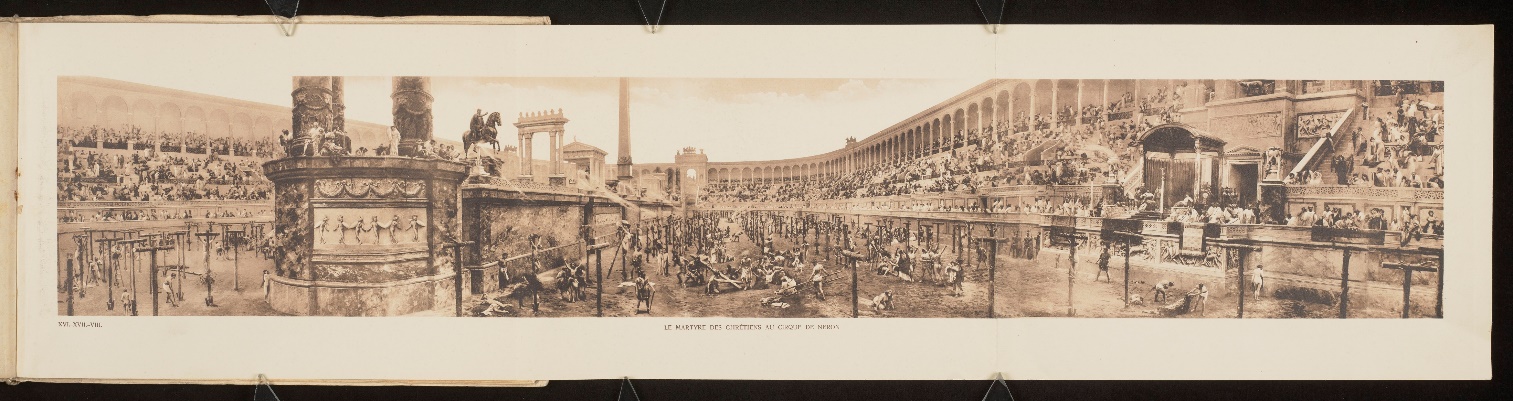
Figure 10. Styka’s whole panoramic pictorial composition reproduced in print. Album Museo ‘Quo vadis’: opere di Jan Styka, Capri, Villa Certosella (Napoli : Trampetti, [1922]), pl. XVI-XVII-XVIII.
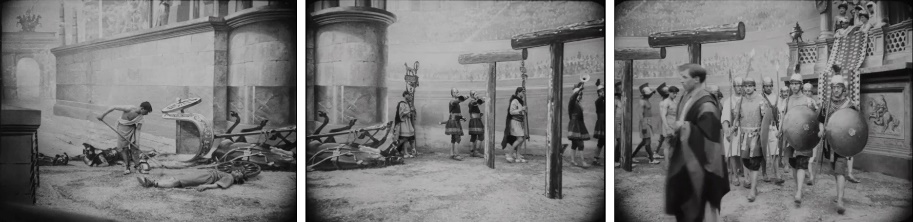
(Video pending) Figure 11. The panoramic camera movement of the Pathé 1905 production. Christian Martyrs (Les Martyrs Chrétiens, prod. Pathé Frères) © 1905 - Fondation Jérôme Seydoux-Pathé.
So, even the camera movement—in other words, what might initially seem to offer a new and specifically cinematic point of view on the Neronian arena—turns out to lie at the heart of a referential and intermedial network. By building bridges between the panoramic camera, the panoramic lantern slide, and the panoramic painting, our study of Christian Martyrs concludes by recalling the richness of the media of the period and the unprecedented network of relays that connected them. The film gives full scope to what Monika Woźniak and Maria Wyke have theorized in terms of the ‘multimedial transformations’ of the ancient subject in the twentieth century, which include hypertextual derivation (in other words direct classical reference) but also ‘the strategies of transtextual or inter- and intramedial play by which those hypertexts form connections with each other’ (Woźniak, Wyke, 2020: 22). Combining literary, performative, and pictorial interplay, this 1905 Pathé film provides an exemplary illustration of how early cinema, characterized by an as-yet ‘non-specific’ artistic culture open to networks of cross-references and a ‘necessary’ intermediality (Gaudreault, Marion, 2005b), revives not so much antiquity itself as a particular way of imagining and looking at the classical subject, guiding it ‘to cross national boundaries, cultural categories, and media to gain a long and rich afterlife in popular culture’ (Woźniak, Wyke, 2020: 1).
Footnotes
- ^ This study – for which I would like to thank Maria Wyke for her editing and Ivo Blom for his insights – is adapted from a presentation given at the Museum of Dreamworlds Workshop organized in Amsterdam by Aylin Atacan, Ivo Blom, Bryony Dixon, Elif Rongen-Kaynakçi and Maria Wyke in April 2025, with the projection of the Jérôme Seydoux Pathé Foundation restored version of the Christian Martyrs (Les Martyrs Chrétiens, Pathé, 1905).
- ^ Catalogue Pathé: Supplément de mai 1905 (Paris: Pathé Frères, May 1905, p. 18, personal translation into English). I couldn’t find any translation of the complete original French notice in Pathé’s anglophone catalogues. I thus worked from the translation proposed on the website BetweenMovies.com and adjusted it in order to preserve at best its literary quality.
- ^ My thanks go to Stéphanie Salmon, director of the Foundation, for granting me access to this digitized version, restored from the original nitrate negative held in its collections with the support of the CNC and the collaboration of L’Immagine Ritrovata (Paris, Bologna). I am also grateful to Emily Cauquy, Monique Faulhaberg, and Laure Marchaut for enabling me to consult the 35mm print preserved at the CNC in 2014.
- ^ The film Quo vadis ?..., directed by Ferdinand Zecca, was reportedly shot in May 1901 according to Journal comptable no. 3 (28 February 1902, coll. Fondation Jérôme Seydoux-Pathé), but its release is only documented in the Catalogue Pathé: Supplément de mars 1902 (Paris: Pathé Frères, March 1902, pp. 19–20).
- ^ The Bologna Film Festival Il Cinema Ritrovato presented a digitized version of the copy preserved at the CNC in 2016.
- ^ For an overview of the concept of ‘attraction’ and its impact on the study of early cinema, (see Strauven, 2006).
- ^ A promotional still from the film captures the exact moment when the two combatants reenact Gérôme’s pose. Entitled Combat de Gladiateurs, it is preserved in a hand-coloured version at the Jérôme Seydoux-Pathé collection (PHO - P - 856). Pathé promotional stills of the time often selected (and thus revealed) their elaborate reenactments of paintings, which I call ‘tableaux vivants’ (see Boillat, Robert, 2016: 40-47).
- ^ On this term, its theatrical legacy and pictorial implications, (see Robert, 2021: 268-271).
- ^ In certain versions of the catalogue and in some prints of the film, four tableaux are listed instead of three, with the first divided into two parts: the title Christian Martyrs is assigned to the sequence depicting the parade in the circus, culminating in the crucifixion and devouring of the condemned, while a separate title, Ancient Gladiator, introduces the section devoted to the confrontation between a gladiator and a lion.
- ^ It is worth noting that the original French catalogue provides a translation of this famous expression —though marred by a curious error (maybe a mere typo, maybe a real misunderstanding)—rendering Ave Caesar as Avec César (‘with Caesar’).
- ^ (Gaudreault, Marion, 2005b). It should be noted that although Gaudreault and Marion describe this phenomenon, they date it to the phase of cinema’s institutionalization (that is, considerably later than the film examined here), positing an earlier period in which catalogue texts were more ‘functional’ than ‘fictional’, shaping literary description in imitation of the cinematic medium. However, my own survey of Pathé catalogues reveals, on the contrary, the remarkable literary quality of these texts as soon as catalogues began to include descriptive entries for their films, that is, as early as the 1902–1903 catalogues. The film examined here is emblematic in this respect: exceptional in the extent of its development and in the way it pushes literary play to the point of pastiching major novelistic references, though it is not exceptional in the quality of its writing.
- ^ If the question of the written sources for the oral commentary provided by lecturers is complex and difficult to document, early cinema Passion Plays constitute a clear case of films for which accompanying texts have been recovered (Robert, 2012: 530-531). Furthermore, the booklet made available by Pathé to accompany their 1907 Passion Play (preserved at the Cinémathèque française) is modelled on catalogue notices, following the same principle of describing and commenting on each tableau. The texts of the booklet and the catalogue even directly substitute for one another: in the Catalogue Pathé 1907 (Paris: Pathé Frères, 1907, p.245), there is no detailed description of the tableaux, only their titles and a reference to this separately printed ‘very well studied text’, ‘the reading of which should accompany the projection’, ‘in accordance with the action’, so as to make it a ‘veritable animated history’. In this same 1907 catalogue, the films produced before 1905 generally do not receive detailed textual descriptions, which focus on the latest released. But the historical, biblical and literary pre-1905 films, which called for informed commentary, are accompanied by the recommendation to consult,,’for explanation,’ a ‘special illustrated notice’ (ibid., pp.149-150, 157-158, 172-174, 223-224, 241). This suggests that the catalogue pages that provided detailed descriptions of these films at the time of their release were made available as standalone notices intended to provide the ‘explanation’. Thus, in all likelihood, they operated as a script for commentary, and that the same function applies to the notices reproduced in full. Dated 1905 and thus included in their entirety in the 1907 catalogue (pp.174–175), the four pages for Christian Martyrs, whose literary and referential sophistication we have highlighted here, seem likewise to have been intended to be recited alongside the projection.
- ^ See the thorough research and press review provided on the website of Le Grimh by Seguin (Seguin, 2024).
- ^ Audace incroyable: Paul Villers, « Les rois de la cage », Le Voleur illustré, n°2555, 24 June 1906, p.1223.
- ^ E. Charteris, ‘Taming the Wild,’ The London Magazine, September 1905, p.172.
- ^ Juliano was not the only person to perform this attraction, and it is often hard to tell whether it is him or the tamer Bostock who poses with his head in the lion’s mouth in press illustrations. André Foucault, “Les risques du métier de dompteur,” Le Grand Illustré, 7 January 1906, p.1-3 ; ‘Fauves et dompteurs’, Lectures pour tous, February 1905, p.58.
- ^ One of the best illustrations of this Death Circle show appears in La Vie au grand air, n°261, 3 July 1903, p.449.
- ^ The existence of the film Le cercle de la mort (Mendel, 1903), shot at the Kursaal of Enghien, is documented on the Grimh website.
- ^ Postcards recording the 21 December 1905 terrible incident (private coll.)
- ^ G. Soury, ‘Les Fauves au cinéma’, Ciné-journal, N°235, 22 February 1913, p. 58-60 ; G. Soury, ‘Les Fauves au cinéma (suite)’, Ciné-journal, N°235, 22 February 1913, pp. 40-45.
- ^ Dans la brousse (Gaumont, 1912), in which the lion called D’Artagnan is shot, and Au pays des lions (Gaumont, 1912), ending with the killing of Prince, a lion bought to the Auguste Laurent menagerie. See G. Soury, ‘Les Fauves au cinéma (suite)’, Ciné-journal n°235, 22 February 1913, pp. 41-44.
- ^ ‘Les coulisses d’un cinématographe’, Le Grand Illustré (Paris), 30 April 1905, p. 5; The Sketch (London), 10 May 1905, p. 5.
- ^ The film stages this final pose of the fight in such a way as to reveal the side of the gladiator that is concealed from us in the painting. In the 1901 Pathé production, the dominant figure finally turns his back to the audience, offering a frontal view of his shield, as though the painted figure had performed a volte-face or rotation, seemingly exploring the potential of the tableau vivant to shift the point of view on a work of art. Interestingly, Gérôme himself created a sculptural version of his dueling pair in 1878 (i.e. six years after the painting), allowing the viewer’s gaze to move around the figures and explore the composition from different angles. The 1901 film extends this principle, not by changing the camera angle—the camera remains stationary—but by setting the figures in motion.
- ^ ‘Ridley Scott Uncut: Exclusive Online Interview’, New York Times Online, 5 October 2006.
- ^ One can cite Jean-Léon Gérôme’s paintings entitled: Ave Caesar, morituri te salutant (1859); The Christian Martyrs' Last Prayer (1883); and The Retreating Lions (1902).
- ^ It is rather amusing to note that the original has never been found… And that the painting thus exists today only through and for its reproductions.
- ^ It should be made clear that the novel is itself the source of the painting: Checa painted it shortly after reading Lew Wallace’s novel, directly illustrating the scene of the chariot race described therein. Its illustrative destiny as the novel’s cover image is therefore particularly apt, closing—or sustaining—the referential loop.
- ^ An element that has precisely been associated with Gérôme (Païni, 2010), as though Pathé were reframing Checa through Gérôme.
- ^ The original illustrations were destroyed in a fire at the Universal Exhibition of Saint Louis, surviving only through reproductions (engravings, postcards) and (re)editions, such as in the album by Auguste-Jean Boyer d’Agen, L’écrivain et le peintre de "Quo Vadis": Henryk Sienkiewicz et Jan Styka (Paris: Lapina, 1912).
- ^ See also the various issues of the Panoramic and Immersive Media Studies Yearbook, published since 2024, which succeeds the International Panorama Council Journal (2013-2023).
- ^ On this show, combining slides, films, recorded narration, and music, produced by the religious movement that later became known as the Jehovah’s Witnesses and reportedly reaching more than nine million spectators worldwide between 1914 and the 1920s, see the research in which I am participating at the George Eastman Museum, together with other slide and film experts, under the leadership of Paolo Cherchi Usai, which is on the verge of publication. I would like to thank all the members of the Photo-Drama of Creation team who studied the slides with me, namely Jeremy Brooker, Sam Grosdemanges, and Brian A. Kutscher, who owns this slide and kindly had it photographed for me (figure 9).
Blom, I. (2023) Quo vadis?, Cabiria and the ‘Archaeologists’: Early Italian Cinema’s Appropriation of Art and Archaeology. Turin: Kaplan.
Boillat, A. and Robert, V. (2016) 'Tableau variation in early cinema: Life and Passion of Christ (Pathé, 1902-1905)', trans. T. Barnard, in D. J. Shepherd (ed.), The Silents of Jesus in the Early Cinema. Oxford: Routledge, pp. 40-47.
Bulwer-Lytton, E. (1850) The Last Days of Pompeii. Rahway, N.J.: The Mershon Company. Second edition. First edition 1834.
Bulwer-Lytton, Lord Edward. (2006) Les derniers jours de Pompéï, French transl. by Hippolyte Lucas (1850). Free Ebook edition.
García, A. B. (2019) El pintor Ulpiano Checa (1860–1916). Madrid: Ayuntamiento de Colmenar de Oreja.
Gaudreault, A. and Marion, P. (2005a) “Du filmique au littéraire : les textes des catalogues de la cinématographie-attraction,” CiNéMAS, 15: 2-3, Spring, pp. 121-145.
Gaudreault, A. and Marion, P. (2005b) 'A Medium Is Always Born Twice…', Early Popular Visual Culture 3:1, pp. 3–15.
Griffiths, A. (2008) Shivers Down Your Spine: Cinema, Museums, and the Immersive View. New York: Columbia University Press.
Huhtamo, E. (2013). llusions in Motion: Media Archaeology of the Moving Panorama and Related Spectacles. Boston: MIT Press.
Robert, V. (2012) 'Le verbe en intertitre, l’icône en photogramme. Citations canoniques dans le cinéma muet', in C. Clivaz, C. Combet-Galland, J-D. Macchi & C. Nihan (eds.), Écritures et réécritures. Peeters: Leuven/Paris, pp. 529-547.
Robert, V. (2021) 'Tableau' in D. Païni, P. Perrin & M. Robert (eds.), Enfin le cinéma ! Arts, images et spectacles en France (1833-1907). Paris: Réunion des musées nationaux, pp. 268-271.
Seguin, J-C. (2024). 'Julien Simon dit JULIANO', Grimh.org, May.
Sienkiewicz, H. (1896) Quo Vadis? A Narrative of the Time of Nero, transl. from the Polish by Jeremiah Curtin, in its online version published by the Project Gutenberg.
Sienkiewicz, H. (1903) Quo Vadis. Roman des temps néroniens, transl. from the Polish by B. Kozakiewicz and J.-L. De Janasz. Paris: Edition de la Revue Blanche/Bibliothèque Charpentier [1900].
Strauven, W. (ed.) (2006)The Cinema of Attractions Reloaded. Amsterdam: Amsterdam University Press.
Trumpener, K. and Barringer, T. (eds.) (2020) On the Viewing Platform: The Panorama Between Canvas and Screen. Yale: Yale University Press.
Uricchio, W., & Pearson, R. E. (1993) Reframing Culture: The Case of the Vitagraph Quality Films. Princeton: Princeton University Press.
Woźniak, M. and Wyke, M. (eds.) (2020) The Novel of Neronian Rome and its Multimedial Transformations: Sienkiewicz’s Quo vadis. Oxford: Oxford University Press.