
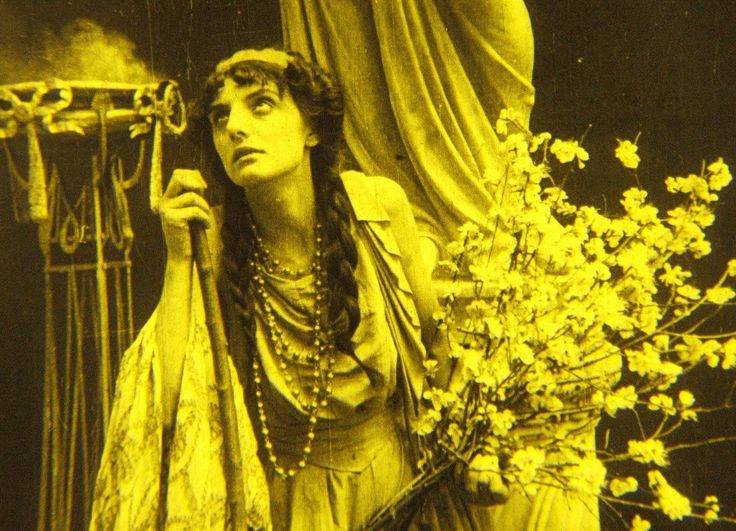
Jone o Gli ultimi giorni di Pompei (original)
1913
Alternative Titles
Gli ultimi giorni di Pompei (Alternative), The Last Days of Pompeii (Alternative), The Priest of Isis (Alternative)
BFI identifier
309731Synopsis
Set in Pompeii and featuring the eruption of AD79. Based on the novel by Edward Bulwer-Lytton. Rl.1. Ione and Glaucus, who are in love, buy flowers from a blind girl, Nydia. Arbases, the Egyptian Priest of Isis, holds a magnificent banquet (139). Scenes showing a day in the life of a lady of fashion (186), followed by a chariot race (331). At the races, Arbaces conceives a passion for Ione. He tells her Glaucus is unworthy of her love and that he is infatuated with a blind slave that he bought from Burbius. To prove his love, Glaucus presents Ione with the slave- Nydia, the blind flower seller. Nydia secretly loves Glaucus and tells Ione that he was her saviour. She accompanies Ione to the house of Arbaces (856). Rl.1b. Arbaces instructs his servants to take Nydia to their quarters and conducts Ione into an inner temple. Nydia goes in search of her mistress and, unable to find her, seeks the assistance of Glaucus. In the precincts of the temple and the presence of the dancing girls, Arbaces attempts to violate Ione, who is rescued in time by Glaucus and Nydia (347). Rl.2. Glaucus thanks Nydia for her assistance. She confesses her unhappiness to Julia, a patrician friend, who asks Arbaces for a philtre that will bring Nydia Glaucus' love. Arbaces consults with a witch who then gives Julia and Nydia the philtre. Nydia, believing that she has a love potion, administers it to Glaucus. Glaucus, the victim of Arbaces' jealousy, immediately suffers a fit of madness and dashes wildly through the streets. In the groves of Isis Arbaces and another priest, Menegates, are walking. Glaucus stumbles into the grove and collapses. Menegates goes to his assistance but is killed by Arbaces with Glaucus' sword. However, the murder is witnessed by an elderly priest, Calenus. Glaucus is arrested for the murder while Arbaces offers Calenus untold wealth for his silence. Nydia, learning of Glaucus' arrest, goes to see Arbaces who orders his servants to imprison her. She escapes and wanders blindly in the subterranean passages of Arbaces' house where she overhears Arbaces receive Calenus and conduct him to an inner chamber (1073). Rl.3. Arbaces shows Calenus his treasures, then creeps stealthily from the chamber and locks the old man in. Nydia is recaptured by the servants. Publicly accused by Arbaces, Glaucus is condemned to the arena. Sallust, his friend, is grief-stricken. Ione goes to Arbaces for assistance. She repulses his further advances and is imprisoned. Nydia writes to Sallust for help and when the message is delivered he collects his friends to stage a rescue. The spectacle in the arena commences, watched by Arbaces (3092). Sallust and his friends rescue Nydia and Ione (910). Rl.4. Arbaces continues to watch the sports in the arena, which include fights between gladiators (3352). In the background, Vesuvius begins to belch smoke. Glaucus, alone in the arena, is surrounded by lions but they ignore him. Sallust confronts Arbaces with his victims and denounces him to the crowd who demand that he be thrown to the lions. Vesuvius erupts and the crowds panic. The destruction of Pompeii commences (3571). Guided by Nydia, the reunited lovers take refuge on a ship. Having saved them, the lovesick Nydia quietly slips into the sea (700). (3886ft) Note: The main title is a replacement on 1928 stock. All titles are in English and introductory titles on reels 3 and 4 read "The Priest of Isis" on 1916 stock. The whole film is riddled with periodic gaps, particularly in the last reel. (Shortlist)
- Production Country: Italy
- Production Company: Pasquali
- BFI Category: Fiction
- Source: N/A
Cast
Suzanne De Labroy (Nidia)
Ines Melidoni (Julia)
Luigi Mele (Glaucus)
Cristina Ruspoli (Jone)
Giovanni Enrico Vidali (Arbaces)
Giuseppe Majone Diaz (Burbo, the Innkeeper)
Michele Ciusa (Calenus)
Credits
Director: Giovanni Enrico Vidali
Co-director (uncredited): Ubaldo Maria Del Colle
Production Company: Pasquali
Based on the novel by Edward Bulwer-Lytton
Photography: Raimondo Scotti
Set Designer: Domenico Gaido
Film Technical Information
- Original Length: N/A
- Length of BFI Viewing Print: 3851 ft
- Support: Viewable
- Colour
- Format: 35 mm , 35mm BW Positive, 35mm Colour Positive,Digital Betacam,16mm Positive, 35mm Dupe Negative, 35mm Tinted Positive
Comments on the print:
Further details on this print and its relation to the longer, restored version held by theMuseo Nazionale del Cinema (Turin) to follow.