
THEME - The Imperial Gaze: Nero in the early years of cinema
By MARIA WYKE
Nero has occupied the cinema screen more than any other figure of Roman history, creating for spectators – even in the silent era - a radically new, multisensory way of experiencing the emperor as image, movement and sound. Silent cinema’s various versions of Nero go back to his wide circulation in the cultural imaginary of the nineteenth century. Novels, paintings and postcards, revivals of earlier operas and plays as well as the performance of new ones, circus shows and lantern slides all drew with fascination on the emperor’s portrait in ancient sources as a murderer, a monster of lust, a cruel tyrant, an arsonist, persecutor of Christians and a self-styled artist so dedicated to excess that he destroyed the Julio-Claudian dynasty. Across the first decades of the twentieth century, however, cinema shaped its own Neros better to suit the specificity and needs of the medium, its changing technologies and industrial practices, and the differing cultural contexts of its exhibition and consumption. A common motif in its representations of Nero I have here entitled the ‘imperial gaze’. Spectators are invited to look at Nero with horror but, in tension, they are often encouraged to look with his pleasure at the spectacles of suffering being reproduced on screen. Nero’s imperial gaze is disturbingly mapped onto the voyeurism that was one of the new medium’s significant attractions. This essay puts the four prints in the BFI archive that concern Nero - namely, Nero or the Burning of Rome (Nerone o L’incendio di Roma, 1909), The Way of the Cross (1909), and two versions of Quo vadis from 1913 and 1924 - within the context of the eleven silent films about the Roman emperor that have survived from the early years of cinema. The essay reflects upon differences that emerge between these cinematic representations across time and nation, explores more broadly what features of the Nero tradition fascinated cinema, and considers what characteristics the Neros on screen displayed and why.[1]
Poisoner & Palace Plotter
At the beginning of the history of Nero on film, in 1897, the emperor sits enthroned testing poisons on some slaves. The film Néron essayant des poisons sur des esclaves was made by the French company Lumière under the direction of Georges Hatot. The birth of cinema is marked conventionally as the moment in 1895 when customers paid to see in a Parisian café a programme of ten brief views of various events in motion that were projected onto a screen by the new optical device the Lumière Brothers had designed – the cinématographe (Abel, 1994: 10-11 and 91-92). Two years later Paris was also the birthplace of Nero on film. Why, then, was Nero (and Nero as poisoner) chosen by the Lumières brothers for the very first depiction of the ancient world in moving images?
The first Nero film conforms to the technical constraints within which the earliest motion pictures were made. It has a run time of less than one minute and presents a self-contained scene in a single long shot, with the actors moving in and out of the frame. The costumes and props (tunics, togas, fillets, sandals, goblets), and a décor painted on canvas, signal only roughly that the setting is Roman – presumably the gardens of the imperial palace. First one slave and then another are brought in to be presented to the emperor who sits enthroned on a raised dais. Both slaves drink from a cup of poison given to them by a courtier and then stagger in agony. On both occasions, the emperor leans right over to study their suffering more closely as they writhe on the ground in the throes of death (fig. 1).
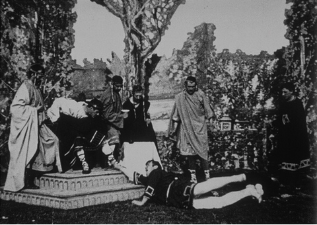
The contortions of Nero’s slaves and the emperor’s scrutiny of them recall the origins of cinematography in the science of motion studies. From the early 1880s, the French physiologist Étienne-Jules Marey, for example, had sought to freeze on the same negative successive phases in the motion of bodies in order to analyse their posture at regular time intervals.[2] Then, from 1895 to 1905, the movement of bodies constituted a key mode of expression for the new medium of motion pictures (Auerbach, 2007: 2; Dahlquist, et. al., 2018: 7-8). In their laboratories, scientists scrutinized sequential photographs of birds in flight, horses racing or athletes jumping. However, in the fairgrounds, music halls and cafés where silent films were first exhibited for the entertainment of spectators, filmmakers often replaced such moving images with executions and assassinations justified by their notoriety (Véray, 2005: 335).[3] So early cinema’s morbid interest in the torment and death of bodies is here given drama and cultural prestige through the use as subject-matter of Nero and his unfortunate slaves.
The film appears not to be drawing directly on ancient sources but on the familiarity of Nero’s reputation as a poisoner in French visual culture, for a regular feature of early cinema was its reproduction of paintings in action. The film’s tableau can be compared, for example, to the composition of a French history painting by Joseph-Noël Sylvestre that had won the Prix du Salon in 1876, in which the famed poisoner Locuste, in the presence of Nero, tests on a slave a poison prepared for the emperor’s rival Britannicus (Blanshard, 2015: 253-254). That and other such paintings of Nero as a poisoner were in turn inspired by Jean Racine’s play Britannicus, first performed in 1669 and to this day a regular in the repertory of the Comédie Française, in which Nero is a budding monster set on poisoning his rival (Éloy, 2005: esp. 69-70). In Act 4 scene 4, the character Narcisse announces to Nero that he has a potion at the ready with which Locuste had made a slave die before the tutor’s eyes.
In the Lumière film from 1897, however, there is no Britannicus or Locuste, and thus no explicit reference to the political purpose of testing poisons, as there is in the play and, by implication or through their titles, in the paintings it inspired. There is just a focus on the murderous act itself and the emperor’s curiosity. This is how the company’s catalogue describes the scene: ‘Nero orders slaves to be brought before his throne to try out poisons. The emperor takes a cruel pleasure in the suffering of the misfortunates who die at his feet.’ The emperor leans over twice to take a closer look, but the poisonings are clearly staged also for the spectator looking at the screen (Hansen, 1991: 1 and 33). The film thus invites audiences to be attracted like Nero to the sadistic display. One reason then for the persistent fascination that cinema has had with Nero is the historical legitimacy he provides for testing the limits of acceptability for what is put on screen and how it is consumed (Michelakis, 2017: 25-26).
The interest of French cinema in focusing on Nero as a poisoner reemerges in the early 1910s when the film industry was now claiming for the new medium the status of an artform. A wizened old Locuste is summoned to the imperial palace by the emperor late on in the film Britannicus (released in 1912). In her company and that of the treacherous Narcisse, Nero tests the effects of her poison on a slave-girl and observes closely the disturbing convulsions with which she dies while facing the camera front screen. The film was made for the studio Film Valetta by the experienced dramatist Camille de Morlhon and distributed worldwide by Pathé Frères, with Jean Hervé in the role of Nero and Romuald Joubé in that of his competitor for the throne, Britannicus.
The film belongs to a genre known as film d’art through the production of which studios like Pathé sought to persuade the middle classes to pay good money to go to the dedicated auditoria it was building. Exploiting the cultural value of the French theatrical heritage, filmmakers turned the recitations of celebrated dramas into cinematic tableaux (Abel, 1994: 318-319). The debt of Britannicus to Racine’s tragedy was advertised explicitly in publicity for the film, as when Le Courrier Cinématographique for 20 December 1912 called it ‘an ancient scene in natural tones based on the masterpiece by J. Racine’ and ‘a marvel of the cinematographic art’.[4] In its theatrical mode of representation, Britannicus demonstrates the substantial technological advances made by the new medium. Its runtime was a sizeable 34 minutes during which spectators were invited into the throne room of the emperor’s luxurious imperial palace, its terraces, private apartments, banquet hall, gardens and external entrance. Each tableau was captured in medium- or long-shot and the movement of the elaborately costumed actors through these spaces was carefully choreographed to display the depth and richness of the sets, their elaborate costumes and stylized gestures and poses.
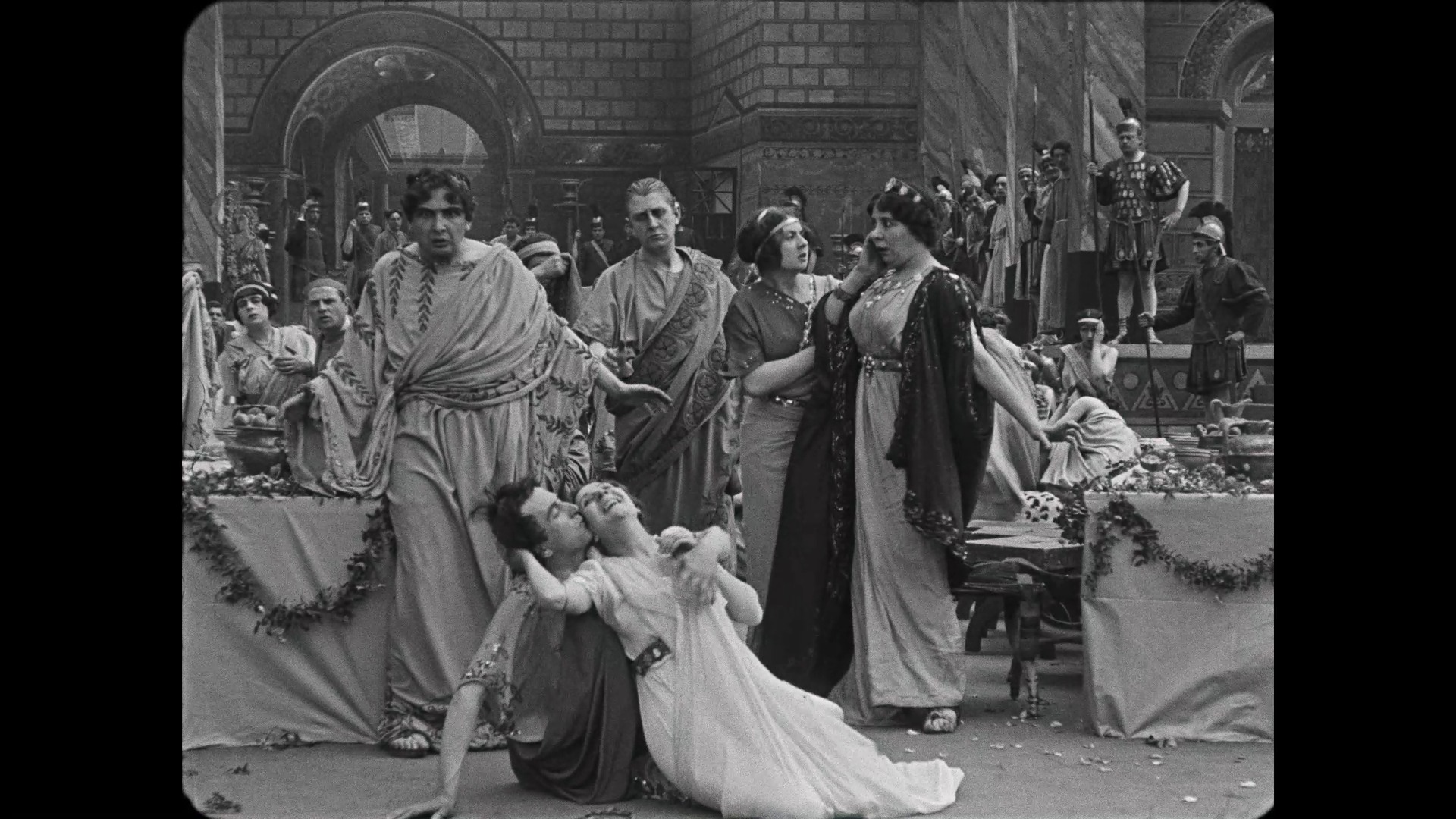
The debt to Racine also meant that Britannicus, unlike the short of 1897, situates Nero’s testing of poisons in the broader context of his plotting to retain the throne. Literate intertitles declare that ‘Agrippina has Nero named emperor to the detriment of Britannicus’, that this is a shocking ‘coup d’etat’ and the rightful heir is the ‘victim of treason’. Nero wants to make Britannicus’ beloved Junie his empress and wishes to rule alone without the guardianship of his mother. Nero summons Locuste when he realizes that Britannicus, Junie and Agrippina are all conspiring against him. He deceives his political rival into thinking that he wants after all to celebrate the couple’s wedding but instead, in the film’s climactic last scene, he poisons the groom. Yet in Racine’s play, the death of Britannicus as well as the testing of Locuste’s poisons are only reported, they are not performed on stage. The filmed drama continues to render into engrossing visual spectacle Nero’s interest in poisons (as well as using the specifically cinematic device of superimposition to manifest the lies that Narcisse tells Britannicus so convincingly). The tragic banquet with which the film closes has an elaborate construction. In long shot, we at first only see Nero far back in the hall feasting separately from his guests, until an unusual camera cut-in focuses more closely on him as he prepares the poisoned wine cup. Once a soldier has marched into the foreground to give the cup to Britannicus, and Junie drinks from it to join him in death, Nero, Agrippina and Narcisse come forward to frame the dying lovers in a painterly and melodramatic composition unlike anything in Racine (fig. 2). Nero here combines grotesque poisoner, raging tyrant and grief-stricken thwarted lover.
A year earlier, however, in its 15-minute tragedy The Son of Locusta (Le fils de Locuste, 1911) the Gaumont studio appears to have offered another cinematic challenge to the French stage tradition for presenting Nero only indirectly as the poisoner of Britannicus.[5] The film, directed by Louis Feuillade, centres unusually not on Nero or his imperial competitor Britannicus but on Locuste, the woman whose job it is to provide Nero with his poisons and who has only a minor role to play in the ancient sources as a favoured ‘tool of despotism’ (Tac., Ann. 12.66).[6] The opening and close of the film are not set in the imperial palace, but in her humble home which Nero visits. The hierarchy of power that divides Nero from his lowly poisoner is put disturbingly on display through the formality and imperiousness of his movements, and his frequent positioning glowering over her. Furthermore, in stark contrast to the painterly tradition, this Locusta is no eager hag. When in her kitchen she cooks up the poisons demanded by her emperor, the film camera moves in closer to display Locusta’s fearful subservience through the eloquent gestures and facial expressions of the actress who plays her (Renée Carl, figure 3). Hidden behind a curtain, Nero again scrutinizes with evident zeal the death throes of a centurion on whom Locusta tests her poisons. The film then replaces Nero’s dynastic plotting and court banquet with a private party at which Locusta’s son accidentally drinks the poison meant for Britannicus. At the end of this tragedy, the stricken and repentant mother begs not to work any longer for the emperor. The closing shot shows her in Gaumont’s attractive colour toning cradling the body of her son like a shockingly secular version of the Pietà (that is, Mary holding the body of Christ) while the emperor departs laughing at her awful predicament.
The cinema of the early 1910s was a mass art form designed for audiences that were now mixed in terms of class and gender. French films of the period that depicted criminals as their protagonists were often condemned by critics as unhealthy for suspectable audiences and detrimental to any attempt to elevate cinema to the level of a respectable artform (Callahan, 2005). A brochure designed by Gaumont to sell The Son of Locusta to exhibitors clearly felt the need to go beyond its inventive plotline and its intriguing sympathy for a coerced female criminal of the lower classes. It moves beyond the timeframe of the film and back into the terrain of Tacitus and Racine to explain that Nero remains unmoved by Locusta’s pleas and demands another poison (by which Britannicus was finally killed in AD 56).[7]
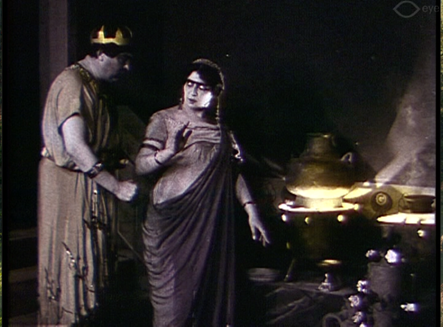
Figure 3. Locuste cooks up poisons at the demand of Nero, in Le fils de Locuste (France, 1911, Gaumont, dir. Louis Feuillade). Courtesy of Eye Filmmuseum.
Adulterer & Matricide
In the era of one-reel costume dramas, cinema also sought out Neronian themes beyond the death of Britannicus, in the emperor’s affair with Poppaea Sabina and the consequent murder of his mother Agrippina in AD 59 (details of which can be traced back to the pseudo-Senecan drama Octavia and Tacitus Annales 13-16). This focus on the emperor’s private passions seems to be a feature particular to Italian cinema and Italy’s own rich traditions for reimaging Nero in theatre and opera as the callous husband, obsessive lover or bloodthirsty son.
Nero or the Burning of Rome (Nerone o L’incendio di Roma), released in 1909 by the Torinese studio Ambrosio, is often called Italy’s first historical epic and was successfully sold internationally accompanied by a 16-page souvenir programme.[8] It begins with Nero (played by Alberto Capozzi) repudiating his wife Octavia after ‘he feels a sudden flame blaze up in his heart’ at the sight of Poppaea Sabina (played by Lydia De Roberti). Since, ‘in her mind’, she harbours ‘designs on sovereignty and domination’, she insinuates herself into Nero’s triumphal parade to enjoy the acclaim of the people. However, they soon rebel against their emperor when they see the bloodied veil that Octavia’s loyal slave brandishes and learn from her that the empress has been killed at the request of the emperor’s ‘ambitious and cruel’ mistress. To punish the rebels, Nero sets fire to Rome but, after he finds himself in his Golden House ‘abandoned by all and in the grip of remorse’, he flees the city and is helped to kill himself by his secretary Epafrodite (played by the director of the film, Luigi Maggi). The melodramatic plot is laid out in the programme in this kind of expressive detail (including dialogue) that exceeds the simple descriptions of the actual intertitles and, through the inclusion of illustrative screenshots, bestows on the film a literary quality by this connection between word and image. The storyline evidently constitutes a vastly condensed synthesis of Italian works for the stage, such as Monteverdi’s opera The Coronation of Poppaea (first performed in 1642) that features the dismissal of Octavia and her replacement by Poppaea or the popular play about Nero by Pietro Cossa (first performed in 1871) that features both the character Epafrodite and Nero’s suicide.[9]
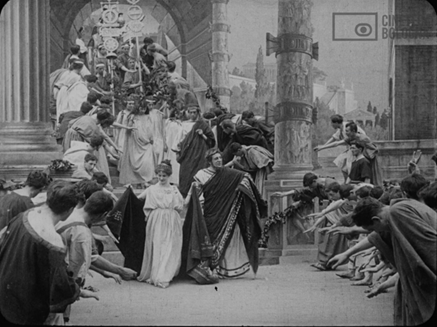
The film also demonstrates its debt to the stylistic conventions of the stage, as most scenes are presented in the form of self-contained tableaux vivant with characters gesturing grandly before painted backdrops as they face out toward their audience in the cinema. Yet use is also made of exterior settings (an attractive lake-side garden for Poppaea’s further seduction of Nero and an isolated woodland for Nero’s ignominious death). The camera is often positioned at an angle to the sets better to suggest their depth, which is equally displayed through the choreography on diagonals of the large cast, as in Nero’s triumphal procession down some steps accompanied by Poppaea and a host of soldiers and standard-bearers (fig. 4).[10] On several occasions emotion has a spatial distribution within the ornate mise en scène, as when the emperor moves into the foreground expressing desire or glee, while his wife is separated in the background expressing, in contrast, anxiety or distress. For example, while Nero is embracing his mistress in the foreground, Octavia enters the banquet hall from the back and approaches her husband to beg miserably for the return of her imperial power.
However indebted the film may have been to the Italian traditions of opera and spoken drama, its later scenes added to court adultery and uxoricide the burning of Rome (presented as a means to punish the consequent rebellion) as well as the remorse of Nero for then scapegoating the Christians. Contemporary Italian reviewers recognised that these additions required alterations to conventional historical causes and to the character of Nero. On 31 October 1909, the film magazine Lux (published weekly in Naples) asked where did Ambrosio get the idea that Nero set fire to Rome to quash a revolt against his sexual desires? Or that Nero experienced remorse?[11] Their conclusion was that the studio wanted to show off advances in its cinematographic skills, to which an intertitle in the arson scenes seems to draw attention when it declares ‘Nero sings over Rome and enjoys the impressive spectacle’. Spectators were invited to anticipate how that spectacle might be presented on screen when it was publicised as part of the film’s title, and through the proleptic appearance of a smoking brazier and a lyre propped against Nero’s chair in early sequences. In the scene itself, uplighting, billowing smoke and a deep red tint were deployed for maximum visual effect and in imitation of the traditions for representing the burning of Rome in antiquarian paintings and in illustrations to the many editions of the historical novel by Henryk Sienkiewicz in which the fire of Rome was vividly described, Quo vadis: A Tale of the Time of Nero (1896).[12]
Video clip 1. Nero experiences remorse, Nerone o L’incendio di Roma (Italy, 1909, Ambrosio, dir. Luigi Maggi). Courtesy of Cineteca di Bologna.
The next scene of Nero’s remorse (‘I rimorsi di Nerone’) appears especially abrupt in narrative terms as Poppaea has now disappeared from the plotline while the Christians have not featured before nor is their martyrdom mentioned in the scene’s intertitle. Yet it is ingeniously complex in pictorial terms as it merges two paintings into one short spectacular sequence (see video clip 1). The position of Nero, casually draped across a couch, and his haunted rather than cruel expression recall John William Waterhouse’s painting The Remorse of Emperor Nero after the Murder of his Mother (1878), while the two nightmare visions he sees projected onto his bedroom wall through the cinematic technique of superimposition show segments of Jean-Léon Gérôme’s The Christian Martyrs’ Last Prayer (1883) in motion – their supplications in the arena followed by their burning as human torches.[13] It was this equally red-tinted sequence that vastly impressed audiences of the film on its release both in Italy and abroad. According to the American trade journal The Moving Picture World of 6 November 1909, it possessed ‘such a marvelous realism of affect that as we sat and watched this colored part of the film, we seemed, as it were, to hear the cries of the victims’. The deployment and propulsion of antiquarian paintings or book illustrations became a common strategy in feature-length Italian films to render in aesthetic terms the later, spectacular parts of Nero’s reign, while celebrating the visual power of the medium as pictures that moved realistically.[14]
Two years later, in 1911, the one-reel film Agrippina (directed by Enrico Guazzoni for the Roman studio Cines) also demonstrated its commitment to the Italian performance tradition for Nero through the decorative display of ancient masks of tragedy and comedy above its opening title.[15] That tradition had frequently staged aspects of Agrippina’s involvement in the accession of Nero to the imperial throne in AD 54 and her loss of power over him, such as in the frequently restaged operas Nerone fatto Cesare (Nero Made Caesar) with a libretto by Matteo Noris and music composed by Alessandro Scarlatti (first performed in 1692-3) or Agrippina with a libretto by Vincenzo Grimani and music by Handel (first performed in 1709). Such works pulled away from their source in Tacitus Annales 14 by giving voice through song to Agrippina’s fears, ambitions and desires.[16] In the film, the empress takes precedence over Nero when each of the film’s principal characters are introduced, posing uncomfortably close to the camera in costume and turning disturbingly to stare out of the film frame at the audience in the cinema. Yet, by the end of the film, the plotline, mise en scène, camerawork and, presumably, accompanying music have all built up sympathy for her in addition to the dignity with which she is performance by Adele Bianchi Azzarili.[17] This protagonist is a mother who had been ambitious for her son to the point of poisoning her husband (as the film insinuates at the start), yet she has also been concerned with the proprieties of marriage, courageous in her attempt to evade being killed and tragic in her final gesture to her assassin to strike her in the womb where her monstrous son had been nurtured (as told in Tacitus Ann. 14.8).
In the first part of Agrippina, we witness the empress in Tacitean mode placing the mantle of power on her son in the imperial palace and, before the cowed Senate, ceremoniously passing to him a laurel crown for his head. The mother’s transgressive authority over both the Roman state and her child is further demonstrated when we see her in the foreground of a shot driving away Nero’s mistress or centre frame threatening to put Britannicus on the throne in his place. As Agrippina loses her authority, however, and Nero turns to the poisons of Locusta, so some sympathy is solicited for her by the film. Roughly halfway through, in the banquet scene, the weight of perversity shifts away from the mother on to the son. We see Agrippina rising and clutching her face in horror at her realisation that Nero has arranged for his rival Britannicus to be killed right before his guests’ eyes (fig. 5). Guazzoni, by training a painter and set designer, and soon to be famed for a whole series of meticulously antiquarian and pictorial reconstructions of ancient Rome on film, has here arranged the deadly feast in a frontal, painterly composition reminiscent of the layout of Nero’s banquets on the French and Italian stage and tinted pink to emphasise the presence of sorcery. Although Agrippina does not go on to present the persecution of the Christians, the scene may evoke by way of contrast Christ’s last supper and the identification of Nero as the Antichrist promoted by the early Church.[18]
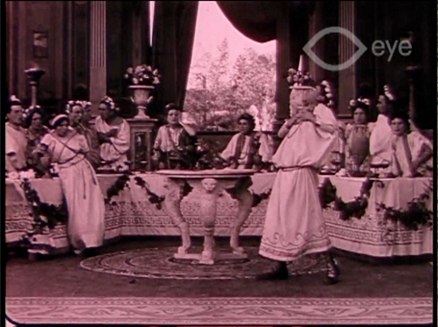
In the latter part of the film, and now fully independent, Nero conspires to have Agrippina murdered. The cinematic portrayal of the first attempt by Nero’s tribune to kill her breaks away radically from theatrical space to depict at some length, on location by the sea and from multiple camera angles and distances the courage of a woman trying to save herself from drowning. Finally, the tribune stabs Agrippina to death in her home. Her murder occurs offscreen but, unusually for the time when the film was made, the camera pans left to focus on her dying moments. In contrast to the Tacitean narrative of the years of Nero’s reign, this is where the film ends, focussed not on Nero but on maternal tragedy.[19] We are invited to watch a death not with imperial satisfaction but with modern horror. In this period, before feature filmmaking, spectators would have seen Agrippina in a variety programme containing other films set in the past, present or future. Drawn into Neronian history in this way, they were offered an opportunity to consider - in the extreme - questions about the relationship of sons to their mothers in the modern world, a world they would have seen in some of the other films they watched alongside this historical drama.
When the Italian film Nerone e Agrippina (Nero and Agrippina) was released in 1914, however, with a runtime in its original version of almost two hours, it was exhibited as a standalone feature in large venues accompanied by an orchestra. By now, the emperor had become so common a subject of Italian filmmaking that reviewers recognised this epic (or ‘kolossal’ as the genre was labelled in Italy) as an attempt by the Torinese studio Gloria and the director Mario Caserini - in intramedial competition - to outdo the Neronian films that had preceded it, especially Agrippina (1911) and, more recently, the feature-length Quo vadis (1913), both made by Guazzoni for the Rome studio Cines.[20] Lydia De Roberti even reprised her role from Ambrosio’s film as Poppaea, while the director’s wife, Maria Gasparini, played Agrippina and the celebrated stage actor Vittorio Rossi-Pianelli played Nero. The advertising for the film’s screening in September 1914 at the Politeama cinema in Piombino (Livorno) boasted that it was ‘superior to every other masterpiece, an absolute novelty, our exclusive’.[21]
The plotline, as the title suggests, takes the emperor’s disturbing relationship with his mother as its key theme played out across four acts, yet covers a tragic parabola for Nero’s reign from accession to death by adding, in act five, an extended presentation of the martyrdom of the Christians and Nero’s suicide. In an illustrated publicity programme produced by Gloria, the screenwriter elaborates an intriguing distinction between what cinema can do with the famous emperor (whose person, he says, ‘still today radiates a grim light of terror’) and what poets and novelists have already done (Cossa and Sienkiewicz are named as well as Arrigo Boito who had published a libretto in 1901 for an opera about religious cults in Neronian Rome). Poets, he says, lead us into someone’s soul, novelists find the obscure causes of events but filmmakers recreate an ambience, an exteriority from which an interiority can be inferred. Operatic, theatrical and novelistic strands are woven into the plot of Nerone e Agrippina, and some scenes are shot with the camera close enough to capture facial expressions and a sense of intimacy. A rare mid-shot, for example, displays Poppaea preparing herself for an encounter with the emperor not long before she persuades him that he has the power to set fire to Rome. She looks in a mirror with self-admiration, sniffs a proffered perfume and rubs it sensuously into her skin. Yet, in the main, the film does not unfold as a drama of Neronian decadence and tyrannic cruelty but as a pleasurable spectacle, even in those acts where it is concerned with court intrigue.
Many of the sets (the Golden House, the Senate, the imperial theatre, the villa by the sea at Anzio) are so vast that the actors are dwarfed by them. And although characters wear richly decorated costumes, they are easy to overlook in comparison with the intricately designed three-dimensional perspectives of the monumental buildings through and before which they move. When Poppaea encourages Nero to burn Rome, for example, she stands with him on a high terrace whose framing columns draw the eye back beyond the imperial group to the arches, colonnades, columns and temple facades in the distance on which the sun is casting attractive shadows but which soon will all be in flames (fig. 6).
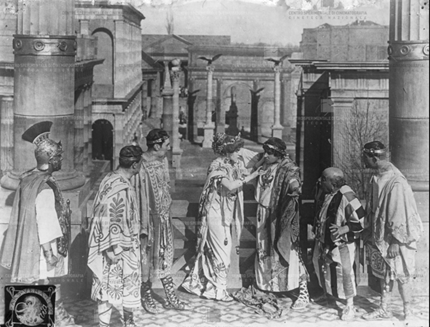
While the studio and some reviewers expressed great admiration for this emphasis on space and spectacle, others observed that it emptied Nerone e Agrippina of dramatic impact. Actors are left to parade rather than perform, and spectators to appreciate the material reconstruction of Rome rather than engage with the individuals caught up in the capricious savagery with which Nero was associated.[22] Although the most spectacular sequence in the Circus of gladiatorial fighting and the martyrdom of the Christians is absent from the surviving print of the film, the associated publicity on its production and surviving screenshots indicate that it was ingeniously shot in the Roman arena at Verona with the use of 900 extras. Yet the Christians are introduced abruptly into the film after more than an hour and afforded only superficial characterisation, such that cinema audiences might scarcely care that an innocent girl is assaulted by Nero but manages to escape his deadly punishments. No wonder that when the epic was exhibited in Britain, for example, the two-page spread in The Bioscope for 16 April 1914 placed ‘an enthralling human story’ fourth in the virtues of the film, after its spectacle, vivid reconstructions and pictorial art. As we shall see, Caserini’s Nerone e Agrippina could not match Guazzoni’s Quo vadis for the cinematic representation of the persecution of the Christians as both an enthralling story and a message of contemporary importance – key requirements for the commercial success of the epic genre.
Arsonist & Persecutor of Christians
A significant number of silent films about Nero include, or focus particularly, on the catastrophic fire that engulfed Rome in AD 64 and the consequent punishment of the Christian community. Both are presented as incontestable features of the emperor’s reign and as ones that he orchestrated or was persuaded to orchestrate. The reconstruction of such events in moving images clearly offered the medium an opportunity to show off its capacity for spectacle but also, as film-going became a practice deeply embedded in society, was used as part of an industry strategy to demonstrate the social respectability of cinema and even its potential to uplift spectators and give drama to their religious identities.
Two works from the late nineteenth century, a period of heightened interest in Nero’s religious repercussions, provide key sources for silent cinema’s portrayal of the emperor as arsonist and persecutor of Christians. Sienkiewicz’ historical narrative Quo vadis was first serialised in a Polish magazine in 1895 and, concurrently, Wilson Barrett’s religious melodrama The Sign of the Cross was performed in the United States. Both outline how a dissolute Roman officer in Nero’s court experiences a religious conversion after being struck by love for a Christian girl of such intensity that he is prepared to face martyrdom with her. Both works achieved great success. The Sign of the Cross was reperformed many times in Anglophone contexts,[23] while Quo vadis circulated internationally in many lavishly illustrated translations and was adapted for the stage as both tragedy and opera.[24] However, in orientation, Quo vadis is unmistakeably Catholic whilst The Sign of the Cross is Protestant and evangelical. As the novel’s title (borrowed from Church legend) implies, it is driven by the apostle Peter’s encounter with a vision of Christ on the via Appia and his struggle to protect the Christian community against the Antichrist. The Christian girl and her lover escape the terrible martyrdoms in the arena the emperor has ordered, the people rebel against his tyranny and the novel ends with Nero’s humiliating suicide and Peter’s triumphant foundation of the Church at Rome. The Sign of the Cross gives little dramatic space to martyrdom. It enacts instead the soldier’s path to conversion and a commitment to the Cross such that the play ends in the arena dungeons as the couple prepare to be thrown to the lions. These divergent emphases reemerge in the cinematic visions of Nero as persecutor, according to different contexts of production and exhibition and according to the growing claims for cinema as a social force.
The Quo vadis of 1901 directed by Ferdinand Zecca and Lucien Nonguet for the French studio Pathé Frères does not present the events of Nero’s reign as a religious message but (in keeping with its very early date) as a thrilling assortment of visual pleasures edged with danger. In a single tableau with a running time of around three minutes, involving more than thirty actors composed frontally before a richly painted décor, the emperor processes into his banqueting hall and takes up pride of place enthroned on high, centre screen. From that position, he can fully appreciate a combat of gladiators, lascivious dances and a disordered orgy that take place in the screen space between him and the audience in the cinema he faces. These kinetic activities are given a pronounced pictorial quality through their dense evocation of nineteenth-century paintings of Roman combat and Roman depravity.[25] The French film is explicitly presented in the studio’s catalogue for exhibitors as an extraction for the screen of the novel’s most interesting parts and is scarcely intelligible without knowledge of it - we witness the novel’s Christian innocent (Lygia) being rescued by her faithful servant (Ursus) from the drunken assault of her Roman suitor (Vinicius). Yet it shows no sign of the original’s religiosity, Catholic or otherwise. On screen Lygia visibly shrinks away in distaste from the debauchery around her, but she is positioned on its margins better for it to be displayed to the emperor and the film audience. The burning of Rome is then the climactic work of this imperial master of spectacles. Courtiers remove the emperor’s throne and table and pull open the curtains at the rear of the set to display the smoke billowing over a panorama of the city and, simultaneously, the set’s impressively deep staging (Salmon, 2024: 10-11).
By the end of that decade, however, European film industries had already come to recognise the need for a more sustained engagement with respected literary or theatrical works in their productions, films about Nero included. Taking American filmmaking in this same direction, J. Stuart Blackton, founder and principal director of the Vitagraph Company of America, understood that there was profit and new audiences to be made from ‘quality’ films. Those with religious subjects or based on Scripture, he saw as providing the additional opportunity to adopt a moral tone that would challenge the powerful criticism of cinema being made by American social reformers. When he directed The Way of the Cross in 1909, Blackton thus enterprisingly advertised the celebrity cleric Reverend Madison C. Peters as its religious consultant (a role Peters went on to play for biblical subjects made by Vitagraph, including the multi-reel Life of Moses made later in the same year). The Reverend duly promoted such films as able vividly to communicate Scripture and therefore as suitable for traditional churchgoers to see.[26]
The Way of the Cross is evidently an adaptation to screen of the by now acclaimed play Sign of the Cross, condensed into just under 10 minutes.[27] Perhaps to avoid copyright concerns, however, it adopts a slightly different title and changes the names of some of the characters including the Roman officer, his Christian beloved, and the dissolute woman whose unrequited love for him impels her first to ask Nero to fetch the innocent girl to a feast at his palace and then to sign a decree of death against the Christians.[28] The film displays high production values and much time is given over to the visual pleasures of spectacle, including in terms of period detail, décor and deep staging. The action at the imperial palace, for example, occurs behind a stretch of water that runs across the foreground of the film frame and in which daylight and the actors’ movements are reflected. At the end of the film, the couple embrace in the arena prison in front of the bars of a cage behind which real lions prowl. There are also a number of visions created through the cinematic device of superimposition, but these visions all have clear moral purpose. After the Christian heroine Leah has refused on multiple occasions to deny her religion and is condemned to death, her protective hero Valerius visits the arena prison where he experiences a struggle over his loyalties. The sequence demonstrating his internal psychological state, torn between transcendent love and dissolute living, is embodied in the visions he sees of first the Christian girl flourishing her cross and then the courtesan proffering a wine cup (see video clip 2). His struggle is resolved with a revelation of the Cross (fig. 7). In earlier scenes, Leah had waved her cross before Valerius, at Nero’s court and in the arena in the hope of showing the Romans by this means the path of commitment to Christ. In evangelism, the Cross represents the suffering, death and resurrection of Jesus and symbolises salvation and new life. Now it is all that the Roman soldier sees and before which he kneels in prayer.
In the focus of The Way of the Cross on this tale of a Roman soldier at Nero’s court transformed by divine intervention, the spectacle of the Cross becomes a stand-in for the spiritual power of moving images, and the converted protagonist a stand-in for a reverential version of offscreen spectatorship. Such visual strategies enabled the American film industry to align cinema rhetorically with the institutions of the church, claiming that it could offer to spectators ‘screen sermons’ (Krämer, 1992). Nonetheless, the trade paper Moving Picture World for 28 August 1909 appeared unsettled by the film. Although the reviewer found it to be a strong prospect commercially, they were unsure whether it should be shown. They questioned the historical accuracy of having a jealous courtesan induce Nero to condemn the Christians and considered the mere presence of the lions too suggestive of the horrors the community were compelled to confront.
There are martyrdoms aplenty, however, in the Italian feature film Quo vadis? of 1913, directed by Enrico Guazzoni for the Roman studio Cines (and starring Carlo Cattaneo as Nero).[29] The film was promoted and exhibited as a cultural artefact that could speak to and for the Italian nation in its elaborate reconstruction of the country’s shared cultural heritage across a runtime of almost two hours. Through films whose stories had international appeal and were made on this lavish scale, Cines also aspired to conquer foreign markets. The premieres of Quo vadis? at home and abroad were thus confected with a sense of grand occasion. In Rome, it opened at higher-than-normal prices in one of Italy’s most famous opera houses (the Teatro Costanzi), accompanied by an orchestra, voices and a choir of fifty singers from the city’s churches. In London, it was shown at the Royal Albert Hall for four weeks and the visit to see it of King George V and Queen Mary was widely reported. As hoped, Quo vadis? achieved extraordinary success in Italy and on world markets, from Brazil to Japan, Canada to Australia, rendering it undoubtedly the most important film made about Nero in the silent era.
Cines promoted its film widely as a faithful adaptation to screen of the celebrated historical novel, and as a work possessed of comparable artistry. Even though it only quoted the richly metaphoric language used by Sienkiewicz in its concluding intertitles, it was characterized throughout by considerable narrative complexity, heavy investment in sensationally realistic spectacle and a strategy of competitiveness with the high arts. In comparison with theatre, the camera often shortens or radically extends the distance between actors and their audience as well as capturing sequences shot on original locations in and around Rome. The solidity and depth of sets, the careful antiquarianism of costumes and props, and the number and mobility of extras are all flaunted. Quo vadis? also exploits the capacity of cinema to exceed the representational possibilities of painting by adding motion, as well as temporal and spatial expansion, to the nineteenth-century paintings it often evokes. In the vast open-air auditorium constructed for the arena sequence, for example, the camera alternates long, medium and point-of-view shots to engage offscreen spectators with spectacles of chariot racing, gladiatorial combat and Christian martyrdom. The difference between painting and cinema is emphasized by the amount of film time given over to a single shot of Nero’s soldiers relentlessly pushing the Christians to the back of the arena, until they turn and take up a position that momentarily reproduces the composition of Jean-Léon Gérôme’s painting The Christian Martyrs’ Last Prayer of 1883 (Blom, 2023: 35-38).[30] The camera then cuts away to the lions pacing about in the enclosures underground, before returning to pan the expression of terror on the faces of the Christians at prayer and to look up at the pleasure on the face of the emperor who observes the misfortunates from his imperial box.
As a film studio funded by the Vatican’s bank, Cines had also been organizing its film-making activities as a way of extending Catholic influence in Italian society. Thus, scenes which feature the Apostle Peter, the founder of the Church at Rome, appear to resonant with contemporary religious significance. Through their excavations of the city’s catacombs in the early years of the twentieth century, Christian archaeologists were endorsing Church doctrine that Peter and Paul had been martyred in Rome during the reign of Nero (a doctrine that had been fundamental to the justification of Catholicism and its centering in the Vatican). When Quo vadis? shows those catacombs fully restored from ruin and peoples them once again with Christians, it also places Saint Peter in their midst. The photographic realism of the film medium thus adds the presumption of historical reality to the Apostle’s presence in Rome and the camera invites offscreen spectators to enter the catacombs with it and join the community before whom he preaches.
Later, Saint Peter prepares to baptise the Roman officer Vinicius in a humble Christian home. As the new convert kneels, so some workmen’s tools are revealed hanging on a black curtain behind his head – an axe fastened to a sickle. The combination of axe and sickle had already been used by labour groups in Italy as a symbol of class struggle. Its surprising presence in the film works to subsume the repression of socialists by the secular, Liberal Italian state into its repression of Catholics (just as the left-wing Italian press had frequently coopted Jesus as a socialist). Cines’ film indigenises the political allegory that had been understood to operate in Sienkiewicz’s novel, where innocent Lygia embodied Catholic Poland in need of rescue from its irreligious imperial oppressors. Transposed into the contemporary Italian context of a struggle between Church and State, the arena scene of Quo vadis? seems to play out the need for the salvation of Catholic Italy from the tyranny of Italy’s Liberal government embodied in Nero and the savagery of the beasts he unleashes there. The film also includes the visitation of Christ to Peter on the Via Appia drawn from the early Church legend that it was this visitation and Christ’s reply to Peter’s question quo vadis, domine? that turned the fleeing apostle back to Rome. The film uses location shooting on the Via Appia itself and the special effect of superimposition to make its modern spectators witness the miraculous moment when Rome became the city of Christ and Peter the protector of the Christian community (see video clip 3). The titular scene exploits fully the devices of cinema to find sanction in religious history for the revival of the Vatican’s authority in contemporary Italy.
Sienkiewicz’s novel ended, after the death of Nero, in present time with Saint Peter’s Church standing victorious on the Vatican hill, commanding the city and the world. The Cines adaptation of the novel to screen is, however, more circumspect, perhaps in deference to the screening of its film in secular Italy and to the profits to be made from its export to non-Catholic countries. The last shot of Quo vadis? gradually illuminates Christ standing before a bright white cross. He looks down at the suppliants kneeling before him, whose chains he breaks, and then out directly at the audience watching the film. This is a vision rather than a scene because it has no specific location. It intimates that the sight of Christ will liberate people and lift them up into the light of salvation, and that it is in the cinema where such an experience is to be found.
This ending was not sufficient to prevent criticism of Quo vadis? when it was distributed in the United States. Church ministers complained that the film seemed anachronistically to impose Catholic practices on the early Christians – particularly their making the Sign of the Cross and their baptism by means other than full emersion.[31] Within the year, however, the American market would have available a version of Nero’s persecutions more amenable to Protestant audiences in the form of the feature film The Sign of the Cross (here referring to the significance of the Cross to the Christian community not to the religious gesture). This sustained adaptation to screen of the Barrett play was released by the studio Famous Players at Christmas time in 1914 better to milk profit from a cinematic version of religious uplift. It was directed by Frederick A. Thomson with a run time of roughly 70 minutes (Sheridan Block played Nero). In the United States in the 1910s, the ‘Progressive’ movement was attempting to improve urban life by reasserting Protestant values and establishing them as part of a shared American identity. Of all the available entertainments, motion pictures were the greatest cause of concern for such reformers, because now cinema had become a major cultural institution and studies were emerging of its significant social and psychological impact on individual spectators. Foreign films (such as French or Italian ones) were disparaged as morbid, gruesome or indecent and demands were made for them to be replaced by good, clean, patriotic American films (Keil, 2009).
Following the emblematic quality of the play, therefore, spectators of Thomson’s film witness the Christian girl Mercia or ‘Compassion’ challenging the decadence of the Roman elite.[32] Through her ennobling influence, the Roman prefect Marcus Superbus or ‘Arrogance’ rejects the mortal sovereignty of Nero and joins her in the arena on the journey to paradise. The emperor’s role here is to symbolize earthly excess and abuse of power and, therefore, he appears only intermittently and is given little character. At the opening of the film, his bright, spacious imperial gardens stand in contrast with the dark and humble cottage where Mercia is instructed in Scripture. When the emperor is induced by his wife and another patrician woman (who both lust after Marcus) first to arrest the Christians and then to throw them to the lions, his decadence is marked out in these two interior scenes by Orientalizing props – black slaves, peacock feather fans, animal skins, dangling earrings, ornate clothing and bejewelled fingers that shake as he brandishes his imperial sceptre and slumps on his throne. In his fourth appearance, in the imperial box at the arena, he grimaces, sticks out his tongue and points with grotesque delight at the Christians awaiting death (fig. 7).
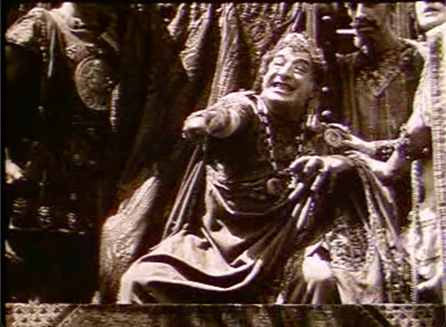
The religious tone of the film’s narrative drive is clearly presented as Protestant rather than Catholic. Saint Peter has no role to play at Rome (as he does in the Polish novel and its Italian film adaptation). When Roman troops are sent to arrest the Christians and Marcus rides to their rescue, they are found gathered in the countryside to hear a reading from Paul’s Letter to the Romans. God’s authority comes to the city from far away. The film’s early Christians are also represented as evangelical. Emphasis is placed on the importance of sharing the message of Christ and on the conversion experience. Marcus, having already fallen romantically for Mercia, fails to participate in an elaborate ‘feast of Bacchus’ that he has organised in his villa. When, in the adjacent room, he tries instead to seduce the innocent Christian, he is stopped in his tracks. Mercia is provided with commanding dialogue here: ‘Desist from me Marcus Superbus and look up to the Cross’. As they sit side by side, she tells him with highly animated gestures and facial expressions the story of Christ’s life. Intertitles deliver snatches of her reverential account which is also intercut with pictures of events from Christ’s birth to his crucifixion, all reminiscent of sacred paintings and framed pictorially in an iris. The scene operates not just at the narrative level to mark the power of the Cross to convert, but also at a meta-cinematic level to substantiate the ethical value of motion pictures. Mercia behaves like a pious film director conjuring up sacred scenes of the life of Christ and Marcus like the ideal film spectator – totally transfixed by the uplifting spectacle placed before him.
Barrett’s play ended in the dungeons with the Roman soldier's declaration of faith and commitment to martyrdom with Mercia. The film adaptation, however, moves on into the arena and the narrative space of the Catholic novel about the time of Nero. Yet, after we see sequences of gladiatorial fighting, Christian prayer and the sadistic pleasure of Nero, we appreciate the more that, in this American version of Neronian history as opposed to the Italian Quo vadis? of the preceding year, the story ends here, in the arena, with the couple embracing, before the Christians actually die. There will be no revolt against the emperor and no visitation of Christ to Peter along the Appian Way. Nero will not die, and the Church will not triumph in the city of Rome. Only individual conversion and personal salvation matter.[33] The final shot of The Sign of the Cross shows a cross planted on top of a hill with light radiating out from behind it. But this is not Calvary, the cross is bare and set in what looks like the American wilderness. This ending thus invites spectators to conclude their cinematic experience gazing at the comforting (if unrealized) vision of a new dawn – a redemptive era begun in the Neronian past but heralding an American future where Protestant faith will transcend present-day corruption.[34]
In contrast, the 1924 European coproduction Quo vadis, directed by Gabriellino D’Annunzio and George Jacoby for the cartel Unione Cinematografica Italiana and with additional financing from Germany, dwells somewhat indulgently on the Neronian corruption that Christianity is supposed to be on the cusp of sweeping away.[35] The film’s opening intertitles declare grandiosely (and, perhaps, tantalisingly): ‘Rome at its apex is a powerful vortex drawing in all of the empire’s vices and virtues – a crucible of might, courage, beauty and corruption. And on her splendid throne, a satyr – cunning, indolent, cruel – master of the world, but never of himself.’ The first thing we see is the emperor Nero lying resplendent on a couch in the grounds of his monumental, richly decorated palace. Through his emerald ring, he peers with sadistic amusement at a series of female victims being thrown into the fountain to fatten his fish for dinner (see video clip 4). The camera then takes up his leering point of view as well as emphasising the erotic associations of semi-clad women under attack by eels through the striking use of some close-up underwater shots.
Video clip 4. Nero leers through his emerald ring at the half-naked women who have been thrown into his fountain, in Quo vadis? (1924, Italian, UCI, dir. Gabrellino D’Annunzio and George Jacoby). Courtesy of Eye Filmmuseum.
In the early 1920s, the Italian film industry was in crisis, so the directors had turned to remaking the kind of film for which Italian cinema had been celebrated across the world in the 1910s – the historical epic set in ancient Rome. [36] Consequently, this Quo vadis was designed less as an adaptation to screen of Sienkiewicz’s novel and more as a remake of, and variation on, Guazzoni’s epic of 1913.[37] One of its key departures from the earlier film is the pride of place it gives to Nero, now played by the German actor Emil Jannings as a satanic grotesque. The star power of Jannings and, therefore, the marketability he brought to the film, necessitated the enhancement of the relatively subordinate role the emperor had been allocated in the novel and its previous screen adaptations. Nero was now the main attraction and the image of Jannings in that role featuring prominently on the posters produced to advertise the film in Italy and abroad. In this new version of Neronian persecution, the emperor’s obsessive lust and his fears for his safety directly endanger the Christian girl Lygia, whom he is shown attempting to rape on two occasions, at the palace and out in the city. The apocalyptic struggle between Church and State, Christ and the Antichrist, is here condensed into lovely Lygia’s endurance of Nero’s satyric assaults.
The settings play a vital role in mapping ancient Rome as the home of vice. Yet the sunlight imperial palace is a magnificent character in itself that triumphs over the city until the Christians emerge from their underground catacombs. Ingeniously, the directors had managed to reuse for Nero’s palace the Palazzo dei festeggiamenti (‘Palace of festivities’), a pavilion designed by the architect Armando Brasini as part of a temporary Roman city built in the Villa Borghese to house the Mostra del Lazio (‘The Roman Exhibition of Agriculture, Industry and the Applied Arts’) from 1922 to 1923.[38] Long takes, extreme long or high angle shots, and the choreography of a cast of thousands display to maximum effect the magnificence of this building and the surrounding gardens. The elaborate mise en scène, richly antiquarian set décor, deep staging and elegant composition within the film frame likewise adds a cinematic beauty to the ‘vortex of vices’ of which imperial Rome and its emperor are supposedly the crucible.
In the second half of the film, its red tinting marks out danger for the Christians but also cinema’s technical capacity to display a whole city on fire. High-angled shots show a cast of thousands charging the imperial palace in angry rebellion. Christians are arrested and Christ himself at last makes not one but two appearances - in a flashback to the crucifixion that Peter had witnessed and as the miraculous vision Peter sees walking toward Rome. Well-known and, therefore, recognisable paintings are invoked as we see the Christians put to the torch in Nero’s gardens (Nero’s Torches of 1876 by Henryk Siemiradzki) or thrown to the lions in the circus (the by-now-customary work of Jean-Léon Gérôme, The Christian Martyrs’ Last Prayer of 1883). Eventually Nero commits suicide with reluctance and the Cross is declared victorious but not before we are offered a series of extraordinary visual attractions designed to match and to exceed the novel and previous film adaptations of it, including: extravagant banquets; beatings and murder; attempted rapes thwarted by a strongman; a city on fire; gladiatorial fighting, the strongman wrestling a bull; a Christian woman heroically surviving a deadly chariot race; lurid martyrdoms; and soldiers from the provinces riding to the rescue of Rome’s citizens.
Across this analysis of how Nero is represented in silent cinema, we have seen how the emperor’s nodal position in a dense network of nineteenth-century receptions of ancient Rome enabled the new medium to position itself in competition with the products of high culture. Through the vehicle of Nero, cinema could be seen to bring novels alive, to make paintings move, or to break the constraints of theatre’s spatial and material designs. National differences in production were shown to be dependent partly on the choice of source material: in France, a theatrical tradition that used Nero to explore tyranny and abuses of power; in the United States, the performance of evangelical melodrama that focused on conversion to Christ and the Cross; in Italy, an operatic tradition that expressed extreme familial passions and a novel popular for its implied support for the Catholic Church. The Quo vadis of 1924 also brings this analysis full circle back to the ambiguities surrounding the imperial gaze embedded in the first film made about Nero in 1897. Bookending the silent era, we are invited to look with revulsion at Nero as the orchestrator of supremely cruel spectacles but also, and on these occasions more importantly, to look with the fascination of Nero at the violent screen entertainment his biography has so frequently offered up to cinema.[39]
Footnotes
- ^ Another version of this essay will be published in a volume on Age(s) of Nero: Representation and Reality edited by Lauren D. Ginsberg and Chris Trinacty for De Gruyter’s Trends in Classics series. I am grateful to the editors for their comments on the chapter I wrote for that book, a few of which I have also picked up on here.
- ^ On Marey and how his studies were influenced by the chronophotographs of Eadweard Muybridge, see Tosi, 2005: 33-191; Mannoni, 2000: 304-363.
- ^ Cf. Hansen, 1991:30-34 who discusses the equally sadistic appeal of some early Edison films, such as the historical reenactment of the execution of Mary Queen of Scots and the restaging of the execution in the electric chair of President McKinley’s assassin.
- ^ See Tunstil, 2003 for an illustration of the cover and for an analysis of the film as an adaptation to the silent screen of Racine.
- ^ On the film, see Wyke, 2026: 25-27.
- ^ On Locusta and female poisoners at Rome, see Cilliers, 2019.
- ^ The brochure, ‘Nouveauté cinematographique’, no. 3293, 1911, is accessible on the website of the Gaumont-Pathé archive.
- ^ The accessible print of Nero or the Burning of Rome in the BFI archive has a runtime of only 2 minutes 30 seconds and German intertitles. It has no main title, is incomplete and its scenes are in the wrong order. The nitrate master is fused with rust. However, the film was restored in 2018 by the Fondazione Cineteca di Bologna, the Museo Nazionale del Cinema (Turin) and the Centro Sperimentale di Cinematografia (Rome). The restoration runs to almost 17 minutes, is tinted and contains Italian intertitles.
- ^ The publicity brochure for the film is available through the website of the Museo Nazionale del Cinema in Turin. See Manuwald 2013 for a comprehensive survey of representations of Nero in opera and spoken drama.
- ^ For this discussion of the film’s interesting use of depth of field, I am indebted to Stella Dagna who discussed it at a workshop run by the Museum of Dreamworlds team at the Eye Filmmuseum in Amsterdam in April 2025.
- ^ Cited in Bernardini, 1996: 344.
- ^ On the novel’s huge influence on representations of Nero in twentieth-century popular culture, see Woźniak and Wyke, 2020.
- ^ For this discussion of the sequence of Nero’s remorse, I am indebted to Andrea Meneghelli who discussed it and the restoration of the film undertaken by Fondazione Cineteca di Bologna at a workshop run by the Museum of Dreamworlds team at the Eye Filmmuseum in Amsterdam in April 2025.
- ^ For this use of art in early Italian antiquity films, see especially Blom, 2023.
- ^ See further on this film, Wyke, 2026: 23-25. There seems to be some hesitancy over the precise identification of the actor who plays Nero.
- ^ Manuwald, 2013 offers a broad survey of how operas about Nero transform the ancient sources; Lanfossi, 2019 considers in particular the genealogies of their versions of Agrippina.
- ^ The actress is sometimes mistakenly identified as Maria Gasparini.
- ^ For Nero as the Antichrist, see Malik, 2020.
- ^ Gili, 1999: 91-92 notes Guazzoni’s astonishing use of location shooting and panoramas here to reinforce his film’s dramatic tension.
- ^ For selected passages from reviews of the film, see Martinelli,1993: 69-73.
- ^ The website of the Museo Nazionale del Cinema in Turin hosts an array of documents concerning the film, including studio publicity, exhibitors’ advertising and Italian reviews.
- ^ See Dagna, 2012: 77-79 on how Caserini’s emphasis on spectacle in this film alienates spectators from engagement with the diva playing Agrippina.
- ^ See Mayer, 1994 for The Sign of the Cross as an example of a successful toga play.
- ^ Various chapters in Woźniak and Wyke, 2020 consider the novel’s wide circulation and its transformation into theatre.
- ^ The scene variously evokes: the falling roses that smother to death the emperor’s garlanded guests in The Roses of Heliogabalus (Lawrence Alma-Tadema, 1888); the bold stance of the gladiator with one foot on his prostrate opponent as he awaits the imperial pronouncement of life or death in Pollice Verso (Jean-Léon Gérôme, 1872); the diaphanous garments and excited gestures of the dancers in Floralia (Hobbe Smith, 1898) or Roman Orgy in the Time of the Caesars (Henryk Siemiradzki, 1872); the overturned jugs and sprawling drunks in The Romans in their Decadence (Thomas Couture, 1847). On such dense pictorial invocations, see Blom 2023.
- ^ On Vitagraph, Blackton and quality films, see Shepherd, 2013: 61-94.
- ^ This film print, with German intertitles, appears to be unique to the BFI. The Library of Congress only has paper print fragments in its Vitagraph collection.
- ^ An earlier British adaptation to screen of The Sign of the Cross from 1904, that appears to have reproduced the original characters Marcus and Mercia, does not survive.
- ^ See Wyke, 2020 for a more extensive discussion of Quo vadis (1913) along these lines. The print in the BFI archive possesses French intertitles but carries a stock date of 1922, meaning it is a later reissue. The film was restored in 1996 by the Fondazione Cineteca Italiana (Milan) and the Eye Filmmuseum (Amsterdam) with English intertitles assembled from a number of surviving sources. It was restored again in 2026 with Italian intertitles. The intertitles of the BFI French reissue frequently use past tenses for narration, insert more dialogue and additionally contain illustrative pictures. For the growing complexity of intertitles in the course of the silent era, see Elliott, 2003: 90-96.
- ^ Blom also notes the striking use in this arena sequence of a static insert as a gladiator poses with his foot on the body of his defeated opponent in order to help audiences recognise that it is a quotation of Gérôme’s Pollice verso (1872).
- ^ For one such complaint, see the handwritten letter sent to the American distributor of Quo vadis, George Kleine, signed by E. E. Hartley and dated 13 August 1913. The letter survives among the papers of George Kleine to be found in the Manuscripts Division of the Library of Congress, in Box 27 ‘Publicity’.
- ^ For a discussion of this film focussed on the representation of the Christian girl Mercia, see Wyke, 2026.
- ^ This is how the arena sequence plays out in the two reels of The Sign of the Cross that survive in the Library of Congress. Interestingly, in the print at the Eye Filmmuseum in Amsterdam, segments from Quo vadis? have been inserted to show the Christians being devoured by the lions. As if they were needed to make Sign more marketable in Europe.
- ^ I am very grateful to the audience of a talk I gave to the St Andrews Classics department for their recognition of this landscape as American in appearance.
- ^ The accessible BFI print is black & white and has a runtime of around 83 minutes, with sections clearly missing, especially from reel 3. A tinted version of the film was restored in 2002 by the Nederlands Filmmuseum (now Eye Filmmuseum, Amsterdam) in collaboration with Fondazione Cineteca Italiana (Milan) and Fondazione Scuola Nazionale di Cinema – Cineteca Nazionale (Rome), with a runtime of 134 minutes and English intertitles.
- ^ For Quo vadis (1924) in the context of postwar film making and the Italian industrial crisis, see Wyke, 2017: 62-66.
- ^ See Scodel and Bettenworth, 2008 for extensive discussion of how this adaptation of the novel to screen compares with others.
- ^ Aylin Atacan’s essay on Quo vadis (1924) on this website offers a detailed discussion of Brasini’s pavilion and its role in the film.
- ^ For Nero’s place in sound cinema, see Winkler, 2017.
Nerone (original)
1909
The life of Emperor Nero. Based on the dramatic poem by Arrigo Boito. No main title. Nero and his servant talking in the palace. They leave (6). Two …
Quo Vadis? (original)
1913
HISTORICAL DRAMA. A story of the persecution of the Christians by the Emperor Nero. Rl.1. [Section missing] Petronius persuades Nero to have the beau…
Quo Vadis? (original)
1924
A story of the persecution of the Christians by the Emperor Nero. Rl.1. Nero amuses himself by watching his victims being cast into the wayer to feed…
The Way of the Cross
1909
No main title. A group of Christians march through Rome. Meanwhile, Valerius gambles and drinks with his friends. He leaves his friends and comes upo…
Abel, R. (1994) The Ciné Goes to Town: French Cinema, 1896-1914. Berkeley/ Los Angeles: University of California Press.
Auerbach, J. (2007) Body Shots: Early Cinema’s Incarnations. Berkeley/ Los Angeles: University of California Press.
Bernardini, A. (1996). Il cinema muto italiano, 1905-1909. Rome: Centro Sperimentale di Cinematografia/La Nuova ERI.
Blanshard, A. J. L. (2015) ‘The Erotic Eye: Cinema, classicism, and the sexual subject’, in Ingleheart, J. (ed.), Ancient Rome and the Construction of Modern Homosexual Identities. Oxford: Oxford University Press, pp. 253-270.
Blom, I. (2023) Quo vadis?, Cabiria and the ‘Archaeologists’: Early Italian Cinema’s Appropriation of Art and Archaeology. Turin: Kaplan.
Callahan, V. (2005) Zones of Anxiety: Movement, Musidora, and the Crime Serials of Louis Feuillade. Detroit: Wayne State University Press.
Cilliers, L. (2019) ‘Cherchez la femme: Three infamous poisoners of ancient Rome’, in P. Wexler (ed), Toxicology in Antiquity. London: Academic Press, pp. 313-26. Second edition.
Dagna, S. (2012) ‘La diva in cammino. La sfilata divistica come figura delle messinscena nel cinema di Mario Caserini’, Immagine, 5, pp. 57-85.
Dahlquist, M., Galili, D., Olsson, J. and Robert, V. (eds.) (2018) Corporeality in Early Cinema. Bloomington: Indiana University Press.
Elliott, K. (2003) Rethinking the Novel/Film Debate. Cambridge: Cambridge University Press.
Éloy, M. (2005) ‘Néron, une icône satanique’, in Joucaviel, K. (ed.) Quo Vadis? Contexte historique, littéraire et artistique de l’oeuvre de Henryk Sienkiewicz. Toulouse: Presses Universitaires du Mirail, pp. 65-120.
Gili, J. A. (1999) ‘La fascination du mal: Néron, antihéros du péplum’, Positif, 456, pp. 90-93.
Hansen, M. (1991) Babel & Babylon: Spectatorship in American Silent Film. Cambridge, MA: Harvard University Press.
Keil, C. (2009) ‘1913: Movies and the beginning of a new era’, in Keil, C. and Singer, B., American Cinema of the 1910s: Themes and Variations. New Brunswick, NJ: Rutgers University Press, pp. 92-114.
Krämer, P. (1992) ‘Screen Sermons: The uses of religion in early cinema after 1907’, in Cosandey, R., Gaudreault, A. and Gunning, T. (eds.), Une invention du Diable? Cinéma des premiers temps et religion. Lausanne: Presses de l’Université Laval, pp. 187-196.
Lanfossi, C. (2019) ‘Ghosting Agrippina: Genealogies of performance in Italian Baroque opera’, The Journal of Musicology, 36 (1), pp. 1-38.
Malik, S. (2020) The Nero-Antichrist: Founding and Fashioning a Paradigm. Cambridge: Cambridge University Press.
Mannoni, L. (2000) The Great Art of Light and Shadow: Archaeology of the Cinema. Exeter: University of Exeter Press. Original French edition 1995.
Manuwald, G. (2013) Nero in Opera: Librettos as Transformations of Ancient Sources, Berlin: De Gruyter.
Martinelli, V. (1993) Il cinema muto italiano, 1914. I film degli anni d’oro. Vol. II. Bianco e Nero. Rome: Centro Sperimentale di Cinematografia/ La Nuova ERI.
Mayer, D. (1994) Playing Out the Empire: Ben-Hur and Other Toga Plays and Films, 1883-1908. Oxford: Oxford University Press.
Michelakis, P. (2017) ‘Greece and Rome on screen: On the possibilities and promises of the new medium’, in Pomeroy, A. J., (ed.), A Companion to Ancient Greece and Rome on Screen. Malden: John Wiley & Sons, pp. 15-35.
Salmon, S. (2024) ‘Antiquités muettes chez Pathé’, in Salmon, S. and Riboud-Seydoux, P. (eds.), Antiquité et Cinema. Paris: Fondation Jérôme Seydoux-Pathé, pp. 9-19.
Scodel, R. and Bettenworth, A. (2008) Whither Quo Vadis?: Sienkiewicz’s Novel in Film and Television. Malden, MA: Wiley-Blackwell.
Shepherd, D. J. (2013) The Bible in Silent Film: Spectacle, Story and Scripture in the Early Cinema. Cambridge/ New York: Cambridge University Press.
Tosi, V. (2005) Cinema before Cinema: The Origins of Scientific Cinematography. Translated by Sergio Angelini. London: British Universities Film & Video Council.
Tunstil, K. E. (2003) ‘Word meets image: Racine on silent film’, Word & Image 19 (4), pp. 247-60.
Véray, L. (2005) ‘1927: The apotheosis of the French historical film?’, Film History, 17 (2/3), pp. 334-351.
Winkler, M. M. (2017) ‘Nero in Hollywood’, in S. Bartsch, K. Freudenburg, and C. Littlewood (eds.), The Cambridge Companion to Nero. Cambridge: Cambridge University Press, pp. 318-32.
Woźniak, M. and Wyke, M. (eds.) (2020) The Novel of Neronian Rome and its Multimedial Transformations: Sienkiewicz’s Quo vadis. Oxford: Oxford University Press.
Wyke, M. (2017) ‘From 1916 to the Arrival of Sound: The Systemization, Expressivity and Self-Reflection of the Feature Film’, in A.J. Pomeroy (ed.), A Companion to Ancient Greece and Rome on Screen. Malden, MA.: John Willey & Sons, pp. 61-89.
Wyke, M. (2020), ‘Word and Image: Competitive Adaptation in the Feature Film Quo vadis?’, in M. Woźniak and M. Wyke (eds.), The Novel of Neronian Rome and its Multimedial Transformations: Sienkiewicz’s Quo vadis. Oxford: Oxford University Press, pp. 143-164.
Wyke, M. (2026) ‘Feminizing ancient Rome: Women at the cinema from the 1890s to the 1930s’, in Woźniak, M. and Wyke, M. (eds.), Audio-Visual Roman Women: Gender, History & Screen Media. London: Bloomsbury Press, pp. 19-35.
https://www.bloomsburycollections.com/monograph?docid=b-9781350461864