Parapluie fantastique, La (original)
1903
Alternative Titles
Ten Ladies in One Umbrella (Alternative), Dix femmes sous une parapluie (Alternative), Dix femmes sous une ombrelle (Alternative)
BFI identifier
22966For further information on how to access the film and associated materials, check the Notes on the Print under the Technical tab.
Synopsis
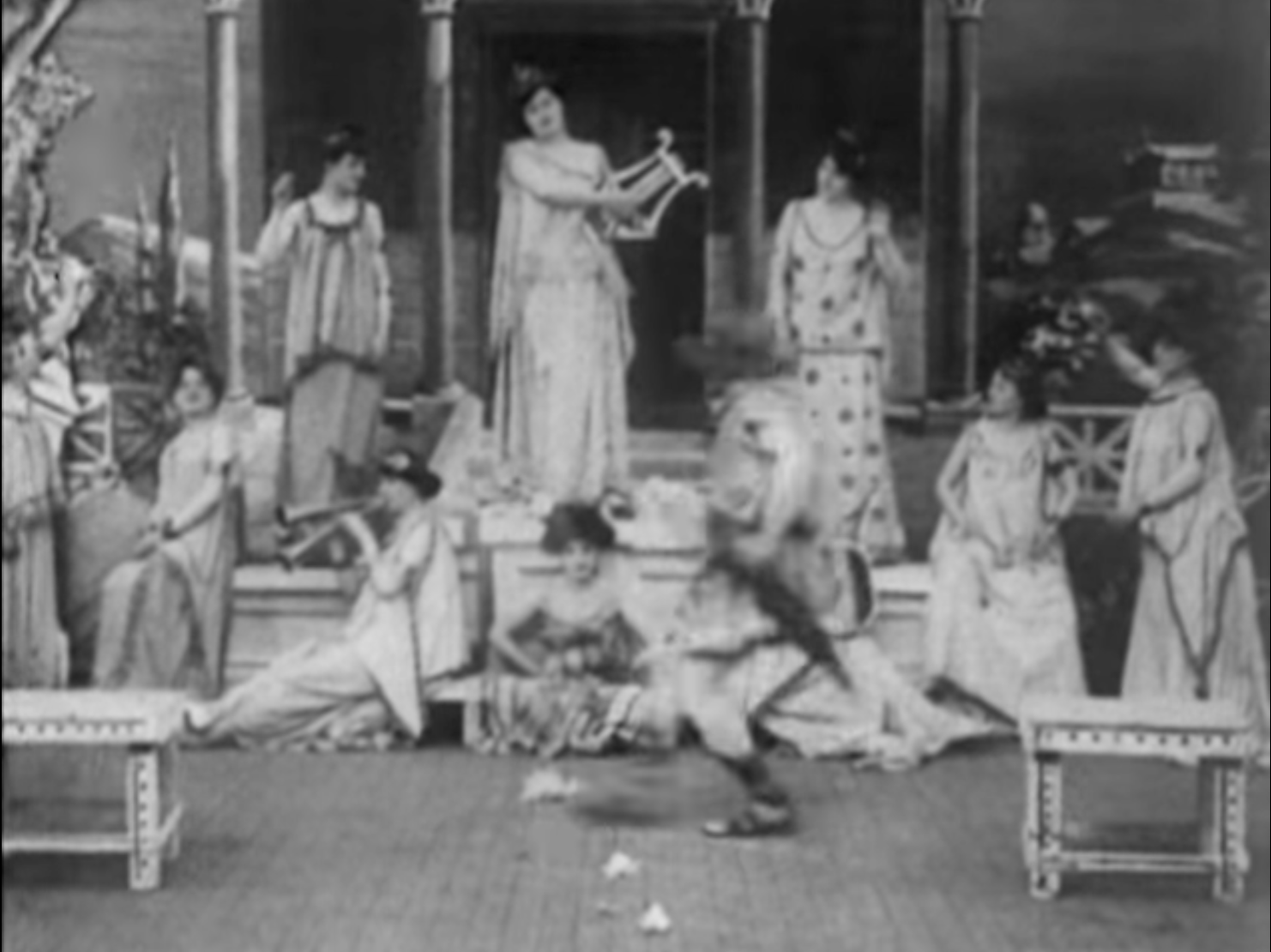
TRICK. A conjuror evokes women in national dress from an umbrella and then transforms them into an ancient Greek tableau. Library of Congress data (6). Méliès copyright (9). No main title. The set of a side show under construction. A theatre booth 'Galathea Theatre'. A conjuror in top hat and tails and carrying a cane and overcoat enters. He sets down his hat and cane with a floursh and throws the overcoat into the wings. He takes the hat and begins to juggle with it. The hat turns into a ball which he bounces up and down. Taking his cane he balances the ball on it. The ball is transformed into a piece of material. He spins the material on the cane and it becomes an umbrella. He jumps on the stage and waving the umbrella across him he is transformed into a Greek in classical dress. He shakes out of his umbrella a young woman in national dress. Waving his umbrella he evokes five more women in national dress and then shaking flowers from the umbrella he evokes a fairy who stands on the centre of the platform playing a lyre. He conjures up three more women. The women form a tableau in front of the stage. The conjuror turns the stage into a Greek temple. At a sign from the conjuror they jump from the stage and are transformed into contemporary clothes. The women dance. The Greek temple is turned into the original theatre set. The conjuror leaps over a stool and is transformed into his original clothes. He picks up his umbrella, tears off the material and it becomes his overcoat. He looks around, picks up the ball and throws it to the ground. It rebounds and becomes his top hat. He acknowledges the audience and bows (82ft). [16mm]. Note. The 'Star' catalogue describes the national dress of the women conjured up in the following order: Algerian, Swiss, Spaniard, Russian, Turk, Hollander, Swede, Gipsy and Fairy. It is difficult when watching the images to ascribe the costumes accurately. (Shotlist)
- Production Country: France
- Production Company: Star-Film
- BFI Category: Fiction
- Source: N/A
Cast
Georges Méliès (Magician)
Credits
Director: Georges Méliès
Production Company: Star-Film
Film Technical Information
- Original Length: 55 m
- Length of BFI Viewing Print: 290 ft
- Support: Viewable
- Black and White
- Format: 35 mm
Comments on the print:
The film's original length is cited in the online filmography of L'association Cinémathèque Méliès - Les Amis de George Méliès as 55 m: https://meliesfilms.com.
Pantelis Michelakis writes: Le Parapluie fantastique (Star-Film, France, 1903), directed by Georges Méliès, who also plays the conjuror, was released also as Dix femmes dans un parapluie, Dix femmes sous une ombrelle, Ten Ladies in One Umbrella, and Ten Girls in One Umbrella. The BFI shotlist recording is 82 ft on 16mm (record). The film is held in six archives (according to FIAF 29572): the BFI, the George Eastman Museum, the Library of Congress, the Museum of Modern Art, the CNC at Bois d’Arcy and the Academy Film Archive. The Library of Congress holds a paper positive alongside a 35mm nitrate negative and positive, an acetate master positive, a polyester dupe negative and two 16mm elements.