
The Way of the Cross
1909
Alternative Titles
Weg Des Kreuzes (Alternative)
BFI identifier
24476Synopsis
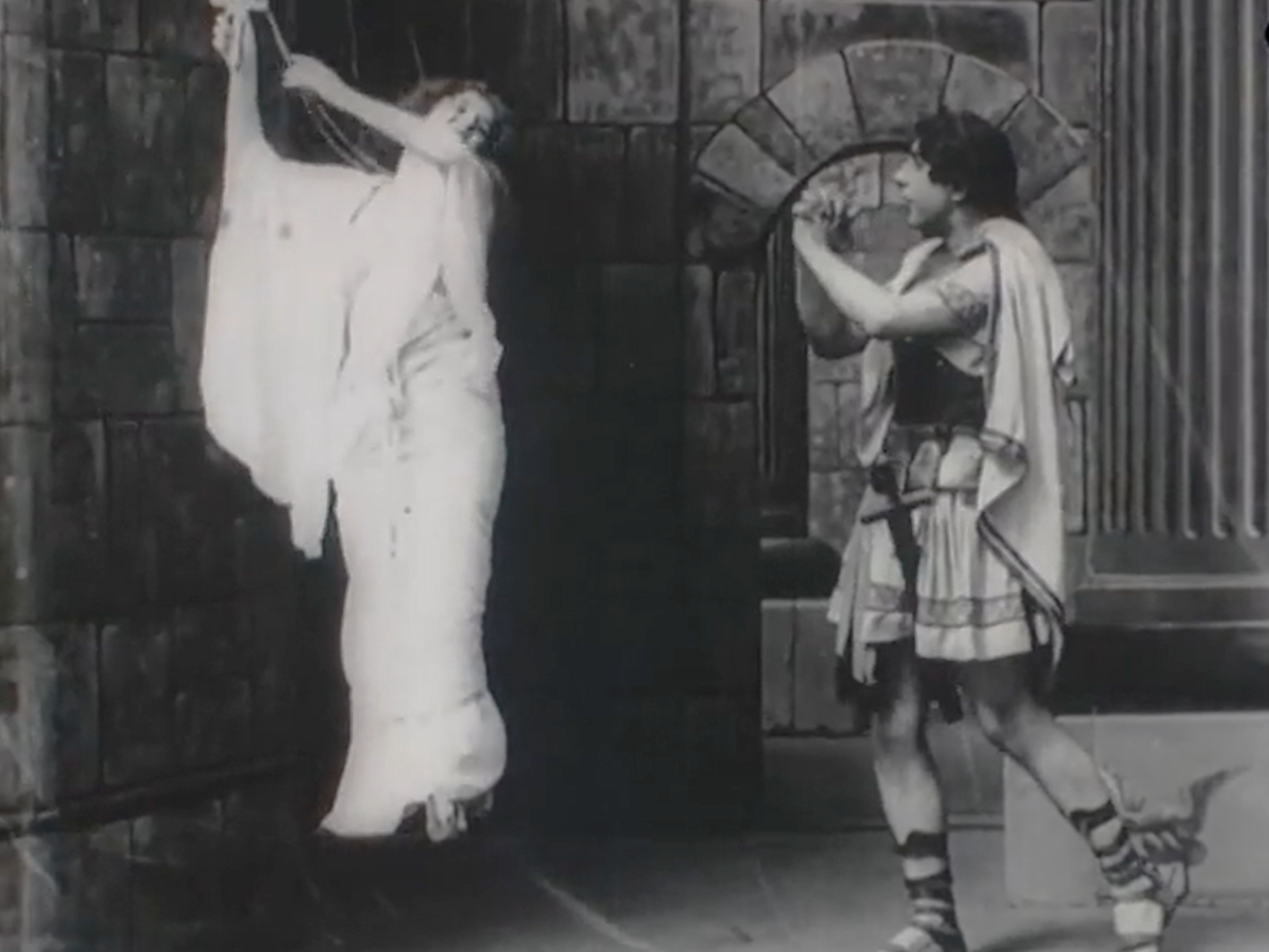
No main title. A group of Christians march through Rome. Meanwhile, Valerius gambles and drinks with his friends. He leaves his friends and comes upon the Christian meeting and falls in love with Leah. This is noticed by Gallia, the lover of Valerius. When the Christian group is attacked by a mob, Valerius rescues Leah and takes her home. He is followed by the slave of Gallia who has been given instructions to follow them. The next day Valerius attends a feast at Nero's palace. Gallia gives information about Leah to Nero and she is brought to the palace to be tormented. Valerius escorts her home although his advances are spurned. The next day Gallia prompts Nero to decree the death of all Christians. Valerius warns Leah and her family and they escape to the catacombs before the arrival of the soldiers. Leah's brother is sent for food. However, he is noticed by Gallia and captured. Under torture on the rack he reveals Leah's hiding place. Valerius visits the catacombs and tries to persuade Leah to leave, however her place is with her family and the Christians. As he leaves he sees the soldiers arriving and insists Leah be tried before Nero. Leah refuses to renounce her religion and she is condemned to death. She is taken to the arena. Valerius too goes to the arena where gladiators are fighting. Leah and the other Christians are led through the arena. Valerius rushes to see her but again she refuses to renounce her faith. Valerius falls to his knees and sees a vision of Leah holding her cross. He then sees Gallia holding a glass of wine for him. This is followed by a vision of the Cross and he decides to join Leah in the cell ready to be thrown to the lions pacing in the background. Leah persuades Valerius to give up his sword and another vision of the Cross appears. The Christians are then led into the arena, Leah holding aloft her cross and accompanied by Valerius (877ft). Note: German titles. (Shotlist)
- Production Country: USA
- Production Company: Vitagraph Company of America
- BFI Category: Fiction
- Source: N/A
Cast
Rose E. Tapley (Leah)
Maurice Costello (Valerius)
William Humphrey
Edith Storey (Gallia)
Credits
Production Company: Vitagraph Company of America
Supervisor: J. Stuart Blackton
Script: Madison C. Peters
Film Technical Information
- Original Length: 900 ft
- Length of BFI Viewing Print: 877 ft
- Support: Viewable
- Black and White
- Format: 35 mm , 16mm BW Positive, Mp4
Comments on the print:
This film print, with German intertitles, appears to be unique to the BFI. The International Federation of Film Archives (FIAF) lists no other archive as holding a copy. The Library of Congress only has paper print fragments in its Vitagraph collection. The BFI nitrate master is tinted. The black and white viewing copy runs to 9 minutes 34 seconds with flash title cards (in length, 877 feet). According to The Moving Picture World the film's original length was 900 ft on its release in August 1909.
For further details on all the elements the BFI archive holds, see here https://collections-search.bfi.org.uk/web/Details/ChoiceFilmWorks/150019097