
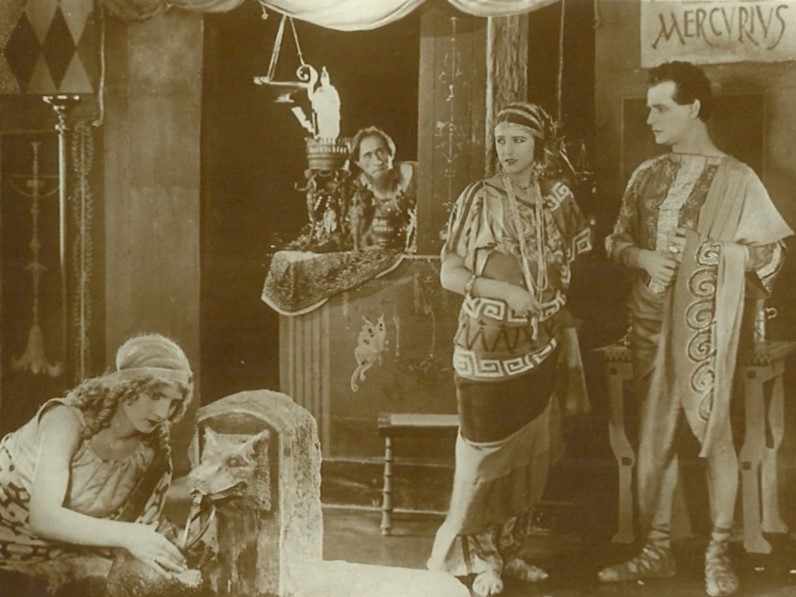
Ultimi Giorni di Pompei, Gli (original)
1926
Alternative Titles
The Last Days of Pompeii (Alternative)
BFI identifier
49553Synopsis
Set in Pompeii and based on the novel by Edward Bulwer- Lytton. Rl.1. Various shots of the ruins of Pompeii and Vesuvius (137). A reconstruction of life in old Pompeii showing artisans at work, street vendors, letter writers and the womens' baths (384). Glaucus, a young patrician, is deserted by Julia, the daughter of Diomed, a wealthy freedman. Glaucus, however, loves Ione, a patrician like himself (602). Rl.2. Arbaces, the Egyptian priest of Isis, is the guardian of Ione and her brother Apecides. Arbaces nurses a secret passion for Ione and is jealous of Glaucus. Glaucus purchases a blind slave, Nydia, who is being mistreated by her mistress. Arbaces, who wishes to gain complete power over Apecides, introduces him to a night of pleasure (476). Rl.3. Dancing girls perform and Arbaces is presented with a female slave on a platter of roses. Meanwhile, Glaucus goes to see Ione, but she refuses to see him having heard that he is amusing himself with a blind slave. He returns home where Nydia devotedly awaits him. He tells her of his love for Ione and Nydia, who secretly loves him, offers to intercede with Ione on his behalf (602). Rl.4. Apecides, disatisfied with his life, goes to see Olinthus, a Christian preacher who introduces him into the catacombs where he absorbs the new theology. Nydia, acting as Glaucus' ambassador, goes to see Ione and learns that she is in Arbaces' palace. She returns to Glaucus and, together with Apecides, hurries to the palace filled with foreboding. In the palace, Arbaces conjures up a vision for Ione in which he appears as her future husband. She tells him that ehr heart is with Glaucus. Glaucus and Apecides are in time to rescue her from violation be Arbaces who, in the ensuing struggle, is stunned by a falling statue caused by an earth tremor (850). Rl.5. Nydia, hiding her sorrow, sings to the united lovers as they sail on the river together. Theya re seen by the jealous Julia. Apecides is baptised. Julia consults Nydia about the possibility of obtaining a love philtre to administer on Glaucus. Nydia is unable to help but, following a suggestion from Julia's maid, they go together to Arbaces. Arbaces gives her a potion to induce madness instead. She accepts this but Nydia steals the potion and administers it to Glaucus herself (409). Rl.6. The horrified girl watches helplessly as Glaucus goes mad and runs amok. Apecides, inflamed by his new faith, meets Arbaces in a deserted grove and threatens to denounce him for his evil ways. Arbaces stabs him dead but is observed by Calenus, on of his priests, who is hidden in the bushes. The maddened Glaucus arrives on the scene and is denounced by Arbaces as the murderer. Glaucus is arrested for the murder despite the efforts of Olinthus who rightly suspects Arbaces of the crime (735). Rl.7. Glaucus is brought to trial and sentenced to death although his friend, Sallust, pleads his cause desperately. Apecides' body is burned according to the rites of Isis. Calenus officiates at the ceremony and afterwards demonstrates with a vision his knowledge of Arbaces' crime. Arbaces offers him untold wealth in exchange for his silence and conducts the priest to his treasure vaults. As Calenus is examining the treasure, Arbaces creeps out of the vault and locks the old man in. Nydia, who has wandered into the grounds in search of Glaucus, witnesses this further crime and hastens off for assistance but is captured by Arbaces' guards and thrown into prison (1014). Rl.8. She bribes her jailer to take a message to Sallust. Glaucus prepares to meet his end in the arena. Sallust receives Nydia's appeal for help and hastens to free her and Calenus. The spectacle commences in the arena with a gladiatorial combat. Arbaces joins the spectators who include Julis and her father. Sallust and his men release Calenus as Glaucus is led out into the arena to face a lion unarmed. Sallust arrives on the scene and denounces Arbaces. Arbaces appeals to the crowd who are divided in their opinion. There is an earthquake and Vesuvius erupts. In the ensuing panic, Sallust and Glaucus meet and Glaucus learns that Ione is a prisoner in Arbaces' palace. Forcing their way through the panic-stricken populace, they make their way to the palace and find Ione with Nydia (1004). Rl.9. The palace collapses as they make their escape. Arbaces searchers for the lovers as the destruction of Pompeii continues. Looters and thieves are at work as the the earthquake and eruption continue. Calenus is buried under falling masonry, whilst the Christians pray. Nydia guides Glaucus and Ione through the ruins but she is separated from them by the crowds. Arbaces and his guards find the lovers and as he is about to seize them, the earth opens and he falls to his death. Nydia finds them again and guides them once more through the fires and destruction. A Roman sentry remains at his post and is buried by lava. Dawn breaks and the united lovers, together with the faithful Nydia, have taken refuge on a ship in the harbour. Unable to live without Glaucus' love, Nydia slips silently away from the lovers and throws herself into the sea (1078). (7370ft) Note: The first and last reel are stencil coloured. The film has obviously been subjected to severe cuts. English titles. Note: The archive has also acquired the restoration by the Cineteca Nazionale, which is approximately 1,300ft longer. It has English intertitles and is tinted and toned, with the beginning and ending stencil coloured. (Shotlist)
- Production Country: Italy
- Production Company: Societa Italiana Grandi Films
- BFI Category: Fiction
- Source: N/A
Cast
Maria Corda (Nidia)
Vittorio Evangelisti (Apecides)
Rina de Liguoro (Jone)
Victor Varkoni (Glaucus)
Bernhard Goetzke (Arbaces)
Emilio Ghione (Calenus)
Livia Maris (Julia)
Carlo Gualandri (Claudius)
Ferruccio Biancini (Olinthus)
Vasco Creti (Sallust)
Alfredo Martinelli (Lepidus)
Giuseppe Pierozzi (Josio)
Enrico Monti (Lidone)
Bruto Castellani (Eumolpo)
Enrico Palermi (Medone)
Carlo Reiter (Pansa)
Carlo Duse (Burbo)
Gildo Bocci (Diomede)
Credits
Director: Amleto Palermi, Carmine Gallone
Production Company: Societa Italiana Grandi Films
Producer: Amleto Palermi, Carmine Gallone
Script: Amleto Palermi
Based on the novel by: Edward Bulwer-Lytton
Photography: Victor Armenise, Alfredo Donelli
Set Designer: Vittorio Cafiero
Costumes: Duilio Cambellotti
Film Technical Information
- Original Length: N/A
- Length of BFI Viewing Print: 8643 ft
- Support: Viewable
- Colour
- Format: 35 mm , D3, VHS cassette
Comments on the print:
Further details about the status of the BFI material will be provided shortly. The viewable print is beautifully stencil-coloured in places.
Visual Resources


