
ARCHIVES - Antiquity film in the BFI National Archive
By BRYONY DIXON
(Curator of silent film, BFI National Archive)
The prevalence in our culture of the works of antiquity during the late nineteenth and twentieth centuries, made the incidence of classical stories, or interest in the lands of the ancient civilisations, inevitable in the early film industry. This interest continues unabated in the twenty-first century with major films such as Gladiator (2000), 300 (2006), and, most recently, Pompeii: Below the Clouds (2025) and The Odyssey (2026).
One of the aims of the Museum of Dreamworlds project is to ask if the portrayal of the ancient world in silent film is essentially an attractive setting for film narratives or can we find deeper relationships between them than the purely incidental? Is the representation of the ancient world reduced to cut-down bible stories for children, as just another historical ‘flavour’ of costumes and props for situation comedies, or a pretext for yet more travelogues filmed among the ruins of ancient Greece and Rome? The film historians and archivists can supply context to the films in regard to their creation and position within popular culture and observe the aspirations of their producers and the pleasures of their audiences (for example we know that the treatment of classical subjects in silent film was part of a long term strategy on the part of producers to upgrade the social class of its audience), but it is the task of the classics scholars to assess how the representation of antiquity in these films has had specific effects both on the place of the classical past in the modern world and on the history of cinema. That is where the value of this collaboration between academia and film archives lies.[1]
In this analysis, I will give some background to the holdings of the BFI National Archive, how the films came to be in the collection, the physical nature of films during the silent period and how conservation and preservation practice affects them, particularly regarding completeness, titling and colouring. As someone with a deep knowledge of the history of silent film – particularly with regard to what was being screened in Britain and the surviving films in the BFI’s collection - I will try to add some context on antiquity as a theme in various types of films, such as drama, comedy, interest film, newsreels etc., produced over the period from the 1890s to the late 1920s when sound film became the industry norm.
General public awareness of films concerning the ancient world will be largely confined to Hollywood blockbusters like the aforementioned Gladiator (2000), while some may have seen the films of previous generations – going back perhaps to Jason and the Argonauts (1963), Land of the Pharaohs (1955) or Ben Hur (1959). Silent film enthusiasts will have heard of, if not seen, Quo vadis? (1913), Cabiria (1914), The Last Days of Pompeii (1926) or the earlier Ben Hur (1925). Fewer people still will have heard of, let alone seen, the first wave of films concerned with antiquity made in the 1900s. This is largely a question of the general inaccessibility of early film, a lack of attention, even within film studies, to films outside the feature-length form and a set of specific problems that beset archivists and prevent the films from becoming better known and understood.
Finding the films
The vast majority of early films on the subject of ancient Greece and Rome were made in France and Italy. It was natural that these Catholic countries with well-developed film industries would be interested in Bible stories and, for Italian producers, ancient Rome and Greece were very much part of the national iconography and as such were promoted through film as part of their international image. In other countries, the production of films on such subjects was more occasional. The USA made a few, catering perhaps for the international and domestic immigrant markets. Britain produced almost none at all – the odd ‘Mummy’ story or a Roman drama if it came via an adaptation to screen of a Shakespeare play. It may seem slightly surprising therefore that a great number of the prints of these films should survive in Britain at the BFI National Archive.
To understand the seemingly counterintuitive distribution of the films of the 1900s and 1910s in the world’s archives, it is necessary to understand a little of the nature of the film business in those years. Before the development of the ‘cinema’ as we know it (that is a network of exhibition halls served by distributors and producers), films were produced by a variety of individuals and companies for direct sale to exhibitors. Many of these showmen were peripatetic, fitting their touring shows within a centuries-old circuit of seasonal fairs, but film exhibition became increasingly urban and settled as time went on. It was only when it settled absolutely in purpose-built cinemas that the business model changed and it became customary to hire film prints and return them to a distributor, rather than buying them outright. The earlier system encouraged the production of large numbers of prints – made on demand - which were left in the hands of the exhibitors or sold onto collectors. It is for this reason that the films of this period are sometimes found in caches that appear to us quite random in terms of their content. We are used to film collections being the product of a studio or having a collecting principle (perhaps a genre of filmmaking or the work of an individual filmmaker) and, although there are some collections of films from early studios (such as the Pathé-Gaumont Archives), others have only the date of their production in common.
Of the latter type two substantial caches are the Joye Collection at the BFI and the Desmet collection held at the Eye Filmmuseum, Amsterdam. The Dutch collection contains over 900 titles as well as accompanying business records from the film distributor Jean Desmet. The Joye collection of 1128 titles was assembled by a Swiss cleric, the Abbé Josef Joye[2] and the films were used, in part, for teaching at the Basel boys seminary where he worked in the 1900s. There are no accompanying paper records and there seems to be no particular collecting philosophy to the material. Where the collection is unique is in the fact that it was assembled at a very specific time in history. It thus represents a snapshot of the distribution of film mostly during the period 1900 to 1914. Within the collection are films made during this very fertile period of short film production, and among which are the films relating to antiquity which concern us here. There are a few hints as to the use to which the Abbé Joye put the films – some of his own interventions, combining scenes from different versions of the Life of Moses for example, suggest that he was using films with religious themes to lecture on passages from the Bible. It is likely that he found subjects relating to ancient Rome and Christianity particularly interesting and we know he also gave general film entertainments.
These collections are of enormous significance in telling us about the nature of the film industry in this period – an industry quite different from that in the era of the feature film. They illustrate the internationalism of the film business when it was not tied to a particular language. The language of the country of production could easily be changed by reprinting intertitles translated into the local language of the place of exhibition, which is why the majority of the Joye films have German titles. So, films from different producing countries were exported all over Europe and the USA, with many of the early catalogues offering films from different producers. Major companies like Pathé, Gaumont or Urban had agency offices in Paris, London and New York. As a consequence of this wide distribution pattern, early antiquity films are found in collections all over the world despite many archives having collecting policies that focus on their own national production. Antiquity themes appear in a whole variety of genres such as short dramas, more elaborate products aspiring to the condition of theatre (in the French film d’art series for example)[3], in comedies and travelogues of famous Roman and Greek sites throughout Europe and North Africa.
Almost every large film archive has some of these early works, and many hold prints or fragments of the same titles, particularly the popular ones such as Gaumont’s La Vie et Passion du Christ (1906), directed by Alice Guy. It was a prestige production sold in huge numbers and available as a whole film or as a kind of pick-and-mix of the twelve scenes or ‘tableaux’. The Gaumont ‘Elge’ catalogue of 1904, in a category called ‘Serious Subjects for Sunday or School Exhibitions – Religious, Pathetic, Moral’, describes it thus:
The following series of eleven pictures, illustrating well-known incidents of the life of our Saviour, are taken from a celebrated Passion Play, inspired by pictures by the great masters. They are quite new, having never hitherto been published and the incidents have each been treated with the reverence and delicacy they deserve. Trouble and care have been lavished on the costume and arrangement, with the result that the pictures are veritable and realistic works of art.
The Manger at Bethlehem
The Flight into Egypt
The Entry into Jerusalem
The Last Supper
The Garden of Olives
Jesus before Pilate
The Scourging
The Way of the Cross
The Crucifixion
The Descent from the Cross
The Resurrection
Total length 550ft Price £13 15s.
This description is quite revealing about how the Gaumont film was constructed and the fact that the episodes were separated – that is, they were moving representations of distinct and famous illustrations rather than an adaptation of a continuous written narrative. The emphasis on reverence and delicacy reveals an awareness of the sensitivities of representing Christ on screen. That this was quite a real concern is indicated by the first British censorship guidelines in 1912 which forbad the ‘materialisation of the conventional image of Christ’. We can assume (censors being generally conservative in their views) that this ruling was in reaction to a widely held position that had existed for some time in Britain. But, crucially for the film archivist, the description also reveals that the film consisted of autonomous parts likely to have become separated over time or confused with the many other very similar versions produced over a decade. Films on the life of Christ and the Passion abound during this period – a rival version by Pathé was produced in the same year, 1906 with a very similar collection of scenes.
If you can imagine yourself as a film archivist at a winding bench opening a can of unidentified nitrate film with no main title and only costumes, sets and perhaps edge markings on the film to help you, you can see how the initial listing of these unusually structured films can lead to multiple archives having differently described parts of the same film. Descriptions like the catalogue entry above are helpful in explaining both the nature of the production and giving us the correct sequence of scenes. A characteristic of the surviving fragments of early films is that they tend to lose their beginnings and endings (or ‘heads’ and ‘tails’ as we know them in the trade); they get damaged in handling and projection and so often lose their identifying main titles. There will be many cases where these films are yet to be properly identified and are listed with assigned titles. A case in point is a film I acquired in recent years, in a random collection of nitrate reels, from an old man’s garden shed. From an initial check on a winding bench, it appeared to be a one-reel comedy about an ancient Roman soldier liberated from a tomb by a pair of bumbling archaeologists into the traffic-filled streets of modern Rome (figure 1). I described it temporarily as ‘Cines comedy c.1910s’ and a description of the action that could be seen in the film, pending further research. As a result of conversations fostered by the Museum of Dreamworlds project, and discussion with Italian film historian Frederico Striuli we now know this is an English language version of Antico Romano (1909) and can add it to our list of BFI antiquity films.[4] Keyword search facilities now enable us to capture words in a film’s synopsis, revealing far more films on a subject than if we were restricted to a title search. Many film archives are only just now arriving at the point of having digitally searchable databases, having been badly under-resourced in this area for decades.
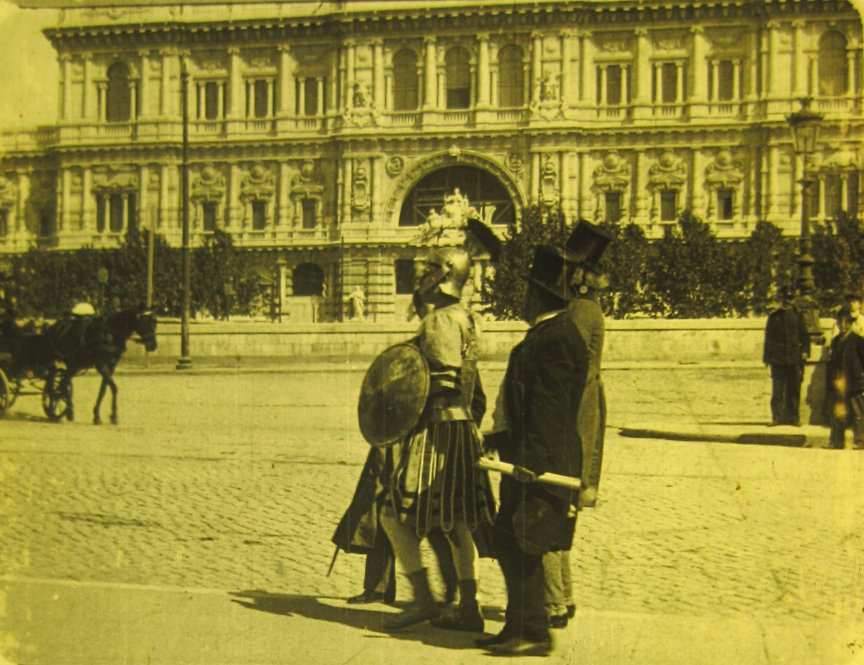
Figure 1. Screenshot from Antico Romano (1909). Courtesy of BFI National Archive.
So, both the academic and the archive community need to educate themselves in the peculiarities of film and the distribution of film during this period in order to understand where the films might be held, how they are likely to be described and in what condition they may be. The task of comparing prints between different collections is arduous and can prevent films being included in restoration or digitisation programmes where funding is predicated on them being uniquely in need of this expensive work. In this regard, the Museum of Dreamworlds project and others of its kind may help us get over these hurdles by allowing for some comparative work between collections.[5]
Aside from the surviving film prints themselves, there is other evidence of the early film industry of use to the archivist and the historian which is becoming easier to access through the digitisation of records. Catalogues produced in the days when films were still sold outright, rather than rented, are revealing about where films concerned with themes of classical antiquity fit in the greater production context. A ten-minute flip through such a catalogue will probably be of more use to the scholar unfamiliar with early film than hours of reading the secondary sources. Here you will find the listings of films on offer grouped into categories. Remembering that films of this period were all short and tended to follow the programming structure of the music hall (which was the dominant popular mass entertainment for at that time, and was made up of short, varied acts or turns) helps in understanding the range of categories. There were news items or ‘actualities’, such as royal and state occasions, ship launches, sporting fixtures, social events. There were ‘interest’ films, such as travelogues from exotic locations, panoramas and phantom rides, industrial films and ethnographic films. On the fiction side, there were novelty acts and performances, animation, trick films, comedies of all sorts and short drama. Really, not unlike an evening’s television programming today.[6] The strategy of the filmmaker was primarily commercial – to attract an audience and sell the product. One tactic would inevitably have been to include content that might feed that generation’s interest in the classics but, over time, as producers began to chase more sophisticated patrons, we can see how they used certain themes to elevate their productions by association with refined literary works such as Shakespeare or Dickens and classical antiquity. Generally, the preserve of only the educated and professional classes, classical subjects could stamp the kite-mark of quality on any film.
An illuminating example of how this association with ‘the classics’ – broadly understood - was used by film producers is the marketing puff for Milano’s 1911 super production Dante’s Inferno, which heralded a whole series of prestige films that promoted longer running times and high production value, and gave rise to the feature film as we know it today. I know that, strictly speaking, the Inferno does not fall into our ancient world category, although it is connected through the story’s guiding figure of Virgil. In any case, the principle of appealing to aspirational tastes for classical literature holds good for all these prestige productions.[7] It is worth quoting in full from a page in Bioscope for 19 December 1912 when it was being heavily promoted to exhibitors in Britain (see also the illustration of the clipping in figure 2).
MILANO’S ‘DANTE’S INFERNO’ (5000 feet)
Beware of imitations!
Inset
The Cinema
Arundel Street, Portsmouth
The only genuine and original production, by Milano
This masterpiece is 5000 feet long, and the proprietors of “The Cinema” have secured the sole right of showing this Divine Comedy in moving pictures for the whole of Portsmouth and Gosport, A treasure for six hundred years, known to but a few scholars, now placed in unsurpassable beauty before all mankind; presented by the filmmakers just as conceived by the immortal Poet, occupying about two hours, telling in a most artistic and realistic manner the great story of DANTE like animated paintings of living Statuary.
The pictures give you in a few hours all the pleasure and knowledge it takes months to acquire through books, consequently the CHANCE OF A LIFETIME.
Special Afternoon Matinees at 2.30, 6d, 1s. and 1s. 6d.
Evenings at 6.30 and 8.30, 6d and 1s.
Warning: on account of the universal attraction this film is creating many showmen have rushed on the market inferior imitations of 1000 and 2000 feet. THE PUBLIC MUST NOT BE DECEIVED, as ‘Dante’s Inferno’ by ‘Milano’ 5000 feet is THE ORIGINAL PRODUCTION.
Book your seats at once
P.O. Tel. 1,024.
Children under 16 will not be admitted
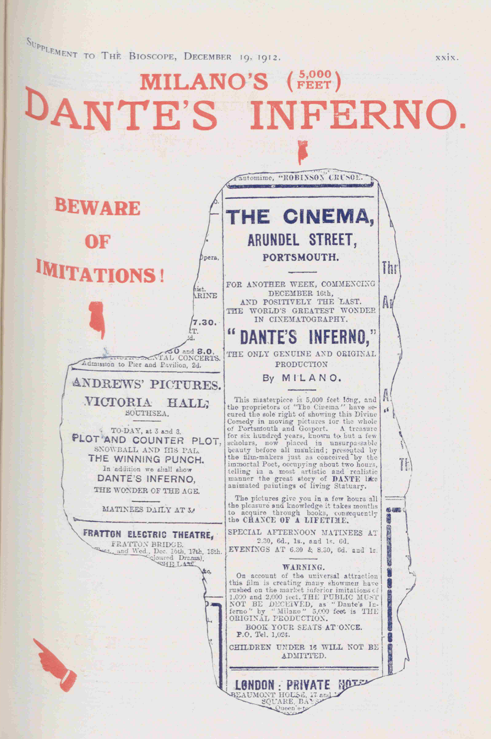
Figure 2. Advertisement for Dante’s Inferno in Bioscope, 19 December 1912.
Immediately noticeable is the repeated quotation of the unusually long running time ‘5000 feet’ (about 74 minutes) as the production’s defining attribute. It becomes clear further down that this is to differentiate this version from several other shorter versions, which were circulating at the same time. This was a feature of the years 1911 and 1912, when there was widespread imitation of productions by different companies. Although this was not a new phenomenon – it was commonplace in the early days of film when producers and showmen would jump on a bandwagon as a matter of sound business strategy – it became much more conspicuous with the larger productions and publicity on a national scale. So the emphasis on long running time as a positive is reinforced by the impressive entrance fee, and the rest of the piece underpins the value-for-money message by hammering home the film’s educational credentials. The idea that you could acquire a working knowledge of such an important classical work, putting you in the same league as Oxbridge dons, lawyers and doctors, must have been an attractive notion for those knocking on the glass ceiling of the class divide. Those patrons who were less attracted by such pretensions may have been intrigued by the implications of the ban on admission for the under-sixteens. Classical art and literary sources had been used as a justification to push the boundaries of censorship for many years over reference to sexual licentiousness, and nudity in particular, and Dante’s Inferno is full of it. Later classical subjects were also marketed in terms of high drama, adventure and visual thrills.[8]
Making the films available
It is necessary to understand that, unlike museum artefacts or books, films must nearly always be duplicated before they become accessible for study or entertainment. The number of early films that are fully ‘restored’ is very few. Many more are available as straight copies of the original print or negative, whether in celluloid, video or digital formats. That is to say, they are mere duplicates of original film materials – they may not have been subject to curatorial research or cataloguing; they may not have been edited into the correct sequence or had their original colours restored let alone scanned or cleaned up digitally. The photochemical and digital processes of copying film are expensive and, with limited resources, archives have to prioritise which films to make accessible. Funding tends to come from the public purse, at least in part, and it is often the case that a particular government funding agency sees its first duty to be to the filmic production of its own country. There is a certain logic in this approach: each national archive would (in theory) look after its own films rather than have to experience a chaotic system where multiple archives might be preserving the same films and duplicating effort. However, in practice, it means that films not produced by the country in whose archive they are held tend not to get prioritised for expensive work. In the rare cases where these films are prioritised for some cultural output (such as a festival programme) the organisation may well be put off a title if it is not a unique holding, that is, if copies are held in more than one collection. This means that large-scale restoration of the films of the 1900s continue to rely on international collaborations, which are notoriously difficult to find funding for.
It is, therefore, no small value of the Museum of Dreamworlds website, through the funding it received from the Arts and Humanities Research Council, that it is providing access to some thirty-six of the antiquity films in the BFI National Archive. Of necessity, however, that access is in the form of digital scans of the archive’s viewing copy – no matter what state it is in. In parallel to the work of the project, I am also currently engaged in the restoration of a film unique to the BFI National Archive – Bruto (1911) – thanks to funding by the Film Fondation. Its director, Enrico Guazzoni, went on to become one of the most important figures in the production of antiquity features of the silent era. I am also investigating Boadicea (1927) for potential restoration in the future. Unusually, it is a British feature film and one of the first cinematic representations of Roman Britain. Its processional features, use of location shooting, and pedagogic ambition puts it in the context of the British practices of historical reenactment and pageantry.
One of the other major attractions of the films of the 1900s for modern audiences, apart from the opportunity to see the world more than 100 years ago is colour. About 8 per cent of the original prints in the Joye collection were in colour. This is not natural colour as we understand it today, but tinting and toning (used to suggest various lighting effects) and stencil colour (an elaborate system of applying a variety of vivid colours to the prints). The restoration of colour to these prints is important in communicating to audiences today that these films were prestige products. Seen in black and white, and in jerky, poor-resolution copies, the films become just so much inexplicable footage; seen in subtle tints or bright jewel colours like a stained-glass window, the films take on the attributes of artefacts (not least because they draw on the aesthetics and colour palette of Victorian tinted photographs or magic lanterns slides). The ‘penny plain or twopence coloured’ marketing strategy of the nineteenth-century publishers of toy theatres (model theatres of cardboard with cut-out characters and accompanying scripts designed for children to use when performing plays) was adopted by twentieth-century film producers as a similar enhancement.[9]
The associations of quality brought by the addition of colour are transformative. Film producers of the 1900s were well aware of the value-added of these associations, and films were often adapted from sources via their illustrations rather than their text . The most famous example relevant here is the aforementioned Life of Christ (1906) produced by Alice Guy at Gaumont that comprised scenes taken from James Tissot’s bible illustrations. The same strategy was employed for an early Alice in Wonderland (1903) based on John Tenniel’s illustrations, adaptations of Charels Dickens’ ‘A Christmas Carol’ based on images by John Leech, versions of Dante’s Inferno taken from Gusave Doré’s engravings, and a plethora of fairy tales based on book illustrations in editions of the brothers Grimm or Charles Perrault. Equally there are instances of well-known fine art paintings informing the aesthetic of films of classical subjects and arguably classical tableaux and statuary find their way into film via the stage and music halls as a means of justifying nudity, or in the form of a range of comedy gags to do with living statues.[10]
If colour contributed materially to the value of early films at the time they were released, then it can also do so today. Increasingly archives are concerned not only to preserve and reproduce the content of these films but also to give a better flavour of their aesthetics. This is something the BFI National Archive has been trying to do with selected films from the Joye collection. The entire collection was duplicated for preservation when we acquired it in the 1970s. The preservation copies were only in black and white (the standard archival method at the time); colour restoration is a long-term and somewhat distant goal due to the costliness of this type of work. The original colour nitrate prints were in poor condition in 1977 when the BFI took them in and inevitably some further deterioration has taken place since that time but work to restore colour using the original nitrate prints has commenced. This is the case particularly for stencil colour which doesn’t render well using photographic processes but can be scanned digitally, making it possible to capture a more representative range of colour and compensate for fading. Over time it is to be hoped we can do more of this work.
Working with other archives to compare film materials on antiquity titles should become easier as digitisation progresses. Putting together fragments to create more complete films is complex, but who could be better than classicists at working with fragments, ruins and lacunae? Projects such as the Museum of Dreamworlds can help us reposition early cinema as aesthetically significant, and as a medium at the cutting edge of the new technology of its day, rather than as one that is archaic, obscure or naïve. It can be a key part of building enthusiasm for returning these films to our screens.
Footnotes
- ^ This analysis constitutes an update on the chapter I wrote about antiquity films from the archivist’s perspective in Michelakis and Wyke 2013: 27-36. It has now been interlinked with some of the archival issues that emerge in other analyses on this website.
- ^ The first name of the Abbé is also cited in scholarship as Joseph.
- ^ See the analyses by Ivo Blom on this website concerning Héliogabale (1910) and Cléopâtre (1910) for examples of two French films produced to match the ambitions of the Film d’Art project.
- ^ For a comparable identification of a film that had no identifying title, see the analysis on this website by Ivo Blom on Pygmalion and Galatea (1912).
- ^ For analyses on this website that draw extensively on the comparison of prints see, for example, Maria Assunta Pimpinelli’s discussion of the various prints of San Paolo (1910) and, for further discussion of its importance to the Museum of Dreamworlds project, see the introductory analysis.
- ^ See the analysis by Maria Wyke of the exhibition of Cabiria (1914) in the UK. Although Cabiria was a long Italian epic, the programme that survives in the BFI National Archive for the West End Cinema in London for 4 to 10 October 1915 demonstrates that it was still exhibited alongside a variety of shorts (figure 5 a to c).
- ^ In his analysis of L’Esclave de Phidias (1917) on this website, for comparison, Ivo Blom notes that it was advertised as a feast for music and art lovers.
- ^ See, for example, the thematic analysis on this website by Maria Wyke of silent films about Nero, in which she considers the opportunities Nero gave to the film Quo vadis? (1924) to display Rome as a giddy ‘vortex of vic’e and the analysis by Aylin Atacan of Gli ultimi giorni di Pompei (1926) for the film’s opportunistic inclusion of female nudity in its detailed reconstructions of the Stabian baths.
- ^ For discussion of the importance of colour to silent antiquity films and issues of its restoration, see the analyses on this website by Stéphanie Salmon on Amour d’esclave (1907) and La Vestale (1908), by Stella Dagna and Andrea Meneghelli on Nerone (1909) and Maria Assunta Pimpinelli on San Paolo (1910).
- ^ Most of the analyses on this website engage with how silent antiquity films enhance their aesthetics by engaging with prior representations of antiquity in painting, theatre and opera, or evoke more directly celebrated statues, artefacts and monuments of the ancient world.
Michelakis, P., & Wyke, M. (eds.) (2013) The Ancient World in Silent Cinema. Cambridge: Cambridge University Press.